Hostinger Web Hosting Review: Pricing, Performance and Limitations
Hostinger is one of the strongest budget options for creators who want managed WordPress tools, a modern control panel and generous features without traditional cPanel pricing. The value is real—but the headline rate requires a 48-month commitment, renewal is substantially higher, included email is free only for the first year, and “unlimited” features remain governed by fair-use and finite compute limits.
This Hostinger web hosting review examines the current Premium, Unlimited and Cloud Startup plans, including their true prepaid totals, renewal rates, storage, CPU/RAM, PHP workers, backups, migration coverage and support boundaries. It replaces old universal speed claims with a practical performance framework you can reproduce on your own site.
Is Hostinger Good Web Hosting?
Yes—Hostinger is a compelling value for new WordPress sites, portfolios and small businesses that can commit to a long first term. Premium covers three sites with 20 GB SSD; Unlimited adds 50 GB NVMe, daily backups and more resources; Cloud Startup doubles storage to 100 GB and supplies 4 CPU cores, 4 GB RAM, 100 PHP workers and a dedicated IP.
The best-value plan is Unlimited for most active businesses. Premium’s weekly backups and 40 PHP workers suit lighter sites, while Cloud Startup makes sense for busier WooCommerce, agency or web-app workloads. Compare the four-year total and renewal—not only the monthly teaser.
*Unlimited websites and other unlimited features are subject to Hostinger’s Fair Usage Policy. Scores are editorial, not customer-review averages.
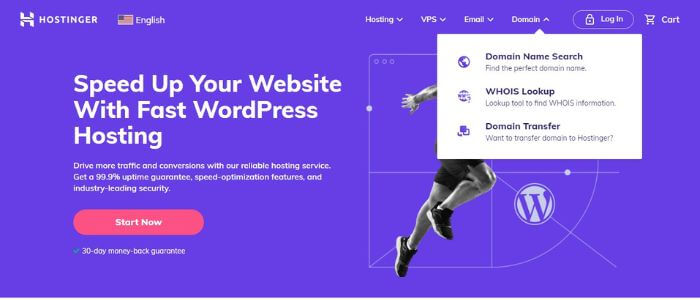
Table of Contents
Product overviewWhat Makes Hostinger Different?
Hostinger packages shared and cloud hosting around its proprietary hPanel rather than cPanel. The interface centralizes sites, domains, DNS, email, backups, WordPress management, file access and performance tools. Beginners usually benefit from the simpler navigation; experienced cPanel users may need to rebuild familiar backup, automation or reseller workflows.
The current US lineup has three relevant tiers. Premium is conventional shared hosting for smaller projects. Unlimited—effectively the successor to the previous Business-style offering—adds NVMe storage, daily backups and greater CPU/RAM/PHP capacity. Cloud Startup places websites in a managed cloud environment with substantially higher resources and a dedicated IP, without requiring customers to administer a VPS.
Hostinger supports WordPress, its AI website builder, ecommerce and a growing Web Apps/Node.js workflow. That breadth makes it more than a bare server account, but every workload still competes for the plan’s finite CPU, RAM, PHP workers, storage, database and inode allocations.
The Hostinger managed-hosting stack
Conceptual composition, not a measured resource percentage.
- Management: hPanel, files, databases, DNS and access sharing
- WordPress: managed updates, staging, cloning, WP-CLI and cache
- Protection: SSL, malware scanning, backups and CDN
- Creation: AI Builder, ecommerce, web apps and email tools
Cost analysisHostinger Pricing: Introductory Term vs. Renewal
Hostinger’s displayed monthly price is the full-term total divided by the number of months. The best advertised rates require 48 months paid upfront. That provides strong price certainty for four years, but it also means a larger initial payment and a major change when renewal begins.
| Plan | Intro equivalent | Upfront / 48 months | Renewal | Websites | Storage | Backups |
|---|---|---|---|---|---|---|
| Premium | $2.99/mo | $143.52 | $10.99/mo | 3 | 20 GB SSD | Weekly |
| Unlimited | $3.99/mo | $191.52 | $16.99/mo | Unlimited* | 50 GB NVMe | Daily |
| Cloud Startup | $7.99/mo | $383.52 | $25.99/mo | Unlimited* | 100 GB NVMe | Daily + on demand |
USD pricing checked September 20, 2026. Taxes and optional products excluded. Renewal is shown as the published monthly rate; the available renewal term controls the amount due.
Introductory vs. renewal monthly equivalents
Each bar is scaled to Cloud Startup’s $25.99 renewal. Intro prices require 48 months prepaid.
Which Hostinger plan should you choose?
Premium is best for one to three light websites where weekly backups are acceptable. It is inexpensive, but 20 GB storage, one CPU core and 40 PHP workers should discourage treating the three-site allowance as three high-traffic stores.
Unlimited is our best-value recommendation for an established blog, small business or several moderate sites. It adds 50 GB NVMe storage, two CPU cores, 3 GB RAM, 60 PHP workers, daily backups and a larger email allowance. “Unlimited websites” means no simple site-count ceiling, not unlimited storage or compute.
Cloud Startup is the better fit for agencies, busier WooCommerce sites and projects that need dedicated IP, 4 CPU cores, 4 GB RAM, 100 PHP workers and 100 GB NVMe. It remains managed, so it is easier than a VPS but less customizable at the operating-system level.
Calculate the total cost before checkout
- Use the amount due today.The introductory monthly figure is not month-to-month billing.
- Record the renewal rate.Premium rises from $2.99 to $10.99 per month at published renewal.
- Add email after year one.Included mailbox allowances are promoted as free for the first year, not permanently free.
- Add the domain renewal.An eligible domain is free for one year and then renews separately.
- Review AI and marketing limits.Credits and first-year promotional services can renew or require separate purchases.
Evidence over hypeHostinger Performance and Uptime
Hostinger advertises a 99.9% uptime guarantee and operates global data centers. Its platform combines managed caching, CDN availability, SSD/NVMe storage and plan-specific CPU/RAM/PHP capacity. Those are credible performance inputs, but they do not prove that every hosted page will load in under one second.
The old review claimed 100% observed uptime, 382 ms average response and universal sub-second page loads without a reproducible test site or monitoring record. Those claims are removed. Page weight, cache state, visitor location, WordPress theme, plugins, database activity, third-party scripts and PHP-worker demand can change results dramatically.
Premium provides one CPU core, 2 GB RAM and 40 PHP workers. Unlimited doubles CPU and raises RAM/workers to 3 GB/60. Cloud Startup supplies 4 cores, 4 GB and 100 workers. PHP workers matter for simultaneous dynamic requests; caching can reduce their workload, while cart, checkout, account, search and admin requests continue to execute PHP.
Relative compute capacity by plan
Published CPU cores and PHP workers. Column height shows workers relative to Cloud Startup.
How to test Hostinger properly
- Use a representative copy.Include actual plugins, images, fonts, analytics and database size.
- Test cached and dynamic pages.Measure the homepage plus search, login, cart or checkout.
- Use audience locations.Select the nearest suitable data center, then test major visitor regions.
- Track resource use.Watch CPU, RAM, PHP workers, inode growth and slow database behavior in hPanel.
- Measure field experience.Google’s Core Web Vitals documentation explains why real-user data matters more than one lab run.
Everyday workflowHostinger Features and hPanel Experience
Managed WordPress
Installation, updates, cache, staging, cloning, redirects, WP-CLI and security tools are integrated.
hPanel
A custom dashboard manages websites, files, databases, domains, DNS, mail and billing.
AI Builder
Plan-specific credits support assisted site creation; it is optional rather than required for WordPress.
Free migration
Eligible websites moving from another provider can receive an automatic/expert-assisted migration.
Security baseline
Unlimited free SSL, malware scanning and managed platform protections are advertised.
Developer tools
SFTP, SSH, WP-CLI, PHP selection, cron jobs and Node.js/Web App allowances cover modern workflows.
hPanel is one of Hostinger’s clearest differentiators. It avoids a separate cPanel license and presents common tasks in a cleaner hierarchy. The tradeoff is ecosystem compatibility: cPanel-specific backup packages, scripts, reseller operations and technician habits do not transfer directly. Evaluate the workflow, not just the visual design.
Hostinger’s current platform also blends hosting with AI creation, ecommerce and email marketing. These can reduce the number of vendors a beginner manages, but plan limits and renewal terms should be evaluated separately. A free first-year tool is not the same as a permanent hosting inclusion.
What “unlimited” leaves outTechnical Limits and Scalability
| Resource | Premium | Unlimited | Cloud Startup |
|---|---|---|---|
| Websites | 3 | Unlimited* | Unlimited* |
| Storage | 20 GB SSD | 50 GB NVMe | 100 GB NVMe |
| CPU / RAM | 1 core / 2 GB | 2 cores / 3 GB | 4 cores / 4 GB |
| PHP workers | 40 | 60 | 100 |
| Inodes | 400,000 | 600,000 | 2,000,000 |
| Databases | 10 | 150 | 300 |
| Max database size | 3 GB | 3 GB | 6 GB |
| Bandwidth | Unlimited* | Unlimited* | Unlimited* |
| Dedicated IP | No | No | Yes |
*Subject to Hostinger’s Fair Usage Policy and all other plan resources. “Unlimited websites” is useful flexibility, but 50 GB storage and 60 PHP workers still place a practical ceiling on how many active sites fit Unlimited.
WordPress installations should also use supported software versions. Check the official WordPress requirements before migrating older sites, especially those depending on obsolete PHP or database behavior.
Recovery and protectionHostinger Backups and Security
Premium includes weekly backups. Unlimited adds daily backups and easy restoration, while Cloud Startup advertises daily and on-demand backups. That distinction matters more than many decorative features: a seven-day gap can represent an unacceptable amount of lost orders, form submissions or editorial work.
No host-managed backup should be the only copy. Download periodic archives or send independent backups to an account the hosting login cannot delete. Keep multiple restore points and test a restore before an emergency. A backup that exists but has never been restored is an assumption.
| Plan | Included backup level | Suitable for | Recommended addition |
|---|---|---|---|
| Premium | Weekly | Low-change brochure sites and personal blogs | Daily off-account backup for active content |
| Unlimited | Daily + easy restore | Businesses, active blogs and smaller stores | Independent weekly/monthly archive |
| Cloud Startup | Daily + on demand | Busy sites and pre-change restore points | Off-account disaster-recovery copy |
Security features include automatic SSL, malware scanning and platform protections. Customers still control the most common risk factors: administrator passwords, WordPress/plugin updates, third-party code, API keys and user permissions. Use unique accounts, multifactor authentication where offered and least-privilege collaboration access.
First-year benefitsFree Domain, SSL and Email: What Renews Separately
Eligible annual plans include a domain for the first year and WHOIS privacy where the registry supports it. Domain renewals are separate from hosting, and most newly registered domains have special refund rules. If a hosting package with a free domain is refunded, Hostinger can deduct the domain’s value while the customer keeps the registration.
SSL is included and renews automatically while eligible hosting remains active. This is the essential HTTPS certificate most sites need. A higher-priced certificate does not make pages load faster and is unnecessary unless an organization has a specific validation or warranty requirement.
Email promotions are time-limited. Premium includes two mailboxes per website free for one year; current Unlimited and Cloud Startup offers advertise unlimited mailboxes per website free for one year. After that period, email renews separately. Export mail before moving accounts because website migration does not include email service.
Moving and getting helpHostinger Migration and Customer Support
Hostinger offers free website migration for eligible sites coming from another provider. The service covers website files and databases; it does not move email, DNS records, cron jobs, custom SSL configurations or FTP accounts. You can have up to five active requests in the queue, but bulk migration is unavailable and each site/subdomain generally requires its own request.
Internal moves between Hostinger accounts or plans do not qualify for the same free external migration. Because Hostinger services generally cannot simply be transferred between accounts, an internal move may require a manual backup/restore and a separate email export.
- Keep the source site online.Do not point DNS until Hostinger confirms completion and you have tested the copy.
- Export email separately.Website migration does not include mailboxes or messages.
- Recreate omitted configuration.Document DNS, cron, FTP accounts and custom SSL before moving.
- Test the temporary destination.Check login, forms, redirects, search, checkout and media.
- Change DNS and monitor.Keep the old plan active through propagation and final transaction checks.
Hostinger advertises 24/7 support, with priority expert support appearing on current plans. The old review’s response-time graph and claim that 87% of reviews were five-star lacked a stable methodology and are removed. Evaluate support with real pre-sales and technical questions during the 30-day refund window.
Related Hostinger tutorials
Balanced assessmentHostinger Pros and Cons
Pros
- Excellent four-year introductory value
- Clean, beginner-friendly hPanel
- Managed WordPress, staging and cloning tools
- Transparent CPU, RAM, worker and inode limits
- Daily backups from Unlimited upward
- Free eligible external website migration
- Free domain for the first year on eligible plans
- Unlimited SSL and bandwidth under fair use
- Cloud upgrade without VPS administration
Cons
- Lowest rate requires 48 months prepaid
- Substantial increase at renewal
- Premium has weekly rather than daily backups
- hPanel is not compatible with cPanel workflows
- Email is free only for the first year
- Domain, email and hosting renew separately
- “Unlimited” remains resource- and policy-limited
- Migration excludes email, DNS and cron
- No root-level server control on managed plans
Market contextHostinger vs. Bluehost and HostGator
| Entry comparison | Hostinger Premium | Bluehost Starter | HostGator Hatchling |
|---|---|---|---|
| Intro basis | $2.99/mo on 48 months | $3.99/mo on 36 months | From $2.75/mo; live term varies |
| Upfront example | $143.52 | $143.64 | Confirm live cart |
| Renewal reference | $10.99/mo | $9.99/mo | $10.99/mo equivalent on 36 months |
| Websites | 3 | 10 | Up to 10 in scalable docs; verify cart |
| Storage | 20 GB SSD | 10 GB NVMe | 10 GB SSD |
| Backups | Weekly | Weekly wording with policy limits | Conditional courtesy backup |
| Panel | hPanel | Custom portal/tools | cPanel/Customer Portal |
| Best fit | Storage and managed tools on a long term | WordPress beginner workflow | Traditional cPanel users |
USD terms checked September 20, 2026. Promotions, taxes, region and selected term can change. Compare the checkout total and renewal notice.
Hostinger Premium gives the most entry storage of these three, while Bluehost allows more sites and HostGator preserves the most conventional cPanel workflow. Hostinger Unlimited is the more meaningful comparison for an active business because it adds daily backups and more compute for only $1/month more during the 48-month promotion.
Hostinger suitability profile
Five-point editorial assessment based on documented terms; not a customer survey.
- Ease 4.5/5: streamlined hPanel experience.
- Intro value 4.5/5: strong features per prepaid dollar.
- Growth 4/5: easy path to managed cloud.
- WordPress 4.3/5: staging, cache, WP-CLI and migration.
- Renewal 3.2/5: materially higher after the first term.
Best-fit usersWho Should Choose Hostinger?
Hostinger is a strong fit for
- First-time WordPress owners who want a simpler control panel and guided tools.
- Small businesses willing to prepay for four years and budget for renewal.
- Designers and freelancers managing several moderate sites under Unlimited or Cloud Startup.
- Small WooCommerce stores that use daily backups and test dynamic traffic.
- Users moving from another provider who qualify for the free external migration service.
Consider another platform when
- You need month-to-month flexibility rather than a long prepaid discount.
- Your workflow requires cPanel/WHM, reseller tooling or cPanel backup compatibility.
- You require root access or custom operating-system packages.
- Your high-volume application needs isolated, independently scalable compute.
- You want email and domain costs permanently bundled into one fixed price.
Hostinger also sells VPS products for advanced projects. Those are a different management class from the plans reviewed here; see our cheapest web hosting providers guide before choosing solely on price.
Ready to choose? Unlimited offers the strongest balance of daily backups, resources and first-term value for most businesses.
View Hostinger Plans →Common questionsHostinger Hosting FAQ
How much does Hostinger really cost?
Is Hostinger Premium enough for WordPress?
Does Hostinger use cPanel?
Are Hostinger websites and bandwidth truly unlimited?
Does Hostinger include email?
Will Hostinger migrate my website for free?
Does Hostinger have a money-back guarantee?
Which Hostinger plan is best for WooCommerce?
Final Verdict: Excellent Long-Term Introductory Value
Hostinger earns an 8.6/10 editorial rating. Premium is one of the most complete low-cost entry packages when three sites and weekly backups are enough. Unlimited is the standout plan for most businesses because the small introductory price increase buys daily backups, NVMe storage and materially more resources. Cloud Startup provides a logical managed upgrade before taking on VPS administration.
The tradeoffs are clear: four years of prepayment unlock the best price, renewal rises sharply, hPanel is not cPanel, and email/domain costs continue separately after promotional periods. If those conditions fit your budget and workflow, Hostinger remains an excellent affordable hosting choice.
Affiliate disclosure: Some links may earn us a commission at no additional cost to you. Commercial relationships do not change the renewal calculations, limitations or comparison method used here.
Sources & comparison methodology
Research was checked September 20, 2026 using official pricing, plan-limit, migration, refund and terms documentation. Prices are compared by required prepayment and published renewal. Resource figures are vendor limits, not independently measured capacity. Editorial ratings assess introductory value, usability, WordPress workflow, growth and renewal—not customer sentiment or fabricated speed tests.
- Hostinger official Pricing and Cloud Hosting pages for prices, renewals, allocations and included services.
- Hostinger plan-parameter documentation for CPU, RAM, PHP workers, inodes, databases and storage limits.
- Hostinger migration documentation for eligibility, exclusions, queue limits and internal-account moves.
- Hostinger Refund Policy and Terms of Service for 30-day eligibility, domain rules, payment restrictions and excluded products.
- Bluehost and HostGator official pricing/plan documentation for the entry-level comparison.
Pricing and promotions can change. Save the checkout summary showing the total due, renewal, domain and email terms before purchasing.