Suspicion Is Not Justice: How the FATF Grey List Punishes Entire Nations Without Proof or Mandate
The grey list does not name a thief. It names a country — and then the financial system treats millions of innocent people as the risk.
No: a country does not “qualify” to be grey-listed the way a defendant qualifies to be convicted. The Financial Action Task Force (FATF) does not prove that a nation’s people laundered money or financed terrorism. It judges whether a government’s anti-money-laundering and counter-terrorist-financing (AML/CFT) paperwork, supervision, and statistics meet a standard written in Paris. If the paperwork is judged “strategically deficient,” the whole jurisdiction goes on the Jurisdictions under Increased Monitoring list — the grey list.
That list is not a court order. FATF has no investigative police force and no elected global mandate. It was created by the G7 in 1989. Ordinary citizens never voted for it. And yet banks, payment processors, and company-formation agents treat the list as if it were a verdict. The freelancer in Nairobi, the church in Kisumu, and the YouTube creator in Lagos do not get a hearing. They get frozen accounts.
The core injustice: if a politician, a bank, or a handful of criminals abuse the system, justice would pursue those people with evidence. The grey list instead marks the passport. Suspicion of a system becomes punishment of a population.
Table of Contents
- What the grey list actually is
- The February 2026 list
- Who gave FATF this power?
- Soft law that behaves like a sanction
- Suspicion is not justice
- Punishing a nation for a few people
- Case study: Kenya and the PayPal freeze
- The bias in who gets listed
- How the longer road lands on churches
- The economic bill the public pays
- A regime that seizes almost nothing
- What grey-listed founders actually do
- What justice would look like
- Frequently asked questions
- Sources
jurisdictions on the February 2026 grey list — each a whole population re-priced as financial risk.
votes the public in listed countries ever cast for the task force that grades them.
average capital-inflow hit after grey-listing (IMF working paper, Kida & Paetzold, 2021).
of estimated criminal proceeds actually seized by the global AML regime the list claims to serve.
What the FATF grey list actually is — and what it is not
FATF keeps two public lists. The language is bureaucratic on purpose. The effects are not.
Grey list
Officially: Jurisdictions under Increased Monitoring. Countries that have “strategic AML/CFT deficiencies” and have agreed an action plan. FATF says they are working with the country. Banks hear: higher risk, extra checks, or walk away.
Black list
Officially: High-risk jurisdictions subject to a Call for Action. As of February 2026: Iran, North Korea, and Myanmar. Members are told to apply enhanced due diligence and, in the worst cases, countermeasures.
FATF itself says it is a “policy-making body,” not a court, and that it “has no investigative authority.” That sentence should stop the conversation. A body that cannot investigate a person is somehow allowed to brand 50 million Kenyans, or 30 million Angolans, as a financial-risk category.
The grey list is not a finding that “this nation is a money-laundering state.” It is a finding that the country’s laws, beneficial-ownership registers, financial-intelligence unit, prosecutions, or statistics do not yet look the way FATF wants them to look. Technical compliance and “effectiveness” scores — not a proven crime by the people who will lose PayPal.
Read the official statement. FATF’s February 2026 increased-monitoring page is here: Jurisdictions under Increased Monitoring — 13 February 2026. The list moves after each plenary. The method does not.
The February 2026 grey list: 23 jurisdictions, one shared sentence
As of the 13 February 2026 plenary, public compilations of FATF’s increased-monitoring statement listed 23 countries and territories. Kuwait and Papua New Guinea were added at that meeting. Nigeria, South Africa, Mozambique, and Burkina Faso had been removed in October 2025 after on-site visits. Kenya was not removed. Kenya has been on the list since February 2024.

Snapshot of the 13 February 2026 increased-monitoring roster: Algeria, Angola, Bolivia, Bulgaria, Burkina Faso, Cameroon, Côte d’Ivoire, DR Congo, Haiti, Kenya, Kuwait, Laos, Lebanon, Monaco, Namibia, Nepal, Papua New Guinea, Senegal, South Sudan, Syria, Venezuela, Vietnam, British Virgin Islands, Yemen. Always verify against the live FATF page; plenaries in June and October can add or remove names.
Who ends up on the list? Regional composition, Feb 2026
Source: FATF “Jurisdictions under Increased Monitoring,” 13 February 2026. Count by region.
Africa still accounts for the largest share even after four African countries were removed in October 2025. A “global standard” that repeatedly lands on African passports is not a coincidence of paperwork. It is a pattern of who can absorb the cost of compliance theatre and who cannot.
| Jurisdiction | Region | Added (recent cycle) | What the public actually feels |
|---|---|---|---|
| Kenya | East Africa | Feb 2024 | PayPal freezes, extra KYC, harder UK/US onboarding |
| Namibia | Southern Africa | Feb 2024 | Correspondent-bank friction, slower trade finance |
| Cameroon | Central Africa | Jun 2023 | Payment-processor de-risking |
| Côte d’Ivoire | West Africa | Oct 2024 | Higher due diligence on remittances and trade |
| Algeria / Angola | Africa | Oct 2024 | Capital-flow stigma, slower FDI paperwork |
| Haiti / South Sudan / Yemen / Syria | Crisis states | Various | Already excluded; the list deepens isolation |
| Monaco / Bulgaria / BVI | Europe / Caribbean | 2023–2025 | Proof the list is not only “poor countries” — but the pain is not equal |
| Kuwait / Papua New Guinea | Gulf / Pacific | Feb 2026 | Newest additions; banks update risk matrices immediately |
| Nigeria / South Africa / Mozambique / Burkina Faso | Africa | Removed Oct 2025 | Relief — but de-risking habits outlive the listing |
The pattern is unmistakable: the list is overwhelmingly composed of African, Caribbean, and developing economies. Academic analysis published in Risks (MDPI) found that countries with GDP per capita under $20,000 face grey-listing rates as high as 40%. Poverty itself has become a risk indicator. Meanwhile, the financial architectures of the wealthiest nations — the secrecy structures, the anonymous shell companies, the luxury real-estate laundering documented for years in London, New York, and Dubai — do not produce comparable listings. The suspicion flows downhill.
Who made FATF — and who never voted for it
This is the question that should be asked before any country is told to rewrite its criminal law because Paris is unhappy with a mutual-evaluation score.
FATF was created at the G7 summit in Paris in July 1989. The founding circle was the G7 heads of state, the European Commission, and a handful of other rich-country governments. The original job was drug-money laundering. After 11 September 2001 the mandate was expanded to terrorist financing. The secretariat sits administratively at the OECD in Paris. FATF is not the UN. It is not a treaty organisation with a global parliament. It is a task force that writes “recommendations.”
Those recommendations — the Forty Recommendations, later expanded — are sold as technical standards. They become domestic criminal law, banking rules, charity rules, and company-law rules because IMF programmes, World Bank assessments, correspondent banks, and FATF-style regional bodies treat non-compliance as a threat to a country’s access to the dollar system.
Nobody in Nairobi, Lagos, or Port-au-Prince elected the people who sit in that plenary. In the same way nobody elected the World Economic Forum. One is a G7 task force. The other is a private Swiss foundation. Different legal forms. The same political fact: a small, unelected circle writes rules that the rest of the world is then told are inevitable.

FATF now has about 40 members, including the United States, the United Kingdom, the EU, China, India, and South Africa, plus two regional organisations. Through nine FATF-style regional bodies it claims a network of roughly 200 jurisdictions. That is not democracy. That is a franchise model. The standard is written at the centre. The evaluations are performed on the periphery. The grey list is the enforcement tool.
What “authority” actually means here
- Not a treaty. There is no FATF convention that every listed country ratified after a public debate.
- Not a court. There is no right of the Kenyan freelancer to confront evidence, call witnesses, or appeal a personal finding — because there is no personal finding. There is a country score.
- Not an elected legislature. Plenary delegates are officials. The public is the object of the policy, not the author of it.
- Not optional in practice. A government can theoretically ignore FATF. Its banks cannot ignore the correspondent banks that do listen to FATF.
So when someone asks, “Who gave them the authority to decide which nation belongs on that list?” the honest answer is: they gave it to themselves, the G7 blessed it, and the dollar-clearing system enforces it. That is power. It is not a mandate from the people being listed.
Soft law that behaves like a sanction
FATF’s defenders always say the same sentence: the recommendations are not legally binding. Watch what happens after the sentence.
Julia Morse’s research in The Bankers’ Blacklist describes the model with uncomfortable clarity: the public list makes private banks move money and services away from listed countries. Domestic elites then pressure their own governments to copy FATF’s rules. The “recommendation” becomes a statute because the alternative is being cut out of correspondent banking.
That is why people in grey-listed countries suddenly cannot open a UK company through a high-street formation agent, or find their long-running PayPal account limited “for their protection.” No Act of Parliament needed to say “Kenyans are forbidden.” The risk matrix is enough. Formation agents, ACSPs, and payment firms apply enhanced due diligence — or they simply refuse the file. The legal story is “we are managing risk.” The lived story is a lock on the door.
If your passport is on the wrong list, you still need a real business vehicle
A US LLC or a UK limited company will not magically erase FATF. It can, if formed honestly, give a non-resident a cleaner way to invoice, collect AdSense, and keep business funds separate from personal accounts. That is damage control, not surrender to the bureaucracy.
If judgment is based on suspicion, justice is already dead
Imagine your neighbour has not robbed you. You suspect he might. You call the police. They arrest him, freeze his salary, and tell the whole street he is “under increased monitoring” until his household paperwork looks better. That is not policing. That is a smear with a procedure manual.
The grey list works on that logic at nation scale. FATF does not have to prove that a Kenyan graphic designer moved terrorist funds. It has to be unsatisfied with Kenya’s beneficial-ownership regime, or the number of money-laundering prosecutions, or the supervision of designated non-financial businesses. “Strategic deficiencies” is a phrase that sounds like evidence. It is a grading rubric.
What justice requires
- A specific person or entity
- A specific prohibited act
- Proof, not a vibe
- A right to answer the charge
- Punishment that fits the actor, not the passport
What the grey list does
- Names a country
- Cites missing forms, stats, and supervisors
- Calls it “risk”
- Gives the public no hearing
- Lets banks punish everyone who holds that nationality
Risk-based regulation has a legitimate core: banks should know their customers, and states should be able to follow criminal money. The grey list jumps from that core to a collective sentence. It treats a weak register in the capital as if it were a confession by the village.
Once you accept suspicion of a system as enough to punish a population, you have left the rule of law. You are in the rule of lists.
A few people sin. The nation pays.
Every country has corrupt officials. Every country has criminals. The United States has enormous money-laundering through real estate, shell companies, and trade. The United Kingdom spent years as a preferred destination for dirty capital through London’s company and property markets. Those facts did not put the American public or the British public on a grey list that froze their PayPal.
When FATF looks at a developing country, the unit of analysis is the jurisdiction. When a politically exposed person in that country steals, the unit of punishment becomes the freelancer who has never met him. That is the moral fraud at the centre of the list.
If there is evidence that a politician, a bank, a charity officer, or a trafficking network moved illicit funds, go after that person. Freeze that account. Indict that company. Do not take a country of 50 million people, most of whom cannot even explain what “AML/CFT” means, and tell the world’s banks they are a risk object.
This is not a plea to ignore crime. It is a demand that the response look like law. Law names defendants. Lists name nationalities.
People in already-excluded economies feel this most sharply. A country that is barely plugged into correspondent banking is then told it is a money-laundering threat. The accusation and the isolation feed each other. You cut a society out of the formal system, then treat the informal workarounds as evidence of guilt.
Kenya: a grey list, then the PayPal freeze
Kenya was added to the grey list in February 2024. The FATF action plan talked about beneficial ownership, supervision, investigations, and terrorist-financing risks. Two years later, at the February 2026 plenary, Kenya was still there. Nigeria and South Africa had been taken off in October 2025. The Kenyan designer with a decade-old PayPal account did not get a plenary.
What happened on the ground is the part FATF’s PDFs do not print. Freelancers, agencies, and small exporters reported long-running PayPal accounts limited or frozen. Accounts that had received ordinary client payments for years. No accusation of terrorism. No court. A compliance wave, timed to a country risk rating, hitting people who do not sit in Treasury and do not write the Proceeds of Crime Act.
A country score is published
FATF says Kenya has strategic deficiencies and an action plan. Global banks update the jurisdiction as higher risk.
Payment firms over-comply
PayPal, banks, and processors would rather freeze a thousand innocent accounts than explain one bad one to a regulator. De-risking is cheaper than due diligence.
The innocent lose the rails
The person who invoices for design work, online tutoring, or a YouTube channel is treated as a suspicious corridor. Their “crime” is the passport field.
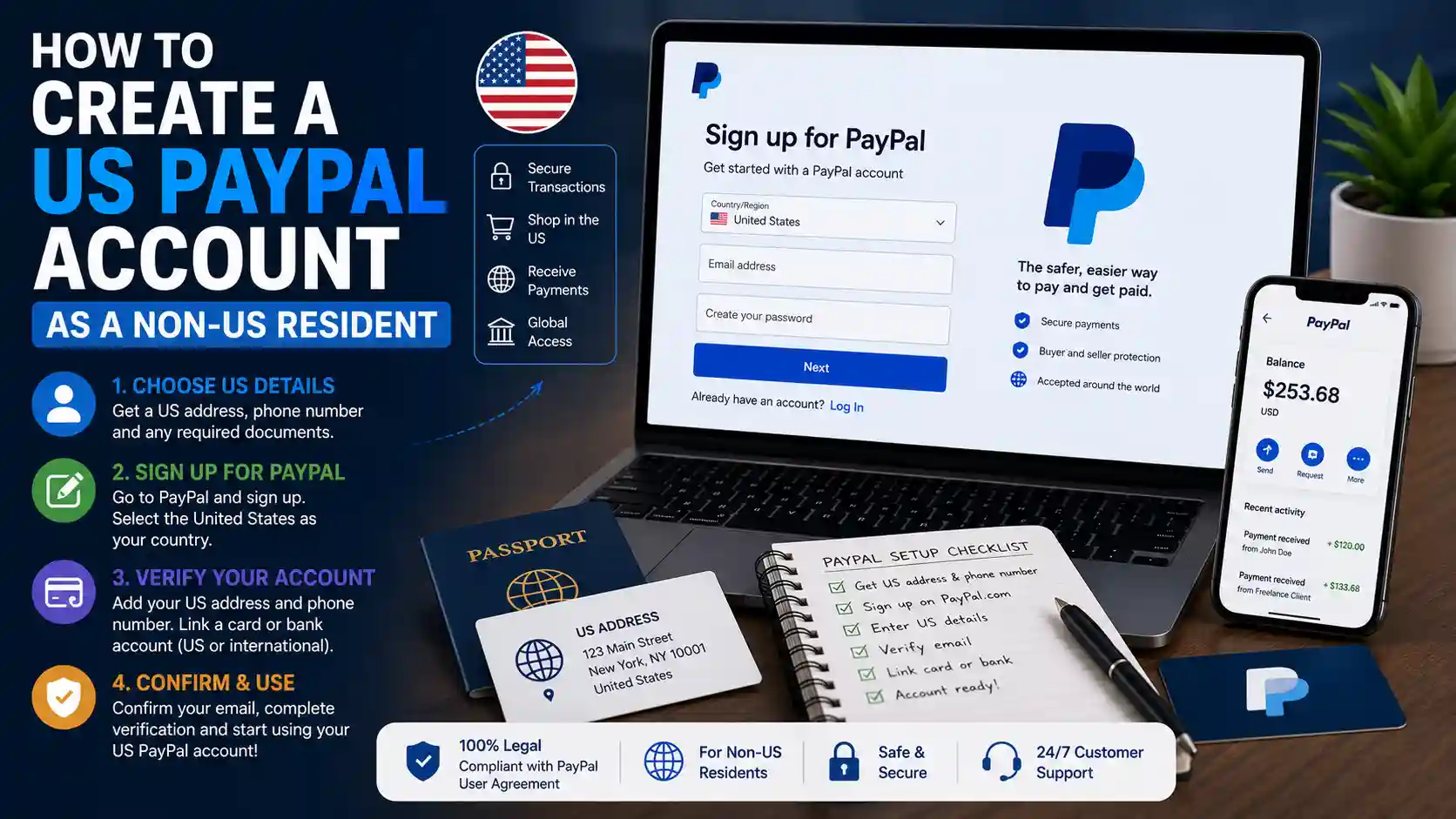
This is why the grey list is not a polite peer-review exercise. It is a switch that turns millions of ordinary economic lives into enhanced-due-diligence files. If you need a US payment stack that is not tied to a grey-listed personal account, the practical path many non-residents use is a real US company plus a real EIN — not a fake American identity. That path is documented in our guide on how to create a US PayPal account as a non-US resident.
Important: forming a company is not a licence to lie to PayPal, hide beneficial owners, or evade tax. It is a way to operate as a disclosed business instead of a flagged personal passport. Shortcuts that fake residency usually end in a permanent ban.
De-Risking: The Company That Couldn’t Be Formed
Entrepreneurs from grey-listed countries routinely report the same wall: UK and EU company formation agents, banks, and payment providers declining applications “due to jurisdiction risk.” The FATF list becomes a filter at the door of the global economy. A founder in Namibia or Nepal with a legitimate product can be refused a business bank account, a payment processor, or even a registered agent — not because of anything she did, but because of a suspicion attached to her passport.
This is the quiet mechanism of collective punishment: no official announces it; no law states it; it simply happens, one declined application at a time, as compliance officers convert a “reputational” list into a blanket refusal policy. The result pushes honest entrepreneurs toward workarounds — which is exactly how you create the informal flows the system claims to fight.
Locked out by your passport? Build a legal bridge.
Thousands of founders from grey-listed and de-risked countries now operate through properly formed US LLCs and UK Ltd companies — with legitimate US/UK bank and payment access — because the entity, not the individual’s nationality, is what global platforms underwrite. Northwest Registered Agent is the standard route for US formation; 1st Formations for the UK.
Form Your US LLC with Northwest → Form a UK Ltd with 1st Formations Affiliate links — we may earn a commission at no extra cost to you. Always comply with KYC/AML disclosure rules in every jurisdiction you operate in.Suspicion Is Not Justice
Every fair legal system on Earth shares one axiom: suspicion is not proof, and punishment requires proof. We do not imprison a man because his neighbor thinks he might steal. We do not fine a household because one member is under investigation. The grey list inverts this axiom at national scale: an entire population is economically penalized because a bureaucracy suspects that its government’s anti-money-laundering framework has “strategic deficiencies.”
Consider what is being punished. In most listed countries, the alleged failures are institutional — gaps in legislation, under-resourced financial intelligence units, slow judicial systems — frequently the inherited consequences of poverty and, in several cases, of colonial-era institutions the listing nations themselves designed. The citizens did not choose these gaps. Many are actively suffering under them. And yet the penalty lands on them: frozen accounts, refused visas of commerce, vanished investment.
Even where individual wrongdoing exists — corrupt politicians, sanctioned officials — the just response is targeted: freeze their assets, prosecute them, sanction them. Modern targeted-sanctions technology makes this easier than ever. Collective grey-listing is the opposite: it punishes the many for the suspected sins of the few. That is the definition of collective punishment, and it has no place in a system that claims to stand for justice.
The bias is in the design, not only in the mood
FATF will say the methodology is the same for everyone. Look at the map anyway.
Western financial centres wrote the standard. They have armies of compliance officers, software vendors, and consultants who sell “FATF-ready” reforms. A small African financial-intelligence unit is scored against the same template. Failure is then treated as moral failure rather than a capacity gap. Analysts noted this as far back as the old “non-cooperative countries” era: some listed places were not refusing to cooperate so much as lacking the infrastructure to satisfy a rich-country checklist.
Meanwhile, countries that have been repeatedly accused — in journalism and in policy debates — of letting terror finance or kleptocratic money move through their banks have spent long stretches off the grey list, or have been listed briefly and then celebrated out. The UAE was grey-listed in 2022 and removed in 2024. Turkey was listed and removed. The United States and the United Kingdom, whose company registries and property markets have been magnets for illicit wealth, sit in the plenary that grades everyone else.
Monaco and the British Virgin Islands on the same list as South Sudan and Haiti should tell you the rubric can touch rich jurisdictions. It should also tell you the consequences are not the same. A BVI service provider hires more lawyers. A Haitian or Kenyan freelancer loses the month’s rent.
Bias here does not require a cartoon villain in a smoke-filled room. It requires a standard designed around the administrative state of the G7, exported as if it were natural law, then enforced by banks that fear US and European regulators more than they fear excluding Africa.
They take the longer road. The road still goes through the church door.
FATF did not print “close the churches” on a communiqué. It printed Recommendation 8. Originally a special recommendation on non-profit organisations after 2001, Rec 8 told countries to protect the NPO sector from terrorist abuse. In the hands of nervous governments and even more nervous banks, “protect” became “suspect the whole sector.”
Churches, mosques, charities, and mission organisations move money across borders. They collect cash. They send support to people in hard places. That profile is enough for a de-risking algorithm. Account refusals, delayed wires, and “know your donor” demands followed. Independent researchers and the International Center for Not-for-Profit Law documented years of this as “policy laundering”: a security rule written internationally, then used at home to watch and constrict civil society.
FATF’s own 2021 stocktake of unintended consequences admitted the damage: de-risking, financial exclusion, and over-application of measures to non-profits. In 2023 it revised guidance on Recommendation 8 and said not every NPO is high-risk. That revision exists because the first version, as implemented, treated churches and charities as a terrorist-finance channel until proven otherwise.
You do not need a secret memo titled “Target Christianity.” You need a global rule that treats cross-border giving, cash collections, and independent civil society as inherently suspicious. Churches live in that category. So do mosques, temples, and humanitarian groups. The longer road is technical language. The destination is the same: the offering, the mission wire, and the pastor’s bank account become compliance events.
For believers and for secular builders alike, the practical lesson is ugly and simple. If the formal rails can be shut from Paris, you cannot build a life that has only one switch. Diversified legal entities, transparent books, and less dependence on a single processor are not “clever tricks.” They are how you keep feeding a family and a congregation when a list moves.
The Economic Cost of a Suspicion: The public pays a macroeconomic fine for a paperwork grade
IMF economists Mizuho Kida and Simon Paetzold, in a 2021 working paper, estimated that grey-listing is associated with a decline in capital inflows of about 7.6 percent of GDP on average. That is not a slap on a ministry’s wrist. That is investment, borrowing, and confidence leaving the country — which means jobs, imports, and currency pressure for people who did not write the deficient statute.
What grey-listing costs, in one picture
decline after grey-listing
(IMF, Kida & Paetzold 2021)
proceeds actually seized
(Ronald Pol, 2020)
Two independent studies, one indictment: the innocent pay more than the system catches. World Bank and IMF work on correspondent-banking de-risking shows the other channel — foreign banks close relationships with local banks because the compliance cost of a grey-listed corridor is not worth the fee income. Remittances get slower and more expensive. Trade finance shrinks.
World Bank and IMF work on correspondent-banking “de-risking” showed the other channel: foreign banks close relationships with local banks because the compliance cost of a grey-listed corridor is not worth the fee income. Remittances get slower and more expensive. Trade finance shrinks. The already-excluded become more excluded. FATF then points at informal value transfer and calls it a risk. The arsonist has arrived to discuss fire safety.
Measured economic damage of grey-listing
Sources: IMF Working Paper 2021 (Kida & Paetzold); The Banker; IADB. Declines in inflows, % of GDP.
The poverty bias: likelihood of being grey-listed
Source: economic-consequences analysis of FATF grey-listing (Risks/MDPI, 2023). The poorest countries are the most likely to be listed.
World Bank and IMF work on correspondent-banking “de-risking” showed the second channel:
- Foreign banks close relationships with local banks because the compliance cost of a grey-listed corridor is not worth the fee income.
- Remittances get slower and more expensive; trade finance shrinks; the already-excluded become more excluded.
- Ordinary freelancers, charities, and startups are treated as suspects by global platforms.
- FATF then points at informal value transfer and calls it a risk. The arsonist has arrived to discuss fire safety.
The system is self-fulfilling: list a poor country, starve it of capital, and then point at the resulting informality as justification for the listing. That is not regulation. That is a poverty trap with a compliance department.
A global machine that catches almost none of the money
If this architecture actually confiscated the proceeds of crime, the democratic-deficit argument would still stand — but the utilitarian argument would have something to say. It does not.
Ronald F. Pol’s 2020 paper in Policy Design and Practice called global AML “the world’s least effective policy experiment.” His estimate: less than 1% of criminal proceeds are seized, while the cost of the system is orders of magnitude larger. UNODC has long put criminal proceeds in the range of 2–5% of global GDP. The confiscation numbers never remotely match.
FATF’s own mutual evaluations keep showing the same split: countries can score well on “technical compliance” (laws on the books) and poorly on “effectiveness” (actual cases, actual assets). The grey list still leans on that machinery. It exports a model that is expensive, exclusionary, and bad at its stated job — then punishes countries that cannot afford a convincing performance of it.
The official story vs. the seizure reality
Illustrative split based on Pol’s “well under 1%” seizure estimate. The grey list is not how you close that gap. It is how you spread the cost to people who were never in the gap.
The official story vs the seizure reality
Illustrative split based on Pol’s “well under 1%” seizure estimate and UNODC proceeds ranges. The grey list is not how you close that gap. It is how you spread the cost to people who were never in the gap.
FATF’s own mutual evaluations keep showing the same split:
- Countries score well on “technical compliance” (laws on the books) and poorly on “effectiveness” (actual cases, actual assets).
- The grey list still leans on that machinery, exporting a model that is expensive, exclusionary, and bad at its stated job.
- Then it punishes countries that cannot afford a convincing performance of it.
What people in grey-listed countries actually do
You can hate the list and still have invoices to send. The honest options are narrow. The dishonest ones get accounts killed.
1. Separate the person from the business — legally
A personal PayPal in a grey-listed country is a flagged corridor. A disclosed company in the US or UK, with a real registered agent, a real EIN or Companies House file, and a real beneficial owner, is a different risk object. It is still reviewed. It is not the same as a personal account that happens to live on a list.
Non-residents can generally form a US LLC without citizenship, an SSN, or setting foot in America. The requirements, state choice, and EIN path are in How to Form an LLC for Non-US Residents. If you are comparing agents, start with the best LLC formation services for non-US residents.
2. Use the company for the work that actually needs it
Creators who need AdSense or a cleaner payout story often put the channel in the company, not in a personal name that keeps tripping country filters. See how to create an LLC for a YouTube channel and Google AdSense and, if you run more than one property, how to open multiple AdSense accounts without turning the structure into a ban magnet.
3. Pay yourself like an owner, not like a ghost
Once the entity exists, the money still has to reach you without looking like layering. Owner’s draws, payroll, and tax treatment are a separate discipline: how to pay yourself as an LLC.
4. Reduce single-point-of-failure banking
The grey list is a reminder that a processor can close you for a reason that has nothing to do with your invoices. Building personal liquidity and not living inside one platform is the longer project — the one we unpack in how to become your own bank.
US entity or UK entity?
US LLC: usually the cleaner wrapper for US processors, AdSense, and dollar invoicing. UK limited company: still useful for European clients and a Companies House footprint, but grey-list nationalities should expect heavier AML from UK agents. Use a formation agent that already onboards non-residents, and tell the truth on every KYC form.
What would justice look like instead of a list?
It would look like the thing FATF keeps saying it cannot do, and then approximating with a blunt instrument: go after the guilty.
- Name the person, the company, the wallet, the official. If there is proof, prosecute. Mutual legal assistance already exists for that.
- Stop converting capacity gaps into moral verdicts. A thin financial-intelligence unit is a development problem. It is not a reason to freeze a tutor’s PayPal.
- Make banks prove a customer-level risk before they close an entire nationality corridor. “Grey-listed country” is not a customer due-diligence file.
- Put Recommendation 8 back in its box. Churches and charities are not terrorist-finance utilities. Targeted cases, not sector-wide suspicion.
- Publish the democratic deficit out loud. If G7 governments want this power, they should have to defend it in their own parliaments as what it is: extraterritorial economic coercion by list.
Until that happens, the grey list will keep doing what it was built to do. It will not catch the sophisticated launderer who already has London lawyers. It will catch the nation that cannot staff a beneficial-ownership office, and then it will catch the church secretary and the freelancer as collateral.
Suspicion is not evidence. A plenary is not a jury. A passport is not a predicate offence. Any system that cannot tell those things apart has no right to call itself a guardian of the financial system — and no right to run your economy from a room you never voted for.
Frequently asked questions
Is the FATF grey list the same as a criminal conviction of a country?
No. It is a public finding that FATF considers a jurisdiction’s AML/CFT system strategically deficient, plus an action plan. It is not a trial, and it does not prove that the country’s ordinary residents committed money laundering or terrorist financing.
Who created FATF and who votes for it?
FATF was created by the G7 in Paris in 1989. Its members are governments and two regional organisations. The public in listed countries does not elect FATF, does not sit in the plenary, and has no individual right of appeal against a country listing.
Does grey-listing legally ban you from forming a UK or US company?
There is usually no statute that says “this nationality may not incorporate.” In practice, UK formation agents, ACSPs, and banks apply enhanced due diligence or refuse files from grey-listed countries. US LLC formation for non-residents remains legally available, subject to identity checks, a registered agent, and honest disclosures.
Why were Kenyan PayPal accounts frozen?
After Kenya’s February 2024 grey-listing, payment firms tightened country-level risk controls. Long-running freelance accounts were limited or frozen without a finding that those users committed a crime. That is de-risking: closing a corridor because the jurisdiction is listed, not because the customer was proven guilty.
If only a few politicians are corrupt, why list the whole country?
That is the central criticism. FATF grades systems, then private institutions punish populations. A just response would pursue the officials and entities with evidence, not mark every passport from that state.
Is FATF targeting churches?
FATF’s text targets “non-profit organisations” via Recommendation 8, on the theory that a minority of NPOs can be abused for terrorist financing. In implementation, churches, charities, and other faith groups have faced account closures and transfer blocks. FATF later admitted over-reach. The effect on churches is documented even when officials deny a religious motive.
Does grey-listing even work against criminals?
Independent research, including Ronald Pol’s, finds that global AML regimes seize well under 1% of estimated criminal proceeds while imposing large compliance and exclusion costs. Grey-listing is effective at moving bank behaviour. It is a weak way to convict actual launderers.
What can a founder in a grey-listed country do right now?
Keep records, tell the truth on KYC, and — if you need US or UK commercial rails — form a real company rather than a fake identity. A US LLC via a non-resident-friendly agent is the most common path; a UK company is possible but often slower for grey-list nationalities.
Do not let a list be the only thing that defines your business
If you are building from a grey-listed country, form the entity properly, keep the books clean, and keep more than one way to get paid. The bureaucracy will not apologise. You still have invoices.
📚 Sources & Research Notes (click to expand — primary documents, academic research, journalism & civil-society files)
Primary and cited sources
This article is journalism and analysis, not legal advice. FATF lists change after each plenary. Company formation, banking, and payment-processor decisions depend on your facts, your provider’s risk appetite, and the law in each country.
Primary & Official Documents
- FATF — Jurisdictions under Increased Monitoring, 13 February 2026 The live roster of grey-listed jurisdictions referenced throughout this piece.
- FATF — High-Risk Jurisdictions subject to a Call for Action, 13 February 2026 Black-listed states as of February 2026: Iran, North Korea, Myanmar.
- FATF — The FATF (mandate and self-description) FATF describes itself as a “policy-making body” with no investigative authority.
- FATF — High-Level Synopsis of the Stocktake of the Unintended Consequences of the FATF Standards FATF’s own admission of de-risking, financial exclusion, and NPO over-application.
- FATF — Revised Recommendation 8 Guidance on Non-Profit Organisations Post-stocktake guidance that not every NPO is high-risk.
- FATF — History and mandate expansion
Academic & Institutional Research
- Kida, Mizuho & Paetzold, Simon — “The Impact of Gray-Listing on Capital Flows: An Analysis Using Machine Learning” Estimated average capital-inflow decline of 7.6% of GDP after grey-listing.
- Pol, Ronald F. — “Anti-money laundering: The world’s least effective policy experiment? Together, we can fix it.” Seizure of criminal proceeds estimated well under 1% of estimated totals.
- Morse, Julia C. — The Bankers’ Blacklist: Unofficial Market Enforcement and the Global Fight against Illicit Financing The model by which a public list makes private banks reprice whole jurisdictions.
- UNODC — Estimates of criminal proceeds as a share of global GDP The denominator against which seizure rates must be measured.
Policy Analysis & Civil-Society Research
- Hayes, Ben — “Counter-Terrorism, ‘Policy Laundering,’ and the FATF: Legalizing Surveillance, Regulating Civil Society” How a security rule written internationally gets used domestically to constrain civil society.
- RUSI — “FATF’s Recommendation 8: A Cure Worse Than the Disease” A landmark critique of NPO over-regulation and the limited evidence of terrorist abuse of nonprofit organisations.
- Charity & Security Network / ICNL — Nonprofit De-Risking Documentation Documentation on nonprofit de-risking, including research reporting that two in three U.S. nonprofits with foreign operations faced bank de-risking.
- International Center for Not-for-Profit Law (ICNL) — Documentation on Recommendation 8 implementation Country-level case studies of NPO over-application and de-risking effects.
Media, News & Reporting
- Business Daily Africa — “PayPal freezes, blocks Kenya accounts in money-laundering fears” Reporting on frozen and banned Kenyan accounts linked to anti-money-laundering compliance measures.
- WeeTracker (2026) — “Kenyans furious at PayPal as frozen funds and banned accounts mount” Reporting on Kenyan freelancer accounts being locked and access to balances restricted, including accounts with long histories of use.
- Al Jazeera — South Africa, Nigeria, Mozambique, and Burkina Faso removed from the grey list Reporting on on-site visits that preceded the October 2025 removals.
- Wikipedia — Compilation of the 13 February 2026 grey list (23 jurisdictions) and blacklist Working snapshot used to compile the jurisdiction tables above; verify against live FATF sources.
This article is commentary and general information, not legal or financial advice. Nothing here encourages evasion of AML/KYC laws; we advocate lawful transparency, due process, and reform. Company formation, banking, and payment-processor decisions depend on your facts, your provider’s risk appetite, and the law in each country.