How to Form a US LLC from South AfricaThe Complete Non-Resident Guide for South African Founders
Yes – South African citizens can legally form a US LLC without a visa, without an SSN, and without ever boarding a plane. This guide walks you through state selection, real costs, the exact Northwest Registered Agent ordering flow (7 screenshots), EIN acquisition for foreign founders, USD banking from Cape Town or Johannesburg, and the IRS filings most owners miss. South Africa’s big advantage: unlike most African countries, it has a US income tax treaty (in force since 1997) – which changes your W-8BEN strategy and your repatriation maths.
Quick Answer: How to Form a US LLC from South Africa
South African citizens can fully own a US LLC with no US visa, no SSN and no physical presence. The process has six moving parts: (1) pick a formation state – Wyoming is the default recommendation for non-residents, Delaware if you plan to raise investment, New Mexico for the lowest ongoing cost; (2) hire a registered agent in that state (required by law); (3) file the Articles of Organization through a formation service like Northwest Registered Agent ($39 + state fee) or directly with the state; (4) obtain an EIN from the IRS using Form SS-4 by fax or mail – no SSN/ITIN needed for foreign owners; (5) open a US business bank account remotely (Mercury, Relay, Wise Business); and (6) stay compliant: state annual reports, registered-agent renewal, and – critically – the annual Form 5472 + pro-forma Form 1120 information return that every foreign-owned single-member LLC must file even when it owes $0 of US tax.
South-Africa-specific note (your advantage): South Africa is one of the very few African countries with a bilateral income tax treaty with the United States – signed in 1997 and still in force. That means, unlike founders from no-treaty countries, you can claim reduced treaty withholding on Form W-8BEN for US-source FDAP income (dividends generally at 5% or 15% depending on ownership level, with reduced or exempt rates on certain interest and royalty categories). On the flip side, the South African Rand (ZAR) floats freely and outward payments are governed by SARB exchange-control rules (Single Discretionary Allowance of R1 million/year, plus a Foreign Investment Allowance up to R10 million with a SARS Tax Clearance Certificate), and SARS taxes residents on worldwide income.
Total realistic first-year cost: roughly $139-$500 depending on state and add-ons. Total realistic timeline: 1-3 days for the LLC, 3-8 weeks for the EIN (the IRS bottleneck for foreign applicants), then a few days for banking.
Table of Contents
- Why South African founders choose a US LLC
- US LLC basics in 90 seconds
- Legality: ownership, visas & CIPC
- Choosing your state (with charts)
- True cost: year 1 and beyond
- Registered agent explained
- Step-by-step: Northwest walkthrough
- After formation: EIN, bank, payments
- US taxes for South African owners
- The US-SA tax treaty advantage
- South Africa-side taxes, SARB & ZAR
- Compliance calendar
- DIY vs formation services
- Common mistakes to avoid
- Use cases for South African founders
- Master checklist
- FAQs
- Final thoughts
Why South African Founders Are Forming US LLCs
South Africa has one of Africa’s most mature digital and financial economies – Cape Town’s “Silicon Cape” startup scene, Johannesburg’s fintech and finance hub, and a deep pool of remote software engineers billing US and EU clients in dollars. Yet ZAR volatility, SARB exchange controls and SARS worldwide-income taxation push serious founders to route international income through foreign entities. A US LLC has become the most common offshore wrapper for South African freelancers, developers, consultants and creators.
- Payment rails: US clients, ad networks and marketplaces pay US entities with far fewer holds. A US LLC unlocks USD business accounts (Mercury, Relay, Wise Business) that are harder to access as a South African sole proprietor.
- Currency hedge: earning and holding revenue in USD inside a US LLC is a natural hedge against ZAR depreciation; you convert to Rand only what you need locally.
- Treaty advantage: the 1997 US-South Africa income tax treaty lets you claim reduced withholding on US-source FDAP income – a genuine edge over founders from no-treaty African countries.
- Remote-dev talent: South African engineers are heavily recruited by US startups; a US LLC matches the contracting pattern those employers expect.
- Entity momentum: US business formation has been running above 5 million applications per year since 2021 (US Census Bureau, Business Formation Statistics) – a large share from non-resident founders using exactly the workflow in this guide.
- Liability shield: an LLC separates your personal assets (home, savings, retirement annuity) from business liabilities.
US LLC Basics in 90 Seconds
A US Limited Liability Company (LLC) is a state-created business entity that blends corporate liability protection with partnership-style tax flexibility. It is not a corporation, and it does not require US citizenship, residency, or a US bank account to form.
| Term | Plain-English meaning | What it means for you in South Africa |
|---|---|---|
| Articles of Organization | The one-page certificate filed with the state that creates the LLC | Filed online by you or your formation service; approval = your LLC exists |
| Registered agent | A person/company with a physical address in the state to receive legal mail | Must be hired; you cannot act as your own agent from Cape Town or Johannesburg |
| EIN | Employer Identification Number – the LLC’s tax ID from the IRS | Free; foreign owners apply by fax/mail (Form SS-4), no SSN needed |
| Operating agreement | Internal rulebook: ownership, voting, profit splits | Not filed publicly; banks and marketplaces often request it |
| Single-member LLC (SMLLC) | One owner; “disregarded entity” for US tax | The default structure for solo South African founders |
| Member-managed vs manager-managed | Owners run it vs appointed managers run it | Member-managed is simplest for solo founders |
| Franchise tax / annual report | Yearly state fee to keep the LLC in good standing | Ranges from $0 (NM) to $800+ (CA) – see state chart below |
| Form 5472 | IRS information return for foreign-owned US disregarded entities | Mandatory annual filing even with $0 US tax; $25,000 penalty for skipping |
Legality: Can a South African Citizen Own a US LLC?
Yes, without restriction. All 50 US states permit foreign individuals and foreign companies to own LLCs. There is no citizenship test, no residency test, and no requirement to ever visit the United States. South Africa is not subject to US OFAC sanctions that would complicate ownership or banking, so the standard foreign-founder workflow applies cleanly.
Three legal myths, cleared
- “I need a visa.” No. Owning and remotely managing a US LLC from South Africa requires no US visa. (Physically working inside the US is a different question – ownership alone does not grant work authorization. Note South Africa is not an E-2 treaty country, so the treaty-investor visa route used by some nationalities is not available; L-1 and EB-5 remain options with an immigration attorney.)
- “I need an SSN or ITIN.” No. The IRS issues EINs to foreign-owned LLCs via Form SS-4 filed by fax or mail, with the “foreign” box ticked and no SSN/ITIN on line 7b.
- “I need a US address.” Not yours personally. Your registered agent’s in-state address satisfies the state’s contact requirement, and formation services bundle mail forwarding if you want a business mailing address.
Choosing Your State: Wyoming, Delaware, New Mexico & the Rest
Your LLC can form in any state, but for a South-Africa-based owner with no US physical operations, the decision is almost purely about cost, privacy and future plans. Here is the shortlist that matters:
| State | One-time filing fee | Annual state cost | Privacy | Best for |
|---|---|---|---|---|
| Wyoming ⭐ | $100 | $60 min. annual report licence tax | Owners off public record | Default pick for non-residents: cheap, private, no state income tax |
| Delaware | $90 | $300 franchise tax (due June 1) | Members not listed on formation doc | Startups planning VC investment; court precedent (Court of Chancery) |
| New Mexico | $50 | $0 – no annual report, no franchise tax | Owners off public record | Lowest lifetime cost; set-and-forget freelancers |
| Florida | $125 | $138.75 annual report | Names public | Founders with genuine FL ties or LATAM-facing businesses |
| Texas | $300 | Franchise tax report (no tax due under ~$2.47M revenue) | Names public | Founders with real TX operations |
| Nevada | $425 initial | ~$350/yr (list + licence) | Partial | Rarely worth the cost for non-residents |
| California | $70 | $800/yr minimum franchise tax + $20 biennial statement | Names public | Only if you actually operate in CA |
Fees verified against Secretary of State fee schedules, September 2026. Confirm live before filing – states adjust fees periodically.
One-time state filing fee for LLC Articles of Organization (USD)
Source: state Secretary of State / Division of Corporations fee schedules (Sept 2026). Nevada total includes initial list of managers ($150) and state business licence ($200).
Recurring annual state cost to keep the LLC in good standing (USD)
Excludes registered-agent renewal (needed in every state, ~$125/yr with Northwest). California = $800 minimum franchise tax + $20 biennial statement of information amortised.
Our recommendation for South African founders
- Wyoming (default): low entry ($100), low renewal ($60), no state income tax, owner privacy, and the most non-resident-friendly banking track record.
- Delaware (if fundraising): investors and accelerators expect Delaware; home to roughly two-thirds of the Fortune 500 and over 1.8 million registered entities (Delaware Division of Corporations). You pay for that prestige with a $300/year franchise tax.
- New Mexico (if minimizing): $50 in, $0/year forever after, no annual report to forget. The trade-off is slightly less name recognition with some banks.
The True Cost of Forming a US LLC from South Africa
Two cost layers: one-time (state fee + formation service + optional add-ons) and recurring (registered agent, state annual report/franchise tax, US tax filing help, South African accounting).
| Item | Typical cost | Frequency | Notes |
|---|---|---|---|
| State filing fee (WY example) | $100 | Once | $50 NM / $90 DE / $125 FL etc. |
| Northwest formation service | $39 | Once | Includes registered agent first year in current bundles – confirm at checkout |
| EIN (DIY via IRS fax/mail) | $0 | Once | Or paid add-on via formation service if you prefer hands-off |
| Operating agreement | $0-$100 | Once | Template included by many services; lawyer-drafted costs more |
| Registered agent renewal | ~$125/yr | Annual | Legally required every year |
| State annual report / franchise tax | $0-$800/yr | Annual | State-dependent (see chart above) |
| US tax return prep (Form 5472 package) | ~$250-$600/yr | Annual | DIY possible but penalty risk makes pros worth it |
| US business bank account | $0 | — | Mercury / Relay / Wise Business have no opening fee |
What you pay at checkout – Wyoming example (USD)
Based on Northwest’s published $39 + state fee pricing and Wyoming SOS fee schedule, Sept 2026.
3-year cumulative cost of ownership: Wyoming vs Delaware vs California (USD)
Illustrative model: state filing fee + $39 service in year 1, then annual state fee + $125 registered-agent renewal. Excludes tax-prep fees and one-off add-ons. California includes the $800 minimum franchise tax each year.
Ready to start? Northwest Registered Agent is our recommended formation service for non-US residents: flat $39 + state fee, in-house registered agent service, and a track record with foreign-owned LLCs.
Start Formation at Northwest →Registered Agent: The Requirement You Cannot Skip
Every US state requires your LLC to maintain a registered agent – a person or company with a physical street address in the formation state, available during business hours to accept service of process (lawsuits) and official state mail. From South Africa, you cannot fulfil this yourself.
- Cost: typically $100-$300/year market-wide; Northwest charges $125/year and bundles the first year with most formation orders.
- Privacy bonus: the agent’s address – not yours – appears on public filings as the official contact point.
- Compliance risk: letting the agent lapse triggers “administrative dissolution” in most states – your LLC loses good standing, and banks/payment processors freeze accounts until it is reinstated (with penalties).
We maintain a full independent write-up in our Northwest Registered Agent review, including how their mail-scanning dashboard behaves for overseas clients.
Step-by-Step: Form Your US LLC from South Africa with Northwest (7 Screenshots)
Below is the exact ordering flow we ran for a South-African-owned Wyoming LLC. The whole form takes 10-15 minutes; state approval then typically lands within 1-3 business days for Wyoming, Delaware and New Mexico online filings.
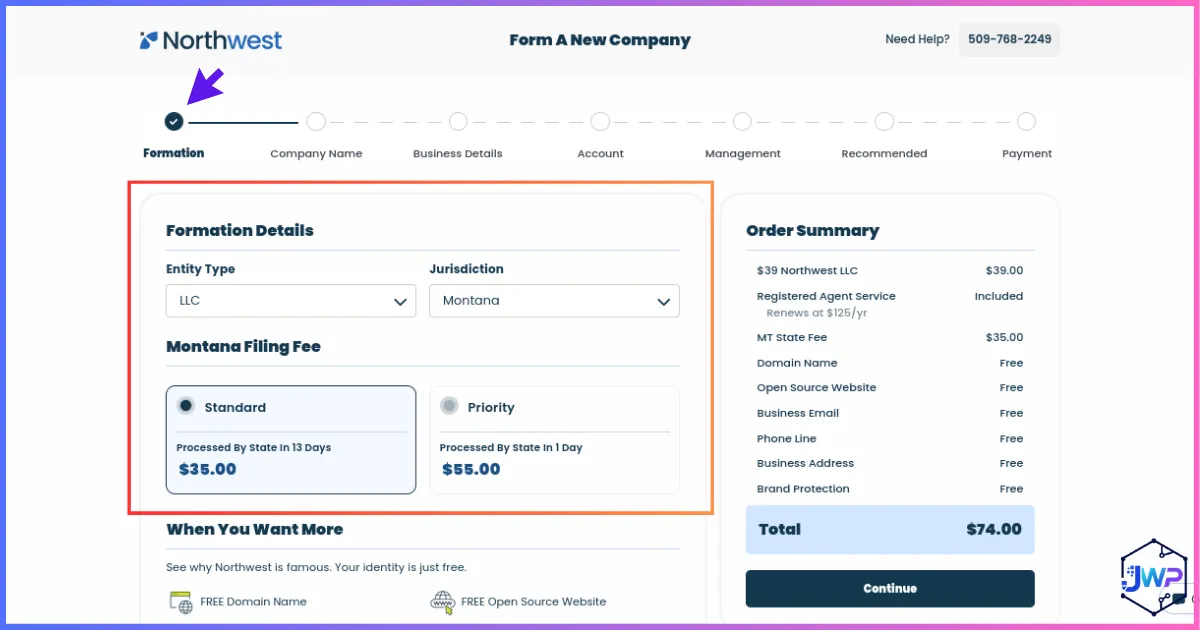
Open the order form and set formation details
Choose your entity type (LLC) and formation state. For most South-Africa-based founders this is Wyoming; pick Delaware only if investment is on your roadmap.
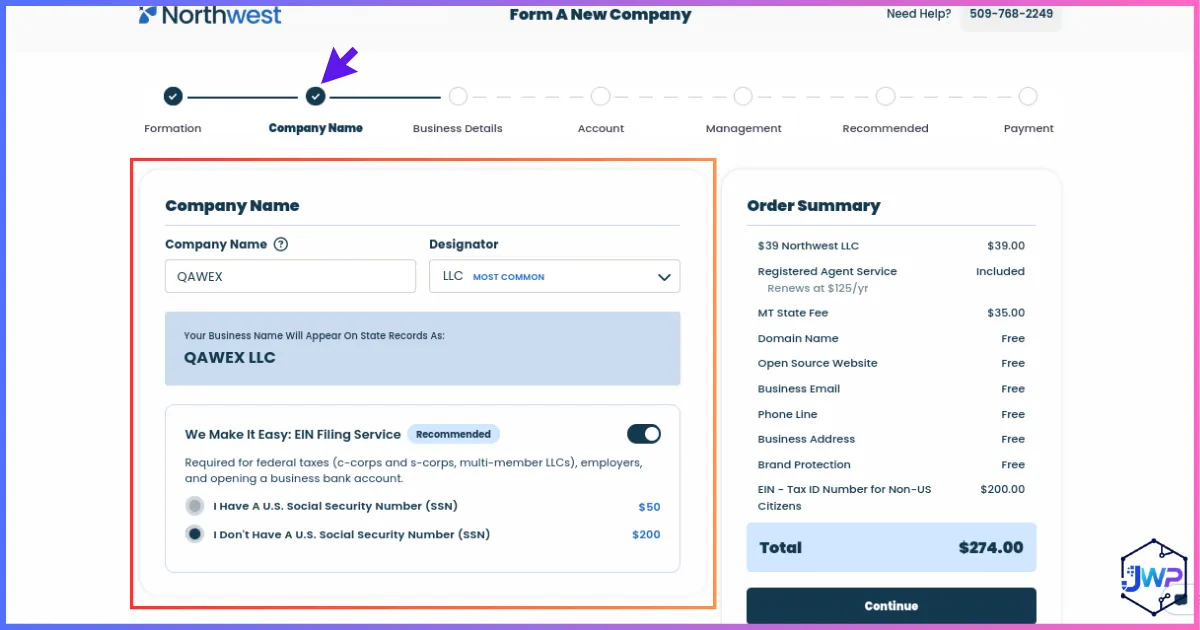
Add your company name (and decide on the EIN service)
Enter your desired LLC name exactly as it should appear, including the “LLC” or “Limited Liability Company” ending. Northwest runs the state availability check for you. On this screen you’ll also see the optional EIN service – recommended if you’d rather not handle IRS Form SS-4 fax correspondence yourself, but skippable to save money (we cover the free DIY route below).
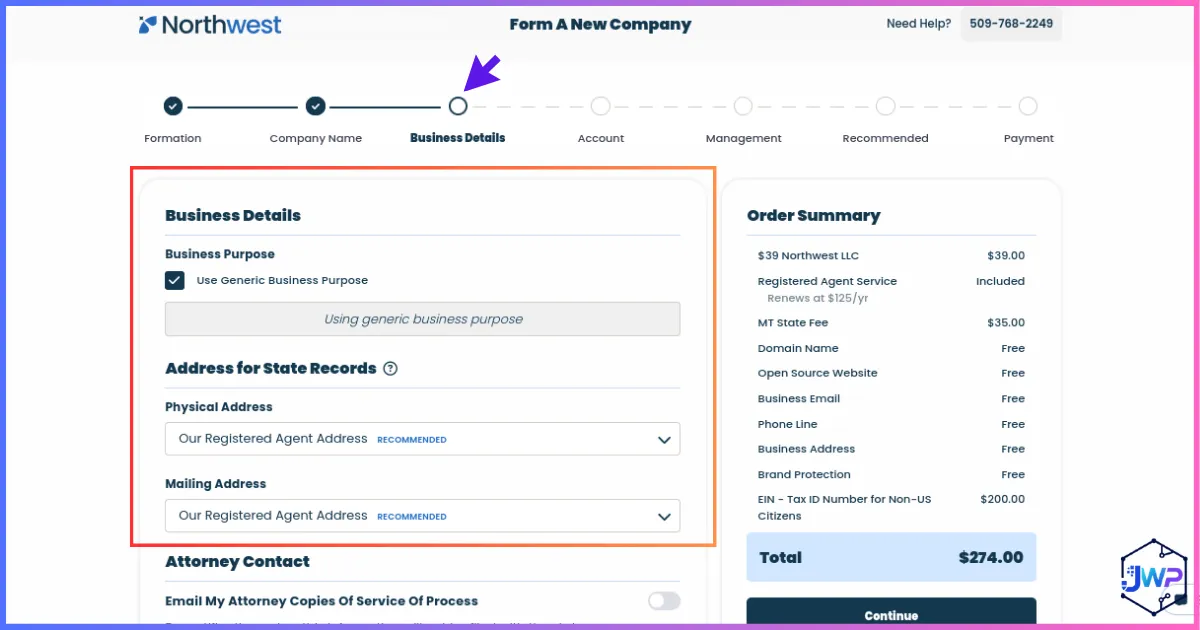
Enter business details
Purpose statement (a generic “any lawful business” line is standard and fine), your contact email, and mailing preferences. Your South African residential address is used for correspondence; the registered agent’s Wyoming address handles official state service.
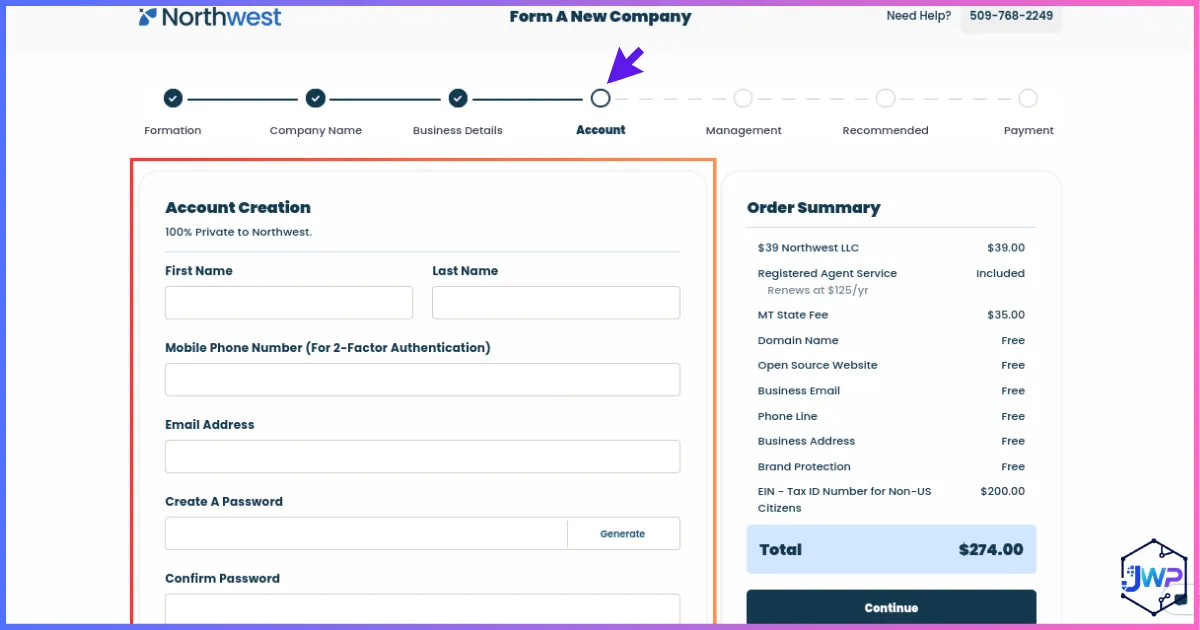
Create your client account
This account becomes your control panel: formation status, scanned mail from your registered agent, annual report reminders and renewal invoices. Use an email you’ll keep for years – losing access complicates renewals.
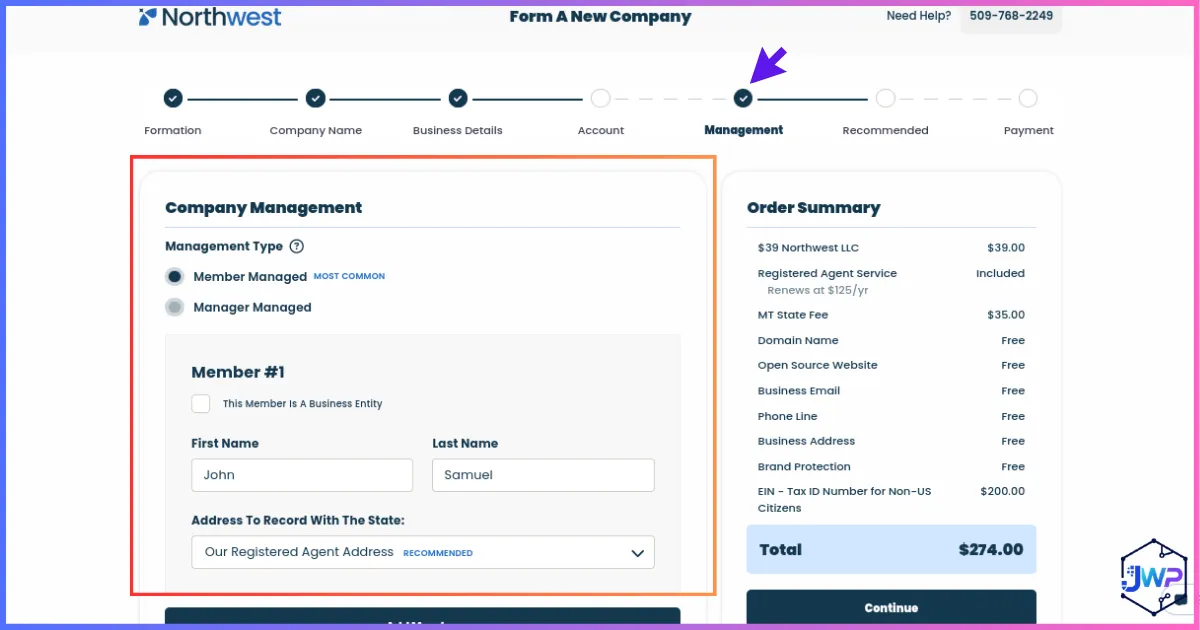
Enter company management details
Declare the management structure (member-managed for solo founders) and the owner’s details – name, South African residential address, and passport-based identity information. South African passports are fully accepted; nothing on this screen requires US status.
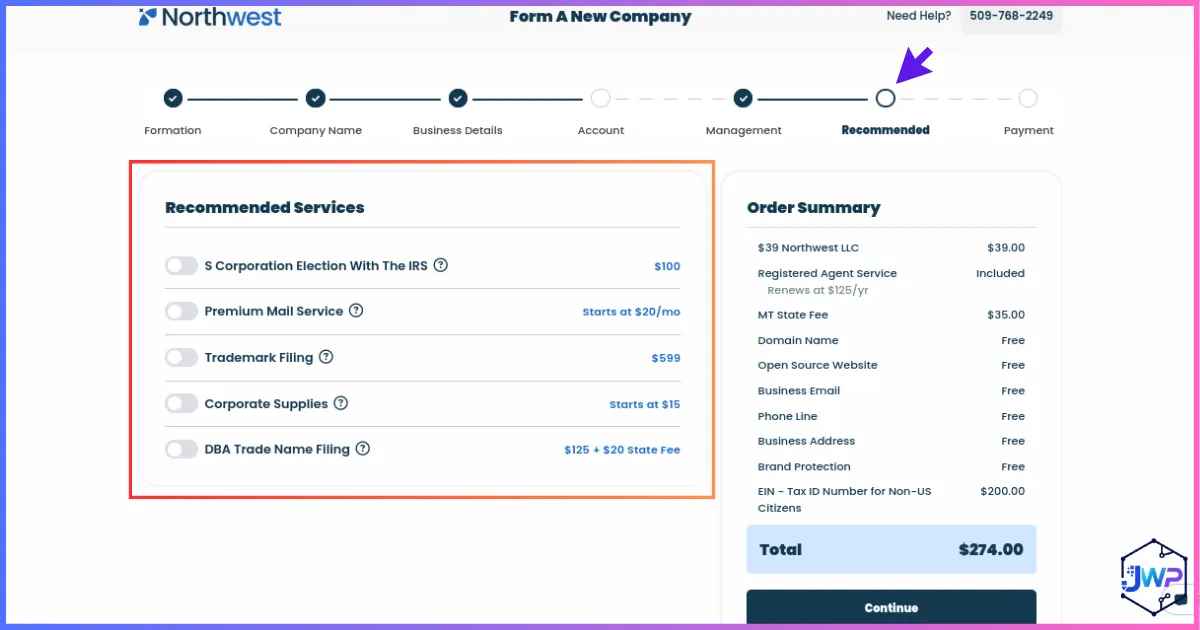
Review optional recommended services
Mail forwarding, certified copies, compliance monitoring and similar add-ons appear here. Honest advice: skip anything you can’t justify. Mail forwarding is the only one most non-residents eventually add.
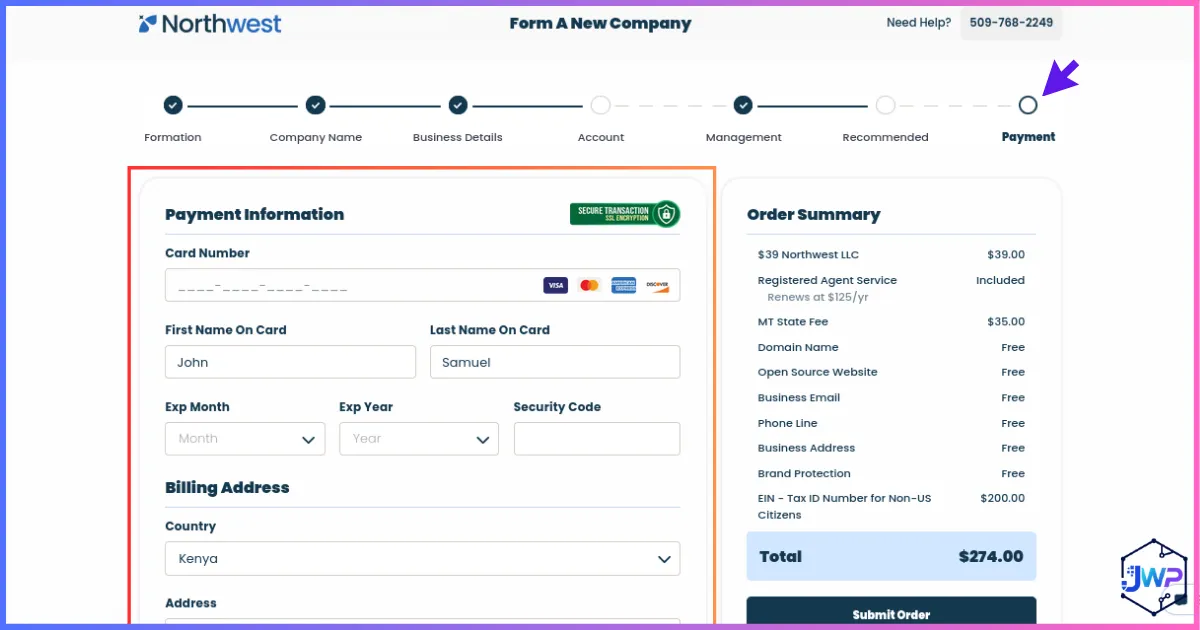
Enter payment information and submit
You’ll see the final breakdown – $39 service fee + your state’s filing fee (+ any add-ons) – before paying by card. After submission, Northwest prepares and files the Articles; you’ll receive the stamped formation documents by email once the state approves. South African cardholders with internationally-enabled bank cards (Standard Bank, FNB, Absa, Nedbank, Capitec) can pay directly; the outward payment draws on your SARB Single Discretionary Allowance.
After Formation: EIN, Operating Agreement, Banking & Getting Paid
1. Get your EIN (the foreign-founder route)
- Download Form SS-4 from IRS.gov and complete it for your LLC. On line 7b, leave SSN/ITIN blank and mark the foreign-owner indicators as instructed.
- Submit by fax (using the current international fax number published in the SS-4 instructions) or by mail if you prefer paper trails.
- Wait. IRS guidance suggests ~4 weeks by fax and 4-5 weeks by mail; foreign applications commonly land in the 3-8 week window during peak seasons. Paid formation-service EIN add-ons use the same IRS channels – they save effort, not time.
2. Adopt an operating agreement
Even single-member LLCs should sign one: banks, Stripe-style processors and marketplaces routinely request it, and it reinforces the liability shield by evidencing corporate separateness.
3. Open a US business bank account – from South Africa
- Mercury and Relay: US fintechs that onboard non-resident-owned LLCs with EIN + formation docs + passport; no US visit required.
- Wise Business: multi-currency USD/EUR/GBP account details; excellent for converting client payments to ZAR at competitive rates.
- Payoneer: receiving accounts for marketplaces (Amazon, Upwork enterprise billing, app stores).
PayPal needs care: a US PayPal business account generally expects US tax status, so most South African owners route client payments to Mercury/Wise instead. Our walkthrough on creating a US PayPal account as a non-US resident covers the eligibility realities and workarounds that stay compliant.
4. Invoice and get paid
Issue invoices from the LLC (US entity name + EIN + US bank details). For US clients paying for services you perform in South Africa, provide Form W-8BEN (you, the foreign individual owner, since a single-member LLC is disregarded). Because South Africa HAS a US income tax treaty, you can – and should – claim treaty benefits on the W-8BEN to reduce withholding on US-source FDAP income. More in the treaty section below.
US Taxes for South African LLC Owners: What You Owe (and What You Don’t)
The income-tax picture
A single-member LLC owned by a non-resident alien is a disregarded entity: the IRS looks through it to you. If you have no US trade or business – no US office, no US employees, no dependent agents in the US, and services performed from South Africa – your business income is generally not US-source and owes $0 US income tax. There is also no US self-employment tax for non-residents on foreign-performed services.
The filing you must not skip: Form 5472
Foreign-owned single-member LLCs must file Form 5472 together with a pro-forma Form 1120 every year – even with zero US tax and zero US activity. The failure penalty is $25,000 per violation under IRC §6038A. See the official IRS Form 5472 guidance for the current filing mechanics.
Other US tax touchpoints
- State level: Wyoming/Delaware-style LLCs with no in-state activity generally owe no state income tax, but the franchise/annual report fees in the charts above still apply.
- Sales tax / marketplace rules: selling digital or physical goods into US states can create economic-nexus sales-tax obligations independent of income tax – get advice before scaling e-commerce.
- Multi-member LLCs: become partnerships (Form 1065 + foreign-partner withholding rules) – a materially harder compliance load; structure deliberately.
- BOI reporting: under FinCEN’s 2025 interim final rule, US-domestic LLCs are not currently required to file Beneficial Ownership Information reports; foreign-formed entities registered in the US remain in scope. Rules are in flux – re-check FinCEN before assuming permanence.
The US-South Africa Tax Treaty: Your Genuine Advantage
Unlike most African countries (Kenya, Nigeria, Angola, Tanzania and others have no operative US treaty), South Africa has a bilateral income tax treaty with the United States – signed in 1997 and in force since the late 1990s. This is a real, practical advantage for South African founders that changes how US-source income is taxed at the withholding stage.
What the treaty does for you
- Reduced dividend withholding: US-source dividends paid to you as the disregarded owner are generally capped at 15% (portfolio holdings) or 5% (where the beneficial owner is a company holding ≥10% of voting stock), instead of the default 30%.
- Reduced / exempt interest & royalties: certain interest and royalty categories qualify for further reduction or exemption under the treaty’s articles – confirm the specific article with a preparer.
- W-8BEN treaty claim: you cite the treaty on Form W-8BEN (with your SARS taxpayer reference as your foreign TIN) so US payors withhold at the treaty rate rather than 30%.
- Double-tax relief: the treaty’s relief-from-double-taxation provisions interact with South Africa’s domestic foreign-tax-credit rules to reduce the chance of the same income being taxed twice in full.
What the treaty does NOT do
- It does not exempt US filing obligations. Form 5472 + pro-forma 1120 is still due. State annual reports are still due. EIN is still required.
- It does not exempt South African tax. SARS still taxes residents on worldwide income; the treaty reduces US withholding, it does not erase your SA liability.
- It does not grant visa rights. South Africa is not an E-2 treaty country; the income-tax treaty carries no investor-visa pathway.
- Limitation-on-Benefits applies. The treaty has an LOB article; you must genuinely qualify as a South African resident beneficiary to claim rates.
US withholding on US-source dividends: default vs US-SA treaty rates (%)
Rates per the US-South Africa income tax treaty (1997), dividends article. Interest/royalty articles may provide further reduction or exemption. Confirm the applicable article and Limitation-on-Benefits test with a qualified preparer before claiming.
The South Africa Side: SARS, SARB Exchange Control & ZAR
A US LLC does not switch off South African tax residency. If you live in South Africa, SARS (South African Revenue Service) taxes you on your worldwide income, which includes salaries, dividends or profits you draw from your US LLC. See the official SARS portal for current residence-based taxation rules.
- Worldwide income: SA tax residents are taxed on worldwide income; your US LLC profits/drawings are declarable. The treaty reduces US withholding but does not remove your SA liability – foreign tax credits apply where US tax was actually paid.
- SARB exchange control (outward): paying US fees (formation, agent, tax prep) is an outward payment. Individuals have a Single Discretionary Allowance (SDA) of R1 million per calendar year for any purpose, plus a Foreign Investment Allowance up to R10 million with a SARS Tax Clearance Certificate. Your authorised dealer bank processes these.
- Inward flows (repatriation): bringing your LLC profits back into South Africa is generally unrestricted (inward receipts are welcome), but the amounts are worldwide-income taxable via SARS.
- ZAR floats freely: the Rand moves with market forces, so USD→ZAR conversion rates vary. Holding revenue in USD inside the LLC and converting only what you need is a common ZAR-depreciation hedge.
- Exit tax caution: if you later cease SA tax residency (“financial emigration”), SARS treats it as a deemed disposal of your worldwide assets (an exit charge) – which can include your US LLC membership interest. Plan before moving, not after.
- VAT: South Africa’s VAT is currently 15% on most goods and services; exported services can be zero-rated but must be properly documented.
- Local entity: any South African operating company is a (Pty) Ltd at CIPC, subject to corporate income tax – do not confuse it with your US LLC.
Your Annual Compliance Calendar
| Task | When | Cost | Consequence of skipping |
|---|---|---|---|
| State annual report / licence tax (WY) | Anniversary month (state-dependent) | $60 (WY) | Administrative dissolution |
| DE franchise tax (if Delaware) | By June 1 | $300 | Penalties + interest + loss of good standing |
| Registered agent renewal | Yearly | ~$125 | Agent resigns → state notices missed → dissolution risk |
| Form 5472 + pro-forma 1120 | April 15 (calendar year; extensions available) | $0 DIY / ~$250-600 preparer | $25,000 penalty per violation |
| SARS annual income tax return (ITR12) | Per SARS filing season | Per SARS | SARS penalties and interest |
| Bookkeeping catch-up (Mercury + Wise + Payoneer) | Quarterly recommended | Time / software | Messy 5472 and SARS filings |
Once money flows, decide deliberately how you’ll compensate yourself – our guide on how to pay yourself as an LLC compares draws, salaries and dividends for non-resident owners.
DIY vs Formation Services: What Should a South African Founder Do?
| Route | Cost | Effort | Best for |
|---|---|---|---|
| Full DIY (state site + own RA search + SS-4 fax) | State fee + RA fee only | High – you own every mistake | Experienced founders comfortable with US paperwork |
| Northwest ($39 + state) ⭐ | Low, flat, transparent | Low – guided form, in-house RA, mail scanning | Most non-residents; privacy-minded founders |
| Bizee / similar budget brands | Low headline price; upsells at checkout | Medium | Price-shoppers who read checkout screens carefully – see our Bizee walkthrough |
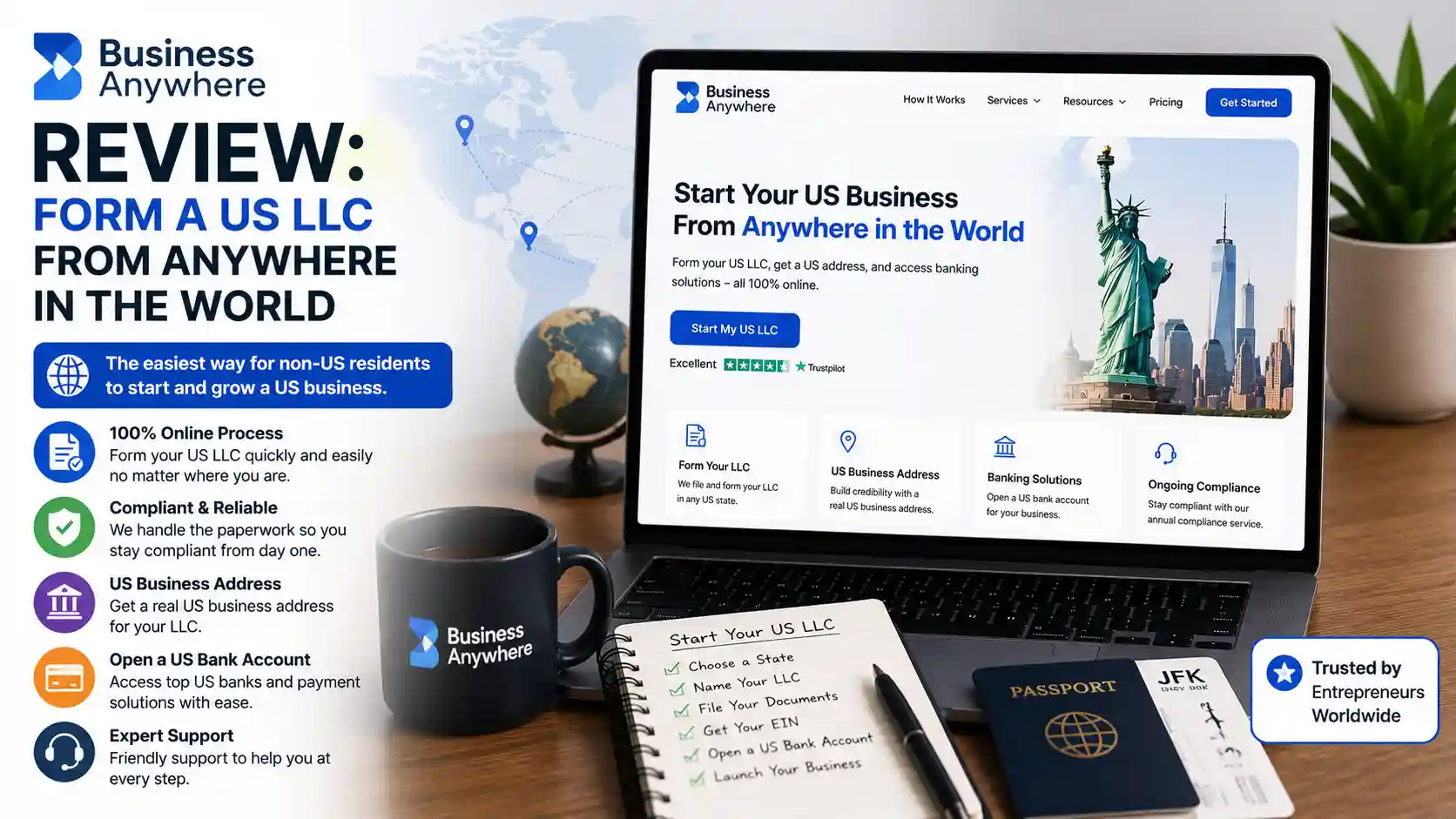
| Premium non-resident bundles (doola, Business Anywhere) | $299-$500+ | Lowest – banking introductions bundled | Founders who want concierge onboarding; compare in our doola review and Business Anywhere review |
For a fuller market comparison including current non-resident eligibility, see our roundup of the best LLC formation services for non-US residents.
Common Mistakes South African Founders Make (and How to Avoid Them)
❌ The mistakes
- Forming in California/New York “because it’s famous” and inheriting $800/yr or publication costs
- Skipping Form 5472 because “I owe no US tax” → $25k penalty exposure
- Forgetting to claim the US-SA treaty on W-8BEN → paying 30% withholding you didn’t owe
- Letting the registered agent lapse → administrative dissolution → frozen bank account
- Running LLC revenue through a personal Standard Bank/FNB/Absa account → pierces the liability shield
- Applying for the EIN twice out of impatience → duplicate EINs
- Ignoring SARS worldwide-income rules because “the money stays in the US”
- Exceeding SARB allowances (R1m SDA / R10m FIA) without a Tax Clearance Certificate
- Financially emigrating without planning the SARS exit charge on the LLC interest
✅ The fixes
- Default to WY / NM for cost, DE only for fundraising
- Diary the 5472 from day one; budget a preparer
- Complete W-8BEN with the treaty article + SARS TIN to claim reduced withholding
- Auto-renew the registered agent on the same card as your domain renewals
- Open Mercury/Relay/Wise immediately after EIN; invoice only from the LLC
- File SS-4 once, track the fax, wait the window out
- Engage a SA tax practitioner (SAIPA/SAICA) before your first owner draw
- Track outward payments against your SDA/FIA; get a TCS above R1m
- Model the exit charge before ceasing SA tax residency
Use Cases: Who Benefits Most in South Africa?
- ☐ Choose state (WY default / DE for fundraising / NM for minimum cost)
- ☐ Search & reserve your LLC name (must end LLC / Limited Liability Company)
- ☐ Order formation via Northwest ($39 + state fee) with registered agent bundled
- ☐ Receive stamped Articles of Organization + agent confirmation
- ☐ Sign operating agreement (keep with records, don’t file)
- ☐ File Form SS-4 by fax/mail for EIN (or use the paid add-on)
- ☐ Open Mercury / Relay / Wise Business account with EIN + docs
- ☐ Set up invoicing + W-8BEN with the US-SA treaty claim for US clients
- ☐ Diary: state annual report, agent renewal, Form 5472 (April 15), SARS ITR12
- ☐ Track outward payments against SDA/FIA; obtain a SARS TCS above R1m
- ☐ Book a SA tax practitioner session before your first owner draw
- ☐ If you want international SEO traction for your LLC-branded site, see our free-backlinks playbook
FAQs: Forming a US LLC from South Africa
Can a South African citizen 100% own a US LLC?
Do I need a US visa, SSN or ITIN?
Which state is best for someone living in Cape Town, Johannesburg or Durban?
How much does it cost in total for year one?
How long does the whole process take?
Does South Africa have a tax treaty with the US?
Will I pay US income tax while living in South Africa?
Do I still pay SARS on my LLC income?
What about SARB exchange control when paying US fees?
Can I open a US business bank account without travelling?
What happens if I financially emigrate later?
Does owning a US LLC help me move to the US?
What happens if I forget the annual report or registered agent renewal?
Final Thoughts: Is a US LLC Worth It for South African Founders?
For South African developers, fintech and mining consultants, creators and SaaS builders selling to US and global markets, a US LLC remains one of the highest-leverage administrative upgrades available: ~$139 to start in Wyoming, 1-3 days to exist, and a payments + currency-hedge + credibility stack that ZAR-bound personal rails simply cannot match. South African founders also hold a rare advantage most of the continent lacks – a 1997 US income tax treaty that lets you claim reduced withholding on US-source income via a correctly completed W-8BEN.
The obligations are real but finite – a registered agent, an annual report, one IRS information return, SARB exchange-control discipline, and honest SARS worldwide-income planning (including the exit charge if you ever financially emigrate). Do it in the right order (entity → EIN → bank → invoicing → compliance calendar), claim the treaty you’re entitled to, avoid the $25,000 Form 5472 trap, and the LLC becomes quiet infrastructure that pays for itself with the first US contract it unlocks.
Sources & Research Notes
All fees and rules verified September 2026 against the primary sources below. State fees, IRS procedures, SARB exchange-control allowances and SARS rules change – confirm live before filing.
- US Census Bureau, Business Formation Statistics – annual US business applications exceeding 5 million since 2021.
- IRS – Form SS-4 instructions (EIN application; foreign applicant fax/mail routes; $0 cost) and IRC §6038A / Form 5472 penalty provisions ($25,000 per violation); official Form 5472 guidance at irs.gov.
- FinCEN – Beneficial Ownership Information interim final rule (2025): domestic reporting companies exempt; foreign-formed registrants remain in scope.
- US Department of the Treasury / IRS – United States-South Africa Income Tax Treaty (1997): dividends article (5%/15%), interest and royalties articles, Limitation-on-Benefits article, and relief-from-double-taxation provisions.
- IRS – Publication 515 (Withholding of Tax on Nonresident Aliens and Foreign Entities) – default 30% withholding on US-source FDAP income absent a treaty claim.
- South African Revenue Service (SARS) – residence-based worldwide-income taxation, foreign tax credits, Tax Clearance Certificates, and ITR12 filing; sars.gov.za.
- South African Reserve Bank (SARB) – exchange-control framework: Single Discretionary Allowance (R1m/yr) and Foreign Investment Allowance (up to R10m with TCS); resbank.co.za.
- CIPC (Companies and Intellectual Property Commission) – South African (Pty) Ltd registration framework.
- Wyoming Secretary of State – LLC filing fee ($100) and annual report licence tax (minimum $60).
- Delaware Division of Corporations – LLC formation fee ($90), $300 annual franchise tax; entity counts and Fortune 500 incorporation statistics.
- New Mexico Secretary of State – $50 LLC filing fee; no annual report requirement for LLCs.
- Florida Division of Corporations (Sunbiz) – $125 formation ($100 articles + $25 registered agent designation); $138.75 annual report.
- Texas Secretary of State – $300 LLC formation fee; Comptroller franchise-tax no-due threshold (~$2.47M).
- California FTB / SOS – $70 formation, $800 minimum annual franchise tax, $20 biennial statement of information.
- Nevada Secretary of State – initial fees ($75 articles + $150 initial list + $200 business licence) and annual renewals.
- Northwest Registered Agent – published formation pricing ($39 + state fee) and registered-agent renewal pricing ($125/yr).