How to Form a US LLC from Tunisia
A founder in Tunis, Sfax, Sousse or Djerba can form a US limited liability company without moving to America. The real work is choosing the right state, documenting ownership, obtaining an EIN, finding a bank that accepts Tunisian residents, and meeting tax and foreign exchange rules on both sides. This guide walks through those decisions and every screen in the supplied Bizee formation flow.
Quick Answer: How to Form a US LLC from Tunisia
A Tunisian resident may generally own a US LLC without a US visa, Social Security number or US co-owner. Choose a state, check the company name, hire a registered agent in that state, and file the LLC’s formation document. After approval, sign an operating agreement, request a free EIN from the IRS, apply for suitable business banking and organize annual compliance.
Do the Tunisia-specific work first: confirm how Tunisian foreign exchange rules apply to funding and owning a company abroad, and how Tunisia will tax your actual activity. Tunisia and the US have an income tax treaty, but treaty benefits depend on tax residence, beneficial ownership, income type and documentation. A US LLC is neither an automatic tax exemption nor a guaranteed path to a US bank account.
For a one-owner LLC held directly by a Tunisian nonresident of the US, the default US federal income tax classification is generally a disregarded entity. The owner may still have US tax on certain US income, and the LLC may have Form 5472 information reporting when it has reportable related-party transactions. Start a transaction ledger on the day the company is formed.
Table of Contents
- Why consider a US LLC?
- Eligibility and legal basics
- Choosing a US state
- Formation and ongoing costs
- What to prepare
- Bizee step-by-step walkthrough
- Getting an EIN
- Business banking and payments
- US tax and Form 5472
- How the tax treaty works
- Tunisian tax and exchange controls
- BOI, privacy and records
- Compliance calendar
- DIY versus formation service
- Examples and mistakes
- Master checklist
- Frequently asked questions
- Final decision guide
Why a Tunisian Founder Might Form a US LLC
A US LLC can serve a real commercial purpose for a Tunisian freelancer, agency, software company or online seller. It gives foreign clients a familiar contracting entity, makes some vendor and marketplace applications possible, and separates company contracts from an individual’s personal affairs. If the business genuinely needs a US entity, the LLC can be a compact way to obtain one.
The benefit depends on what you intend to do. Some platforms accept a US entity only if its owners live in supported countries; others ask for a genuine US operating address, not merely an agent’s address. A bank may reject the owner or business category after the LLC is fully formed. Verify the exact provider’s current policy before spending money. The US certificate alone does not turn a Tunisian operation into a US operation or remove local obligations.
For a wider view, read our Africa formation guide. If you work across the Maghreb, the Algeria and Morocco editions show why neighboring countries’ currency and tax rules must be researched separately.
Can Someone in Tunisia Legally Own a US LLC?
Generally, yes. US states do not ordinarily require an LLC member to be a US citizen or resident. A sole Tunisian owner can hold all membership interests. Forming and remotely owning the LLC does not, by itself, require a US visa. It also does not grant permission to work in the United States. A registered agent with a physical address in the state is required even if all owners remain in Tunisia.
| Term | Plain-English meaning | Why it matters for a Tunisia-based owner |
|---|---|---|
| Articles or certificate of organization | The document accepted by the state to create the LLC. | Save the stamped document for banking and tax records. |
| Registered agent | An in-state recipient of legal and official papers. | Your Tunis address cannot replace a Wyoming, Delaware or New Mexico agent. |
| Operating agreement | Private rules for owners, managers, decisions and distributions. | Banks often request one even for a one-member company. |
| EIN | The LLC’s federal employer identification number. | The IRS issues it free; most banks request it. |
| Disregarded entity | Default US income tax classification for a one-member LLC. | For income tax, the owner is generally treated as earning its activity directly. |
| Foreign qualification | Registration in another US state where the LLC does business. | May be needed if the real US business is outside the formation state. |
There is a separate immigration point: the US State Department lists Tunisia as an E-2 treaty country. That can be relevant to a qualifying investment and visa application, but merely registering a low-cost LLC is not an E-2 visa strategy. Investment, ownership, operation and other visa conditions require their own review.
Which State Should You Choose?
Start with where the company will actually operate. A warehouse, staff, office or regular physical activity in a state may create registration and tax duties there even if the LLC was formed elsewhere. If you will manage a remote service business from Tunisia and have no US operating location, a short list is easier to compare than all 50 states.
| State | State filing fee | Routine state maintenance | When it can fit |
|---|---|---|---|
| New Mexico | $50 | No routine LLC annual report under current rules. | Small remote business prioritizing low state charges. |
| Wyoming | $100, plus any online payment charge. | Annual report and license tax of at least $60; higher with sufficient Wyoming assets. | Founder who prefers its established LLC filing system and can manage the annual report. |
| Delaware | $110. | $400 annual LLC tax due June 1; no Delaware LLC annual franchise-tax report. | Investors or counsel have a specific reason for Delaware. |
These are state government charges, not Bizee or agent prices. The Wyoming filing form and annual report guidance, New Mexico business portal, and Delaware’s filing fee schedule and annual tax page are the sources. Check the live state portal before ordering.
Column chart: state LLC formation fees in US dollars
Official filing charges cited above. Agent, service and payment charges excluded.
Horizontal bar chart: minimum annual state charge
Minimum routine state charge only; every LLC still needs a registered agent.
Wyoming or New Mexico can be sensible for a remote solo founder, but neither state guarantees bank access, privacy from authorities, or freedom from taxes in Tunisia. Delaware’s legal system matters in some investor transactions, yet it is usually a costly default for a small consulting business. Read our LLC privacy guide before relying on public-record differences.
How Much Does a US LLC from Tunisia Cost?
Budget for the entire operating year, not only the state certificate. A formation package can include an introductory registered-agent term, but renewals and optional add-ons vary. Applying directly for an EIN costs $0. Professional cross-border tax advice may be more expensive than formation, especially if the LLC has multiple owners, a Tunisian company as parent, US inventory or significant related-party transactions.
| Cost | When due | How to budget | Required? |
|---|---|---|---|
| State filing | At formation | $50 NM, $100 WY or $110 DE in the comparison. | Yes. |
| Registered agent | Usually yearly | Get the live first-year and renewal quote. | Yes. |
| Bizee formation package | At order | Use the current checkout total; package offers change. | No; direct filing is possible. |
| EIN application | Once | Free if submitted directly to the IRS. | Usually needed in practice. |
| State annual charge | After formation | Depends on the state; compare the chart above. | Where applicable. |
| Tax preparation | As filings require | Request a quote that names the forms included. | Depends on facts; often prudent. |
| Tunisian legal, tax and exchange advice | Before funding and as activity changes | Ask about outward investment, receipts and local business status. | Prudent when resident in Tunisia. |
Donut chart: illustrative $200 Wyoming startup budget
Planning example only, not a Bizee offer or agent quote.
Line chart: three-year state-only minimum cost
Model begins at formation and adds one state charge in each later year. Actual Delaware assessment timing depends on formation year. Agent, service, taxes and other states excluded.
Compare the current Bizee checkout before you commit.
Confirm state filing, package price, registered-agent term and every optional service.
View Bizee formation options →What to Prepare Before Filing
A name search is the start, not the whole preparation. Write down what the company will sell, where customers are, where work will be performed, and how funds will move. This makes state choice, bank screening, tax classification and Tunisian exchange review much easier. If you already operate a Tunisian company, decide whether that company or you personally will own the US LLC; the answer affects ownership evidence and tax treatment.
- Passport and true residential address for each beneficial owner and manager.
- Two or three name choices including “LLC” or another state-approved suffix.
- Ownership percentages, manager or member management, and signing authority.
- A concise description of products or services, expected customer countries and payment flows.
- A registered agent in the chosen US state, including renewal terms.
- An email and phone you monitor from Tunisia and a legitimate payment method for fees.
- Questions for a Tunisian bank or adviser about outward investment, company funding and foreign-currency receipts.
Check the name with the state and search for conflicting trademarks separately. A state may approve a company name that still infringes another company’s brand. Build an operating agreement even for a sole owner; it records ownership and who can sign. Use consistent spellings across the state filing, passport, IRS application, contracts and bank application.
What the registered agent does
The registered agent receives official and legal papers at an address in the state of formation. This is not a general substitute for your Tunisian residence or operating address. Some services offer mail scans or forwarding; check which documents are included. If the service lapses, you can miss a lawsuit or state warning. Calendar renewal and keep the agent informed of your actual contact details.
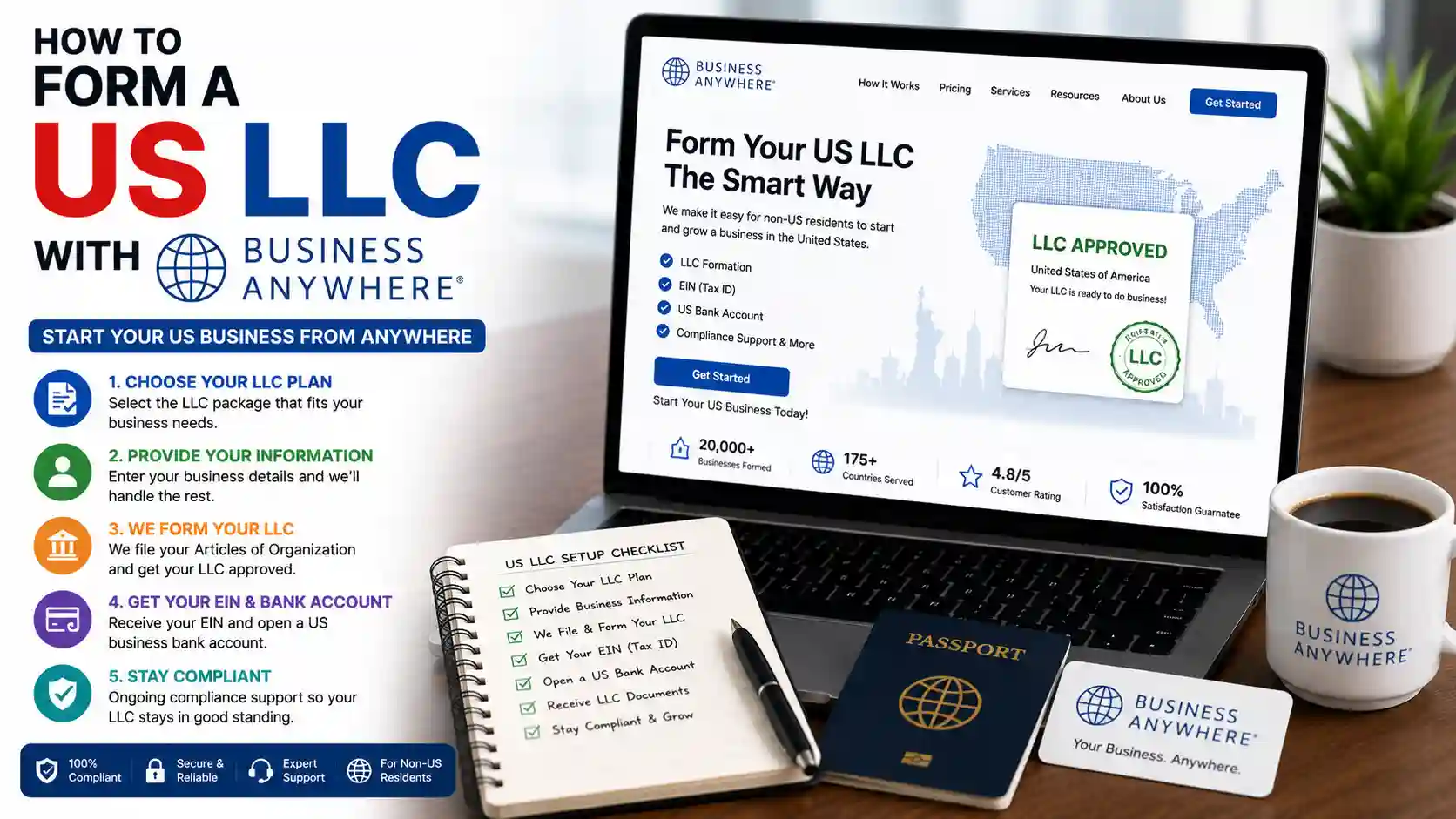
How to Form a US LLC from Tunisia with Bizee: 14 Screens
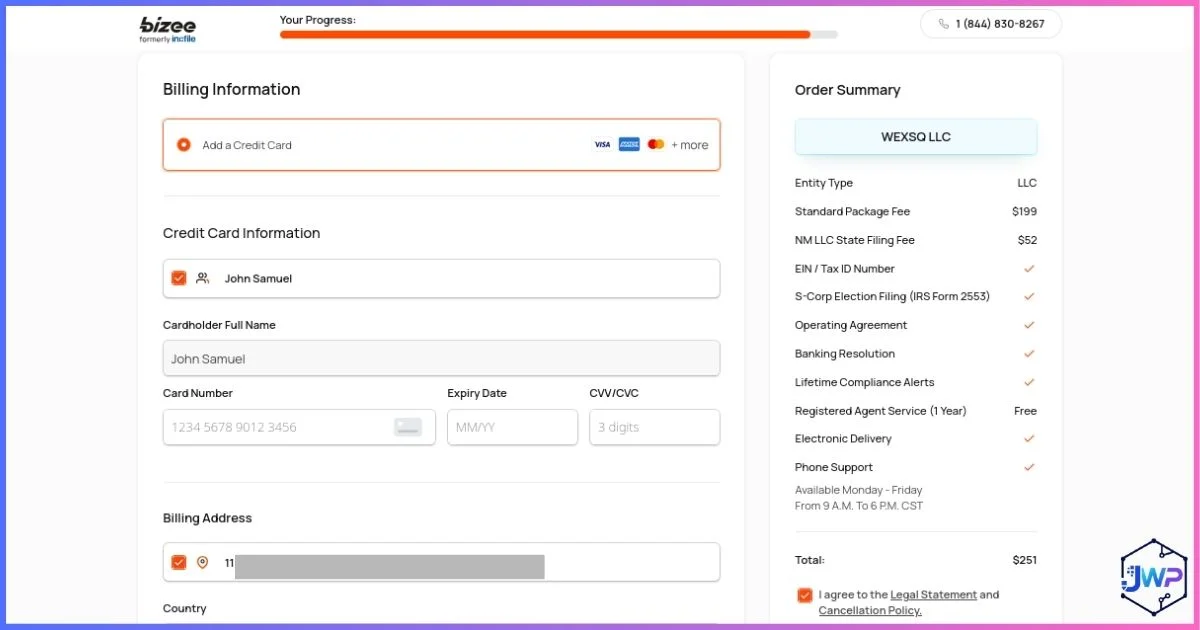
The following screenshots supplied for this project illustrate the Bizee ordering sequence. Packages, screen wording, government fees and provider eligibility may change. Read the live order carefully; this walkthrough does not quote a guaranteed Bizee price or promise approval. Filing directly with a state remains an option.
Select entity type and state
Choose an LLC and the state based on real operations and long-term costs. If you will maintain a US warehouse or staff, ask about registration there rather than choosing another state purely for a low filing fee.

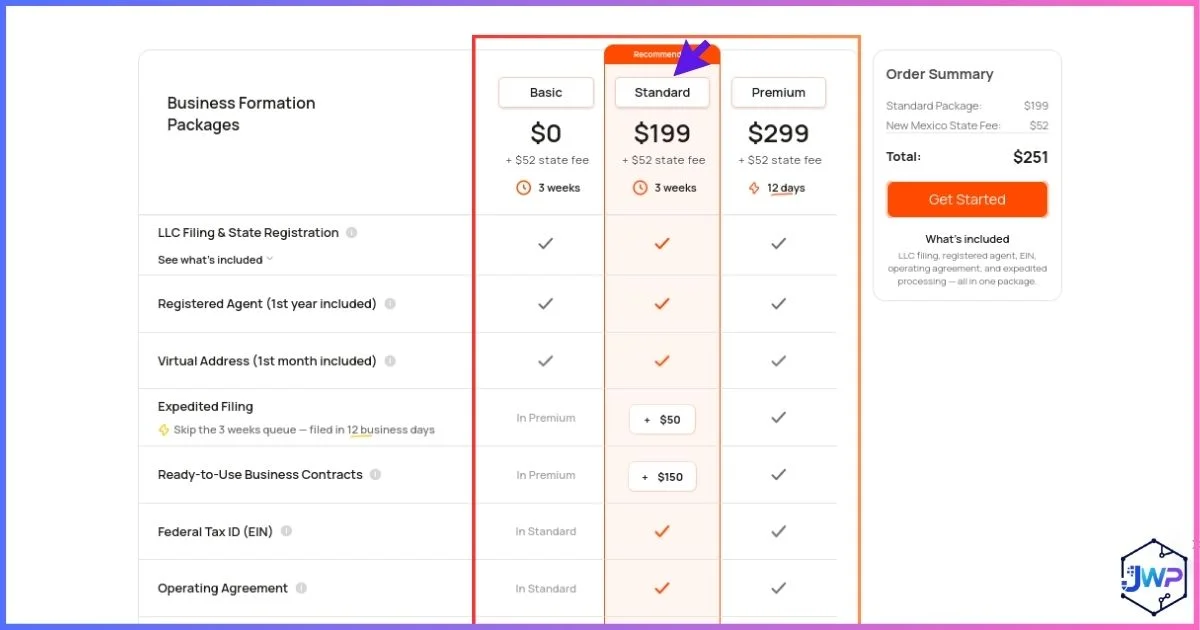
Compare formation packages
Note the government filing fee, provider fee, registered-agent term, renewal rate and optional items. A package price at the top of the page may not equal the final checkout total.
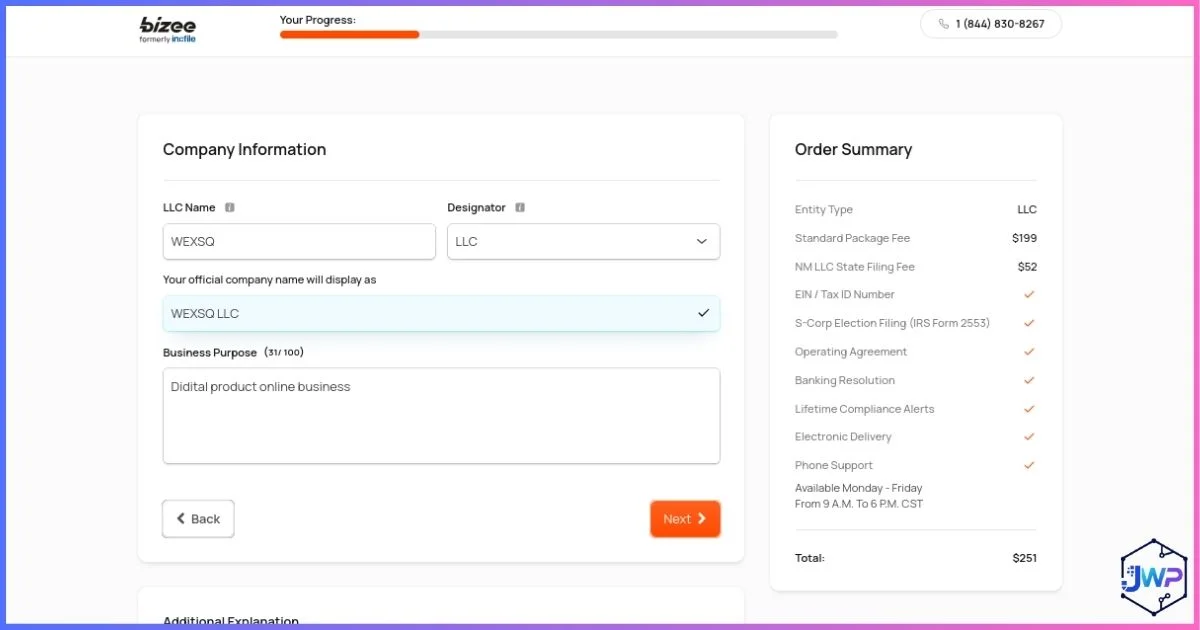
Enter the legal company details
Use the name spelling you checked with the state. Describe the activity plainly and truthfully. A bank may later compare this description with your website, client contracts and invoices.
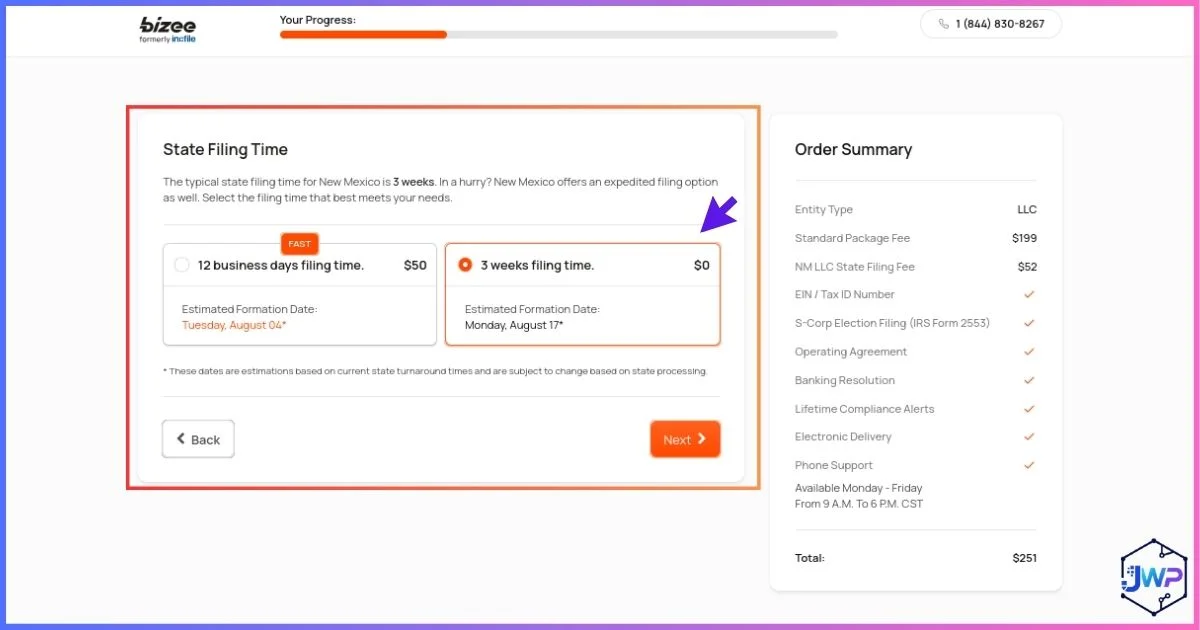
Choose filing speed
Standard state processing may be enough. Expedited formation does not speed up the IRS EIN application or a bank’s due diligence, so purchase it only for a genuine business deadline.
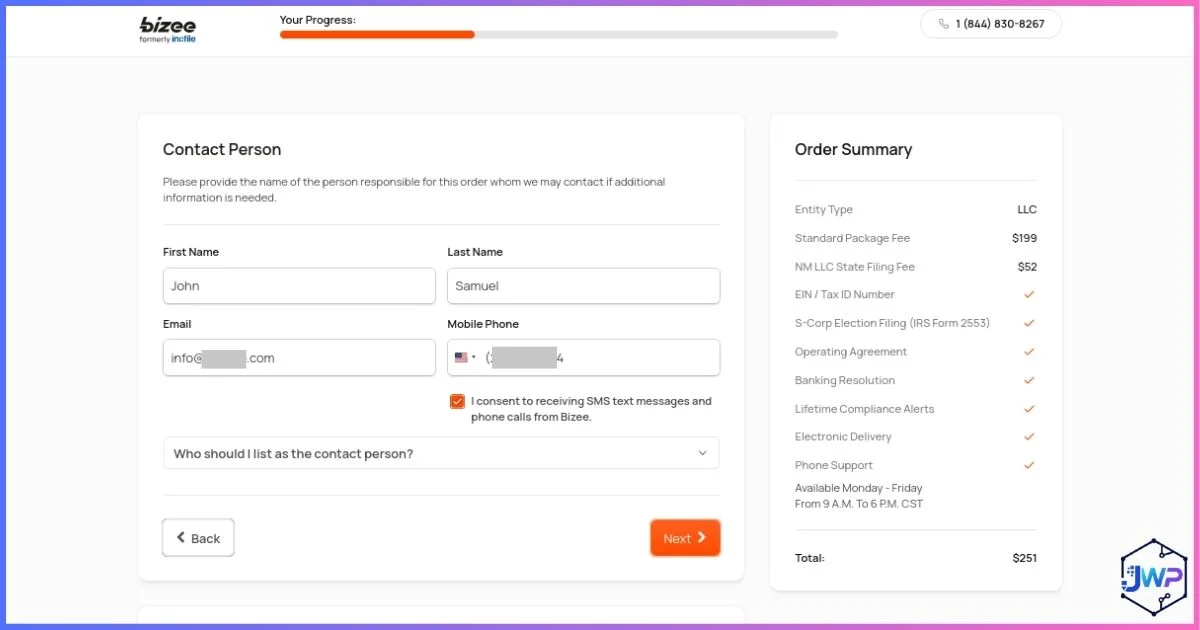
Add a contact person
Use an email and phone that work from Tunisia and check them daily until approval. A rejected name or incomplete filing may require a quick response.
Give truthful address information
Separate the agent’s statutory address, your real Tunisian operating address and any mailing address. Do not represent the agent’s office as your own workplace to satisfy a bank application.
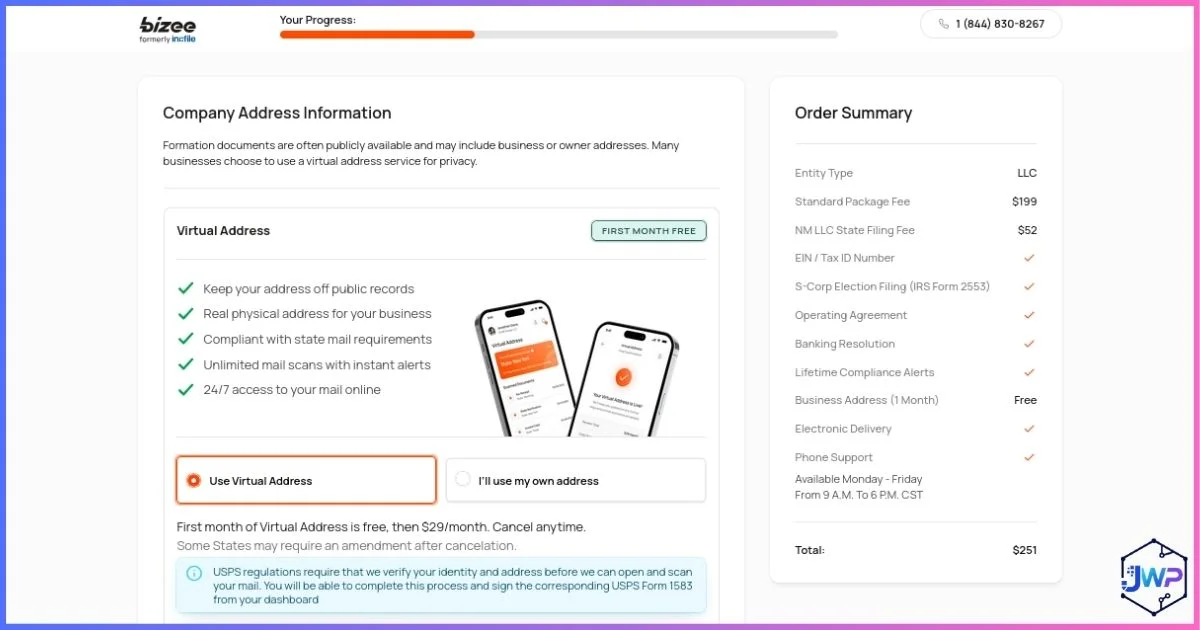
Identify members and managers
List the actual owner or owners and their interests. If a Tunisian company will own the LLC, do not silently substitute its director as the personal owner. Prepare the corporate ownership chain for later bank checks.
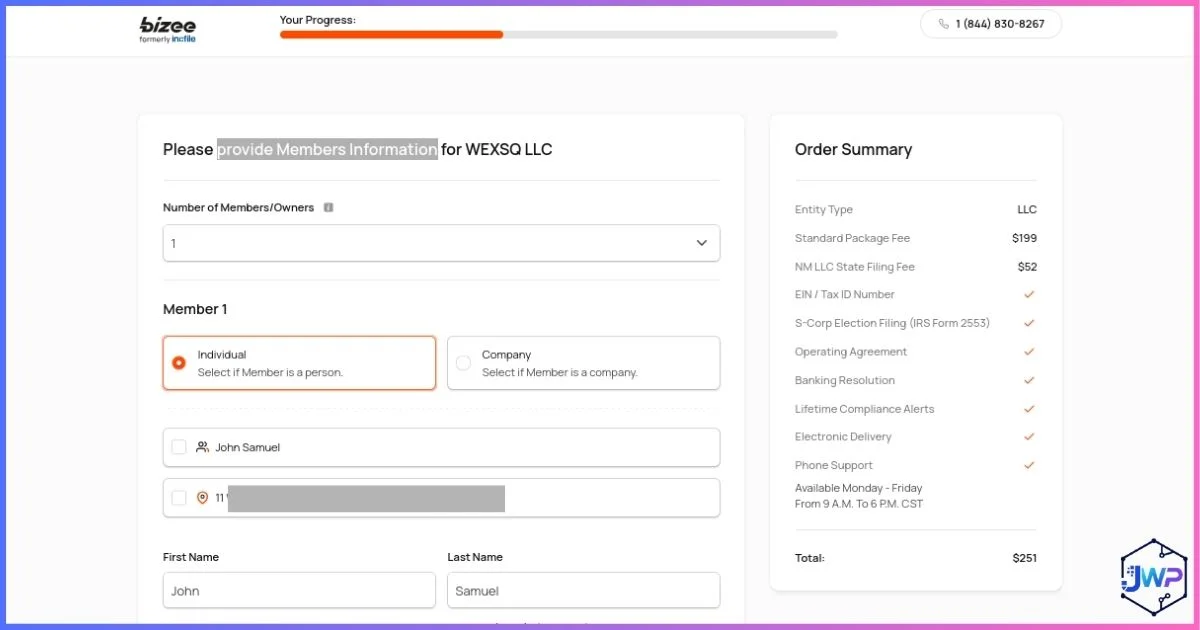
Confirm the registered agent
Choose Bizee’s agent or another qualified in-state provider. Check how legal notices arrive, whether scanned mail is included and when the annual charge renews.
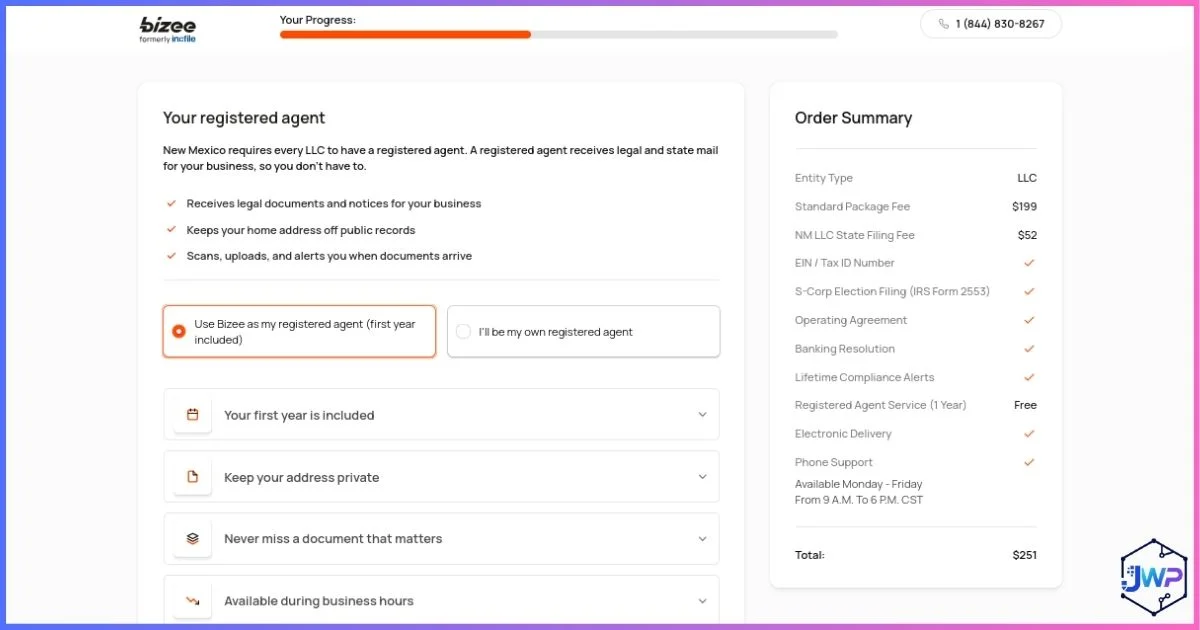
Decide whether to buy EIN help
The IRS issues an EIN at no charge. A provider may charge for preparing or transmitting the request. If you use the service, confirm the legal name and responsible party before it submits.
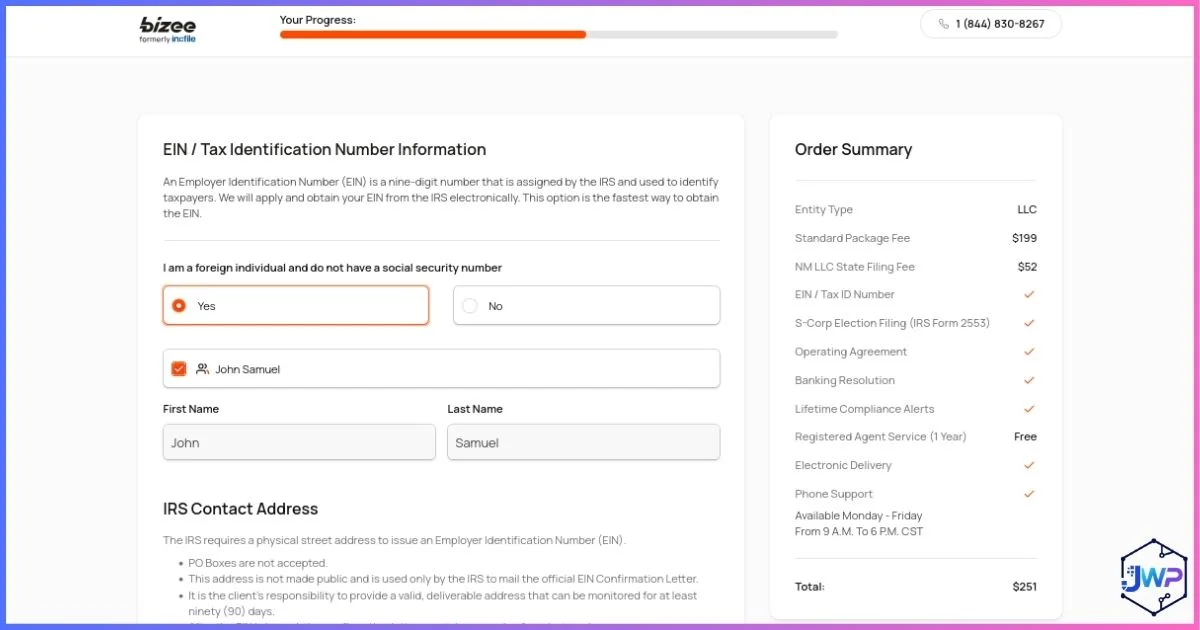
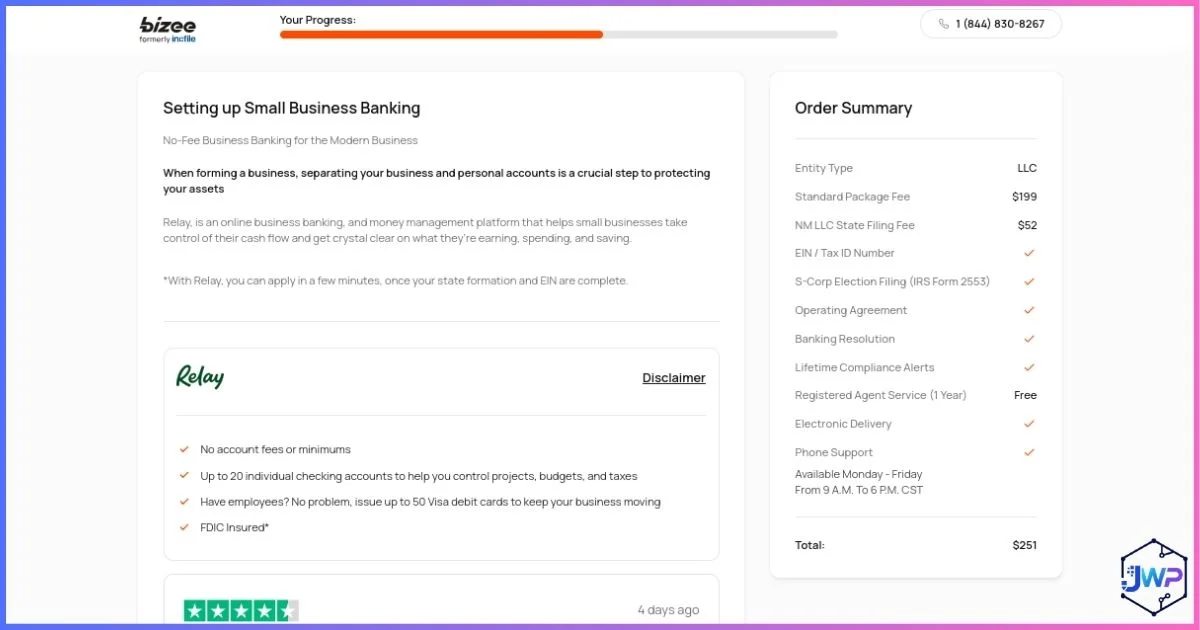
Consider banking after eligibility checks
A banking offer is not an account approval. Confirm whether the partner serves owners resident in Tunisia and accepts your activity, expected payment corridors and true operating address.
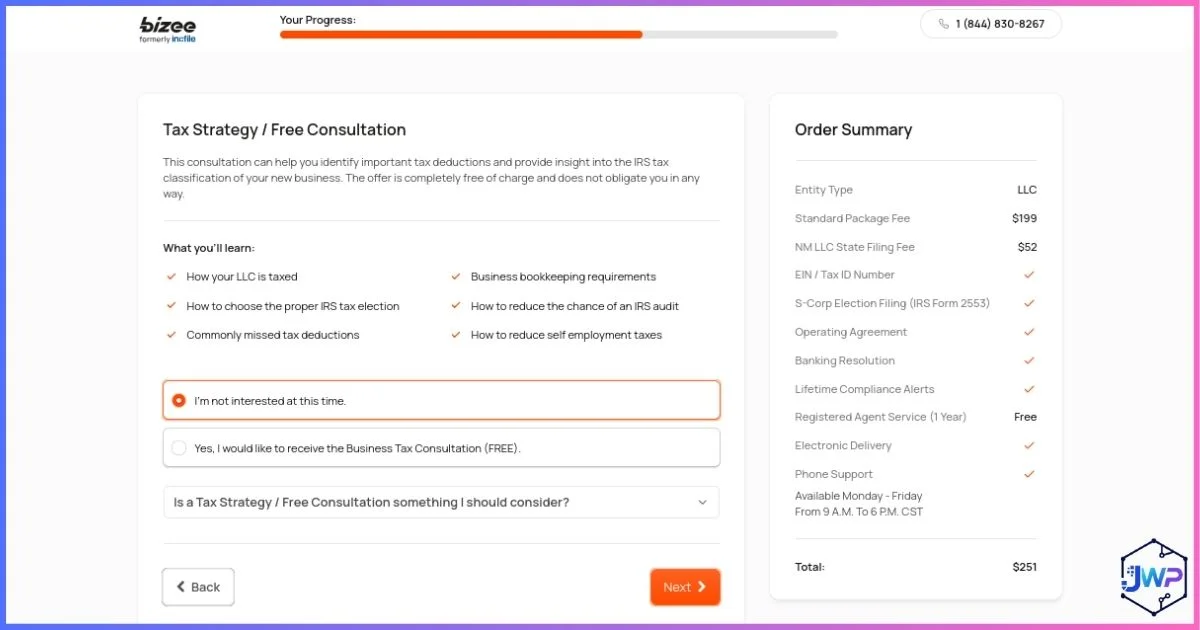
Evaluate the tax consultation
Ask whether the adviser knows foreign-owned disregarded LLCs, Form 5472, US–Tunisia treaty documentation and Tunisian tax residence. A generic US small-business call may not address those issues.
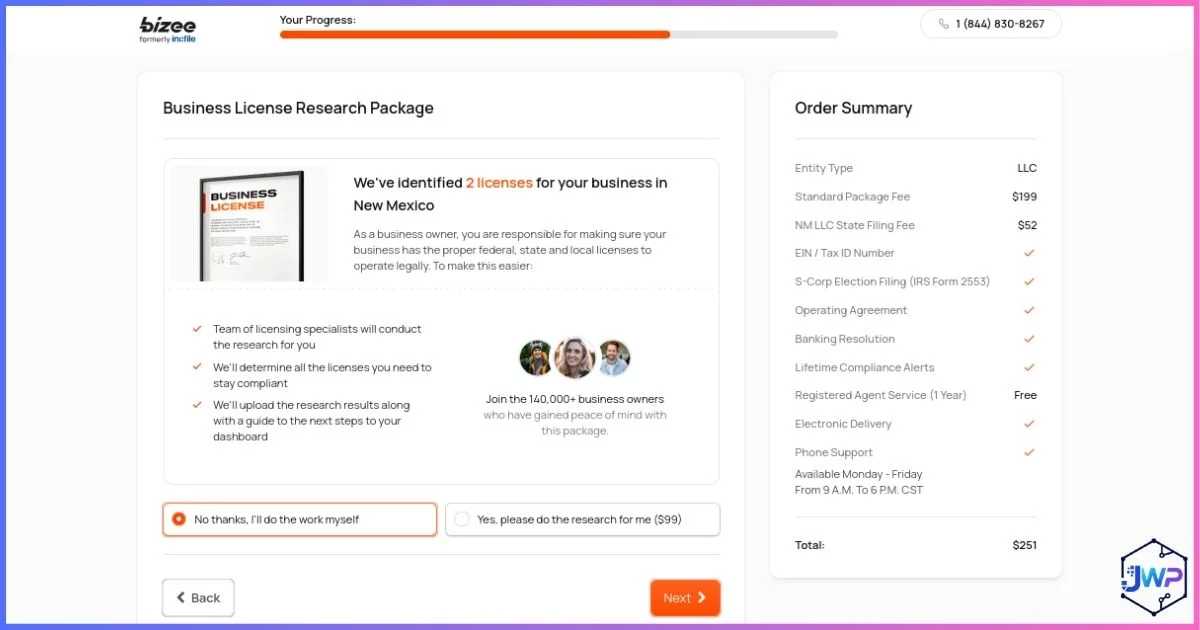
Review license research
US state formation does not replace professional permits, local Tunisian registration or US sales-tax analysis. An optional research package is valuable only if it covers the actual industry and jurisdictions.
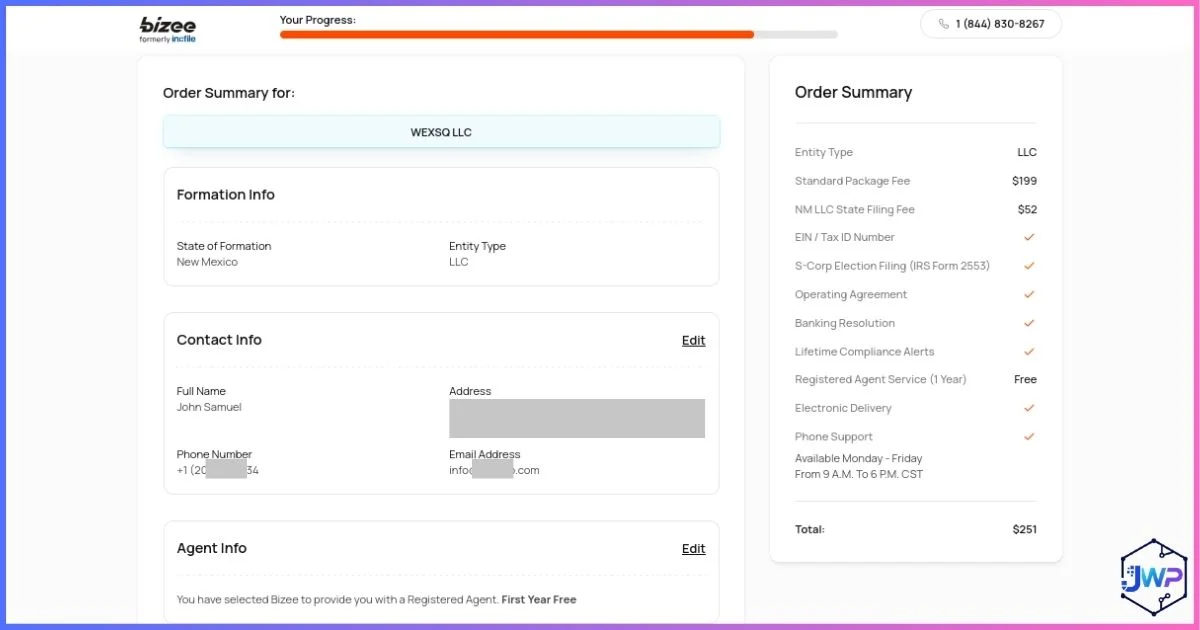
Audit the order summary
Review name, state, members, filing speed, agent term, added services, recurring subscriptions and total due. Save the summary and correct errors before paying.
Pay, then wait for state acceptance
Keep the receipt. The LLC exists when the state accepts the filing, not merely when the provider accepts payment. Download the approved certificate, operating agreement and agent information into a permanent folder.
Getting a Free EIN Without an SSN
An Employer Identification Number identifies the LLC to the IRS and is commonly needed for banking. It is not a personal Social Security number, visa or tax-residence certificate. The IRS does not charge to issue it. Wait until the state approves the LLC, then copy the legal name and formation date precisely onto Form SS-4.
- Identify the real responsible party who controls the entity. Do not enter a nominee just to supply a US address or number.
- Check the LLC’s federal tax classification. A one-member foreign-owned disregarded entity requesting an EIN for Form 5472 has special wording for line 9a in the IRS instructions.
- If the responsible party has no SSN or ITIN and cannot obtain one, follow the current IRS instructions for line 7b rather than inventing a number.
- Use an eligible international application method. The IRS online assistant has restrictions; international applicants may be directed to telephone, fax or mail.
- Keep a copy of Form SS-4 and the IRS confirmation. Ask the IRS about status if its published timeframe has passed; avoid duplicate requests.
Consult the IRS EIN page and Form SS-4 instructions for the current method, phone number and fax details. A paid service can assist with paperwork, but the IRS number itself remains free. Do not pay a company claiming a fee is mandatory for government issuance.
Opening Banking and Payment Accounts
A US LLC and EIN are useful documents for an account application, but the financial institution decides whom it can serve. It may ask about Tunisian residence, source of funds, expected monthly volume, counterparties, website, products and ownership chain. An application may be declined because of the provider’s country policy even when the LLC is lawful. Check the bank’s published eligibility and ask specific questions before making its account a dependency for your launch.
| Document | What it shows | Preparation point |
|---|---|---|
| Approved state filing | The LLC legally exists. | Use the stamped or official copy. |
| EIN confirmation | The IRS assigned an identification number. | Save the official letter or accepted confirmation. |
| Operating agreement | Membership and signing authority. | Ensure it matches the actual owner or parent company. |
| Passport and address proof | Beneficial owner identity and residence. | Use current, readable documents from your real address. |
| Website, contracts and invoices | Commercial activity and payment purpose. | Make activity descriptions consistent across documents. |
| Parent-company documents, if relevant | Ownership through a Tunisian company. | Prepare registrations and the chain to natural-person owners. |
Never describe the registered agent’s address as your own office or invent a US partner to pass onboarding. The bank may accept that address for legal notices but still require the actual Tunisian operating and residential addresses. Keep business receipts separate from personal money and document transfers from the company to yourself. A business account in the US also does not override Tunisian exchange-control obligations for a Tunisian resident.
Our guides to Wise and Payoneer explain possible payment tools. Their residence-country and product availability changes, so check live terms for Tunisia before applying.
US Tax Rules for a Tunisian-Owned LLC
The legal LLC and its US federal income tax classification are separate questions. A one-member LLC is generally disregarded unless it elects corporate treatment. A two-member LLC generally defaults to partnership treatment. A US citizen or US tax resident who lives in Tunisia may be taxed very differently from a nonresident Tunisian owner; see our US citizen guide if that describes you.
Services: where the work is performed
The IRS generally sources personal-service income where services are physically performed. For example, a Tunisian nonresident owner who writes software in Sfax for a client in California generally earns foreign-source service income for US purposes. The client’s nationality, contract signature location and US bank deposit do not by themselves change the source. If the founder travels to California to perform part of the work, the US portion needs separate analysis. See the IRS source-of-services guidance.
Do not apply the services rule to every revenue stream. Royalties are often sourced where intellectual property is used; rent follows property location; goods and inventory have their own sourcing rules. A US office, employee, inventory or agent can create a US trade or business or state nexus. US-source effectively connected income, passive income and foreign-source service income are not taxed the same way. Ask a US cross-border preparer to classify each meaningful income stream rather than declaring all LLC revenue US-free.
| Example | Key facts to establish | Potential issue |
|---|---|---|
| Designer works solely from Tunis for US clients. | Location of each service and any US business presence. | Foreign-source service treatment may apply; Tunisian tax still needs review. |
| Consultant visits New York for billable work. | Workdays and revenue attributable to US activity. | US-source or effectively connected income and filing may arise. |
| LLC sells inventory stored in Texas. | Warehouse, sales, employees and marketplace collection. | Federal, Texas and sales-tax duties may arise. |
| Owner receives US royalties or dividends. | Beneficial owner, source, treaty residence and documentation. | Withholding may apply at a treaty or statutory rate. |
Form 5472 and the pro forma Form 1120
A wholly foreign-owned US disregarded entity is treated as a separate reporting corporation for a narrow information-reporting purpose. If it has reportable transactions with related parties, including certain contributions, distributions or transfers with its owner, it generally files Form 5472 attached to a pro forma Form 1120. No sales or profit does not necessarily mean no reportable transaction. Conversely, the IRS instructions contain an exception when there are no reportable transactions at all.
The IRS Form 5472 instructions specify the special filing method and extension process. The initial penalty for a late, missing or substantially incomplete filing is $25,000; continued failure after IRS notice can generate further penalties. Use a preparer who specifically understands foreign-owned disregarded entities, and record every owner advance, reimbursement, loan and distribution as it happens.
Other US obligations
An LLC with two members, a corporate tax election, employees or US-source business activity can have different forms. State income taxes, annual franchise charges, sales tax, payroll and license rules may apply even when no federal income tax is due. Marketplace collection may handle sales tax on some transactions but not automatically on all sales. Do not register in a low-fee state and assume that it cancels duties in the state where customers, staff or stock create nexus.
The US–Tunisia Income Tax Treaty: What It Can and Cannot Do
The United States and Tunisia have an income tax treaty. That is a meaningful distinction from many countries in this series. The treaty can limit taxation of specified income and may provide reduced source-country withholding for an eligible Tunisian resident who is the beneficial owner. It does not automatically exempt all income flowing through a US LLC. A treaty claim requires the relevant article, actual tax residence, correct beneficial-owner form and any required conditions.
The IRS treaty tables list, for qualifying Tunisian residents, a general US dividend withholding rate of 20%, a special 14% direct-dividend rate in qualifying cases, and a general interest rate of 15%. The treaty text sets a 15% ceiling for many royalties, with distinctions for certain categories. These are maximum treaty source rates, not a menu to select without checking income type and eligibility. Some income can have a lower domestic-law rate or exemption.
Pie chart: illustrative $100 US-source dividend paid to an eligible Tunisian resident
Uses the IRS table’s general 20% Tunisia dividend rate for a qualifying recipient. Not an LLC distribution, tax return calculation or personal tax estimate.
An LLC distribution to its owner is not automatically a corporate dividend. A disregarded LLC generally passes its income character to its owner for US federal income tax purposes. A US corporation paying a dividend is a different transaction. That distinction matters when completing a W-8BEN for an eligible individual or W-8BEN-E for an eligible entity. Never provide a W-9 solely because the LLC is formed in America; the proper form depends on the payee’s US tax status and payment.
Tax treaties are usually about residents, not passports. A Tunisian citizen living in another country may not qualify as a Tunisian treaty resident. An entity owner may have additional residence and limitation-on-benefits questions. A disregarded LLC cannot simply claim every treaty benefit in its own name because it has US formation documents. Confirm how the underlying owner is treated in both countries. Treaties also do not replace state franchise fees, sales tax or Form 5472 reporting.
Tunisian Tax and Foreign Exchange Rules
The US entity does not erase activity conducted in Tunisia. The Tunisian Ministry of Finance’s tax overview says individuals habitually resident in Tunisia are subject to personal income tax and lists categories including business profits, professional income and certain foreign-source income not taxed in the source country. The classification of your US LLC, where the work occurs, and whether you also operate a Tunisian business all matter. A US “disregarded entity” label is a US tax concept; do not assume Tunisia automatically uses the same classification.
A consultant sitting in Tunis and serving US customers needs a Tunisian analysis even when the client pays a US LLC. A Tunisian company owning the LLC adds corporate, related-party and possibly permanent-establishment questions. The right answer can differ between an individual owner, a local company parent and a founder who has moved abroad. Ask a Tunisian tax adviser to trace the actual activity and ownership; do not rely on a blanket claim that foreign billing is exempt.
Outward investment, foreign currency and repatriation
Tunisian foreign exchange law is an important pre-formation issue. The Ministry of Finance regulatory list identifies the exchange and foreign-trade framework, including Law No. 76-18. Its published law text regulates cross-border payments and some obligations between residents. Applicable permissions, allowances and account rules depend on the transaction, current implementing rules and the founder’s status. US state permission to own an LLC is separate from Tunisian permission to fund an overseas investment or hold foreign-currency proceeds.
- May I, as a resident individual or Tunisian company, acquire and fund this US LLC under current rules?
- What approval or declaration is required before I send capital abroad or pay formation expenses?
- Which account may receive export-service proceeds or LLC distributions, and when must funds be repatriated or converted?
- What documents should explain each inward and outward transfer?
- How will salary, owner draw, loan repayment and corporate dividend be treated differently?
Answers can change with new circulars and the source of funds. Do not improvise around a blocked transfer through a friend’s account or mislabel an investment as an ordinary purchase. Keep the approved payment route and documentation with the LLC books. This is particularly important when planning to leave earnings in a US account or pay suppliers directly from that account.
Local registration, invoices and VAT
If the work is done in Tunisia, local business registration, invoicing, tax or VAT rules may apply regardless of the name on the US invoice. Confirm the correct Tunisian status for a freelancer, agency, software exporter or local company. Keep contracts showing who provides the service and where it is performed. The local tax treatment of services, software licenses and goods may differ, just as it does under US law.
Do not compare only the US and Tunisian headline income tax rates. Include bank costs, foreign exchange compliance, treaty documentation, annual state charges and the cost of preparing two sets of records. For nearby examples with different home-country law, see our Egypt guide.
Beneficial Ownership Reporting, Privacy and Records
As of this article’s September 2026 update, FinCEN says US-created companies are exempt from federal Corporate Transparency Act beneficial ownership information (BOI) reporting under its August 2026 final rule. A US LLC owned by a Tunisian person falls in the domestic-entity category. A Tunisian legal entity registering as a foreign company in a US state is a different structure and may need its own BOI analysis. Check FinCEN’s live BOI guidance if the rules change.
Exemption from that federal report does not mean anonymity. Banks, agents, tax authorities and some state filings can require ownership details. New Mexico or Wyoming public records are not substitutes for truthful identity documents. Keep the signed operating agreement, passport and ownership chain secure, and update the bank and authorities when owners or the responsible party change.
Separate company and personal expenses. Save invoices, contracts and payment records for each transaction. Mark transfers clearly as capital contribution, owner draw, loan, expense reimbursement, salary or other actual category; these labels affect US and Tunisian reporting. Our guide to paying yourself from an LLC explains the US-side concepts, but local Tunisian treatment still needs advice.
Your First-Year and Annual Compliance Calendar
State approval is the start of recordkeeping, not the finish line. Calendar deadlines from the actual formation date and the chosen tax year. Ask a US preparer to determine which federal returns are due; do not assume the same date applies to every classification. Ask a Tunisian adviser for local filing and exchange-control deadlines rather than copying another founder’s calendar.
| When | Task | Why it matters |
|---|---|---|
| Before funding | Confirm Tunisian outward investment and foreign-currency procedure. | Ownership and transfer permissions are distinct from US formation. |
| At state approval | Save certificate, operating agreement, owner records and agent contract. | Banks and preparers will ask for them. |
| After approval | Obtain EIN through the IRS; apply for eligible banking. | Banking is a separate review. |
| Monthly | Reconcile accounts and categorize owner or related-party transfers. | Supports Form 5472 and Tunisian records. |
| Before federal filing date | Assess Form 5472/pro forma 1120, owner return, partnership return or corporate return as applicable. | Different classifications require different forms. |
| Wyoming anniversary month | File annual report and pay at least the minimum license tax if formed there. | Protects good standing. |
| June 1 for Delaware | Pay the $400 annual LLC tax if formed there. | Annual tax applies even without a Delaware franchise-tax report. |
| Every year | Renew agent, review US state nexus, treaty documentation, Tunisian taxes and exchange rules. | Facts and rules change over time. |
If you later close the business, formally dissolve the LLC with the state, close accounts, satisfy tax and information returns, and ask a Tunisian adviser how to treat the liquidation proceeds. Abandoning an LLC can leave state charges, agent bills or filing duties running.
DIY Filing Versus a Formation Service
Direct filing can save a provider charge if the ownership is simple and you are willing to work through state forms, agent selection and deadlines. A service can organize a standard filing and document delivery. Neither option substitutes for a US tax preparer or a Tunisian exchange-control adviser. The extra help worth paying for depends on which task you cannot perform confidently.
Direct filing may fit when
- You have one individual owner and straightforward activity.
- You can complete the chosen state’s fields correctly.
- You have selected a reliable agent independently.
- You can maintain records and a deadline calendar.
Specialist advice is useful when
- A Tunisian company will own the LLC.
- You need to move capital abroad from Tunisia.
- US stock, staff, royalties or investors are involved.
- Treaty residence or tax classification is unclear.
Compare provider deliverables line by line: filing, approved documents, agent term, operating agreement, EIN assistance and renewal notices. Avoid purchasing an add-on whose scope does not cover Tunisia or your US state. A low-cost package is worthwhile only if you understand the recurring obligations it leaves with you.
Three Tunisia-to-US LLC Use Cases
Common mistakes to avoid
- Forming first, checking foreign exchange rules later: ask how the LLC will legally be funded and how money can return to Tunisia.
- Treating treaty rates as automatic: the recipient must qualify and supply the correct documentation for the particular income.
- Assuming every US customer payment is US-source: services are generally sourced where performed, while royalties, inventory and other items use different rules.
- Assuming no US income tax means no IRS form: owner contributions or distributions can make Form 5472 relevant even with little revenue.
- Using a registered-agent address as a fictional office: banks often request the actual operating address.
- Leaving the agent or state fee unpaid: loss of good standing can disrupt banking and contracts.
- Mixing personal and LLC money: this complicates accounting, tax and the legal separation you wanted.
- Copying a friend in another country: Tunisian treaty and exchange rules are not the same as those for Morocco, France or the UAE.
Ready to compare a formation package?
Check the current Bizee order total and registered-agent renewal terms alongside your Tunisian funding plan.
Review Bizee LLC options →Master Checklist for a Founder in Tunisia
- Write down where the owner lives, where services are performed and where customers, staff and inventory are located.
- Check banking and payment-provider eligibility for a Tunisian-resident owner and your industry.
- Ask a Tunisian professional or authorized bank how the proposed ownership, capital transfer and receipts comply with exchange rules.
- Confirm local Tunisian tax, registration, invoicing and VAT obligations.
- Choose a US state based on operations, fees and future plans.
- Check name availability and arrange an in-state registered agent.
- File accurately with the state or review the complete Bizee order before payment.
- Sign an operating agreement consistent with the real ownership chain.
- Obtain the free EIN using an eligible IRS method.
- Apply for banking with genuine identity and operating-address documents.
- Record all owner, parent-company and customer transactions from day one.
- Ask a US preparer to map Form 5472, income returns, treaty forms and state tax duties.
- Calendar agent, state, IRS and Tunisian deadlines.
Frequently Asked Questions: US LLCs from Tunisia
Can a Tunisian citizen own 100% of a US LLC?
Do I need a visa or a trip to America to form the LLC?
Can the LLC itself obtain an E-2 visa for me?
Do I need an SSN or ITIN for the EIN?
Which state is cheapest for a remote Tunisian founder?
Does a Wyoming LLC avoid all US state taxes?
Does the US–Tunisia tax treaty make LLC income tax free?
Can I claim a 20% treaty rate on every US payment?
Are services performed in Tunisia taxable in the US?
Must I file Form 5472 if the LLC has no sales?
Can I open a US business account entirely online?
Can I keep all customer revenue in a US account?
Does my US LLC have to file a federal BOI report?
What happens if I stop using the LLC?
Final Decision Guide
A US LLC can be a practical contracting and operational vehicle for a Tunisian founder whose clients or platforms genuinely need one. Begin with the commercial reason, payment-provider eligibility and the lawful route for investment and receipts from Tunisia. Then choose the US state, file accurate documents, obtain the free EIN and maintain separate books.
Tunisia’s US income tax treaty can be valuable for particular payments, but it requires the right owner, residence, income classification and documents. Keep US Form 5472, state renewals and Tunisian tax and exchange rules in the same annual plan. If a Tunisian company will own the LLC, or you expect US staff, stock, investors or royalties, obtain tailored advice before filing.
Review the formation costs in one place.
Check Bizee’s current package, government fee, agent renewal and optional services before completing the order.
Start reviewing Bizee options →Sources & Research Notes
Updated September 26, 2026. Official rules, state fees, banking eligibility and Tunisian exchange procedures can change. State charts use published charges. The budget donut and dividend pie are explicitly labeled examples, not provider quotations or surveys.
- Wyoming Secretary of State LLC filing form and annual report guidance.
- New Mexico Secretary of State business portal.
- Delaware Division of Corporations fee schedule and annual LLC tax instructions.
- IRS EIN guidance and Form SS-4 instructions.
- IRS Form 5472 instructions, filing conditions and penalties.
- IRS sourcing of personal-service income.
- US–Tunisia income tax treaty text and IRS treaty tables.
- Tunisian Ministry of Finance tax overview, exchange-law regulatory list, and published exchange-law text.
- FinCEN BOI reporting and August 2026 final rule.
- US Department of State E-2 treaty-country list.