How to Use Debt to Buy a Business and Build Wealth
The Rich Don’t Run From Debt — They Aim It at Assets
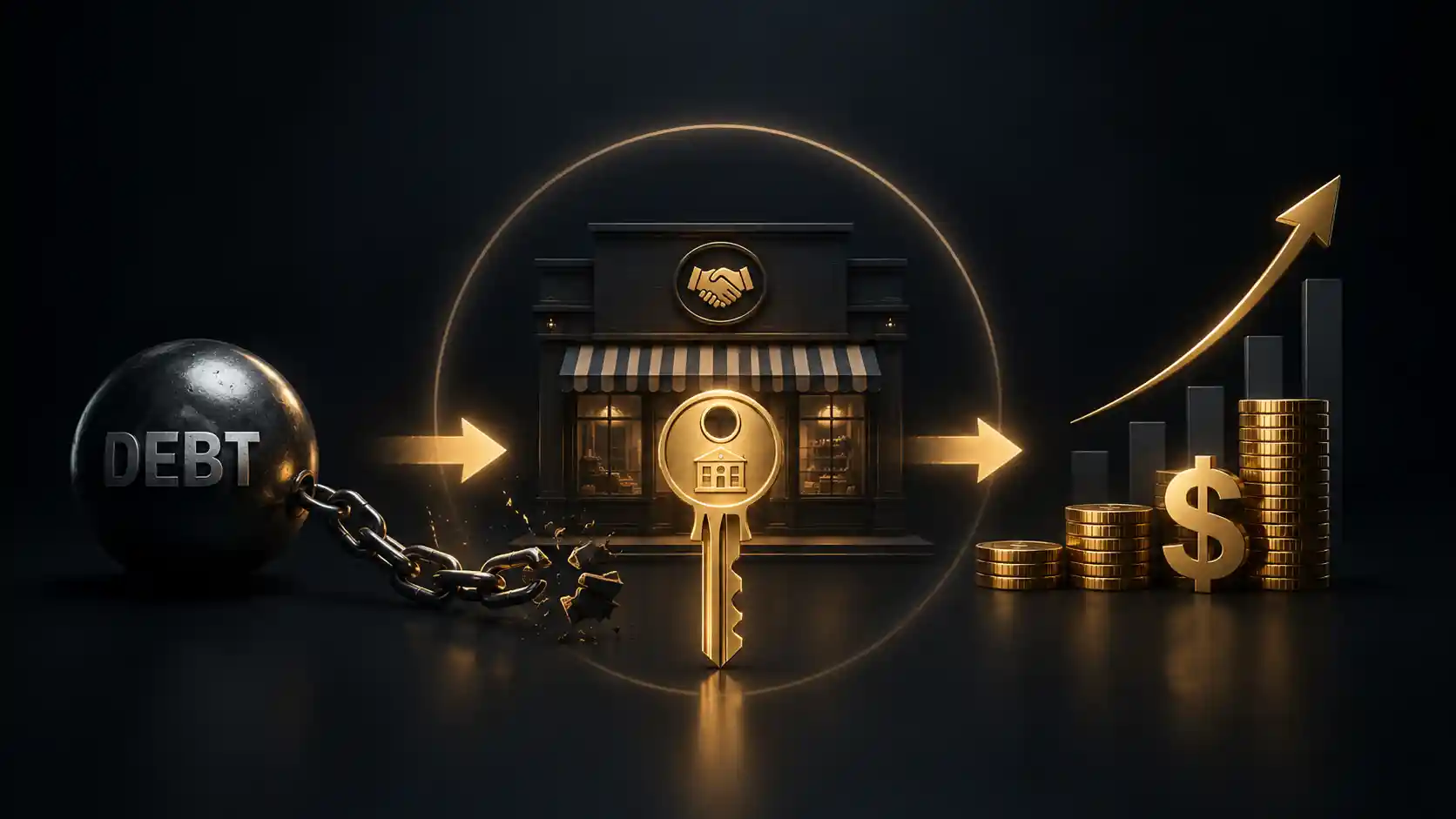
The average person carries roughly $108,000 in debt, while billionaires like Larry Ellison carry over $1 billion — and one balance destroys wealth while the other builds it. The difference isn’t the debt; it’s what the debt buys. This guide shows you exactly how to use debt to buy a business, borrow against assets, and deploy the same leverage playbook the top 1% use — securities-backed lines of credit, SBA 7(a) acquisition loans, seller financing, mortgage math, and credit-card float — plus the traps (margin calls, personal guarantees, 22% APR balances) that wipe out people who get it wrong.
Quick Answer: How to Use Debt to Buy a Business
The smartest way to use debt to buy a business is to put as little of your own cash at risk as legally possible while keeping the asset’s cash flow comfortably above the debt service. In practice that means: 10% down with an SBA 7(a) loan (or less when layered with a seller note), buying a business whose cash flow already covers the loan 1.3x+, keeping loan-to-value (LTV) at 20–30% when borrowing against securities, never carrying credit-card balances, and only borrowing when the asset’s growth or yield beats the interest rate. Debt used this way is a wealth accelerator; debt used to consume is a wealth tax.
📑 Table of Contents
- The debt paradox: same tool, opposite results
- Good debt vs. bad debt
- The data: why leverage builds wealth
- Strategy 1 — Borrow against assets (SBLOC)
- Strategy 2 — Buy, borrow, die
- Strategy 3 — SBA loans to buy a business
- Strategy 4 — Seller financing
- Strategy 5 — Mortgage math & the Augusta Rule
- Strategy 6 — Credit-card float
- The risks: margin calls, LTV & personal guarantees
- How to use debt to buy a business: step-by-step
- Entity, banking & tax setup
- Negotiation scripts & templates
- FAQs
- Sources & research notes
Why Debt Makes the Rich Richer and the Poor Poorer
Debt is a neutral tool, like a knife: it can carve a meal or cut a hand. The average household’s $108,000 of debt is mostly consumption debt — cars, cards, stuff that loses value the moment it’s purchased. Billionaires carry enormous debt too, but it’s asset-backed debt: loans secured by stock, businesses, and real estate that appreciate, produce cash flow, or hold value. One balance pays interest to someone else; the other collects it.
The video frames it as two cycles. The average person borrows to consume → works to repay → borrows again because they’re tired → works more as payments grow. That loop can eat decades. The wealthy person buys an asset → borrows against it → keeps the upside → repeats. The rule that separates the loops: only borrow against things that appreciate, produce cash, or hold value.
| Dimension | Average-person borrowing | Top-1% borrowing |
|---|---|---|
| Purpose | Consumption (cars, lifestyle, emergencies) | Acquiring appreciating / cash-flowing assets |
| Collateral | Often none — unsecured, high-rate | The asset itself (stock, business, real estate) |
| Typical rate | 20–25% (credit cards) | 5–10% (secured, negotiated) |
| Tax treatment | Interest usually non-deductible | Interest often deductible — ask your CPA |
| Outcome | Payments grow, freedom shrinks | Assets compound, debt is repaid by cash flow or estate |
Good Debt vs. Bad Debt: The Only Distinction That Matters
Good debt is any borrowing where the asset’s expected return — appreciation, cash flow, or both — exceeds the all-in cost of the loan, and where the payment is covered by the asset itself or by stable income you’d have anyway. Bad debt is borrowing to fund consumption, or borrowing so large that a normal market dip forces you to sell at the worst moment.
- Good: an SBA loan on a business whose cash flow covers debt service 1.3x or more.
- Good: a securities-backed line of credit at ~6% against a portfolio returning ~10%.
- Good: a seller note priced below bank terms, repaid from the business’s own profits.
- Bad: a 22% APR credit-card balance funding lifestyle.
- Bad: 2x margin on volatile assets — the video calls this “how you give yourself a heart attack and lose your house.”
The Data: Why Leverage Builds Wealth Faster
Leverage multiplies returns on your cash because the asset’s growth applies to the total purchase price, not just your down payment. The video’s headline comparison: $200,000 invested in the stock market at ~8% for 8 years becomes roughly $370,000 (~$170K profit) — the S&P 500 has historically returned about 10% annually since 1957, so this is already a reasonable base case. But the same $200K used as a 10% down payment on a $2M business financed with an SBA loan, growing at just 5% a year, produced ~$5.1M of profit in the video’s model — roughly 30x the stock-market result.
The gap comes from three stacked multipliers: leverage (control $2M with $200K), annual cash flow that services and retires the debt, and the enterprise-value multiple you’re paid when you exit (businesses sell at 2–10x profit, not 1x).
Chart 1 — Same $200K, 8 years: profit outcome (video model)
Model from the embedded video; S&P 500 long-run average ≈ 10%/yr (Fidelity). The leveraged figure includes cash flow and the enterprise-value multiple at exit — that’s the point: leverage + multiples, not just appreciation.
The macro backdrop for buyers has never been stranger: McKinsey’s 2026 “great ownership transfer” research estimates ~6 million U.S. small and medium businesses will change hands by 2035 as baby boomers retire, with more than 1 million viable firms for sale representing up to $5 trillion in value. Meanwhile BizBuySell typically lists tens of thousands of businesses for sale, and closed nearly 9,600 transactions in 2025 alone. Sellers want legacy and income; buyers want leverage. That mismatch is your opportunity.
Chart 2 — The spread that builds wealth: asset return vs. cost of debt
Sources: Fidelity (S&P 500), video example (SBLOC), Lendio/NerdWallet SBA rate caps Aug 2026, Federal Reserve via NerdWallet (card APR, May 2026). When the asset grows faster than the interest rate, the math works; when it doesn’t, you’re the asset.
Watch first: the full 29-minute breakdown this guide expands on.
Strategy 01Borrow Against Assets: SBLOCs, Margin Loans & “Never Sell the Golden Goose”
When Elon Musk needed $44 billion for Twitter, he didn’t liquidate his Tesla stock. He pledged roughly $62.5 billion of shares as collateral and took a $12.5 billion margin loan (a securities-backed loan). He kept every share, every vote, and every dollar of upside — he used his position as leverage instead of cashing out, avoiding capital-gains tax and keeping the compounding engine running.
The video translates this to normal-people math. You own $100K of stock and need $20K today:
| Option | Mechanics | 5-year result @ 10% growth |
|---|---|---|
| Sell $20K of stock | $80K left invested; capital-gains tax due; no interest cost | ≈ $128K |
| Borrow $20K via SBLOC @ 6% | $100K stays invested; pay ~$6K/yr interest (potentially tax-deductible — ask your CPA) | ≈ $135K+ (even if the borrowed $20K earns nothing) |
That’s a securities-backed line of credit (SBLOC): the bank lends against your portfolio, you keep the upside, and the loan can fund a house down payment, a business purchase, or a tax bill. Big private banks often want $250K+ in assets; brokers like Schwab offer pledged-asset lines from ~$100K (with the catch that pledged assets move to a restricted collateral account). The deeper philosophy — borrowing against your own assets instead of renting money from a bank — is exactly what we break down in how to become your own bank.
“Buy, Borrow, Die”: The Forever-Leverage Loop
The wealthiest families run a three-step loop: buy assets (businesses, real estate, stock), borrow against them instead of selling (no capital-gains tax, no interrupted compounding), and at death the estate settles the loans while heirs receive stepped-up assets — the loan gets repaid, but not by you. The only maintenance requirements: keep paying the interest, and if the market drops, top up collateral so your loan-to-value ratio stays healthy.
The failure mode is the margin call: if the asset falls below your LTV threshold and you can’t post more collateral (securities, a house, a car), the bank sells your assets at the worst possible moment — to protect its money, not yours. That’s why conservative LTVs (20–30% on equities, ≤10% on crypto) aren’t pessimism; they’re the price of sleeping at night.
Strategy 03How to Use Debt to Buy a Business with an SBA 7(a) Loan
This is the centerpiece of using debt to buy a business. The SBA 7(a) program guarantees bank loans up to $5 million, lenders approved 78,000+ loans worth $37.2 billion in FY2025, and the average 7(a) loan runs roughly $440–480K — squarely small-business territory. For a change-of-ownership acquisition, the standard requirement is a 10% equity injection (down payment), with terms up to 10 years. That means you control a business generating real cash flow with one-tenth of its price.
The lawn-care deal, decoded
The video walks through a real listing: a Texas lawn-care business, $349K asking price, ~$325K revenue, and $144K cash flow — a ~44% profit margin. With an SBA loan:
Chart 3 — Lawn-care deal: Year-1 cash flow waterfall
Figures from the embedded video’s deal walkthrough. Cash-on-cash return = $93K ÷ $35K ≈ 265%.
A 265% cash-on-cash return in year one is why acquisition debt is called the biggest legal wealth hack available to ordinary buyers. But the same leverage that creates 265% can create −100%, so read the risk section before you fall in love with any deal.
How people mess this up
SBA loans require a personal guarantee (PG): if the business fails before the loan is repaid, the SBA pursues your house, car, and investments — aggressively. The video’s example of a deal to avoid: a luxury boat rental at Lake of the Ozarks asking $150K with only $20K revenue and $10K cash flow, seasonal, and likely requiring a hired captain. That deal only works if the boat itself is worth far more than the price — otherwise you’re buying a job and a guarantee. Renegotiate or walk.
Lenders and sellers fund entities, not napkin plans
A clean LLC with proper records makes SBA underwriting, seller trust, and banking dramatically easier. Set up the entity before you sign the LOI.
Form Your LLC with Northwest →Seller Financing: The Even-Better-Than-The-Bank Structure
Seller financing flips the transaction: instead of paying the owner everything at closing, the owner effectively lends you part of the purchase price, and you repay it from the business’s own profits. Roughly half to 60%+ of all business sales include some form of seller financing, and with ~6 million boomer-owned businesses transitioning by 2035 (McKinsey), millions of sellers care more about legacy, steady income, and tax deferral than a maximum lump sum.
The same lawn-care deal, supercharged
Instead of the bank’s 10-year note, the video models an offer of: $35K down, then 40% of profits until $375K is repaid within 7 years — faster than the SBA note, no banker in the middle, and an extra ~$135K in your pocket over the same 10-year window.
| Dimension | SBA 7(a) route | Seller-financing route |
|---|---|---|
| Down payment | ~10% ($35K) | Negotiable (often 10–30%) |
| Who sets terms | Bank + SBA rules | You + the seller |
| Speed & fees | 60–90+ days, closing costs | Often faster, fewer fees |
| Personal guarantee | Required | Negotiable |
| Video’s 10-yr result | Strong (265% yr-1 cash-on-cash) | Strong + ~$135K extra |
| Best use | Larger deals, credibility | Bridging gaps, aligning with retiring sellers |
The strongest structure in practice is a stack: SBA loan for the bulk + a smaller seller note for the gap, which lowers your cash needed at closing and keeps the seller emotionally and financially invested in your success. See the negotiation scripts below for a ready-to-send offer frame.
Strategy 05Mortgage Math, the Augusta Rule & Your House as a Tool
Mortgages are the biggest debt most people ever take — and the most misunderstood. U.S. homes have appreciated about 4.5% per year on average since 2001, while recent mortgage rates have sat around 6%+. Appreciation alone doesn’t save you, and early payments on a 30-year note can be ~80% interest / 20% principal. On top of that: closing costs, property taxes, insurance, and the AC unit that dies the week after closing. “Rent is throwing money away” is toddler math — homeowners throw money away too; they just call it interest, taxes, and repairs.
The $800/month decision
Chart 4 — Extra $800/mo on a $400K mortgage @ 5% vs. investing at 7%
Model from the embedded video. The deeper point is liquidity: every extra principal dollar is locked in the house until you sell, refinance, or borrow against it.
The wealthy question isn’t “can I afford the payment?” but “is this the best use of my capital?” Order of operations before prepaying a mortgage: max the 401(k), kill anything above ~10% interest, build a real cash buffer, max tax-advantaged accounts, then invest the surplus. And if you own a business, ask your CPA about the Augusta Rule: renting your home to your business for up to 14 days a year tax-free — documented properly, it turns a pure expense into a small income stream. (“The IRS does not accept ‘I saw it on YouTube’ as documentation.”)
Strategy 06Credit-Card Float: 30 Days of Free Money (If You’re Disciplined)
Credit cards are tequila: a sip is fine, the binge is the problem. A purchase on June 1 may not be due until July 1 — a short-term interest-free loan a business can use to buy inventory, sell it, and repay before interest accrues, while collecting rewards and fraud protection on money you were already spending. The trap is carrying a balance at the ~22% average APR: the same $10K spend that earns $200 cash back can owe $2,000+ in interest.
- Float rule: only charge what you can pay in full, every single month. Never fund your life with a card.
- New business with physical spend: cards with 0% intro periods + elevated cash back on office/internet/phone categories can be free working capital.
- Travel-heavy teams: premium travel cards (lounge access, hotel credits, TSA lines) pay for their annual fee when used properly.
- Team spend control: corporate-card platforms with virtual cards, per-member limits, and department tracking catch the person expensing their dating app to your company.
- Already in card debt? Stop optimizing rewards; kill the balance. Snowball (smallest balance first) for momentum, avalanche (highest rate first) for math. Pick the one you’ll actually follow.
The Risks: Margin Calls, Loan-to-Value & Personal Guarantees
Leverage is a magnifying glass, not a magic wand. The video’s two traps: (1) never paying down principal while the asset drops below your LTV threshold → margin call → forced sale at the bottom; (2) borrowing too much — 1x margin (“$10K gets you $10K more”) is how people lose houses. The gap between your loan and your margin is literally called your “sleep” margin, and it affects your actual sleep.
How to Use Debt to Buy a Business: Step-by-Step
- Fix the foundation. Stable income or cash flow, 6+ months of reserves, credit in good shape, no consumer debt above ~10% interest.
- Form the entity. Create your LLC/corp before deal flow starts — lenders, sellers, and marketplaces all underwrite clean entities (Northwest Registered Agent is our pick).
- Define your buy box. Boring, profitable, owner-tired: service businesses, light manufacturing, content assets. Avoid seasonal vanity deals.
- Source deals. Marketplaces like BizBuySell list tens of thousands of businesses; brokers, and direct outreach to boomer owners work too.
- Run due diligence. 2–3 years of tax returns, customer concentration, real owner earnings (SDE), seasonality, liabilities. Renegotiate or walk.
- Structure the stack. 10% down + SBA 7(a) for the bulk + seller note for the gap; model debt service at 1.3x+ coverage.
- Close and operate. Keep cash after closing; don’t assume refinancing will save you; grow profit, because every $1 of profit adds $2–$10 of enterprise value at exit.
- Recycle. Once the business is stable, borrow against it (or sell it at a multiple) to buy the next asset — the buy-borrow-die loop, applied to business owners.
Pre-Borrow Checklist
- The asset appreciates, produces cash, or holds value.
- Asset return > all-in cost of debt, with margin to spare.
- Debt service covered ≥1.3x by the asset’s own cash flow.
- LTV inside safe bands (20–30% equities, ≤10% crypto).
- I can survive 12 months of worst-case revenue with reserves.
- I understand every guarantee I’m signing (PG = my house is on the table).
- Interest deductibility reviewed with my CPA.
- Entity, banking, and records are clean before underwriting.
Entity, Banking & Tax Setup Before You Borrow
Every strategy above gets easier with a real business entity and a clean banking stack. Underwriters and sellers trust an LLC with proper books, a business bank account, and documented ownership far more than a personal name on a napkin offer — start with entity formation via Northwest, then compare providers in our best LLC formation services guide.
Buying from outside the United States? It’s absolutely part of this conversation: work through how to form an LLC as a non-US resident, check whether your country’s banking risk profile affects your accounts via the FATF grey list explainer, and set up payment rails with our US PayPal account guide for non-residents. (Note: SBA loans themselves generally require US presence — non-resident buyers typically lean on seller financing or conventional bank debt.)
And if your cash-flow engine is media rather than machinery — YouTube channels, content sites, ad-driven portfolios — structure it properly too: create an LLC for your YouTube channel and AdSense, and if you operate several properties, understand the rules in our multiple AdSense accounts guide. Content businesses are exactly the kind of cash-flowing assets this debt playbook loves — and they sell at multiples just like lawn-care companies.
TemplatesNegotiation Scripts & Pitch Templates
Short, specific, and respectful beats long and clever. Personalize or don’t send.
Seller-financing offer frame
Hi [Owner],
I’d like to buy [Business] and keep the legacy you built alive. My offer: [X]% down in cash at closing, with the balance as a seller note at [6–10]% over [5–7] years, repaid from the business’s profits — roughly [40]% of annual profit until [total] is paid in full.
What this gives you: a higher total price than a cash-lowball, steady income in retirement, and a buyer whose incentives are aligned with the company’s health. Happy to share my background and references.
— [Your name]
Lender / SBA intro pitch
Hi [Banker],
I’m acquiring [Business], a [industry] company in [state] with [X] years of history, ~$[revenue] revenue and ~$[SDE] owner cash flow. I’m bringing a [10–20]% equity injection plus a proposed seller note, and I’d like to discuss a 7(a) acquisition loan with debt service coverage of [1.3x+].
Attached: 2 years of returns, P&L, my background, and a 12-month cash-flow bridge reserve. When can we talk this week?
— [Your name]
Frequently Asked Questions
Can I really buy a business with only 10% down?
Is seller financing legal and common?
What is a personal guarantee, and can an LLC protect me from it?
What’s a safe loan-to-value ratio when borrowing against investments?
Can non-US residents use debt to buy a US business?
Why not just pay off my mortgage early?
What’s the one-sentence rule for all debt?
📚 Sources & Research Notes
- Embedded video transcript: “If You Don’t Understand Debt, You Don’t Understand Business” (2026) — all deal models (SBLOC comparison, $5.1M SBA model, lawn-care 265% cash-on-cash, seller-financing +$135K, mortgage $800/mo scenarios, LTV bands, Musk/Ellison examples).
- McKinsey (2026) — ~6M SMB ownership transitions by 2035; 1M+ viable for sale; up to $5T in value.
- SBA.gov — 7(a) program rules, $5M maximum; FY2025 volume via Bankrate ($37.2B, 78K+ loans).
- LendingTree / SBA data — average 7(a) loan size ~$443K (FY2024); Crestmont Capital — 10% equity injection for change of ownership.
- NerdWallet / Lendio (2026) — SBA 7(a) rate caps 9.75–14.75%; Federal Reserve via NerdWallet — average assessed card APR ~22.15% (May 2026).
- Fidelity — S&P 500 ≈ 10% average annual return since 1957.
- Zillow / Trading Economics — US home appreciation ≈ 4.5%/yr since 2001.
- BizBuySell Insight Report — ~50K active listings; 9,586 closed transactions in 2025.
- U.S. Chamber of Commerce — seller financing norms (30–60% financed, 6–10% rates, 5+ year terms); Financial Poise — 48% of 2023 sales included seller financing.
- IRS §280A(g) “Augusta Rule” — 14-day tax-free home rental; confirm documentation requirements with your CPA.
- Editorial note: leveraged-acquisition figures include cash flow and exit multiples per the video’s model; treat all numbers as educational examples, not guarantees or personalized advice.
Debt Should Make You More Free — Build the Foundation First
A real entity, clean books, and a trustworthy structure turn you from a risky borrower into a fundable buyer. Set it up once, then let leverage do the heavy lifting.
Start Your LLC with Northwest → Read: How to Become Your Own BankEducational content only — not financial, legal, or tax advice. Talk to your CPA and attorney before borrowing.