Bright Data Proxy Review: Powerful Data Infrastructure With Enterprise Controls
Bright Data is more than a proxy network. It combines residential, datacenter, and ISP infrastructure with granular targeting, account zones, management APIs, an open-source Proxy Manager, success-based Web Unlocker, Browser API, scraper APIs, and datasets. That breadth makes it one of the most capable public-web-data platforms available—and one of the easiest to price incorrectly.
This Bright Data Proxy Review separates raw proxy costs from managed products, calculates effective package rates from current totals, explains the residential KYC policy, and identifies where the platform’s complexity creates genuine value. Our verdict: Bright Data is excellent for governed, revenue-critical data collection and advanced targeting. It is overkill for a casual user who only needs a small, inexpensive proxy allowance.
Is Bright Data Worth It?
Yes—when targeting precision, enterprise controls, managed access, and developer tooling can reduce operational risk or engineering cost. Bright Data is particularly strong for localized commerce and search data, ad verification, protected public sites, browser automation, and large pipelines that need auditable users, zones, budgets, and use-case approval.
Skip it if: you need anonymous consumer access, cannot complete business KYC for new residential zones, or only want the lowest residential price per GB. The $4/GB residential PAYG price is promotional and must be verified; several budget providers undercut it substantially.
Table of Contents
- Bright Data at a glance
- Products explained
- Complete proxy pricing
- Residential proxies
- Datacenter proxies
- ISP proxies
- Web Unlocker
- Browser API and scraping tools
- Targeting, sessions, and protocols
- KYC and network access
- Performance assessment
- Setup and workflow
- Best use cases
- Alternatives
- Pros and cons
- FAQs
- Final verdict
The essentialsBright Data at a Glance
Bright Data is a web-data infrastructure provider built around several layers. At the lowest layer are raw residential, datacenter, and ISP proxy networks. Above them sit managed access products such as Web Unlocker and Browser API. Higher-level scraper APIs and datasets shift even more extraction and maintenance away from the customer.
This layering is Bright Data’s main advantage and its biggest source of confusion. A $4/GB residential promotion does not include Browser API, structured parsing, or datasets. Web Unlocker’s per-successful-request price cannot be compared directly with raw proxy bandwidth. Browser API bills traffic while also supplying browser infrastructure and unlocking. The correct product depends on which engineering responsibilities your team wants to retain.
Product mapBright Data Products Explained
| Product | Billing model | Bright Data handles | You still handle | Best fit |
|---|---|---|---|---|
| Residential proxies | GB, PAYG or commitment | IP network, routing, targeting, rotation | Requests, retries, rendering, parsing | Consumer-grade localized access |
| Datacenter proxies | Per IP or separate GB product | Fast hosting IP infrastructure | Access strategy and parsing | Accessible, high-throughput targets |
| ISP proxies | Per IP or separate GB product | Static ISP-associated infrastructure | Session workflow and extraction | Stable residential-like identity |
| Web Unlocker | Successful requests | Proxy choice, retries, unblocking | Parsing and downstream processing | Difficult sites, raw responses |
| Browser API | GB / plan | Remote browsers, proxies, unlocking | Automation scripts and extraction logic | Interactive and JavaScript-heavy targets |
| Scraper APIs | Target-specific | Access and structured extraction | Request definition and data use | Ready-to-consume records |
| Datasets | Product-specific | Collection and packaged delivery | Analysis and governance | Buying data rather than building a crawler |
Bright Data’s current infrastructure documentation centers on residential, datacenter, and ISP products. Former mobile pricing and quick-start URLs redirect to the general network catalog, and a purchasable standalone mobile offer for a new customer was not verified in the research. Do not rely on older mobile reviews or legacy graphics.
Cost breakdownBright Data Pricing: Raw Proxies and Managed Tools
The figures below are current in the project’s September 2026. They are public USD prices before possible taxes, account funding, and negotiated terms. Promotional residential pricing, rounded labels, and product-specific billing require careful reading.
Residential proxy pricing
| Option | Traffic | Displayed total | Calculated effective rate | Important note |
|---|---|---|---|---|
| Promotional PAYG | As used | $4/GB | $4.00/GB | RESIGB50; reference $8/GB; verify eligibility |
| Commitment 1 | 141GB/month | $499 | $3.5390/GB | Included-traffic rate, not overage |
| Commitment 2 | 332GB/month | $999 | $3.0090/GB | Rounded page labels may differ |
| Commitment 3 | 798GB/month | $1,999 | $2.5050/GB | Largest saved public package |
Residential effective price per included GB
Common $0–$4 scale. Commitment rates are package total divided by allowance; they are not overage rates.
The navigation headline “from $2.50/GB” refers to a larger commitment, not PAYG. Monthly commitment amounts do not roll over when the account remains active throughout the month. PAYG is a distinct billing model. Verify deposit, recharge, credit expiry, and promotion duration before funding the account.
Datacenter proxy pricing
| Quantity | Shared total | Shared $/IP | Dedicated total | Dedicated $/IP |
|---|---|---|---|---|
| 10 IPs | $14 | $1.40 | $22 | $2.20 |
| 100 IPs | $100 | $1.00 | $170 | $1.70 |
| 500 IPs | $475 | $0.95 | $750 | $1.50 |
| 1,000 IPs | $900 | $0.90 | $1,300 | $1.30 |
A separate datacenter bandwidth PAYG option costs $0.60/GB. It is an alternative billing model, not a mandatory bandwidth fee that should automatically be added to every per-IP plan.
ISP proxy pricing
| Quantity | Shared total | Shared $/IP | Dedicated total | Dedicated $/IP |
|---|---|---|---|---|
| 10 IPs | $18 | $1.80 | $35 | $3.50 |
| 100 IPs | $145 | $1.45 | $275 | $2.75 |
| 500 IPs | $700 | $1.40 | $1,300 | $2.60 |
| 1,000 IPs | $1,300 | $1.30 | $2,500 | $2.50 |
ISP bandwidth PAYG is separately listed at $8/GB. Saved commitment cards show 71GB/$499, 166GB/$999, and 399GB/$1,999 monthly. Their rounded unit labels are not exact package arithmetic, so use the total and allowance when budgeting.
Ten-IP monthly entry: shared vs dedicated
Column chart uses a common $0–$35 scale. Datacenter and ISP identities solve different problems.
datacenter
datacenter
ISP
ISP
Managed product pricing
| Product | Free allowance | PAYG | Saved scale example | Billing basis |
|---|---|---|---|---|
| Web Unlocker | 5,000 requests/month | $1.50 / 1,000 requests | $499 / 383,000; then $1.30/1K | Successful requests |
| Browser API | 5,000 credits + 1GB/month | $8/GB | $499 / 71GB | Traffic / plan |
| Scraper APIs | Product-specific | Target-specific | Target-specific | Do not import raw-proxy rates |
| Datasets | Dataset-specific | Dataset-specific | Custom/product-specific | Delivered data |
Bright Data is built for staged adoption. Start with the lowest abstraction that meets the target, set a hard budget, and move upward only when retries, rendering, or maintenance justify managed tooling.
Check Bright Data’s Current Plans →Flagship networkResidential Proxies: Coverage and Controls
Bright Data advertises 400M+ monthly residential IPs across 195 countries. “Monthly” matters: the figure is not a guarantee that 400 million addresses are simultaneously active or accessible in every location. Treat it as provider-reported breadth, not an independently counted live pool or a success-rate metric.
Residential targeting is the network’s strongest practical feature. Depending on configuration, customers can select country, state or region, city, US ZIP code, and ASN/carrier. This supports localized product availability, search results, prices, advertising, and carrier-specific research. Advanced filters do not replace target validation: websites can also use cookies, language, account history, payment region, GPS, and device characteristics.
Rotation and sticky sessions
Bright Data’s zone and username parameters control routing, targeting, and sessions. Rotation is suitable for stateless crawling and broad discovery. Sticky sessions suit multi-page flows, carts, account workflows, and cases where changing identity would break continuity. The exact syntax and allowed duration should come from the current dashboard and product documentation rather than copied legacy snippets.
Who residential proxies suit
- E-commerce assortment, price, and inventory monitoring across regions.
- Local search and SERP studies requiring city or US ZIP precision.
- Ad verification, brand protection, and affiliate compliance checks.
- Travel, real estate, and marketplace research where consumer IP identity matters.
- Large public-data pipelines that can complete business KYC and use-case review.
Fast and predictableDatacenter Proxies
Datacenter proxies originate from hosting infrastructure rather than household ISPs. They are usually the right starting point for accessible targets because they are fast and inexpensive. Bright Data advertises a 1.3M+ datacenter network and sells shared and dedicated addresses by IP, plus a separate traffic-based option.
Shared IPs reduce cost but share reputation with other users. Dedicated IPs cost more and isolate reputation, which is valuable for allowlists, stable sessions, controlled research, and targets sensitive to neighboring activity. The $0.60/GB product fits rotating or transfer-oriented workloads where buying a fixed inventory is less useful.
Static residential-like identityISP Proxies and Fair Use
ISP proxies are hosted in datacenters but registered to internet service providers. They combine static sessions and high throughput with an ISP-associated identity. Bright Data’s shared inventory is cheaper; dedicated ISP isolates the IP to one customer. The product fits accounts, long-lived carts, cybersecurity work, localized monitoring, and systems that require stable allowlisting.
Bright Data’s “unlimited” ISP FAQ is not a promise of infinite unrestricted traffic. The terms describe 100GB of fair usage per IP per month, pooled across the purchased inventory. Ten IPs at the start of the month therefore correspond to a 1,000GB pool; additional charges can apply beyond the allowance. Plan around the explicit threshold rather than the headline word “unlimited.”
| ISP approach | Best for | Cost driver | Main caveat |
|---|---|---|---|
| Shared per IP | Affordable stable ISP identities | Number of IPs | Shared reputation |
| Dedicated per IP | Reputation isolation and allowlists | Number of IPs | Higher fixed commitment |
| PAYG bandwidth | Variable rotating/transfer workloads | GB transferred | $8/GB can be costly on heavy pages |
| Bandwidth commitment | Predictable monthly transfer | Included allowance | Unused commitment does not roll over |
Managed retrievalWeb Unlocker Review
Web Unlocker sits between raw proxies and a full scraping API. Your application submits a target request; Bright Data manages proxy selection, access strategy, retries, and anti-bot handling, then charges for successful requests under the product’s billing definition. You generally retain parsing and downstream data validation.
The public free tier advertises 5,000 monthly requests without a payment card. PAYG is $1.50 per 1,000 successful requests. The saved Scale example is $499/month for 383,000 included requests, with additional requests at $1.30 per 1,000. Enterprise arrangements add options such as premium SLA, priority support, account management, and SSO.
When Web Unlocker is worth more than raw proxies
- Your crawler spends excessive time on retries, fingerprints, and target-specific access logic.
- Raw bandwidth looks cheap but accepted-record yield is poor.
- Target defenses change frequently and maintenance interrupts product work.
- You want successful-request economics instead of paying for every transport attempt.
Web Unlocker does not make scraping automatically compliant, accurate, or complete. Validate returned content, schemas, location fidelity, and freshness. “Successful” billing may not be identical to your business definition of a usable record.
Interactive pagesBrowser API, Scraper APIs, and Datasets
Browser API
Browser API supplies remotely managed browser infrastructure with built-in proxies and unlocking. It supports Puppeteer, Playwright, and Selenium, making it suitable for JavaScript-heavy sites, scrolling, clicking, login flows, screenshots, and pages whose useful data emerges only after browser interaction.
The free tier advertises 5,000 credits plus 1GB each month. PAYG costs $8/GB; the Scale example costs $499/month with 71GB included. The navigation’s lower “from” rate should not be substituted for PAYG. Browser traffic can grow quickly because scripts, images, fonts, media, and network calls count toward transfer.
Scraper APIs
Target-specific scraper APIs move further up the stack by handling extraction and, where offered, structured output. Pricing is product-specific. Do not copy residential $/GB, Web Unlocker $/request, or Browser API $/GB onto a scraper API estimate.
Datasets
Datasets can eliminate the need to run a crawler when Bright Data already packages the needed records. Evaluate coverage, freshness, schema, permissible use, update cadence, and cost per accepted record. Buying a dataset can be cheaper than collecting it; it can also be wasteful when the required slice is narrow or custom.
| Choose this | When you need | Primary output | You retain |
|---|---|---|---|
| Raw proxy | IP routing and targeting only | Target response | All access, rendering, parsing logic |
| Web Unlocker | Automated access without full browser control | Retrieved response | Parsing and validation |
| Browser API | Clicks, rendering, screenshots, interactive state | Browser artifacts / script output | Automation and extraction scripts |
| Scraper API | Target-aware extraction | HTML or structured records | Request design and consumption |
| Dataset | Prepared data without collection infrastructure | Packaged records | Filtering, analysis, governance |
Control surfaceTargeting, Authentication, Protocols, and Management
Bright Data organizes access through account zones. Zone-specific usernames and passwords identify the product and configuration; username parameters can encode country, city, session, and other routing choices. This model is powerful for separating teams, use cases, targets, and budgets, but it is less intuitive than pasting a single generic proxy endpoint.
HTTP(S) and SOCKS5 documentation is available, though protocol setup is not guaranteed to be identical across products. Some pages describe SOCKS5 through Proxy Manager. Use current dashboard ports, certificates, and examples because older integration snippets vary.
Proxy Manager and APIs
The open-source Proxy Manager can centralize rules, rotation, headers, routing, logs, and access for applications that cannot encode every parameter directly. Management APIs allow programmatic zone and account workflows. These controls are a major reason Bright Data suits platform teams rather than one-off scripts.
Bright Data workload-fit radar
Qualitative editorial assessment, not measured latency or success.
Access policyKYC, Business Verification, and Approved Use
New residential zones created after July 7, 2026 require a registered business, corporate email address, real account funding, and human-reviewed KYC. Personal-email accounts are ineligible. Existing zones created on or before that date are unaffected, and already verified customers retain access under the policy.
Residential access is scoped to the approved use case. Policy-blocked target categories or methods require review; they should not be approached as technical obstacles to bypass. KYC is unavailable in Playground/Limited Trial because the process requires real funding. Approval is not instant.
Business verification adds friction, but it also creates clearer account ownership and use-case governance. Enterprise teams may view that as a feature, particularly where procurement, vendor risk, legal review, and auditable access matter.
Evidence checkPerformance, Success Rates, and Reliability
This review does not award Bright Data a numerical speed, uptime, CAPTCHA, or target-success result. The project contains provider claims but no controlled benchmark across representative targets and regions. Pool size and premium positioning do not substitute for target-specific evidence.
Performance varies with target defense, geography, page weight, protocol, concurrency, session policy, rendering, retry logic, and the definition of “success.” A successful HTTP response can still contain a block page, empty shell, wrong region, stale record, or incomplete schema.
What to measure in a pilot
- Accepted-result rate after content and schema validation.
- p50, p95, and p99 latency by target and region.
- 403, 429, CAPTCHA, timeout, empty-content, and soft-block rates.
- Bytes and browser credits per accepted result.
- Geo fidelity: currency, language, inventory, ads, and local ranking.
- Session continuity across multi-step workflows.
- Total cost per 1,000 usable records, including labor.
The most credible Bright Data performance advantage is architectural choice. A team can begin with datacenter IPs, move to residential or ISP identity, add managed unlocking, then adopt a browser or target-specific API. That lets engineering cost—not marketing claims—drive escalation.
Practical workflowHow to Evaluate and Deploy Bright Data
- Define the outputDocument targets, fields, regions, freshness, session needs, volume, rendering, and compliance basis.
- Select the lowest sufficient layerTry datacenter for accessible targets; use ISP or residential when identity is necessary; use Web Unlocker or Browser API only when maintenance justifies it.
- Complete access review earlyFor residential, prepare registered-business details, corporate email, funded account, and a clear lawful use case.
- Create isolated zonesSeparate products, targets, environments, teams, and budgets so usage and incidents are attributable.
- Run a capped representative pilotInclude hard pages, regions, hours, pagination, and failure states—not only a homepage or IP checker.
- Instrument accepted outputLog response classes, validation failures, bytes, retries, latency percentiles, and cost per useful record.
- Scale with guardrailsApply concurrency limits, retry ceilings, spend alerts, automatic stop rules, credential rotation, and retention controls.
For protocol fundamentals, see the neutral MDN guide to proxies and tunneling. Bright Data proxies are not a consumer VPN: they do not automatically supply a device-wide privacy tunnel, kill switch, or consumer DNS protection.
Workload matchingWhat Bright Data Is Best For
Localized e-commerce intelligence
Residential country/state/city/US ZIP targeting supports regional assortment, price, inventory, and promotion studies. Web Unlocker helps with difficult storefronts; Browser API fits interactions and JavaScript; scraper APIs can reduce parser maintenance. Choose only as much management as the workload needs.
SERP and SEO monitoring
Granular geography and carrier/ASN options can support controlled local search studies. Search also depends on language, cookies, account state, and device traits, so standardize inputs and validate the visible result rather than trusting IP metadata alone.
Ad verification and brand protection
Precise geography, persistent sessions, browser screenshots, and enterprise governance make Bright Data a strong fit. Account zones can separate markets and clients; Browser API can interact with pages and capture evidence.
Travel, real estate, and marketplace data
These targets often combine localization, rendering, and changing access defenses. Bright Data’s multiple abstraction layers let teams retain a custom parser while outsourcing access, or outsource more extraction through a scraper API.
Cybersecurity and threat intelligence
Dedicated datacenter or ISP identities provide stable endpoints and reputation isolation, while SOCKS5 and Proxy Manager broaden integration options. Target categories remain subject to policy and approved-use review.
Responsible public-data collection
Use purpose limitation, rate controls, minimization, access logging, and retention policies. The Robots Exclusion Protocol specification (RFC 9309) explains robots.txt behavior but is not a grant of permission or complete legal analysis.
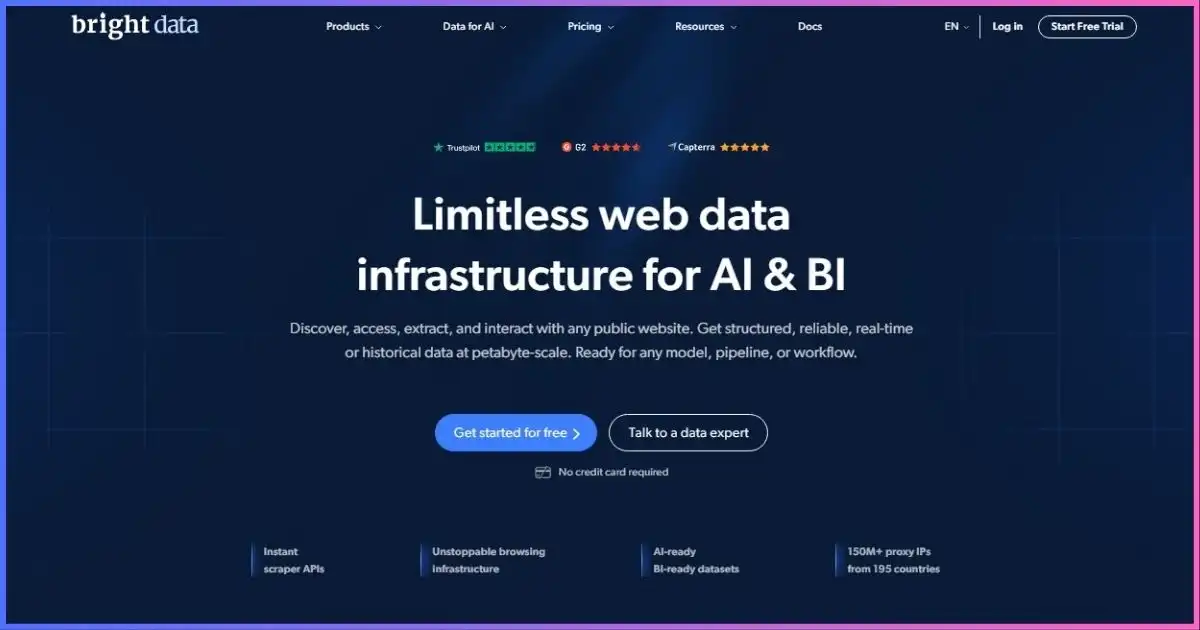
Archived project screenshot. Treat the live dashboard and checkout—not image text—as current evidence.
Market contextBright Data Alternatives
Bright Data is strongest when its control plane and managed products matter. It is weaker when a project needs only cheap raw residential bandwidth.
| Provider | Small residential entry* | Best reason to choose it | Trade-off vs Bright Data | Read next |
|---|---|---|---|---|
| Bright Data | Promo PAYG $4/GB | Targeting, controls, managed toolkit | Complex billing and strict residential access | This review |
| ProxyShare | $9 / 10GB / 30 days | Lowest small raw-residential package | Far less managed tooling | Head-to-head |
| Webshare | $3.50 / 1GB monthly | Low-cost self-service control panel | Less granular enterprise stack | Head-to-head |
| Oxylabs | $30 / 5GB | Premium proxies and enterprise APIs | Different network/tool economics | Head-to-head |
| IPRoyal | $7.35 / 1GB PAYG | Residential traffic that never expires | Higher entry rate, smaller managed stack | Head-to-head |
*September 2026 public offers. Promotions, validity, quantities, networks, and capabilities are not equivalent.
Small-tier residential price per GB
Directional sticker-price context only. ProxyShare requires 10GB/30 days; Oxylabs 5GB; Bright Data is promotional; IPRoyal traffic does not expire.
Choose Bright Data when…
- Country/state/city/ZIP/ASN targeting materially affects data quality.
- Web Unlocker, browser automation, scraper APIs, or datasets can reduce engineering.
- Zones, management APIs, KYC, account ownership, and enterprise contracting are useful controls.
- The pipeline produces enough value to justify a premium, complex platform.
Choose a lighter provider when…
- You only need inexpensive residential GB and manage every request yourself.
- You cannot satisfy registered-business and corporate-email requirements for residential access.
- Non-expiring allowance matters more than advanced targeting.
- A simple one-product dashboard is more valuable than a broad toolkit.
Balanced assessmentBright Data Pros and Cons
Pros
- 400M+ monthly residential IP claim across 195 countries
- Country/state/city/US ZIP/ASN targeting where supported
- Shared and dedicated datacenter and ISP options
- Web Unlocker with free allowance and success billing
- Browser API with Puppeteer, Playwright, and Selenium
- Scraper APIs and datasets for higher-level collection
- Proxy Manager, zones, and management APIs
- Strong enterprise governance and scaling path
Cons
- Product and billing catalog is complex
- $4/GB residential PAYG is promotional
- New residential access requires registered business, corporate email, funding, and KYC
- Commitment allowances do not roll over
- Managed products cost separately from raw proxies
- ISP “unlimited” remains subject to 100GB/IP fair use
- No universal money-back guarantee verified
- No current standalone mobile offer verified
How we arrived at 9.1/10
Editorial weighting uses current prices, documentation, controls, and product fit—not an invented lab benchmark.
- 25% — Network and targeting
- 20% — Managed product breadth
- 20% — Developer and management controls
- 15% — Pricing and accessibility
- 10% — Governance and access clarity
- 10% — Scaling and support options
FAQsBright Data Proxy Review: Frequently Asked Questions
Is Bright Data legitimate?
How much do Bright Data residential proxies cost?
Does Bright Data require KYC?
Does Bright Data have a free trial?
What is Bright Data Web Unlocker?
What is Bright Data Browser API?
Does Bright Data offer SOCKS5?
Does Bright Data offer mobile proxies?
Is Bright Data good for small projects?
Can Bright Data replace a VPN?
Bright Data Is a Premium Platform, Not Merely a Proxy List
Bright Data deserves its place on an enterprise shortlist. The 400M+ monthly residential network claim, granular targeting, shared and dedicated datacenter/ISP options, Proxy Manager, zones, APIs, Web Unlocker, Browser API, scraper products, and datasets form a coherent path from raw access to managed data delivery.
The trade-offs are significant: complex billing, a promotional residential headline, non-rolling commitments, separate managed-product costs, strict new-zone business KYC, fair-use thresholds, and no verified universal refund guarantee. Budget buyers can find cheaper raw residential traffic elsewhere.
Bottom line: choose Bright Data when data quality, location precision, automation, governance, and engineering savings matter more than the lowest $/GB. Start with a capped representative pilot and judge cost per accepted record—not pool size or marketing success claims.
For broader context, read our best proxy providers guide, Bright Data vs ProxyShare, Webshare vs Bright Data, or Bright Data vs Oxylabs.
Disclosure: This article contains an affiliate link. If you purchase through it, we may earn a commission at no extra cost to you. The rating reflects the project’s independent pricing and documentation analysis, not commission rates. Promotions, taxes, inventory, approval, and terms can change; confirm live checkout and contract details. This is not legal advice.
Sources & Comparison Methodology
This review uses proxy research of September 18, 2026.
The 9.1/10 editorial score weights network and targeting (25%), managed product breadth (20%), developer/management controls (20%), pricing/accessibility (15%), governance/access clarity (10%), and scaling/support options (10%). Price charts use displayed totals and allowances; package division is shown as calculated effective cost, not an overage promise.
- Official source: Bright Data residential, datacenter, ISP, Web Unlocker, and Browser API pricing; residential introduction, network access, quick-start, configuration, and general infrastructure documentation.
- Alternatives: current Webshare, ProxyShare, Oxylabs, and IPRoyal pricing notes. Billing periods, promotions, validity, and scope differ.
- Neutral context: MDN proxy/tunneling documentation and IETF RFC 9309, linked in relevant sections.
- Images: approved JoshWP featured artwork and Bright Data screenshot; image text is not used as current evidence.
No unsupported cross-provider speed, uptime, success, CAPTCHA, review-rating, or support-response claim is presented. Run a capped workload pilot and calculate total cost per accepted 1,000 records.