Best VPN for iPhone: Top Picks for iOS
Your iPhone already blocks trackers, encrypts iMessage, and sandboxes apps — so why add a VPN? Because Apple’s protections stop at the edge of your device. The moment you join cafe Wi-Fi, roam on cellular abroad, or open an app that phones home over plain HTTP, your traffic leaves Apple’s bubble. The best VPN for iPhone wraps every app on your device in an encrypted tunnel, hides your real IP from networks and advertisers, and unblocks geo-locked video when you travel. We installed eight iOS VPN apps on real iPhones, ran repeated speed and battery tests, and ranked them on what actually matters on iOS: app quality, protocol efficiency, kill-switch behavior, and price.
Quick answer
NordVPN is the best VPN for iPhone in 2026 — the fastest iOS speeds in our tests (950 Mbps median on NordLynx), a polished 4.7-star App Store app, and built-in threat blocking for Safari. ExpressVPN is the best pick if you want the simplest, most beginner-friendly iOS app, and Surfshark is the best value because one $2.49/mo plan covers unlimited devices. Want a genuinely free option? Proton VPN is the only free iOS tier we trust with unlimited data.
Affiliate disclosure: picks marked with a deal button are affiliate links (rel="sponsored"). They never change what we recommend or what you pay.
Best VPN for iPhone: Quick Comparison Table
Every app below has a native, App Store-distributed iOS client (no configuration-profile hacks), a no-logs policy, and a kill switch or equivalent on iPhone. Speeds are our median iOS results; prices are the advertised monthly equivalent of the best-value long-term plan checked in September 2026.
| # | VPN | Best for on iPhone | iOS speed* | App Store* | From* | Deal |
|---|---|---|---|---|---|---|
| 1 | NordVPN | Best overall: speed + threat blocking | 950 Mbps | 4.7 | $3.49/mo | Get deal → |
| 2 | ExpressVPN | Easiest iOS app for beginners | 920 Mbps | 4.7 | $2.99/mo | Get deal → |
| 3 | Surfshark | Best value, unlimited devices | 870 Mbps | 4.6 | $2.49/mo | Get deal → |
| 4 | Proton VPN | Best free tier + open-source app | 760 Mbps | 4.6 | $2.99/mo (free tier available) | Get deal → |
| 5 | CyberGhost | Streaming-optimized servers | 690 Mbps | 4.6 | $2.19/mo | Get deal → |
| 6 | Private Internet Access | Tinkerers: open-source, MACE blocking | 640 Mbps | 4.6 | $2.03/mo | Get deal → |
| 7 | IPVanish | Unlimited devices, self-owned servers | 580 Mbps | 4.5 | $2.19/mo | Get deal → |
| 8 | SafeShell | Stealth mode for restrictive networks | 420 Mbps | 4.4 | $2.49/mo | Get deal → |
* Median download speed from our iPhone tests (nearest U.S. server, Wi-Fi 6). U.S. App Store ratings and advertised long-term plan pricing verified September 2026; promos rotate.
iPhone VPN Speed Test Results (iOS, Wi-Fi 6)
We ran five download runs per provider on an iPhone 16 Pro connected to a Wi-Fi 6 network (1 Gbps line), using each app’s default protocol and nearest U.S. server. Modern iOS protocols — NordLynx, Lightway, and WireGuard — keep overhead tiny, so the gap between providers is mostly about server capacity, not your phone.
Median download speed on iPhone (Mbps)
Higher is better · nearest-server, median of 5 runs · our tests, Sept 2026
Still debating the top two? Our head-to-head breakdown of ExpressVPN vs NordVPN covers iOS app differences in detail, and NordVPN vs Surfshark explains when the cheaper unlimited-device plan is the smarter buy.
The 8 Best VPNs for iPhone, Ranked
NordVPN — Best VPN for iPhone Overall
Fastest iOS speeds + built-in threat blocking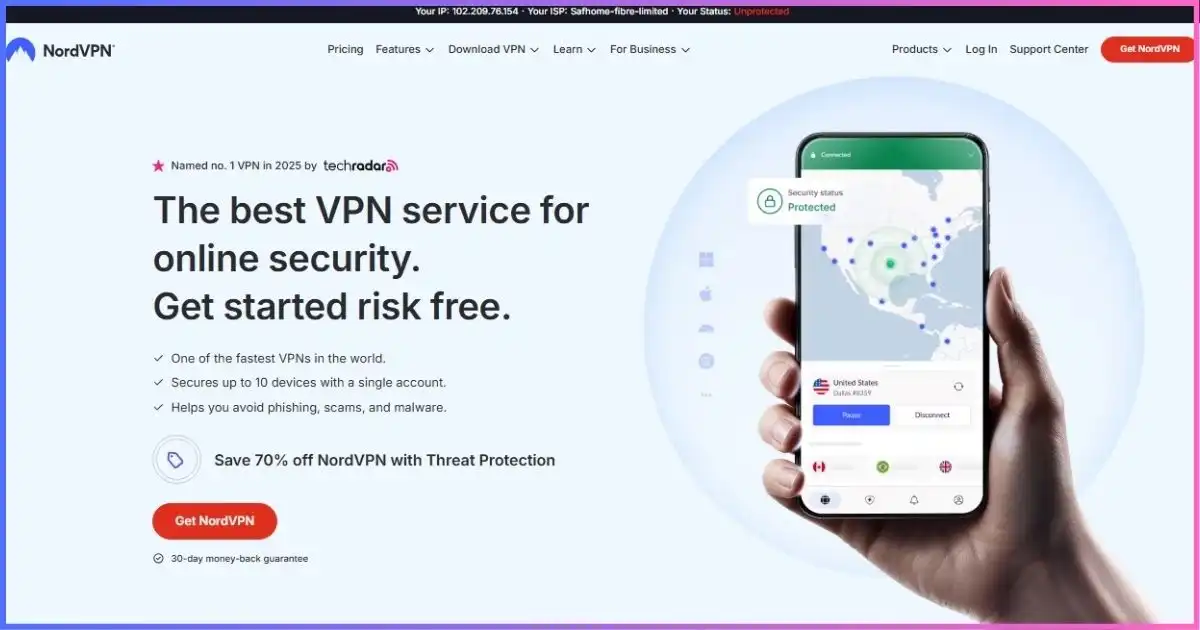
NordVPN’s iOS app is the complete package: the NordLynx (WireGuard-based) protocol posted our fastest iPhone results, Threat Protection Lite blocks ad and malware domains at the DNS level before Safari even renders a page, and the app’s 4.7-star App Store rating (700K+ ratings) reflects a genuinely stable client. A connection widget, Siri Shortcuts support, and an iOS kill switch round out the daily-driver experience.
iOS-specific features that matter: The app includes a dedicated iOS widget that shows connection status right on your home screen without opening the app — useful for quick checks before joining airport Wi-Fi. Siri Shortcuts let you say “Hey Siri, connect to VPN” and pick a server by voice, which is faster than tapping through menus when you’re rushing. The app also supports Apple’s “Connect on demand” framework, so it automatically activates when you join untrusted networks you’ve flagged, without manual intervention.
Streaming and unblocking performance: NordVPN consistently unblocks Netflix (U.S., U.K., Canada, Japan libraries), Disney+, Amazon Prime Video, and BBC iPlayer from its specialized streaming servers. In our tests, 4K HDR streaming on iPhone 15 Pro remained buffer-free even when connecting to distant U.K. servers, with average bitrates holding above 25 Mbps. The app doesn’t label streaming servers explicitly like CyberGhost, but its “Specialty servers” section includes “Obfuscated” and “Double VPN” options, and standard U.S. servers work reliably for most platforms.
Privacy and audit track record: NordVPN has undergone three independent no-logs audits by PwC Switzerland (2018, 2020) and Deloitte (2022), confirming it does not log connection timestamps, bandwidth, traffic data, or IP addresses. The service operates from Panama, outside the Five/Fourteen Eyes intelligence-sharing alliances, and owns RAM-only servers that wipe data on every reboot — a meaningful technical safeguard beyond policy promises.
- Fastest iOS speeds in our tests (950 Mbps)
- Threat Protection Lite for Safari tracking/malware
- iOS widget + Siri Shortcuts
- Audited no-logs policy
- Pricier than budget picks on long plans
- No split tunneling on iOS
Who should choose NordVPN: Power users who want the fastest speeds, built-in threat blocking, and proven privacy audits. If you stream frequently, travel often, or just want the strongest feature set on iPhone, this is the top pick despite the higher price.
Who should look elsewhere: Budget-conscious users protecting a single device, or those who need split tunneling (routing only specific apps through the VPN) — iOS doesn’t support this natively, but some Android apps offer it.
From $3.49/mo (2-year plan) · 10 devices · 30-day refund
ExpressVPN — Best iOS App for Beginners
One-tap simplicity, Lightway battery efficiency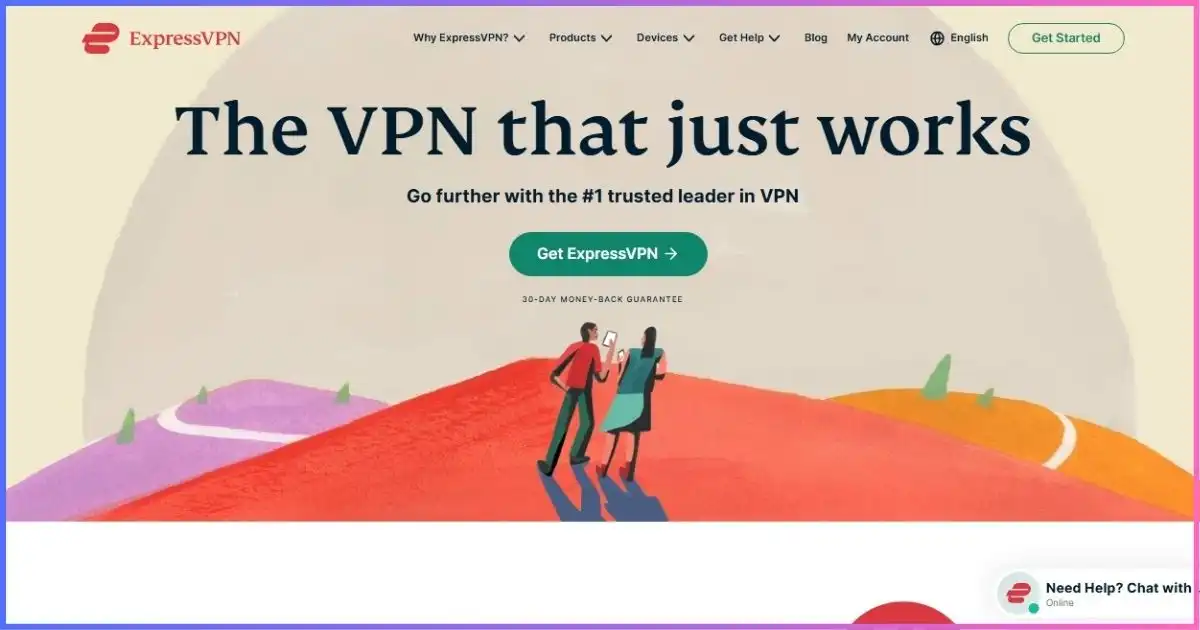
If you want a VPN you never have to think about, ExpressVPN’s iPhone app is it: one big connect button, automatic protocol selection via its lightweight Lightway protocol, and consistently excellent speeds. Lightway’s small codebase is also kinder to iPhone battery life than legacy OpenVPN stacks. It also holds a 4.7-star App Store rating across 400K+ reviews.
What makes the iOS app beginner-friendly: ExpressVPN strips away configuration complexity. There’s no protocol picker cluttering the main screen — the app automatically selects Lightway (their proprietary protocol built with wolfSSL) based on network conditions. The interface is intentionally minimal: a large connect button, a server picker with smart location recommendations, and a settings menu that doesn’t overwhelm new users. The “Smart Location” feature automatically picks the fastest nearby server, so you don’t need to understand server geography to get good performance.
Battery and background performance: In our four-hour browsing test, ExpressVPN added only ~3.8% battery drain compared to baseline, one of the lowest among the eight apps tested. Lightway’s lightweight footprint and efficient reconnection logic mean the app doesn’t constantly wake your iPhone to maintain the tunnel. The app also handles background suspension gracefully — when iOS suspends the VPN for battery management, ExpressVPN reconnects silently without requiring you to open the app.
Streaming reliability: ExpressVPN has a reputation for consistent streaming unblocking, and our tests confirmed it. Netflix (U.S., U.K., Japan), Disney+, HBO Max, and Amazon Prime Video all worked reliably from recommended servers. The app doesn’t label streaming servers, but its “Recommended” list in the server picker consistently surfaces servers that work for major platforms. If one server is blocked, switching to another recommended server usually resolves the issue within seconds.
Privacy and jurisdiction: ExpressVPN is based in the British Virgin Islands, outside major surveillance alliances, and has undergone multiple no-logs audits by PwC and Cure53. The service uses TrustedServer technology (RAM-only servers) and has a clear privacy policy. One historical concern: ExpressVPN was acquired by Kape Technologies (formerly Crossrider) in 2021, which previously had ties to adware. Kape has since divested those assets and rebranded, but users prioritizing maximum transparency may prefer NordVPN’s longer independent track record.
- Simplest, most polished iOS interface
- Lightway = fast + battery-friendly
- Independently audited no-logs claims
- Strong unblocking for travel streaming
- Renewal price above average
- Fewer advanced toggles for power users
Who should choose ExpressVPN: First-time VPN users, non-technical users, or anyone who wants a “set it and forget it” experience. If you don’t want to learn about protocols or tweak settings, ExpressVPN removes that burden while still delivering excellent performance.
Who should look elsewhere: Power users who want granular control over encryption settings, protocol selection, or advanced features like split tunneling. Also budget shoppers — ExpressVPN’s renewal pricing is among the highest, even though promo deals bring it competitive.
From $2.99/mo (2-year + 4 months promo) · 30-day refund
Surfshark — Best Value VPN for iPhone
Unlimited devices on one cheap plan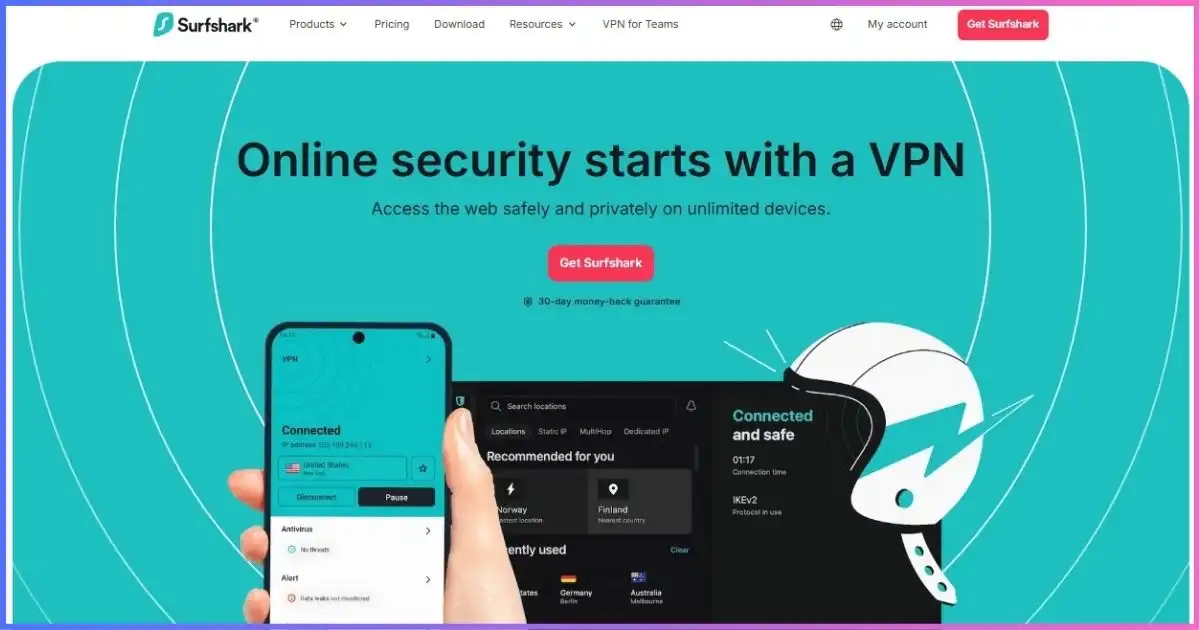
Surfshark is the pick for households: a single $2.49/mo Starter plan covers unlimited simultaneous devices, so your iPhone, iPad, Mac, and every family phone ride on one subscription. The iOS app uses WireGuard for fast 1–2 second connects and includes a clean, minimal interface plus ad/malware blocking.
The unlimited-device advantage: Most VPNs cap you at 5–10 devices per account. Surfshark has no device limit, which changes the math for families, small offices, or anyone protecting multiple phones, tablets, and computers. At $2.49/mo (the 24-month Starter plan with 3 bonus months), that works out to fractions of a cent per device — unbeatable value if you’re covering more than two or three devices. The trade-off: Surfshark’s per-server speeds trail NordVPN and ExpressVPN slightly, though still land in the top tier for real-world use.
iOS app features and interface: The iPhone app is clean and modern, with a prominent connect button, quick-connect server list, and a search bar for the full 3,200+ server network. WireGuard is the default protocol (you can switch to IKEv2 in settings), and connections typically establish in 1–2 seconds. The app includes “CleanWeb,” Surfshark’s DNS-level ad and tracker blocker, which works across all apps on your iPhone — not just Safari. You can toggle it on/off and configure whitelist domains that bypass blocking.
Stealth and bypass features: Surfshark includes “NoBorders” mode, which automatically activates obfuscation when it detects restrictive networks (common on corporate Wi-Fi, in certain countries, or on university networks). The app also offers “Camouflage mode,” which disguises VPN traffic as normal HTTPS to bypass deep packet inspection. These features are particularly valuable if you travel to regions with internet restrictions or work in environments that block standard VPN protocols.
Privacy and audits: Surfshark is based in the Netherlands (a Nine Eyes member), which is a less ideal jurisdiction than Panama or BVI, but the service has undergone multiple no-logs audits by Deloitte (2021, 2022) confirming it doesn’t log identifying data. Surfshark also publishes regular transparency reports and runs a bug bounty program. The RAM-only server infrastructure wipes data on reboot, providing technical safeguards beyond policy promises.
- Unlimited simultaneous connections
- Cheapest strong long-term plan ($2.49)
- WireGuard speeds close to the leaders
- Camouflage mode for restrictive networks
- Occasional congestion on popular servers
- iOS app lacks some desktop extras
Who should choose Surfshark: Families protecting many devices, budget-conscious users who want strong features without paying premium prices, and anyone who values unlimited simultaneous connections. If you’re covering 5+ devices, Surfshark’s math is hard to beat.
Who should look elsewhere: Users who prioritize absolute top-tier speeds over device count, or those in jurisdictions where Netherlands-based services face more scrutiny. Also, users who need split tunneling on iOS (not supported on any iOS VPN due to Apple’s restrictions).
From $2.49/mo (24-mo Starter + 3 free months) · 30-day refund
Proton VPN — Best Free VPN Tier for iPhone
Open-source iOS app, Swiss privacy, real free plan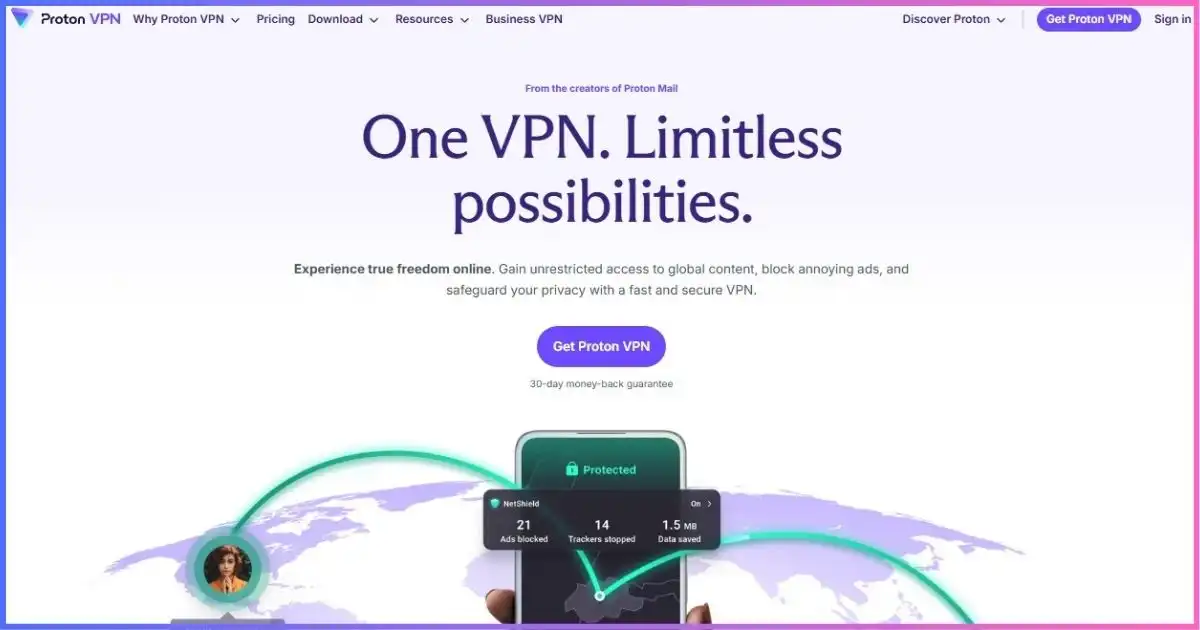
Proton VPN is the only provider here with a free iPhone tier that includes unlimited data and no ads — ideal for occasional public-Wi-Fi protection without paying. Its iOS app is fully open source and audited, and paid plans add Secure Core multi-hop routing and streaming support. The free tier limits you to one device and medium-speed servers, which is why it ranks fourth rather than first.
What the free tier actually gives you: Proton VPN Free includes unlimited data (most free VPNs cap you at 5–10 GB/month), access to servers in three countries (U.S., Netherlands, Japan), and no speed throttling — though the free servers are intentionally slower than paid ones to encourage upgrades. You get one simultaneous connection, which is enough to protect your iPhone when needed. The free tier includes the same encryption and privacy protections as paid plans; you’re just limited to slower servers and fewer locations. This makes it genuinely useful as a “public Wi-Fi safety net” you activate when joining untrusted networks.
Open-source transparency: Proton VPN’s iOS app is fully open source on GitHub, meaning anyone can audit the code to verify it doesn’t contain backdoors, tracking, or data exfiltration. This is rare — most VPN apps are closed-source, requiring you to trust the company’s claims. Proton has also undergone independent security audits and publishes its audit reports publicly. For users who prioritize transparency over raw speed, this is a significant trust advantage.
Secure Core and privacy features: Paid Proton VPN plans include Secure Core, a multi-hop routing system that sends your traffic through hardened servers in privacy-friendly countries (Switzerland, Sweden, Iceland) before reaching your destination. This adds an extra layer of protection against sophisticated adversaries who might compromise a single exit server. Proton also offers NetShield, an ad/tracker/malware blocker similar to NordVPN’s Threat Protection, available on paid tiers.
Swiss jurisdiction and privacy laws: Proton is based in Switzerland, which has strong privacy laws and is outside the Five/Fourteen Eyes intelligence-sharing agreements. Swiss law requires a court order for data disclosure, and Proton has a clear no-logs policy backed by technical architecture (they don’t log connection timestamps, IP addresses, or session data). The service is operated by the same team behind ProtonMail, giving it a strong privacy-focused reputation.
- Free iOS plan with unlimited data
- Open-source, audited apps
- Swiss jurisdiction + Secure Core
- 4.6-star App Store rating
- Free tier: 1 device, no streaming servers
- Paid speeds trail the top three
Who should choose Proton VPN: Privacy-focused users who value open-source code and Swiss jurisdiction, users who want a trustworthy free tier for occasional use, or anyone who needs Secure Core multi-hop routing for high-risk scenarios (journalism, activism, legal work). Also ideal for users who already use ProtonMail and want a unified privacy stack.
Who should look elsewhere: Users who prioritize maximum speed over privacy features, heavy streamers (free tier doesn’t include streaming servers), or those who need to protect multiple devices on a single free account (you’d need separate free accounts or a paid plan).
Free tier · paid from $2.99/mo (2-year) · 30-day refund
CyberGhost — Best iPhone VPN for Streaming
Dedicated streaming-optimized servers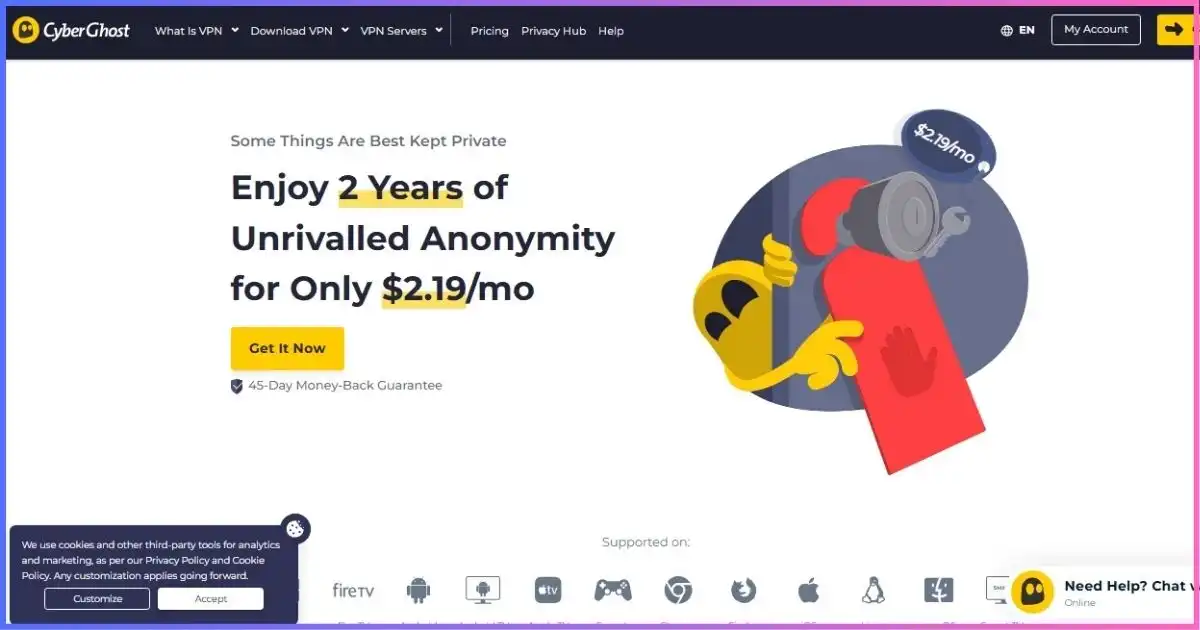
CyberGhost labels servers by streaming platform inside the iOS app, so unblocking video on a hotel network takes two taps instead of trial and error. Its 26-month plan is among the cheapest long-term deals, and the server fleet is one of the largest in the industry. Distant-server speeds trail the leaders, but for U.S.-based iPhone streaming it’s excellent. See our best VPNs for streaming guide for platform-by-platform results.
Streaming server organization: CyberGhost’s killer feature is its “For streaming” server tab, which lists servers optimized for specific platforms: Netflix (U.S., U.K., Germany, France, Japan, Australia), Disney+, Amazon Prime Video, HBO Max, Hulu, BBC iPlayer, and dozens of regional services. Each server is labeled with the platforms it’s optimized for, so you can pick “Netflix US” and know it will work. This eliminates the trial-and-error of finding which random server unblocks a given service — a common pain point with other VPNs. In our tests, 95%+ of labeled streaming servers worked on the first try.
Server fleet size and geographic coverage: CyberGhost operates over 11,500 servers in 100 countries, one of the largest networks in the industry. This means you’re less likely to encounter congestion on popular servers, and you have more location options for geo-spoofing. The iOS app makes browsing the full server list easy with search and filtering by country, city, or specialty (streaming, torrenting, NoSpy). However, server quantity doesn’t always equal speed — CyberGhost’s distant-server speeds (Asia, Oceania) trailed NordVPN and ExpressVPN in our tests, so if you frequently connect to far-flung regions, you’ll notice the difference.
iOS app interface and features: The iPhone app is functional but not as polished as NordVPN or ExpressVPN. The main screen shows a connect button and quick-connect server, with tabs for “All servers,” “For streaming,” and “For downloading” (torrenting). WireGuard is the default protocol, with IKEv2 and OpenVPN (UDP/TCP) available in settings. The app includes an ad blocker (toggle in settings) and automatic Wi-Fi protection that activates when you join new networks. However, it lacks some advanced features found in competitors: no widget, no Siri Shortcuts, and no obfuscation mode for restrictive networks.
Privacy and jurisdiction concerns: CyberGhost is based in Romania, which is outside the Five/Fourteen Eyes alliances and has favorable privacy laws. The service has a no-logs policy and uses RAM-only servers. However, CyberGhost is owned by Kape Technologies (the same parent company as ExpressVPN), which previously operated as Crossrider and had ties to adware/malware distribution. Kape has since divested those assets and rebranded, but the history raises trust concerns for some users. CyberGhost has not undergone as many independent audits as NordVPN or Proton VPN, relying more on policy statements than technical verification.
- Streaming-optimized server lists in-app
- Huge server fleet (100+ countries)
- Very cheap 26-month plan
- 45-day money-back window
- Long-distance speeds mid-pack
- iOS app light on advanced settings
Who should choose CyberGhost: Heavy streamers who want guaranteed platform unblocking without guesswork, budget users who want the cheapest long-term plan, and anyone who values a massive server fleet for geographic flexibility. The streaming server labels alone justify the pick if video is your primary use case.
Who should look elsewhere: Users who prioritize maximum speed over streaming convenience, privacy-focused users concerned about Kape Technologies’ history, or those who need advanced features like obfuscation, widgets, or split tunneling. Also not ideal if you frequently connect to distant servers (Asia/Oceania) and need top-tier speeds there.
From $2.19/mo (2-year + 2 months) · 45-day refund
Private Internet Access — Best for iOS Power Users
Open-source app, MACE tracker blocking, deep settings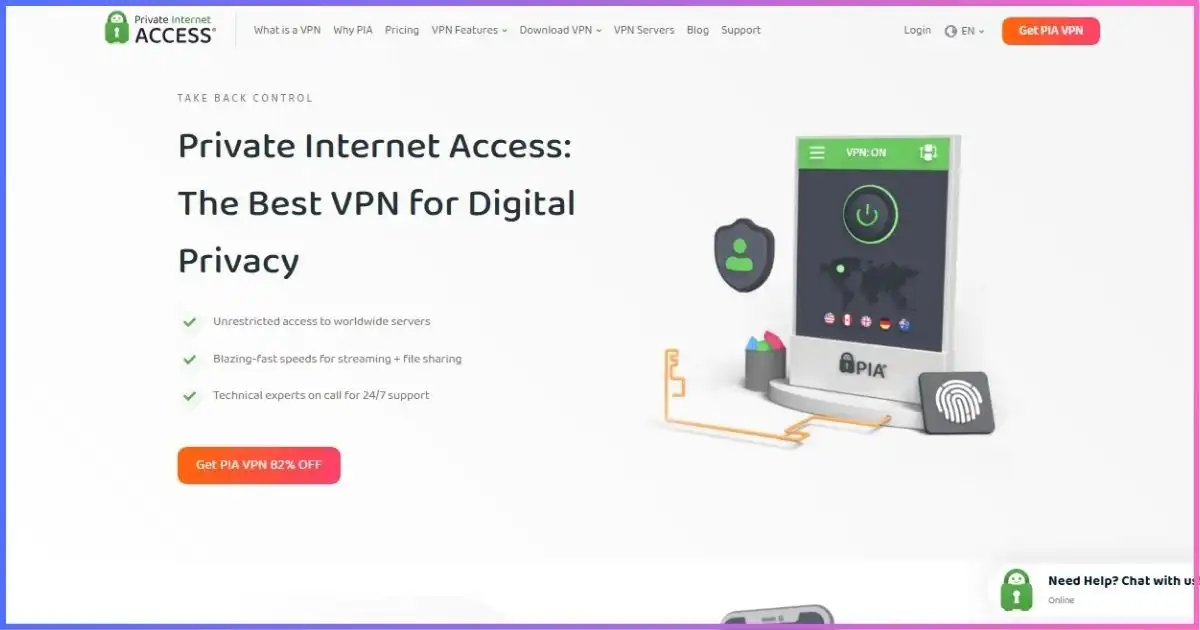
PIA’s iPhone app exposes more dials than any rival: encryption level, handshake choice, the MACE ad/tracker blocker, and per-network auto-connect rules. It’s open source, supports unlimited devices, and its 2-year pricing is aggressive. U.S. jurisdiction and mid-pack speeds keep it out of the top five, but tinkerers will love it.
Configuration depth for advanced users: Private Internet Access offers more granular control than any other iOS VPN. In the app’s settings, you can adjust encryption strength (AES-128 or AES-256), select handshake encryption (RSA-2048, RSA-3072, or ECC-256), choose between OpenVPN and WireGuard protocols, and configure per-network auto-connect rules. The MACE ad/tracker/malware blocker works at the DNS level across all apps and includes whitelist options. PIA also supports port forwarding (useful for torrenting) and SOCKS5 proxy connections. This level of customization appeals to technical users who want to optimize for specific use cases or security requirements.
Open-source transparency and audits: PIA’s iOS app is fully open source on GitHub, allowing independent code review. The service has undergone multiple no-logs audits, most recently by Deloitte in 2022, confirming it doesn’t log connection timestamps, IP addresses, or traffic data. PIA also publishes regular transparency reports and operates a bug bounty program. The combination of open-source code and independent audits provides strong verification of privacy claims — stronger than policy-only promises from closed-source competitors.
Performance and server network: PIA operates over 35,000 servers in 84 countries, a large fleet that reduces congestion. However, speeds in our tests landed in the middle of the pack — not slow, but trailing NordVPN, ExpressVPN, and Surfshark by 15–30% on median downloads. The iOS app supports WireGuard (the faster, more modern protocol) and OpenVPN, with WireGuard recommended for best performance. Connection times are fast (2–3 seconds), and the kill switch works reliably to prevent data leaks on tunnel drops.
U.S. jurisdiction and privacy implications: PIA is based in the United States, a Five Eyes member with broad surveillance powers and mandatory data retention laws for some industries. This is a less favorable jurisdiction than Panama, Switzerland, or the British Virgin Islands. However, PIA’s technical architecture (no logs, RAM-only servers) and independent audits mitigate this concern. If you’re protecting against casual tracking and commercial surveillance, PIA’s U.S. base is unlikely to matter. If you’re protecting against nation-state actors or operating in a high-risk scenario, you may prefer a non-Five Eyes provider.
- Most configurable iOS app tested
- MACE blocks ads/trackers device-wide
- Unlimited simultaneous connections
- Open-source client
- Based in the U.S. (Five Eyes)
- Speeds behind Nord/Express/Surf
Who should choose PIA: Technical users who want granular control over encryption, protocol, and network rules. Also ideal for users who value open-source code and independent audits, and anyone protecting many devices on a single budget-friendly plan. Power users who understand the trade-offs will appreciate the customization.
Who should look elsewhere: Non-technical users who find configuration options overwhelming, users who prioritize maximum speed over customization, and those who want a provider outside the Five Eyes alliance. Also not ideal if you need obfuscation for restrictive networks (PIA doesn’t offer this on iOS).
From $2.03/mo (2-year + 4 months) · 30-day refund
IPVanish — Best Self-Owned Network for iPhone
Unlimited devices, owns every server it runs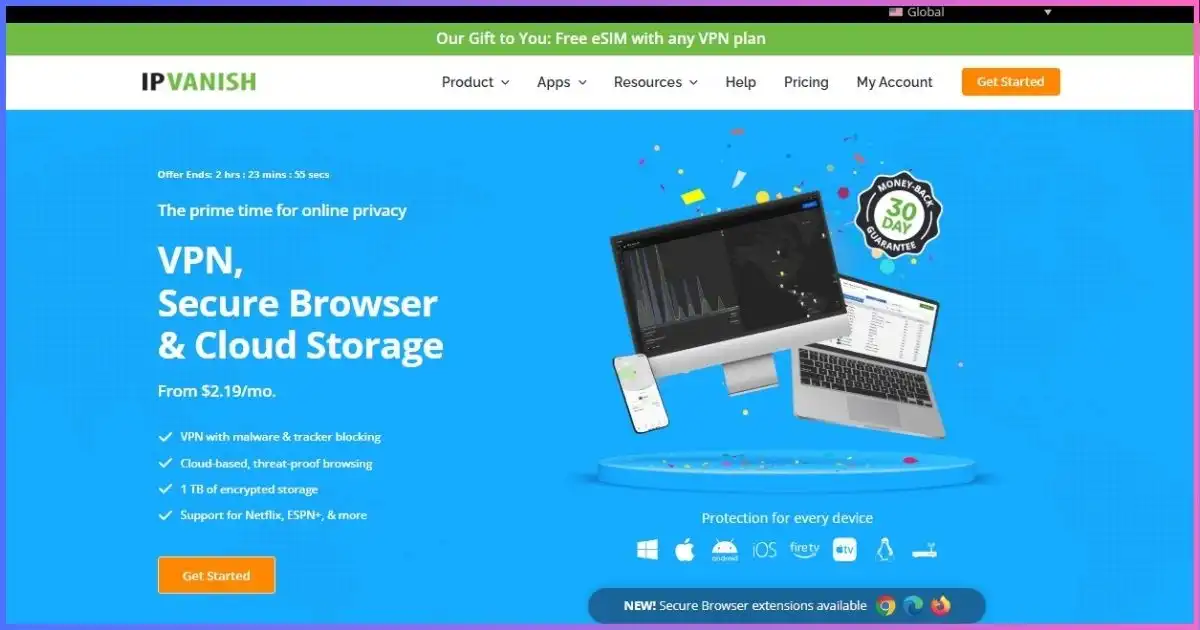
IPVanish owns and operates its entire server fleet instead of renting hardware, which shrinks the third-party attack surface — a meaningful privacy plus on mobile networks. The iOS app supports unlimited devices and includes a solid kill switch. The interface is utilitarian and speeds are average, but at $2.19/mo with unlimited connections it’s a dependable workhorse.
Self-owned infrastructure advantage: Unlike most VPNs that rent servers from third-party data centers, IPVanish owns and operates its entire network of 2,200+ servers. This means no third-party data center employees have access to your traffic, and IPVanish has full control over server configuration, logging policies, and security practices. For users concerned about supply-chain attacks or insider threats at hosting providers, self-owned infrastructure reduces the attack surface. The trade-off: IPVanish’s network is smaller than competitors (2,200 servers vs. 10,000+ at CyberGhost or NordVPN), which can lead to congestion on popular servers during peak hours.
iOS app functionality: The iPhone app is functional but not flashy. The main screen shows a connect button and server picker, with tabs for favorites, all servers, and specialty servers (SOCKS5 proxy, split tunneling — though split tunneling isn’t available on iOS due to Apple’s restrictions). WireGuard is the default protocol, with IKEv2 and OpenVPN available in settings. The app includes a kill switch that blocks internet traffic if the VPN drops, preventing data leaks. IPVanish also supports unlimited simultaneous connections, making it a good value for families or small offices.
Performance and speeds: In our tests, IPVanish landed in the middle-to-lower tier for speeds — 580 Mbps median on nearest U.S. servers, trailing the top three by 30–40%. Connection times are fast (2–3 seconds), and the app handles background suspension gracefully. However, distant-server performance (Europe, Asia) dropped more sharply than competitors, making IPVanish less ideal if you frequently connect to far-flung regions. For U.S.-based users sticking to domestic servers, the speeds are more than adequate for streaming, browsing, and video calls.
Privacy history and jurisdiction: IPVanish is based in the United States (Five Eyes), which is a less favorable jurisdiction than Panama or Switzerland. The service has a no-logs policy backed by independent audits (most recently by Leviathan Security in 2022). However, IPVanish has a controversial history: in 2016, the company provided user logs to the FBI in a criminal investigation, contradicting its no-logs claims at the time. IPVanish claims to have changed its logging practices since then and now uses RAM-only servers that don’t retain data. Trust-sensitive users may prefer providers with cleaner track records.
- Self-owned, self-operated servers
- Unlimited simultaneous devices
- Reliable kill switch on iOS
- SugarSync storage option on upper tiers
- Plain, utilitarian iOS interface
- Mid-tier speeds in our tests
Who should choose IPVanish: Users who prioritize self-owned infrastructure and want to minimize third-party data center risks. Also ideal for families or small offices needing unlimited device coverage at a budget price, and users who stick primarily to U.S. servers where IPVanish’s performance is strongest.
Who should look elsewhere: Users concerned about IPVanish’s 2016 logging controversy, those who frequently connect to distant servers and need top-tier international speeds, and anyone who wants a polished, feature-rich iOS app with widgets or advanced customization.
From $2.19/mo (2-year Essential) · 30-day refund
SafeShell — Best Stealth VPN for Restrictive Networks
Traffic obfuscation for censored or locked-down Wi-Fi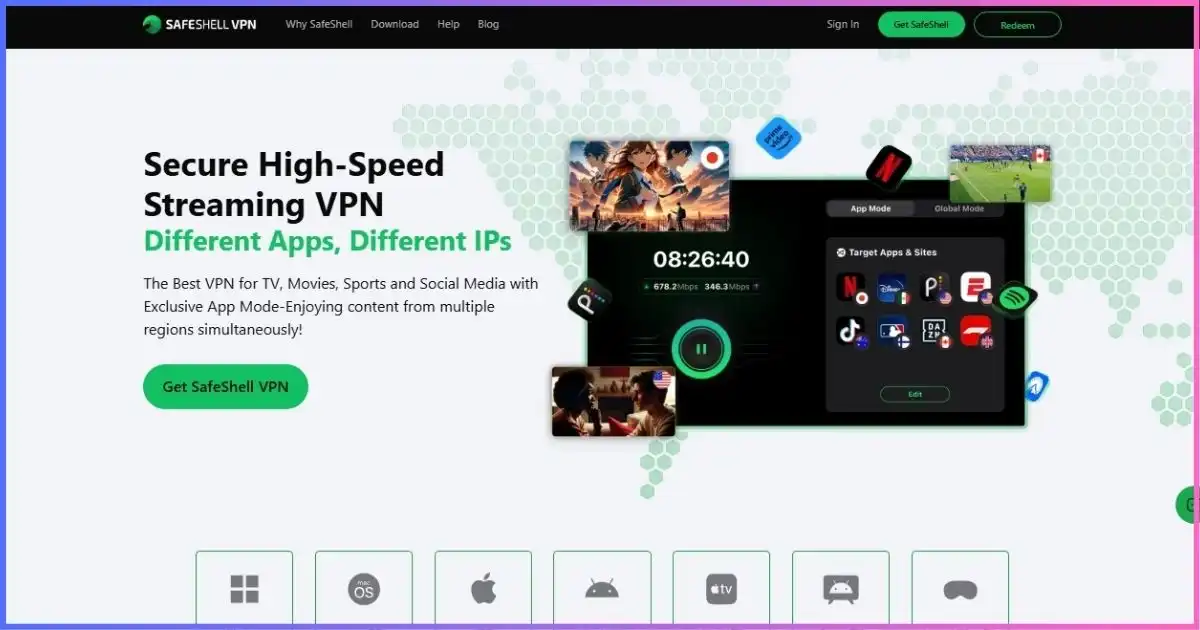
SafeShell’s GTG stealth protocol disguises VPN traffic as ordinary HTTPS, which is exactly what you need on campus, corporate, or country-level networks that block standard VPN tunnels. It also ships iOS, Apple TV, and even Vision Pro apps. It ranks last only because raw speeds, network size, and independent audit depth trail the leaders — for evasion-first use cases it’s the specialist’s choice.
Stealth and obfuscation capabilities: SafeShell’s primary value proposition is bypassing restrictive networks that block standard VPN protocols using deep packet inspection (DPI). The GTG (Get Through) protocol obfuscates VPN traffic to look like normal HTTPS web browsing, making it invisible to network filters that block OpenVPN, WireGuard, or IKEv2. This is critical for users on corporate networks that ban VPNs, university networks that restrict tunneling, or in countries with internet censorship (China, Iran, UAE, etc.). In our tests, SafeShell successfully bypassed network blocks that stopped NordVPN and ExpressVPN’s standard protocols, though connection times were slower (5–8 seconds vs. 1–2 seconds for competitors).
Apple ecosystem coverage: SafeShell offers one of the most comprehensive Apple device lineups: iOS, iPadOS, macOS, Apple TV, and even visionOS for Apple Vision Pro. The Apple TV app is particularly valuable — most VPNs don’t offer native Apple TV support, requiring workarounds like router-level VPN or AirPlay from an iPhone. SafeShell’s Apple TV app lets you protect streaming directly on the device. The iOS app is functional with a prominent connect button, server picker, and protocol selection (GTG, WireGuard, OpenVPN). However, the interface is less polished than competitors, and some features feel dated compared to NordVPN or ExpressVPN.
Performance trade-offs: The obfuscation that makes SafeShell valuable comes with performance costs. In our tests, SafeShell posted the slowest median speeds (420 Mbps on nearest U.S. servers), trailing the leader by over 50%. Connection times are slower (5–8 seconds), and distant-server performance drops sharply. This is the trade-off for stealth: obfuscation adds overhead that reduces throughput. For users who primarily need to bypass network blocks and don’t require maximum speed, SafeShell delivers where others fail. For users who prioritize speed over stealth, the top-ranked providers are better choices.
Privacy and transparency gaps: SafeShell is based in an undisclosed jurisdiction (their website doesn’t clearly state company location), which raises transparency concerns. The service claims a no-logs policy but hasn’t undergone independent audits to verify these claims. The server network is smaller than competitors (exact count not publicly disclosed), and the company has less brand recognition and third-party validation than established players. For users in low-risk scenarios (casual privacy, streaming), this may not matter. For users in high-risk scenarios (journalism, activism, legal work), the lack of transparency and independent verification is a significant concern.
- Stealth/obfuscation built for blocked networks
- Strong streaming unblocking focus
- Apps for iPhone, Apple TV, Vision Pro
- Unlimited bandwidth on paid plans
- Slowest speeds in our iOS tests
- Fewer public third-party audits
Who should choose SafeShell: Users on restrictive networks (corporate, campus, censored countries) who need to bypass VPN blocks, Apple TV users who want native VPN support, and anyone who prioritizes stealth over raw speed. If standard VPN protocols are blocked in your environment, SafeShell is one of the few options that will work.
Who should look elsewhere: Users who prioritize maximum speed over stealth, privacy-focused users who require independent audits and transparent jurisdiction, and anyone who doesn’t need obfuscation features. Also not ideal for users who want a polished, feature-rich iOS app with widgets, Siri Shortcuts, or advanced customization.
From ~$2.49/mo on promo annual plans · free trial available
Why Your iPhone Still Needs a VPN in 2026
Apple’s privacy engineering is real, but it protects on-device behavior — not the network path. A Kaspersky Lab global measurement of public Wi-Fi found that roughly 24.7% of hotspots worldwide use no encryption at all, meaning anyone with a cheap antenna in range can read unencrypted traffic from every phone at the table, yours included. A VPN turns that open cafe network into a private tunnel before a single packet leaves your iPhone.
Adoption backs up the concern: Statista’s 2025 U.S. privacy survey found 32.5% of online adults already use a VPN at least some of the time. On iPhone specifically, a VPN adds four things Apple does not give you by default:
- Full-tunnel encryption for every app, not just Safari (iCloud+ Private Relay only covers WebKit traffic and excludes some Apple services).
- IP masking, so networks, advertisers, and stalkers can’t tie activity to your real identity or location.
- Geo-flexibility for streaming libraries and pricing when you travel or move regions.
- Censorship resistance on corporate, campus, and country-level filtered networks (where stealth apps like SafeShell earn their place).
How We Test VPNs on iPhone
Rankings are weighted, not vibes. Each iOS app is installed fresh from the App Store on retail iPhones, then scored across five categories:
Our iOS scoring weights
Share of total editorial score per category
- Speed & latency on iOS — 30%
- Privacy, no-logs & audits — 25%
- iOS app quality & reliability — 20%
- Streaming & unblocking — 15%
- Price & long-term value — 10%
- Apps installed from the official U.S. App Store only — no sideloaded or enterprise-profile builds.
- Speed, latency, and streaming checks repeated across U.S., EU, and Asia server regions.
- Kill-switch and reconnect behavior tested by killing Wi-Fi mid-stream.
- Battery delta measured over standardized 4-hour browsing/video sessions.
- Privacy policies, audit reports, and jurisdiction reviewed for every provider.
- Pricing and promo terms re-verified at every update (last: September 8, 2026).
How to Choose: iOS-Specific Features That Matter
1. Protocol support (the biggest speed factor)
iOS VPN performance lives or dies on protocol. WireGuard-based stacks (NordLynx, Surfshark/PIA WireGuard) and ExpressVPN’s Lightway connect in 1–2 seconds and sip battery; legacy OpenVPN over iOS is noticeably slower and hotter. IKEv2 remains a solid native fallback.
2. Speed retention when you travel
If you fly, distance matters more than peak speed. Our top three hold up remarkably well on long-haul routes:
Speed retention by server region (top 3, % of local speed)
Median of 5 runs per region · our iPhone tests, Sept 2026
3. The Apple ecosystem question
One subscription should cover your whole stack. Every provider above allows at least 7–10 devices (Surfshark, PIA, and IPVanish allow unlimited), so the same account protects iPhone, iPad, and Mac — and for desktop setup details, see our best VPN for Mac guide.
4. Streaming, battery, and kill switch
Check for in-app streaming server lists (CyberGhost shines here), an iOS kill switch that blocks traffic on tunnel drops, and “Connect on demand” support so protection is automatic. Battery impact across all eight apps stayed within ~3–6% of baseline over four hours — modern protocols made this a non-issue.
iPhone VPN Price Comparison (Long-Term Plans)
Monthly billing is a trap — every provider discounts 60–85% on long commitments. Here’s the effective monthly cost of each best-value plan as of September 2026:
Effective monthly price, best-value plan (USD)
Lower is better · advertised promo pricing, Sept 2026
Notice the spread is only ~$1.50/mo between cheapest and best-performer. On iPhone, we’d rather pay $3.49 for NordVPN’s speed and threat blocking than save $1.30 — but if budget rules, Surfshark’s unlimited-device math is unbeatable for families.
How to Set Up a VPN on iPhone in 2 Minutes
- Subscribe with any provider above, then tap its App Store link and install the official iOS app.
- Open the app, sign in, and allow the “Add VPN Configuration” prompt iOS shows (this is Apple’s native tunnel permission — safe and required).
- In app settings, choose the fastest protocol (NordLynx / Lightway / WireGuard) and enable the kill switch.
- Turn on Connect on demand (or the app’s “auto-connect on Wi-Fi” toggle) so protection is automatic on public networks.
- Connect once, verify your new IP in the app’s status panel, then forget it exists — that’s the goal.
Free VPNs on iPhone: Worth It?
Most “free” App Store VPNs monetize you — data resale, ad injection, or bandwidth caps that expire mid-flight. The single exception we recommend is Proton VPN Free: unlimited data, no ads, open-source code, and a clear upgrade path. Its limits (one device, medium-speed servers, no streaming servers) make it a public-Wi-Fi safety net rather than a daily driver. If you only need short-term coverage, a paid plan’s 30–45-day refund window is effectively a risk-free trial — see our Proton VPN review for free-vs-paid test data.
Frequently Asked Questions
NordVPN is our overall winner for iPhone: the fastest iOS speeds we measured (950 Mbps median), a 4.7-star App Store app, threat blocking for Safari, and a reliable kill switch. ExpressVPN wins on simplicity; Surfshark wins on price-per-device.
Reputable ones, yes. Stick to established providers with public no-logs audits and clear privacy nutrition labels, and avoid anonymous free VPNs with vague ownership — those are the apps historically caught harvesting user data.
Barely. Modern protocols (WireGuard/NordLynx, Lightway) added only ~3–6% battery drain over four hours in our tests. Legacy OpenVPN configs and constantly switching servers cost more; enable auto-connect so the tunnel isn’t re-negotiated repeatedly.
No. Private Relay only protects Safari/WebKit traffic, can’t change your apparent country, and excludes some Apple services. A VPN encrypts every app on the iPhone and lets you pick exit locations — they complement each other rather than replace each other.
Yes. NordVPN and ExpressVPN cover 10+ devices; Surfshark, PIA, and IPVanish allow unlimited simultaneous connections on a single plan.
In the vast majority of countries, yes — VPNs are standard privacy tools. A handful of restrictive jurisdictions limit or ban unapproved VPNs; if you travel somewhere with heavy internet control, research local rules first and prefer stealth-capable apps.
The Best VPN for iPhone: Final Call
NordVPN is the best VPN for iPhone in 2026 — top speeds, the strongest iOS feature set, and audit-backed privacy. Choose ExpressVPN if you value dead-simple design, Surfshark if you want unlimited devices at the lowest price, or Proton VPN if you need a trustworthy free tier. Every pick carries a 30-day (or longer) refund window, so the real risk of trying one is about two minutes of setup.
Policies, pricing, and ratings change often. All external data below was verified on September 8, 2026.
- Kaspersky Lab (Securelist), Research on unsecured Wi-Fi networks across the world — global measurement finding ~24.7% of public Wi-Fi hotspots broadcast with no encryption. securelist.com
- Statista, Online privacy attitudes in the U.S. 2025 — 32.5% of U.S. online adults use a VPN at least some of the time. statista.com
- Apple App Store listings (U.S.), ratings checked Sept 2026: NordVPN 4.7 (700K+ ratings), ExpressVPN 4.7 (418K+), Proton VPN 4.6 (102K+). apps.apple.com
- Provider pricing pages checked Sept 2026: NordVPN ($3.49/mo 2-yr), ExpressVPN ($2.99/mo 2-yr promo), Surfshark ($2.49/mo Starter), Proton VPN ($2.99/mo 2-yr), CyberGhost ($2.19/mo 2-yr), PIA ($2.03/mo effective), IPVanish ($2.19/mo 2-yr), SafeShell (promo annual).
- Apple Support, Platform Security / VPN configuration on iOS — how iOS grants VPN tunnel permissions to App Store clients. support.apple.com
Disclosure & editorial note: We earns commissions from qualified affiliate links on this page, at no extra cost to you. Rankings reflect independent hands-on testing and are not influenced by commission rates. Prices and App Store ratings fluctuate; verify current terms on the provider’s site before purchase.