IPRoyal vs Bright Data Proxy: Which Provider Is Better?
Bright Data is the stronger overall web-data platform; IPRoyal is the better flexible self-service proxy provider. Bright Data’s currently researched residential promotion starts at $4/GB PAYG—below IPRoyal’s $7.35 first-gigabyte PAYG price—and adds exceptionally granular targeting, account zones, Proxy Manager, Web Unlocker, Browser API, scraper APIs, and datasets.
IPRoyal’s counterargument is practical: residential traffic does not expire. It also offers currently verified rotating and dedicated mobile proxies, while Bright Data’s former mobile URLs now redirect and no standalone new-customer mobile offer was verified. This IPRoyal vs Bright Data Proxy comparison separates promotional rates, commitment pricing, per-IP products, and managed services so unlike offers are not blended into a false winner.
IPRoyal or Bright Data: Who Wins?
Bright Data wins capability, targeting, management controls, and the current promotional residential rate. IPRoyal wins non-expiring bandwidth, simpler low-volume flexibility, and verified mobile choice. Choose Bright Data for governed business data pipelines, US ZIP/ASN targeting, difficult targets, browser automation, scraper APIs, or datasets. Choose IPRoyal for seasonal residential usage, straightforward sticky/rotating access, mobile projects, or teams that do not need an enterprise platform.
Important access difference: new Bright Data residential zones created after July 7, 2026 require a registered business, corporate email, funded account, and human-reviewed KYC. IPRoyal’s suitability should still be checked for the intended lawful use, but the researched comparison does not show an equivalent new-zone policy.
*Promotion uses coupon RESIGB50 against an $8/GB reference price. Eligibility, duration, account funding and renewal must be confirmed.
Table of Contents
- Comparison at a glance
- How the providers differ
- Residential pricing
- Expiry and commitment economics
- Network and targeting
- Sessions, protocols and controls
- Datacenter comparison
- ISP proxy comparison
- Mobile proxy comparison
- Web Unblocker and managed tools
- KYC and account access
- Free access and refunds
- Performance methodology
- Use-case winners
- True-cost framework
- Pros and cons
- FAQs
- Final verdict
Side-by-sideIPRoyal vs Bright Data at a Glance
| Category | IPRoyal | Bright Data | Winner / fit |
|---|---|---|---|
| Residential PAYG entry | 1GB/$7.35; traffic does not expire | Promotional $4/GB PAYG; terms require confirmation | Price: Bright Data* Retention: IPRoyal |
| Residential network | 64M+ IPs / 195 countries | 400M+ monthly IPs / 195 countries | Bright Data breadth* |
| Targeting | Country, state, city | Country, state/region, city, US ZIP, ASN/carrier where supported | Bright Data |
| Datacenter | From $1.57/IP for 30 days | Shared 10/$14; dedicated 10/$22; PAYG traffic $0.60/GB | Configuration-dependent |
| ISP | From $1.80/IP; some offers $2.40 | Shared 10/$18; dedicated 10/$35; traffic PAYG $8/GB | IPRoyal entry / Bright Data options |
| Mobile | Rotating and dedicated plans verified | No current standalone new-customer offer verified | IPRoyal |
| Managed unlocking | Web Unblocker from $1/1,000 requests | 5K free monthly; PAYG $1.50/1,000 successful requests | Depends on volume/scope |
| Managed browser | No comparable product verified | Browser API: free allowance, PAYG $8/GB | Bright Data |
| Management stack | Simpler self-service proxy account | Zones, Proxy Manager, management APIs, scraper APIs, datasets | Bright Data |
| Residential onboarding | No equivalent researched policy | New zones: registered business, corporate email, funding, human KYC | IPRoyal accessibility |
*Provider network totals use different definitions and are not independently verified or a measured availability/performance ratio. Bright Data’s $4 rate is promotional.
Choose IPRoyal if…
Your residential usage is irregular, unused allowance must retain value, mobile identity matters, or you want a smaller self-service product set without enterprise tooling.
Choose Bright Data if…
Your business needs precise targeting, users/zones, management APIs, managed unlocking, remote browsers, scraper APIs, datasets, or room to scale into a governed data platform.
Different product philosophiesFlexible Proxy Catalog vs Full Web-Data Platform
IPRoyal is primarily a proxy provider. Its lineup covers rotating residential, datacenter, ISP, rotating mobile, dedicated mobile and Web Unblocker. The dashboard and products are suited to teams that want to manage request logic and parsing while buying the identity needed for each target.
Bright Data has raw residential, datacenter and ISP networks, but it continues upward through Web Unlocker, Browser API, target-specific scraper APIs and datasets. Account zones, an open-source Proxy Manager and management APIs add operational controls. This breadth is valuable for organizations that want one vendor from raw IP transport to ready-made data, but it creates more product and billing decisions.
| Layer | IPRoyal | Bright Data |
|---|---|---|
| Raw identity | Residential, DC, ISP, mobile | Residential, DC, ISP |
| Managed access | Web Unblocker | Web Unlocker |
| Remote browser | No comparable saved offer | Browser API |
| Structured extraction | Customer-owned in most workflows | Product-specific scraper APIs |
| Pre-collected data | No comparable catalog verified | Datasets |
| Operations | Self-service endpoints and controls | Zones, Proxy Manager and management APIs |
Price versus permanenceResidential Proxy Pricing Compared
Small-volume PAYG and subscription rates
| Provider / option | Traffic | Total | Rate | Validity caveat |
|---|---|---|---|---|
| IPRoyal PAYG | 1GB | $7.35 | $7.35/GB | Does not expire |
| IPRoyal PAYG | 2GB | $12.50 | $6.25/GB | Does not expire |
| IPRoyal PAYG | 10GB | $55.10 | $5.51/GB | Does not expire |
| IPRoyal subscription | 1GB | $7 | $7/GB | Traffic advertised non-expiring; confirm subscription terms |
| IPRoyal subscription | 2GB | $11.90 | $5.95/GB | Same caution |
| IPRoyal subscription | 10GB | $52.50 | $5.25/GB | Same caution |
| Bright Data promo PAYG | Any used GB | Usage-based | $4/GB | RESIGB50 promotion; verify eligibility/duration |
If the promotion applies, Bright Data costs $40 for 10GB of usage versus IPRoyal’s $52.50 subscription or $55.10 PAYG total. The $12.50–$15.10 difference favors Bright Data on immediate cost. IPRoyal’s advantage is that a bought balance can wait for the next project instead of depending on promotional/account conditions.
Small-volume residential unit rates
Common $0–$7.35 scale. Bright Data is promotional; IPRoyal traffic does not expire.
Bright Data promotional monthly commitments
| Allowance | Monthly total | Calculated included rate | Important note |
|---|---|---|---|
| 141GB | $499 | $3.5390/GB | Promotional commitment |
| 332GB | $999 | $3.0090/GB | Promotional commitment |
| 798GB | $1,999 | $2.5050/GB | Promotional commitment |
Use totals divided by allowances, not rounded card labels. These are included-traffic rates, not verified overage prices. Bright Data’s navigation “from $2.50/GB” refers to high commitment—not $4 PAYG.
IPRoyal’s deepest public rate
IPRoyal advertises $1.75/GB, but that requires a 10TB subscription. It beats Bright Data’s calculated $2.505/GB at 798GB, yet requires over 12.5 times the traffic commitment. Neither is a sensible comparison for a small project. At scale, obtain checkout/contract totals, overage rules and expiry terms rather than extrapolating headlines.
Utilization changes the winnerNon-Expiring Traffic vs Monthly Commitments
IPRoyal’s signature benefit is residential traffic that does not expire. A seasonal retailer or agency can buy data for a project, pause, and use the balance later. Bright Data PAYG is usage-based, while active-account monthly commitment amounts do not roll over when the account remains active for the entire month.
This means there are two separate Bright Data comparisons. Promotional PAYG has no advertised monthly commitment and can be efficient for small variable use if the offer applies. Monthly commitments require high utilization to achieve their calculated rate. Do not buy 141GB/$499 to get $3.54/GB if the workload will consume only a fraction.
Illustrative cost of 10GB immediate usage
Published/researched rates only; no trial credits, tax, funding or promotion restrictions included.
PAYG
subscription
promo PAYG
The chart does not value IPRoyal’s retained balance or predict renewal. Bright Data’s $4/GB offer must be confirmed.
Pool size and location precisionResidential Networks and Targeting
Bright Data advertises 400M+ monthly residential IPs across 195 countries; IPRoyal advertises 64M+ IPs in 195 countries. “Monthly IPs” is a measurement window, not simultaneous availability, and the providers may count differently. The larger number supports Bright Data’s breadth positioning but does not prove a sixfold performance advantage.
IPRoyal supports country, state and city targeting. Bright Data adds state/region where supported, city, US ZIP and ASN/carrier depending on configuration. For ordinary national/local access, both cover core needs. For ad-tech, telecom, fraud research or US hyperlocal work, Bright Data’s ZIP and ASN controls create a meaningful advantage.
Editorial product-fit profile
Qualitative fit from current features and terms—not a measured network benchmark.
Connection controlsRotation, Sticky Sessions, Protocols, and Authentication
| Capability | IPRoyal | Bright Data |
|---|---|---|
| Residential rotation | Rotating and sticky sessions | Rotation and session parameters by zone/username |
| HTTP/HTTPS | Supported by relevant products | Documented; setup varies by product |
| SOCKS5 | Advertised for residential | Documented; some pages describe use through Proxy Manager |
| Authentication | Credentials/endpoints by product | Zone-specific username/password; routing parameters in username |
| Management | Self-service controls | Zones, Proxy Manager and management APIs |
| Best advantage | Simplicity and broad proxy-type access | Segmentation, automation and enterprise operations |
Protocol support does not make either service a consumer VPN. A proxy routes configured application traffic and does not automatically create a device-wide encrypted tunnel, kill switch or DNS protection. MDN’s proxy and tunneling guide explains the underlying role.
Fast static infrastructureDatacenter Proxy Pricing
IPRoyal advertises datacenter proxies from $1.57/IP for 30 days, $1.48 for 60 days and $1.39 for 90 days. Bright Data separates shared per-IP, dedicated per-IP and a bandwidth-priced offer:
| Bright Data quantity | Shared total / rate | Dedicated total / rate |
|---|---|---|
| 10 IPs | $14 / $1.40 per IP | $22 / $2.20 per IP |
| 100 IPs | $100 / $1 per IP | $170 / $1.70 per IP |
| 500 IPs | $475 / $0.95 per IP | $750 / $1.50 per IP |
| 1,000 IPs | $900 / $0.90 per IP | $1,300 / $1.30 per IP |
Bright Data also lists a separate $0.60/GB datacenter PAYG product. Do not add it to per-IP pricing as though both charges are mandatory. At small quantity, Bright Data shared is slightly below IPRoyal’s 30-day headline, while Bright Data dedicated is higher. IPRoyal’s exact sharing, location and quantity must be matched before declaring a direct winner.
Stable residential-like identityISP Proxy Pricing and Fair Use
| Option | Entry | Higher tiers | Fair-use note |
|---|---|---|---|
| IPRoyal ISP | From $1.80/IP; some offers $2.40 | Checkout/configuration dependent | 100GB/proxy/30-day pool before throttling/top-up effects |
| Bright Data shared ISP | 10 IPs/$18 ($1.80/IP) | 100/$145; 500/$700; 1,000/$1,300 | 100GB/IP/month pooled across purchased IPs |
| Bright Data dedicated ISP | 10 IPs/$35 ($3.50/IP) | 100/$275; 500/$1,300; 1,000/$2,500 | 100GB/IP/month pooled; extra charges may apply |
| Bright Data traffic ISP | $8/GB PAYG | 71GB/$499; 166GB/$999; 399GB/$1,999 | Separate from per-IP options |
Both providers attach real thresholds to “unlimited” per-IP language. IPRoyal’s current help describes 100GB per proxy in each 30-day cycle, after which dedicated products may be throttled and shared products can become unavailable without a top-up. Bright Data pools 100GB per purchased ISP IP each month; additional use can incur charges. Transfer-heavy buyers should model the policy, not the headline.
A clear IPRoyal advantageMobile Proxy Comparison
IPRoyal currently has two mobile models. Rotating mobile is billed by traffic: 2GB at $6.80/GB ($13.60), 10GB at $6/GB ($60), 50GB at $5.60/GB ($280), and 100GB at $5.20/GB ($520). Dedicated mobile starts at $10.11/day or $130/month, with longer terms shown at $123.50 and $117 monthly equivalents.
Bright Data formerly published mobile-specific URLs, but those now redirect to the general proxy-network catalog or infrastructure documentation. Generic FAQ language still mentions mobile, yet a purchasable standalone plan for a new customer was not verified. Therefore, IPRoyal wins current public mobile availability; contact Bright Data if mobile is contract-critical rather than relying on legacy material.
Beyond raw proxiesWeb Unblocker, Web Unlocker, and Browser Tools
Managed unblocking
| Product | Free allowance | Public entry | What it replaces |
|---|---|---|---|
| IPRoyal Web Unblocker | Not verified | From $1/1,000 requests | Some proxy selection, rotation, retries and access tuning |
| Bright Data Web Unlocker | 5,000 requests/month; no card listed | PAYG $1.50/1,000 successful requests | Proxy selection, retries and anti-block access |
IPRoyal’s headline unit rate is lower, but the research does not establish an identical success definition, free allowance or target scope. Bright Data’s Scale example is $499/month for 383,000 included requests and $1.30/1,000 additional requests, with enterprise features quoted separately. Pilot the same targets and count usable results.
Browser API, scraper APIs, and datasets
Bright Data Browser API supplies managed browsers, proxies and unlocking for Puppeteer, Playwright and Selenium. It advertises 5,000 credits plus 1GB free monthly, then $8/GB PAYG; a $499 Scale tier includes 71GB. Scraper APIs and datasets add target-specific structured collection, but no universal price should be transferred across products.
No equivalent IPRoyal managed-browser, scraper-API or dataset catalog was verified. If the team already owns browser automation and parsing, IPRoyal’s simpler raw infrastructure may be sufficient. If browser health, unblocking or parser maintenance is the bottleneck, Bright Data’s broader stack can reduce engineering cost despite higher complexity.
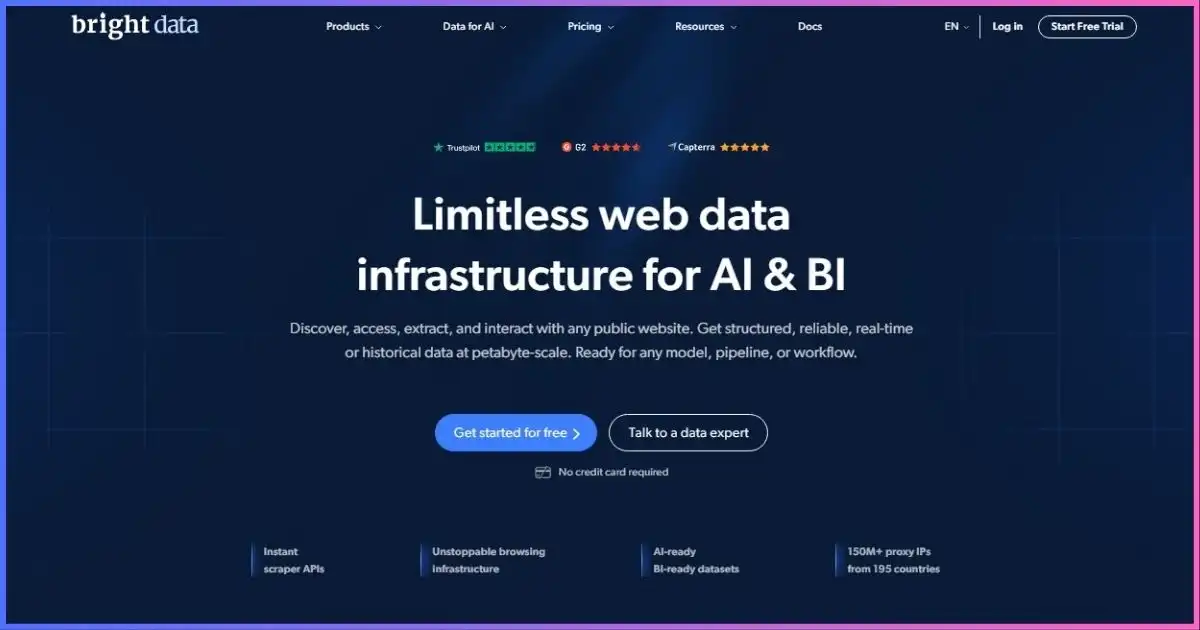
Archival project image. It is not evidence for current pricing or network counts.
A decisive access constraintBright Data KYC vs IPRoyal Accessibility
New Bright Data residential zones created after July 7, 2026 require a registered business, corporate email, real account funding and human-reviewed KYC. Personal-email accounts are ineligible. Zones created on or before that date are unaffected, and previously verified customers retain access under the researched policy.
Access is tied to an approved use case; blocked categories or methods require review rather than technical retries. KYC is unavailable in Playground/Limited Trial because real funding is required, and approval is not instant. This makes Bright Data a poor fit for anonymous casual use but a stronger fit for governed organizational procurement.
The IPRoyal research does not establish an equivalent residential onboarding rule. That does not mean unrestricted use: product availability, payments, location and the customer’s intended lawful purpose still matter. Confirm account requirements before committing automation to either provider.
Testing and purchase protectionFree Access, Refunds, and Billing Caveats
Bright Data’s free allowances apply to managed products—not raw residential proxies. Web Unlocker advertises 5,000 monthly requests; Browser API advertises 5,000 credits plus 1GB monthly. No unrestricted seven-day raw residential trial should be promised from legacy copy.
No universal Bright Data money-back guarantee was verified. Check deposits, auto-recharge, credit expiry, promotion rules and product-specific refunds. Usage caps may enforce with lag, so client-side spend ceilings and retry limits remain important.
IPRoyal’s research also does not establish a universal free tier or refund promise for this comparison. Its low 1GB PAYG entry provides a small pilot, but buyers should check the live payment/refund policy before purchase.
Marketing is not a benchmarkSpeed, Success Rate, and Reliability
No controlled head-to-head speed, uptime, CAPTCHA or target-success benchmark exists in the current research. Bright Data’s larger pool, premium positioning and managed tools do not prove better results for every target. IPRoyal’s simpler catalog and non-expiring traffic do not prove lower cost per useful page.
| Pilot metric | Calculation | What it reveals |
|---|---|---|
| Usable response rate | Correct target content ÷ attempts | Soft blocks and wrong pages |
| Accepted-record rate | Valid unique records ÷ extracted records | End-to-end data quality |
| Latency | p50, p95 and p99 by route | Typical and slow-tail performance |
| Location fidelity | Correct currency/inventory/language ÷ checks | Actual targeting effectiveness |
| Session survival | Completed flows ÷ attempts | Sticky-session usefulness |
| Total cost | Fees + bytes + retries + labor ÷ accepted records | Fair comparison across products |
Test the same lawful public pages, regions, concurrency and validation rules. The Robots Exclusion Protocol (RFC 9309) explains robots.txt behavior but is not a grant of permission or complete legal analysis.
Workload winnersWhich Provider Is Better for Your Use Case?
| Use case | Better starting point | Reason |
|---|---|---|
| Seasonal residential scraping | IPRoyal | Traffic does not expire |
| Small immediate residential use | Bright Data promo* | $4/GB vs $7.35 PAYG if eligible |
| US ZIP / ASN targeting | Bright Data | Broader documented filters |
| Mobile ad verification | IPRoyal | Current rotating and dedicated mobile plans |
| Browser automation | Bright Data | Managed Browser API |
| Managed raw-page access | Both | Compare unblocker success definitions and useful-result cost |
| Structured scraper APIs/datasets | Bright Data | Broader verified platform catalog |
| Simple self-service proxy account | IPRoyal | Less platform complexity |
| Enterprise governance | Bright Data | Zones, KYC, management APIs, SSO/SLAs by quote |
*Promotion eligibility and duration must be confirmed.
Suggested proxy-pilot decision weights
Adjust before testing so the decision reflects business impact.
- 30% Useful-response quality
- 25% Cost per accepted record
- 20% Targeting/session fidelity
- 15% Engineering and maintenance
- 10% Governance/support
Use a fair denominatorHow to Compare the True Cost
- Choose the lowest sufficient identity.Start with datacenter, then ISP, residential or mobile only when results require it.
- Model actual utilization.Value IPRoyal’s retained traffic and penalize unused Bright Data commitments; treat PAYG separately.
- Match product responsibility.Raw proxy prices exclude browser infrastructure, unblocking, parsing and storage.
- Define accepted output.Specify fields, freshness, geography, uniqueness and content checks before testing.
- Add every cost.Include traffic, IPs, managed requests, browser usage, retries, infrastructure and labor.
The final formula is (provider fees + expired commitment + infrastructure + labor) ÷ accepted records. IPRoyal can beat a lower unit rate when non-expiry prevents repeated waste. Bright Data can beat a cheaper raw provider when its filters or managed tools materially improve valid output or save engineering time.
Trade-offsIPRoyal and Bright Data Pros and Cons
IPRoyal
Pros
- Residential traffic does not expire
- 64M+ advertised IPs in 195 countries
- Country/state/city targeting
- Rotating and sticky sessions
- Current rotating/dedicated mobile plans
- Web Unblocker and broad raw proxy catalog
Cons
- Higher small-volume residential rate
- $1.75/GB requires 10TB
- Smaller managed-tool stack
- ISP headline varies by offer
- Static fair-use threshold applies
- No universal benchmark/refund verified
Bright Data
Pros
- 400M+ monthly residential IP claim
- Granular ZIP/ASN/location targeting
- Shared/dedicated DC and ISP options
- Web Unlocker and Browser API free allowances
- Scraper APIs, datasets and Proxy Manager
- Zones and enterprise controls
Cons
- $4/GB residential rate is promotional
- Complex catalog and billing
- New residential zones require business KYC
- Commitment allowances do not roll over
- Managed tools bill separately
- No current standalone mobile plan verified
Choose by operating model: IPRoyal favors retained bandwidth and straightforward proxy use; Bright Data favors targeting precision, managed data collection and organizational controls.
Frequently asked questionsIPRoyal vs Bright Data Proxy FAQ
Is IPRoyal better than Bright Data?
Which is cheaper, IPRoyal or Bright Data?
Does IPRoyal residential traffic expire?
Does Bright Data require KYC?
Which provider has the larger residential network?
Which provider offers mobile proxies?
Which has the better Web Unblocker?
Are their ISP proxies really unlimited?
Final verdictBright Data Wins Capability; IPRoyal Wins Flexibility
Choose Bright Data for a high-value business pipeline that benefits from its larger advertised network, US ZIP/ASN targeting, zones, management APIs, Proxy Manager, Web Unlocker, Browser API, scraper products and datasets. Its current $4/GB promotion is attractive, but verify eligibility and prepare for registered-business KYC on new residential zones.
Choose IPRoyal when usage is seasonal, a retained residential balance matters more than the lowest immediate rate, or verified rotating/dedicated mobile products are required. It is also easier to justify when the team already owns request logic, browsers and parsing and does not need an enterprise platform.
Our recommendation: start with IPRoyal for irregular raw-proxy and mobile workloads. Start with Bright Data for advanced targeting and managed data collection. Run a capped pilot and decide on cost per accepted record.
For deeper standalone analysis, read our IPRoyal Proxy Review and Bright Data Proxy Review. Enterprise buyers can also compare Bright Data vs Oxylabs, while budget-focused teams may prefer IPRoyal vs Webshare.
Sources & comparison methodology
This comparison uses the September 18, 2026 research, compiled from official IPRoyal and Bright Data pricing, product, documentation, access-policy and billing material. No authenticated checkout, paid account, contract review or controlled cross-provider performance benchmark was performed.
Method: raw residential, datacenter, ISP, mobile and managed products were kept separate. Bright Data promotional prices are explicitly labeled; calculated package rates divide public totals by included allowances. Network figures remain provider-attributed. Charts show transparent price arithmetic or qualitative decision aids—not measured speed, uptime or success.
Fair comparison: test matching targets, regions and validation rules. Add provider fees, unused commitment, traffic, retries, browser/managed charges, infrastructure and labor, then divide by accepted records. Confirm live promotion, KYC, funding, refund and contract terms before purchase.
Disclosure: This article contains affiliate links. JoshWP may earn a commission if you purchase through them, at no extra cost to you. That does not change the calculations, caveats or methodology. Use proxies and scraping tools only where lawful and permitted by applicable terms and data rights.