ScrapingAnt vs Scrape.do: Which Web Scraping API Is Better?
ScrapingAnt and Scrape.do are API-first web retrieval services, but they optimize for different workloads. ScrapingAnt combines managed Chrome, HTML and Markdown endpoints, prompt-driven JSON extraction, proxies, and developer integrations. Scrape.do emphasizes straightforward unblocking with datacenter or residential/mobile routes, JavaScript rendering, browser interactions, geotargeting, sync/async requests, and predictable standard multipliers.
Our ScrapingAnt vs Scrape.do verdict: ScrapingAnt is the better starting point for a generous recurring free tier, low paid entry, Markdown output, and built-in AI extraction. Scrape.do is the better value for JavaScript rendering and residential/browser-heavy collection because its standard rendered modes consume far fewer credits. The right choice depends on request mix, not the largest credit number on the pricing page.
ScrapingAnt or Scrape.do?
Choose ScrapingAnt if you want 10,000 recurring free credits, a $19 paid tier, HTML-to-Markdown, prompt-based structured extraction, or integrations such as MCP, Make, n8n, and GitHub Actions. Choose Scrape.do if your workload frequently needs rendering: standard datacenter rendering costs five credits versus ScrapingAnt’s ten, while residential/mobile rendering costs 25 versus ScrapingAnt’s 125.
For simple datacenter requests, both start at one credit. At equal credit volume, neither credit guarantees one usable record. Compare provider cost plus engineering and validation labor per accepted result.
Table of Contents
- Side-by-side comparison
- How the products differ
- Plans and pricing
- Credit costs
- Real request capacity
- Browser and rendering
- Markdown and AI extraction
- Proxies, locations, sessions
- APIs and integrations
- Concurrency and reliability
- Proxy Mode security
- Use-case winners
- True-cost framework
- Pros and cons
- FAQs
- Final verdict
- Sources and methodology
At a glanceScrapingAnt vs Scrape.do Comparison
| Category | ScrapingAnt | Scrape.do | Edge |
|---|---|---|---|
| Core product | Managed browser, proxy, Markdown, and AI extraction API | Managed retrieval/unblocking API with rendering and interactions | Depends on workflow |
| Free tier | 10,000 credits monthly; no card | 1,000 successful credits monthly; no card | ScrapingAnt |
| First paid tier | $19 for 100,000 credits | $29 for 250,000 credits | Entry: ScrapingAnt; volume: Scrape.do |
| Simple datacenter | 1 credit | 1 credit | Tie |
| Rendered datacenter | 10 credits | 5 credits | Scrape.do |
| Residential without render | 25 credits | 10 credits | Scrape.do |
| Residential + render | 125 credits | 25 credits | Scrape.do |
| Structured extraction | Prompt-driven AI extractor with typed/nested JSON | Customer normally owns parsing and schema | ScrapingAnt |
| Async API | No comparable native async job system verified | Jobs, polling, cancellation, results, webhooks | Scrape.do |
| Locations | API docs list 24 selectable countries | Pricing advertises 160+ countries | Scrape.do |
| Concurrency | Advertises unlimited; error docs still define 409 concurrency limit | 5–200 pricing-page slots; async docs conflict on middle tiers | Confirm both |
| Bandwidth | Credit-based API; separate proxy products by GB | Unlimited bandwidth advertised; credits still apply | No direct unit advantage |
The architectural choiceManaged Browser and AI Extraction vs Managed Unblocking
Content transformation matters
The /v2/general endpoint returns page content, /v2/markdown produces LLM-ready
Markdown, and /v2/extract turns prompt-described fields into structured JSON. Managed
Chrome is enabled by default, with selector waits, custom JavaScript, cookies, headers, proxy selection,
and timeouts.
ScrapingAnt is therefore especially appealing for AI pipelines, research assistants, RAG ingestion, and teams that want extraction support without building every selector.
Retrieval economics matter
Scrape.do takes a narrower but efficient approach: request a URL, choose proxy/render/geo/session options, and receive the response. Its standard credit schedule is notably favorable for rendered datacenter and residential/mobile traffic.
Sync, Async, webhook, and Proxy Mode options fit applications that already own parsing, validation, storage, and business logic.
Neither product is a full programmable workflow platform like Apify or a visual crawler designer like Octoparse. If those distinctions matter, see Apify vs ScrapingAnt, Apify vs Scrape.do, and Octoparse vs Scrape.do.
Public USD pricingScrapingAnt vs Scrape.do Plans
| Provider / plan | Monthly price | Credits | Support / notable features |
|---|---|---|---|
| ScrapingAnt Free | $0 | 10,000 monthly | No card; all tiers start with 10K free credits |
| ScrapingAnt Enthusiast | $19 | 100,000 | Email; documentation-only integration help |
| ScrapingAnt Startup | $49 | 500,000 | Priority email; snippets and expert assistance |
| ScrapingAnt Business | $249 | 3 million | Debug sessions, custom pools/avoidances, account manager |
| ScrapingAnt Business Pro | $599 | 8 million | Priority debug sessions and business support features |
| ScrapingAnt Custom | $699+ | 10 million+ | Dedicated support and enterprise onboarding |
| Scrape.do Free | $0 | 1,000 monthly | 5 concurrent; all core features; no card |
| Scrape.do Hobby | $29 | 250,000 | 10 pricing-page concurrency; email support |
| Scrape.do Pro | $99 | 1.25 million | 50 pricing-page concurrency; priority email |
| Scrape.do Business | $249 | 3.5 million | 100 concurrency; premium routes, team, dedicated support |
| Scrape.do Advanced | $699 | 10 million | 200 concurrency; custom WAF strategy/SLA, Slack |
| Scrape.do Custom | Negotiated | Negotiated | Custom volume, concurrency, support, infrastructure |
Scrape.do annual pricing is advertised as ten monthly payments for twelve months: $290, $990, $2,490, and $6,990 for Hobby through Advanced, with switching handled through support. ScrapingAnt unused credits do not roll over; its product page says users can restart a plan mid-month to refresh credits. Confirm live checkout terms.
Monthly paid plan commitments
Shared $0–$699 scale. Bars compare subscription price, not equivalent request capacity or service value.
Which provider is cheaper per 1,000 simple requests?
Assuming one credit per successful simple datacenter response and full allowance use, ScrapingAnt Enthusiast works out to $0.19 per 1,000 credits, while Scrape.do Hobby is about $0.116. ScrapingAnt Startup improves to roughly $0.098, ScrapingAnt Business to $0.083, Scrape.do Pro to about $0.079, and Scrape.do Business to roughly $0.071. These are allowance ratios—not guarantees of 1,000 accepted records—and exclude retries, AI extraction, special target profiles, and labor.
Workload economicsCredit Costs Compared
| Request type | ScrapingAnt | Scrape.do | Lower standard cost |
|---|---|---|---|
| Simple datacenter, no browser | 1 | 1 | Tie |
| Browser/page source, no JS, datacenter | 2 | Not separately mapped | Not directly comparable |
| JavaScript rendered datacenter | 10 | 5 | Scrape.do, 2× fewer |
| Simple residential/mobile route | 25 residential | 10 residential/mobile | Scrape.do, 2.5× fewer |
No-JS browser with return_page_source=false | 50 | Not separately mapped | Not directly comparable |
| Rendered residential route | 125 residential | 25 residential/mobile | Scrape.do, 5× fewer |
| Google domain via datacenter | 10 | Target profile may vary | Test and inspect headers |
| AI structured extraction | Character formula + base request | No equivalent prompt extractor verified | ScrapingAnt capability |
ScrapingAnt’s Ant-credits-cost response header reports consumption, and its documentation says
failed/error requests consume zero credits. Scrape.do charges documented successful statuses—2XX, 400, 404, and
410—and exposes Scrape.do-Request-Cost. Some named domains receive automatic proxy/render profiles
costing 10–200 Scrape.do credits, so the header is authoritative.
Standard mode credit cost: lower is better
Each bar uses a shared 125-credit scale. Scrape.do named-domain profiles and ScrapingAnt AI character charges are excluded.
Translate credits into workTheoretical Request Capacity
| Plan / credits | Simple DC | Rendered DC | Residential | Rendered residential |
|---|---|---|---|---|
| ScrapingAnt Free / 10K | 10,000 | 1,000 | 400 | 80 |
| Scrape.do Free / 1K | 1,000 | 200 | 100 | 40 |
| ScrapingAnt Enthusiast / 100K | 100,000 | 10,000 | 4,000 | 800 |
| Scrape.do Hobby / 250K | 250,000 | 50,000 | 25,000 | 10,000 |
| ScrapingAnt Business / 3M | 3,000,000 | 300,000 | 120,000 | 24,000 |
| Scrape.do Business / 3.5M | 3,500,000 | 700,000 | 350,000 | 140,000 |
Theoretical maxima divide the credit allowance by documented standard mode cost. They are not speed, success, or accepted-record guarantees. Scrape.do named-domain costs and ScrapingAnt AI extraction charges can reduce capacity materially.
Dynamic websitesHeadless Browser, JavaScript, and Interactions
ScrapingAnt’s managed Chrome is enabled by default. Its API supports selector waits, custom JavaScript snippets, cookies, headers, a configurable 5–60 second timeout, page-source modes, datacenter or residential routing, and country targeting. A documented default browser request with JavaScript rendering costs ten datacenter credits or 125 residential credits.
Scrape.do offers JavaScript rendering and browser interactions such as waiting for page states and manipulating dynamic content. Every plan advertises core access to rendering, datacenter and residential/mobile proxies, geotargeting, and sticky sessions. Its five-credit rendered datacenter and 25-credit rendered residential/mobile modes are the decisive advantage for browser-heavy jobs.
Neither price guarantees a valid result. Browser execution can still yield a challenge, consent wall, wrong region, incomplete lazy-loaded component, or logged-out page. Run representative URLs, verify required fields, and measure credits per validated response.
ScrapingAnt’s differentiatorMarkdown and AI Data Extraction
ScrapingAnt exposes dedicated Markdown and AI extraction endpoints. Markdown strips much of the layout noise and
is useful for language-model ingestion, search indexing, summarization, and retrieval-augmented generation. The
AI extractor accepts free-form field descriptions, supports typed and nested output, converts field names to
camelCase, and can return null when data is absent.
The extractor operates on Markdown/text rather than CSS layout and raw styling tags. Its total credit formula is:
ceil((Markdown input characters + output characters) ÷ 30) + underlying scraping-request cost
Large pages or verbose outputs can make AI extraction much more expensive than the base fetch.
Prompt-driven extraction reduces selector work, but it also introduces nondeterminism and a character-dependent meter. Validate types, required fields, null handling, hallucination risk, and schema consistency. Scrape.do does not present an equivalent general prompt-to-JSON extractor in the supplied current documentation, so customers normally parse the returned page in their own code.
Identity and geographyProxies, Locations, and Sticky Sessions
ScrapingAnt’s current homepage advertises more than three million rotating proxies. Its Web Scraping API proxy documentation lists 24 selectable countries, while the separately billed standalone residential proxy product advertises 100+ countries. Do not transfer the standalone network’s coverage claim to the credit-based scraping API.
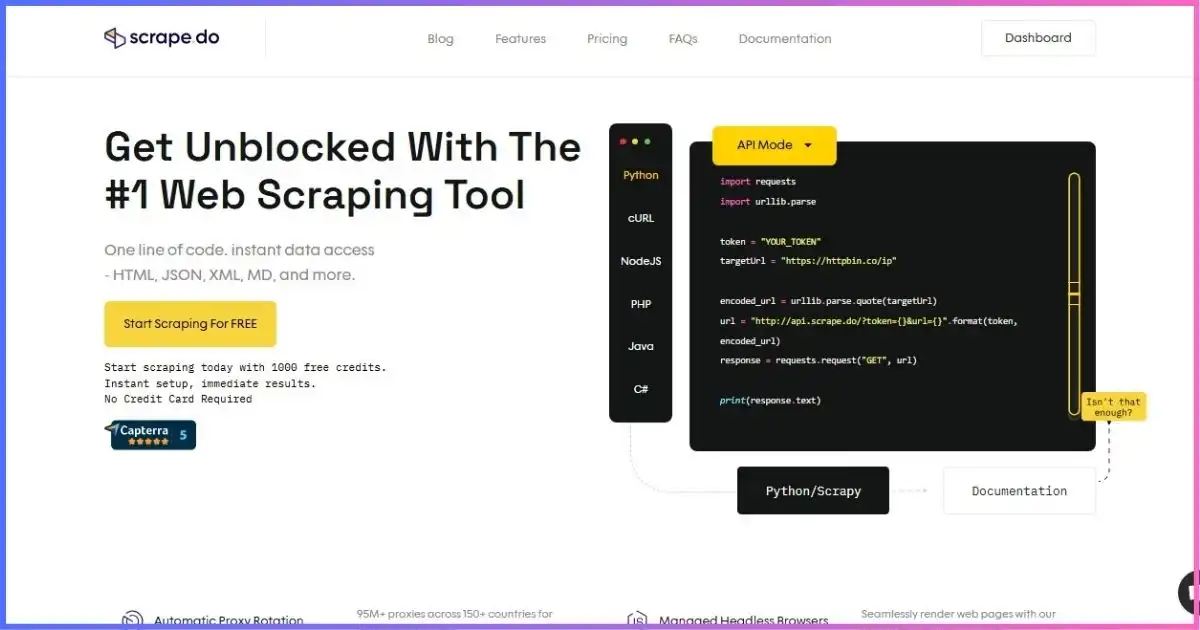
Scrape.do documentation advertises more than 150 million IPs and the pricing page advertises geotargeting across 160+ countries. These are provider-reported marketing figures, not independently counted inventory or availability guarantees. Its standard credit model groups residential and mobile routes together; test the exact target, location, and identity behavior needed.
Both support persistent identity patterns for multi-step browsing. Sticky sessions help when consecutive requests must appear related, but a blocked identity can contaminate the entire sequence. Rotate on access failures, limit session life, and avoid sending sensitive cookies without reviewing data handling and contracts.
Developer experienceAPIs, Async Jobs, and Integrations
| Surface | ScrapingAnt | Scrape.do |
|---|---|---|
| Direct HTTP API | General, Markdown, Extract, and Usage endpoints | Synchronous retrieval endpoint with request parameters |
| Async jobs | No comparable native job workflow verified | Submit, poll, cancel, retrieve temporary results, or receive webhooks |
| Proxy Mode | Yes; same credit model | Yes; shares API subscription |
| SDKs | Python and JavaScript clients | Standard HTTP integration patterns |
| Automation | MCP server, Make app, n8n community node, GitHub Action | Async webhooks integrate into customer workflows |
| Native storage/scheduler | No durable dataset store or Apify-like scheduler verified | Async results temporary; no equivalent durable store |
ScrapingAnt has the richer set of named integrations; Scrape.do has the stronger native async-job story. With either provider, an application can call the service using ordinary HTTP techniques such as those in the MDN Fetch API reference. Durable storage, record validation, alerting, retention, and most orchestration remain customer responsibilities.
Published limits need verificationConcurrency, Throughput, and Reliability
ScrapingAnt’s current site and migration guide advertise no concurrency cap or unlimited concurrent requests. However, its current error documentation still defines HTTP 409 as “concurrent requests limit exceeded” and advises retrying or upgrading. Treat “unlimited” as a reason to load-test, not permission to send an unbounded burst.
Scrape.do’s pricing page lists 5, 10, 50, 100, and 200 concurrent main-API requests from Free through Advanced. Its Async API documentation conflicts on the middle tiers, listing 5, 5, 15, 40, and 200, plus separate async pools of 2, 2, 5, 12, and 60. We use pricing-page values in plan tables but recommend written confirmation for throughput-sensitive deployments.
Scrape.do advertises 99.98% success on its homepage, while both providers make broad infrastructure claims. We did not run a controlled benchmark and do not convert those claims into a universal winner. Measure median and p95 latency, correct-content rate, accepted-record rate, credits consumed, retry rate, and provider errors on your own domains.
Important trust decisionProxy Mode Security Caveats
Both providers document a Proxy Mode that lets proxy-compatible applications use their scraping infrastructure. ScrapingAnt says SSL verification must be disabled. Scrape.do says the client must trust its certificate authority or disable SSL verification. Disabling certificate verification weakens transport authentication and should never become a casual production default.
Workload winnersWhich Tool Is Better for Your Use Case?
| Use case | Better starting point | Why |
|---|---|---|
| Recurring free development/testing | ScrapingAnt | 10,000 monthly credits versus 1,000 |
| Lowest paid entry | ScrapingAnt | $19 Enthusiast versus $29 Hobby |
| LLM-ready page content | ScrapingAnt | Dedicated Markdown endpoint |
| Prompt-to-JSON extraction | ScrapingAnt | Typed and nested AI extractor |
| Rendered datacenter pages | Scrape.do | 5 credits versus 10 |
| Residential/mobile retrieval | Scrape.do | 10 standard credits versus 25 residential |
| Rendered residential pages | Scrape.do | 25 credits versus 125 |
| Native async API with webhooks | Scrape.do | Documented jobs, polling, cancellation, webhooks |
| Named automation integrations | ScrapingAnt | MCP, Make, n8n, GitHub Actions |
| Broad country selection | Scrape.do | 160+ advertised versus 24 API-selectable countries |
Read the individual ScrapingAnt review and Scrape.do review for deeper product detail. For a wider shortlist, see our best web scraping tools guide and ScraperAPI vs Scrape.do comparison.
Suggested pilot decision weights
Adjust these weights before testing so the decision matches your workload rather than our assumptions.
- 30% Validated output quality — complete, accurate, correctly localized records.
- 25% Accepted-record cost — fees, credits, retries, and labor.
- 20% Workflow fit — Markdown/AI versus async/unblocking needs.
- 15% Throughput — sustained rate and tail latency.
- 10% Governance — security, retention, access, support.
A fair purchasing testHow to Compare the True Cost
The fair denominator is total provider and engineering cost per accepted record. Subscription cost per credit is useful only when the two providers spend equal credits on the same validated output—which their rendered and residential modes clearly do not.
- Define accepted output.Specify required fields, correct locale, freshness, uniqueness, and error rules.
- Build a representative URL set.Include static, rendered, protected, regional, long, and unusual pages.
- Use the cheapest valid mode.Do not enable residential or rendering globally because a subset of URLs needs it.
- Record cost headers.Log credits, status, mode, location, latency, retries, and validation outcome.
- Price extraction work.Include ScrapingAnt AI character charges or the customer parser and maintenance needed with Scrape.do.
- Load-test responsibly.Confirm sustained concurrency, error behavior, rate limiting, and retry backoff.
- Compare validated economics.Divide fees, infrastructure, and labor by accepted records—not attempted URLs.
Also confirm authorization and target policy. The Robots Exclusion Protocol in RFC 9309 standardizes robots.txt behavior, but it does not replace terms-of-service, privacy, copyright, data-rights, or legal review.
Balanced trade-offsScrapingAnt and Scrape.do Pros and Cons
ScrapingAnt
Pros
- Generous 10,000-credit recurring free tier
- Low $19 paid entry
- Dedicated HTML, Markdown, and AI extraction endpoints
- Typed and nested prompt-driven JSON
- MCP, Make, n8n, GitHub Action, Python, and JavaScript integrations
- Failed/error requests documented as zero credit
Cons
- Rendered residential requests cost 125 credits
- Unused credits do not roll over
- AI extraction adds character-based charges
- 24 API-selectable countries in current proxy docs
- Unlimited-concurrency claim conflicts with HTTP 409 docs
- Proxy Mode asks clients to disable SSL verification
Scrape.do
Pros
- Strong standard economics for rendered and residential work
- 250,000 credits on the $29 Hobby plan
- Core features advertised across all plans
- 160+ countries advertised for geotargeting
- Sync and Async APIs, webhooks, and Proxy Mode
- Annual terms provide twelve months for ten payments
Cons
- Only 1,000 recurring free credits
- Named domains may cost 10–200 credits
- Parsing and durable storage usually remain customer-owned
- Async results are temporary
- Pricing and async concurrency tables conflict
- Proxy Mode requires custom CA trust or disabled verification
Bottom line: start with ScrapingAnt for AI/Markdown workflows and low-cost experimentation. Start with Scrape.do when browser rendering, residential identity, async retrieval, or broad country targeting dominates.
Frequently asked questionsScrapingAnt vs Scrape.do FAQ
Is ScrapingAnt better than Scrape.do?
Which is cheaper, ScrapingAnt or Scrape.do?
Which has the better free plan?
Which is better for JavaScript rendering?
Does ScrapingAnt extract structured data?
Does Scrape.do offer an Async API?
Do unused credits roll over?
Are their proxy pool figures independently verified?
Is Proxy Mode safe?
ScrapingAnt Wins AI Value; Scrape.do Wins Rendered Retrieval Value
Choose ScrapingAnt when your priority is affordable experimentation, Markdown for LLM workflows, prompt-based structured extraction, or integration through MCP, Make, n8n, and GitHub Actions. Its 10,000-credit recurring free tier and $19 Enthusiast plan make it easy to test, while its AI layer can eliminate some parser engineering.
Choose Scrape.do when a meaningful share of pages needs JavaScript rendering, residential/mobile routing, async processing, or wide country selection. Its standard five-credit rendered datacenter and 25-credit rendered residential/mobile modes are substantially more efficient than ScrapingAnt’s ten and 125 credits.
Our recommendation: pilot both on the same representative URL set. Select the provider with the lower total cost per validated result after credit multipliers, extraction work, retries, concurrency, storage, and maintenance—not the one with the larger headline pool or nominal allowance.
Sources & comparison methodology
Research scope: official public pricing and documentation reflected in the project’s September 18, 2026 research. We reviewed plans, credits, browser modes, proxies, locations, AI extraction, Async API, Proxy Mode, concurrency, support, and integrations. No paid checkout, private contract review, or controlled cross-provider benchmark was performed.
Method: monthly prices share a dollar scale. Credit costs share a 125-credit scale. Theoretical capacity divides plan credits by documented standard request cost and does not represent guaranteed responses or accepted records. Pool, success, and concurrency claims remain labeled as provider-reported. The pilot donut shows suggested editorial weights, not performance results.
Official ScrapingAnt material represented: homepage/pricing, credit-cost, AI extractor, proxy settings, Proxy Mode, MCP, Make, n8n, GitHub Action, and error documentation. Official Scrape.do material represented: pricing, request-cost, headless-browser, Async API, and Proxy Mode documentation.
Affiliate disclosure: This article contains affiliate links. We may earn a commission if you purchase through them, at no extra cost to you. This does not change the comparison. Prices, credits, and limits can change; verify live checkout and contract terms. Scrape only where lawful and permitted.