5 Best Web Scraping Tools: APIs, No-Code Scrapers, and Automation Platforms
Apify is the best web scraping tool overall for developers and teams that want an end-to-end platform: programmable JavaScript/Python Actors, a huge ready-made tool marketplace, schedules, webhooks, datasets, queues, proxy access, and integrations. It is not the simplest or cheapest choice for every job, however.
ScrapingAnt is our value API pick, Scrape.do is the simplest all-features API, Octoparse is best for no-code desktop-to-cloud workflows, and ScraperAPI is best for mature retrieval pipelines and structured endpoints. This guide compares what each credit or plan actually buys—not just the headline price.
Which web scraping tool should you choose?
Choose Apify for custom crawlers, reusable workflows, storage, and scheduling in one cloud. Choose Octoparse if business users need a visual builder. Choose ScrapingAnt for low-cost browser/API access plus AI extraction, Scrape.do for a focused fetch-and-unblock API with every feature on every plan, or ScraperAPI for structured endpoints, Crawler, DataPipeline, and high-volume tiers.
Table of Contents
Start with architectureThe Four Kinds of Web Scraping Tool
| Category | What it handles | Best fit | Tools here |
|---|---|---|---|
| Cloud automation platform | Code, runtime, schedules, queues, storage, proxies, integrations | Reusable and complex workflows | Apify |
| Managed scraping API | Fetching, proxy rotation, retries, rendering, anti-bot handling | Developers who own parsing/storage | ScrapingAnt, Scrape.do |
| No-code builder | Visual selection, pagination/click flows, local/cloud runs, exports | Analysts and operations teams | Octoparse |
| API + pipeline suite | Managed retrieval plus structured endpoints, scheduled batch jobs | Production acquisition pipelines | ScraperAPI |
Side by sideBest Web Scraping Tools Compared
| Tool | Paid entry | Free access | Primary model | Rendering / proxies | Workflow features |
|---|---|---|---|---|---|
| Apify | $19/mo + PAYG | $5 monthly usage | Compute/resources + Actor events | Browser code, residential/DC, Unblocker | Schedules, webhooks, datasets, queues, integrations |
| ScrapingAnt | $19/mo; 100K credits | 10K credits monthly | 1–125+ credits/request | Managed Chrome; DC/residential | HTML, Markdown, AI JSON; integrations; no native durable store verified |
| Scrape.do | $29/mo; 250K credits | 1K credits monthly | 1–25 credits standard modes; named domains may cost more | JS/browser; DC/residential/mobile | Async jobs/webhooks; customer owns durable storage |
| Octoparse | $83 monthly or $69/mo annual | 10 local tasks | Tasks/cloud processes + add-ons | Built-in browser; paid cloud IP rotation | Visual builder, schedules, exports, API |
| ScraperAPI | $49/mo; 100K credits | 5K trial; FAQ also lists 1K free plan | 1–75 credits core API | Rendering, premium/ultra proxies | Crawler, structured endpoints, DataPipeline, AI parser |
USD public pricing checked September 17, 2026. “Paid entry” plans are not equivalent bundles. Promotions, taxes, Actor-specific charges, and enterprise terms can change.
Lowest monthly paid plan commitment
Shared scale; included capacity and billing units differ.
Entry-plan headline allowance
Different units: credits are not pages; Octoparse uses tasks. Log scale is avoided—bars are each normalized to the largest item within its own unit family only.
Starter
credits
credits
Standard
credits
Editorial fit radar: full platform vs focused API
Qualitative decision aid, not a measured performance test. Blue: Apify. Green: Scrape.do.
Ranked reviewsThe Best Web Scraping Tools in Detail
Apify — build, run, schedule, store, and integrate complete workflows
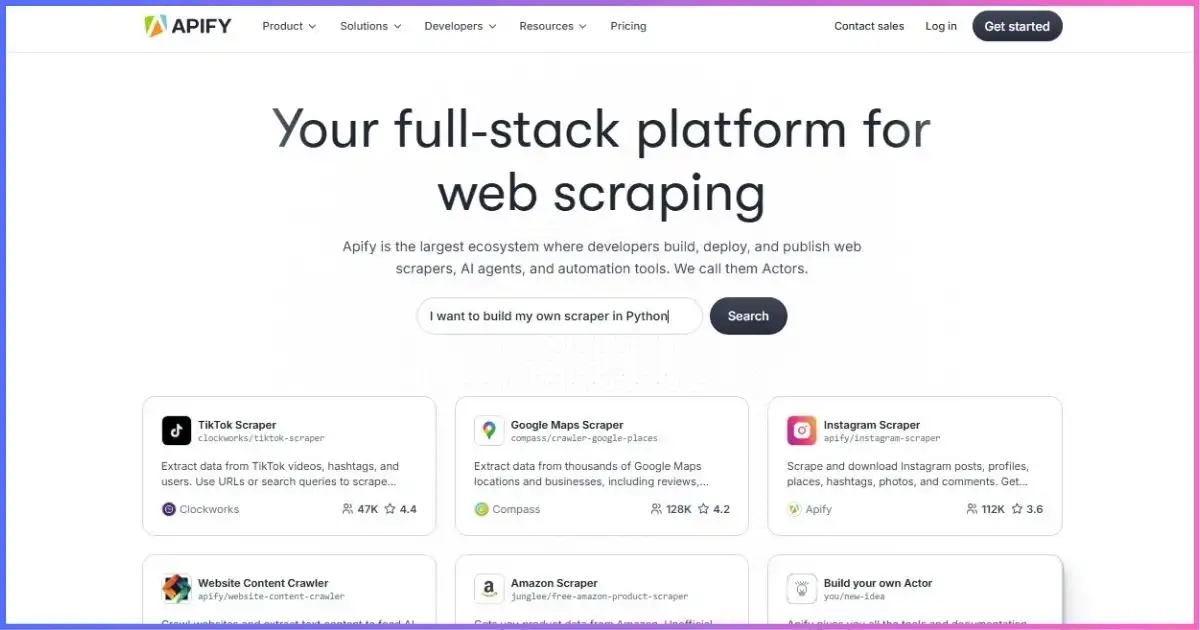
Apify is the most complete platform here. Actors are serverless JavaScript or Python programs that can run manually, through tasks, schedules, API calls, webhooks, or other Actors. Datasets store tabular results, key-value stores hold arbitrary outputs, and request queues coordinate URLs. The Store advertises more than 69,000 web-data and automation tools, though quality, maintenance, and billing vary by Actor.
The free plan includes $5 monthly usage. Starter costs $19 monthly with $19 prepaid usage, $0.20 per compute unit, 64 GB maximum Actor RAM, and 32 concurrent runs. Scale is $199 with $0.16/CU and 128 concurrent runs; Business is $999 with $0.13/CU and 256. Proxy, storage, transfer, and some Actor event charges can add to compute. Rental pricing is being retired in favor of pay-per-event or pay-per-usage models.
Pros
- End-to-end programmable platform
- Huge ready-made Actor ecosystem
- Native scheduling, storage, queues, webhooks
- JavaScript/Python, REST API, integrations
Cons
- Multi-part billing takes work to forecast
- Actor quality and pricing vary
- More learning curve than one-endpoint APIs
- Unused monthly usage expires
Read our Apify review.
ScrapingAnt — managed Chrome, Markdown, and AI extraction from $19
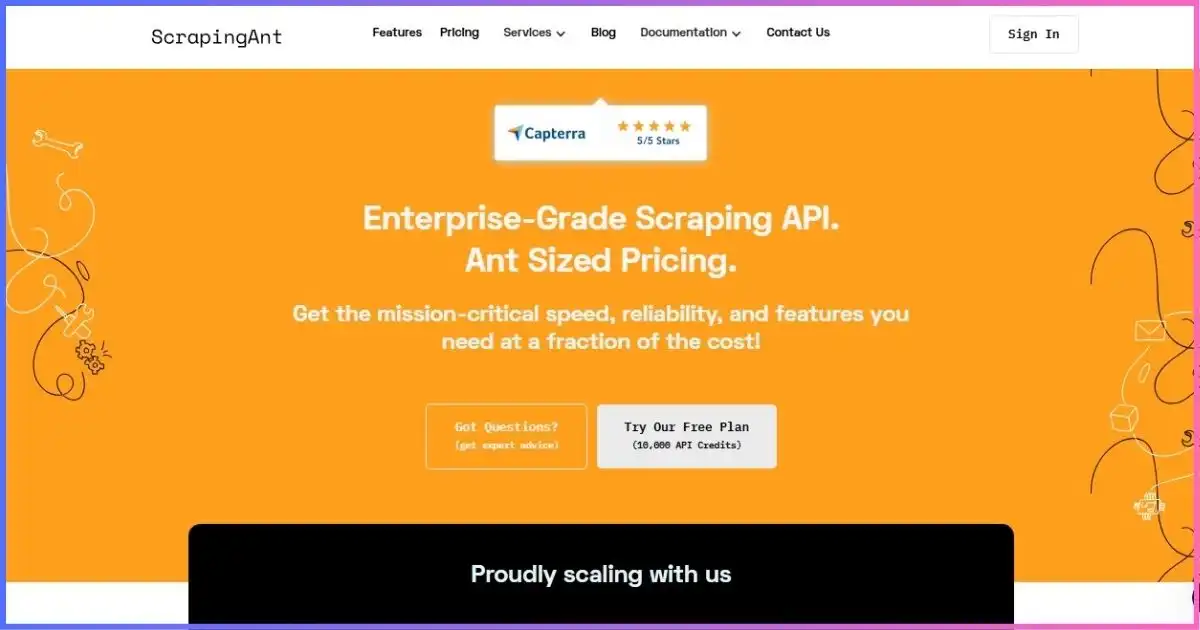
ScrapingAnt offers HTML fetching, LLM-ready Markdown, and prompt-described structured JSON through focused endpoints. Managed Chrome supports selector waits, custom JavaScript, cookies, headers, page-source modes, and datacenter or residential routing. Integrations include REST, proxy mode, MCP, Make, n8n, GitHub Actions, and JavaScript/Python clients.
The free plan includes 10,000 monthly credits; Enthusiast is $19 for 100,000 and Startup $49 for 500,000. A simple datacenter request costs 1 credit, rendered datacenter 10, residential 25, and rendered residential 125. Thus, 100K credits theoretically cover 100K simple DC requests but only 800 rendered residential requests. AI extraction adds a character-based charge to the underlying request.
Pros
- Low paid entry and recurring free plan
- HTML, Markdown, and typed AI JSON
- Managed browser and integrations
- Failed/error requests advertised as free
Cons
- Residential + browser costs 125 credits
- No native durable dataset store verified
- Concurrency marketing and error docs conflict
- Proxy mode requires a security review
Read our ScrapingAnt review.
Scrape.do — a focused API with every core feature on every plan
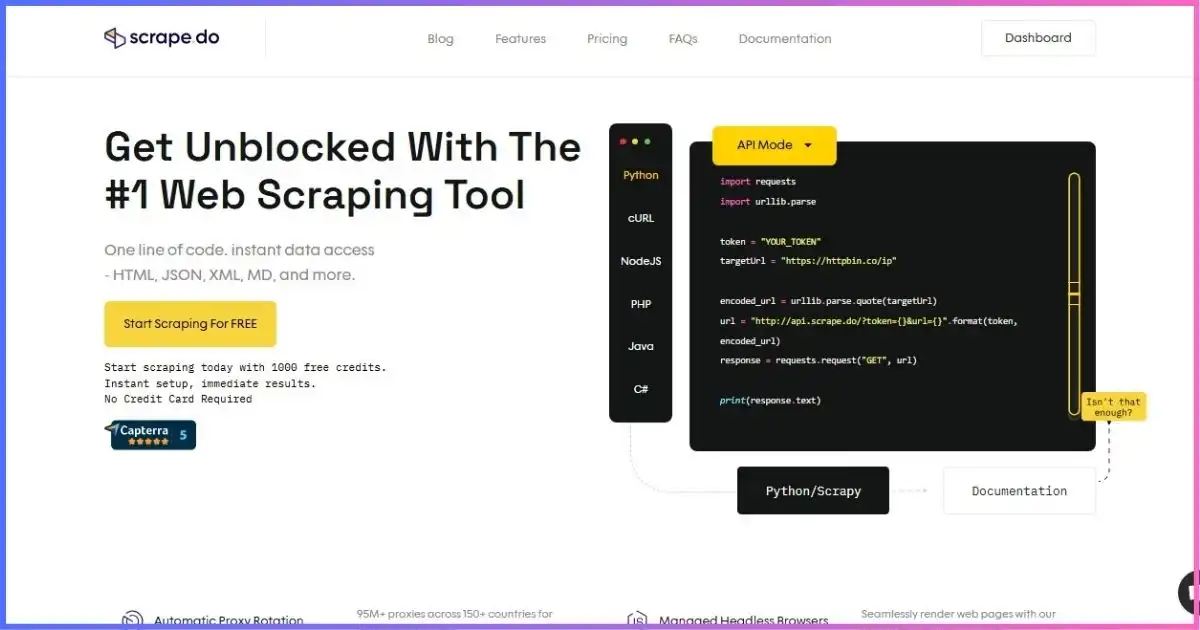
Scrape.do minimizes feature gating: even Free includes datacenter and residential/mobile proxies, JavaScript rendering, browser interaction, geo-targeting, and sticky sessions. It is a strong fit when developers want managed retrieval but prefer to own parsing, validation, scheduling, and durable storage.
Free supplies 1,000 monthly credits and five concurrent requests. Hobby is $29 for 250,000 credits; Pro $99 for 1.25M; Business $249 for 3.5M. Standard datacenter access costs 1 credit, rendered DC 5, residential/mobile 10, and rendered residential/mobile 25. Some named domains use automatic profiles costing 10–200 credits. Pricing and async documentation currently disagree on some concurrency limits, so load-test the intended mode.
Pros
- All core features on every plan
- Low credit multipliers
- Async API and webhooks
- 160+ country targeting advertised
Cons
- Named domains may cost up to 200 credits
- Concurrency docs conflict
- No Apify-like durable workflow store
- Proxy mode certificate setup needs review
Read our Scrape.do review.
Octoparse — visual task building for analysts and operations teams
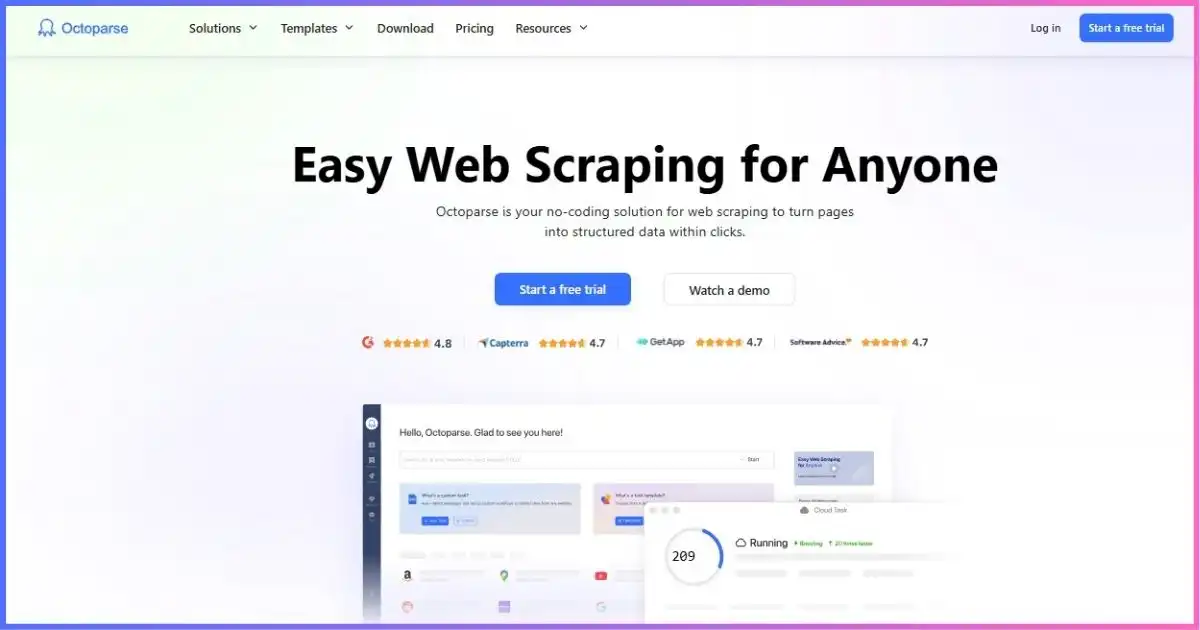
Octoparse replaces code with a desktop browser and visual workflow: click fields, define pagination, loops, conditions, and interactions, then run locally or in the paid cloud. The free plan supports 10 tasks and local execution. Standard adds 100 tasks, up to three current pricing-page cloud processes, schedules, rotating cloud IPs, CAPTCHA solving, 500+ templates, exports, and API access.
Standard costs $83 month-to-month or is advertised from $69 monthly on annual billing. Professional costs $299 monthly or $249 annual-effective, with 250 tasks, up to 20 cloud processes, cloud destinations, Advanced API, priority support, task review, and training. Residential bandwidth, CAPTCHA usage, paid templates, crawler setup, and managed service can add cost.
Pros
- Accessible visual workflow builder
- Local free tier
- Cloud schedules and exports on paid plans
- Large preset-template library
Cons
- Highest entry subscription here
- Some templates/add-ons cost extra
- Current vs older concurrency docs differ
- Custom tasks still need desktop configuration
*Annual total advertised as $829; rounded effective rate. Read our Octoparse review.
ScraperAPI — retrieval API, structured endpoints, Crawler, and DataPipeline
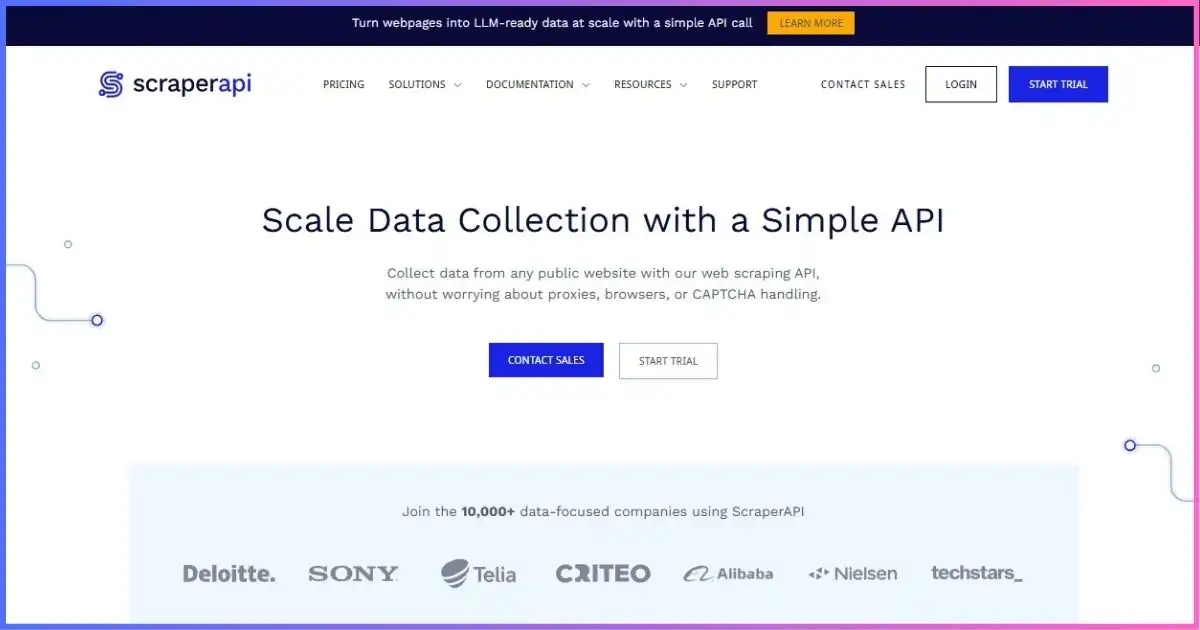
ScraperAPI has expanded beyond a single retrieval endpoint. It now documents synchronous and asynchronous APIs, proxy port, structured endpoints, SDKs, Crawler, AI Parser, MCP, n8n integration, and DataPipeline. DataPipeline accepts fields, CSV, or webhook inputs, supports schedules through cron, and returns saved downloads or webhook results. Structured JSON/CSV is target-dependent—not universal.
Hobby is $49 for 100K credits and 20 threads; Startup $149 for 1M/50; Business $299 for 3M/100 and global geotargeting. A normal request costs 1 credit, Amazon 5, rendering or premium proxy 10, Google/Bing 25, LinkedIn 30, and ultra-premium plus rendering 75. The pricing hero offers a seven-day 5K-credit trial, while its FAQ also describes a 1K-credit free plan; check signup.
Pros
- Many invocation and workflow paths
- Structured endpoints for supported targets
- DataPipeline scheduling/delivery
- Credit-cost header and max-cost controls
Cons
- Advanced modes consume up to 75 credits
- Free messaging is inconsistent
- Global geo starts at Business
- Pipeline uses a separate credit table
Read our ScraperAPI review.
The pricing trapWhat 100,000 Credits Actually Buys
| Tool / 100K credits | Simple/basic | Rendered DC | Residential | Rendered residential / premium |
|---|---|---|---|---|
| ScrapingAnt | 100,000 | 10,000 | 4,000 | 800 |
| Scrape.do | 100,000 | 20,000 | 10,000 | 4,000 |
| ScraperAPI | 100,000 normal | 10,000 rendered | 10,000 premium | 4,000 premium + render; 1,333 ultra + render |
Theoretical maximum successful responses using documented core multipliers. Named domains, bot protection, screenshots, AI extraction, pipelines, and target-specific profiles can differ. “Accepted record” yield will be lower if returned content fails validation.
Budget correctlyUse Cost per Accepted Record
Include the plan, compute, proxy traffic, credit multipliers, transfer, storage, retries, templates, CAPTCHA services, and engineering labor. A cheaper API can cost more if it requires custom orchestration and repair; a full platform can cost more if your job only needs one HTTP endpoint.
- Define accepted output. Specify fields, validation, freshness, geography, and delivery format.
- Classify target difficulty. Static HTML, rendered app, protected marketplace, SERP, and authenticated pages need different modes.
- Run the same URL set. Use easy, hard, regional, and long-tail pages; never benchmark only vendor demos.
- Log actual consumption. Record response cost headers, retries, bytes, runtime, and add-on charges.
- Validate content. Detect block pages, empty shells, wrong locales, duplicates, and stale values.
- Compare total cost. Divide provider plus labor cost by accepted records, then repeat at expected concurrency.
GovernanceResponsible Web Scraping
Collect only data you are authorized to access. Consider contracts, privacy, intellectual property, database
rights, computer-access laws, and target restrictions with qualified counsel when risk is material. RFC 9309 defines the
Robots Exclusion Protocol, but robots.txt is neither an authorization grant nor a complete legal
test.
Use per-domain throttles, exponential backoff, caching, data minimization, credential isolation, retention limits, and audit logs. Avoid bypassing authentication or collecting sensitive/personal data without a lawful basis.
FAQWeb Scraping Tool Questions
What is the best web scraping tool overall?
Apify is the best overall for programmable, end-to-end workflows. Octoparse is better for no-code users, while focused APIs are faster to integrate when you already own parsing and storage.
What is the best free option?
It depends on the test: Apify gives $5 monthly platform usage, ScrapingAnt 10K recurring credits, Scrape.do 1K monthly credits, Octoparse 10 local tasks, and ScraperAPI advertises a 5K trial while its FAQ also lists a 1K free plan.
Which tool is easiest for beginners?
Octoparse is easiest for non-programmers because its desktop builder models extraction as visual steps. Developers who only want an endpoint may find Scrape.do or ScrapingAnt quicker.
Which tool handles JavaScript sites?
All five can handle JavaScript, but through different models: Actor/browser code in Apify, managed browsers in the APIs, and visual browser actions in Octoparse. Rendering usually increases credits, time, or add-on cost.
Are published success rates comparable?
No. Target lists, geography, request modes, retry policies, and validation rules differ. This guide does not rank providers by unsupported cross-vendor performance claims.
Final Verdict
Apify is the best web scraping tool overall when you need a durable platform rather than only page retrieval. ScrapingAnt offers the most attractive low-cost API entry, Scrape.do keeps every core feature available from Free upward, Octoparse is the clear no-code choice, and ScraperAPI has the deepest adjacent retrieval and pipeline suite.
Start with a capped, representative pilot. The winner is the tool with the lowest reliable cost per accepted record and the smallest operational burden for your team.
Disclosure: This article contains affiliate links. We may earn a commission at no extra cost to you. Rankings reflect product fit and official-source research, not commission rates. Prices and features were checked September 17, 2026 and can change. No paid checkout or controlled cross-provider performance benchmark was performed.
Sources & comparison methodology
We reviewed current official pricing, documentation, product pages, help centers, and billing guidance on September 17, 2026. We preserved billing units, multipliers, minimum plans, annual-billing context, and known documentation conflicts. Vendor uptime, pool, and success claims were not converted into comparative scores.
- Apify: pricing, Actor Store/running, storage, integrations, security, usage limits, and billing documentation.
- ScrapingAnt: pricing, credit costs, HTML/Markdown/AI endpoints, proxy, MCP, and integration documentation.
- Scrape.do: pricing, request costs, browser, async API, and proxy-mode documentation.
- Octoparse: pricing, official pricing guide, templates, cloud extraction, scheduling, API, and subscription help.
- ScraperAPI: pricing, credit costs, structured endpoints, DataPipeline, Crawler, and result-format documentation.
- Neutral technical references: MDN Fetch API and IETF RFC 9309.
Ranking criteria: workflow completeness, access methods, parsing/storage/orchestration, pricing accessibility, cost transparency, developer or no-code experience, integrations, support, and fit for the stated use case.