CyberGhost VPN vs Private Internet Access
CyberGhost VPN vs Private Internet Access is a close contest between two Kape-owned services built for different users. CyberGhost prioritizes simplicity: streaming-, downloading-, and gaming-labeled servers, seven-device support, a 45-day refund period on longer plans, and a friendly interface. Private Internet Access (PIA) prioritizes control and value: unlimited connections, open-source apps, advanced split tunneling, configurable WireGuard/OpenVPN behavior, and VPN-side port forwarding.
After comparing current prices, renewal terms, privacy evidence, infrastructure, networks, apps, streaming, torrenting, gaming, and travel tools, PIA wins narrowly, 8.9/10 to CyberGhost’s 8.8/10. CyberGhost remains the better choice for beginners and streaming-first users; PIA is stronger for households, torrent users, and anyone who wants lower long-run costs with deeper networking controls.
Is CyberGhost Better Than Private Internet Access?
CyberGhost is better for beginners, streaming-server discovery, wider country coverage, and a longer trial-by-refund period. It covers 100 countries and 125 locations, organizes servers by use case, allows seven devices, and gives eligible six-month or longer plans a 45-day money-back window. Its $51.74 introductory 26-month charge is lower than PIA’s current long-term first payment.
PIA is better overall for long-term value, device-heavy households, privacy transparency, split tunneling, and P2P. It allows unlimited devices, publishes open-source apps, supports granular desktop and DNS routing rules, and offers VPN-side port forwarding in supported non-US regions. Its current $69.81 three-year renewal is dramatically cheaper than paying CyberGhost’s $51.74 annual renewal three times.

Table of Contents
- CyberGhost vs PIA overview
- 12-round scorecard
- Pricing, renewal and refunds
- Privacy, ownership and audits
- Security and protocols
- Servers and network design
- Speed and reliability
- Apps, devices and split tunneling
- Streaming and smart TVs
- Torrenting and port forwarding
- Gaming
- Travel and restrictive networks
- Support and ease of use
- Which VPN should you choose?
- Frequently asked questions
- Final verdict
- Sources and methodology
At a glanceCyberGhost VPN vs Private Internet Access Comparison
Both subscriptions include their full standard VPN networks; neither requires a premium tier to unlock ordinary countries or WireGuard. Optional Dedicated IP and security products are excluded from the core score except where their design is directly relevant. This keeps the comparison focused on what every standard subscriber receives.
| Category | CyberGhost VPN | Private Internet Access | Winner |
|---|---|---|---|
| Overall score | 8.8 / 10 | 8.9 / 10 | PIA |
| Best for | Beginners, streaming discovery, longer refund test | Value, households, P2P, advanced controls | Depends |
| Long-term intro | $51.74 / first 26 months ($1.99/mo equivalent) | $69.81 / first 39 months ($1.79/mo equivalent) | PIA |
| Published renewal | $51.74/year | $69.81 every 3 years | PIA |
| Refund window | 45 days on 6+ month terms; 14 days monthly | 30 days for eligible new purchases | CyberGhost |
| Countries / locations | 100 / 125 | 91 / 154 | Split |
| Simultaneous devices | 7 | Unlimited | PIA |
| Protocols | WireGuard, OpenVPN, IKEv2; platform-dependent | WireGuard and configurable OpenVPN | PIA |
| Server storage | RAM-only network | RAM-only network | Tie |
| Open-source apps | No | Yes | PIA |
| Port forwarding | No | Supported non-US regions | PIA |
| Streaming workflow | Service-labeled servers | Streaming-optimized locations | CyberGhost |
USD prices verified September 19, 2026. Long terms are prepaid. Tax, region, cookies, account state and promotion routes can change the final checkout.
12-round comparison scorecard
Round count is only a summary; security, privacy, price and network quality carry more weight in the final rating.
PIA wins price, privacy transparency, security control, devices/apps, split tunneling and P2P. CyberGhost wins refunds, country coverage/discovery, streaming and ease of use. Speed and gaming/travel are close enough to tie.
Rounds 1–2 · Split decisionPricing, Renewals, and Money-Back Guarantees
CyberGhost asks for the lower first payment: $51.74 for 26 months, equal to $1.99 per month during the introductory term. The catch is renewal frequency—it renews at $51.74 every year. Its six-month plan costs $41.94 ($6.99/month), while monthly service costs $12.99.
PIA’s current offer costs $69.81 for 39 months, equal to $1.79 per month. It then advertises renewal at $69.81 every three years. PIA’s annual term is $47.88 for the first year and at renewal, while its monthly plan is $11.95. PIA costs $18.07 more at the first checkout but covers 13 additional months—and its effective price stays far lower at renewal.
First payment and normalized 3-year renewal cost
Lower is better. Introductory terms have different lengths; renewal compares three CyberGhost annual charges with PIA’s stated three-year renewal.
first payment
first payment
3 renewal years
3-year renewal
PIA wins price and renewal value. CyberGhost wins the refund-policy round: eligible six-month and longer plans have a 45-day money-back window, compared with PIA’s 30 days. CyberGhost’s monthly plan has only 14 days. Store and reseller purchases can follow different rules, and turning off renewal is not the same as requesting a refund.
Long-term value winner: PIA. Its three-year renewal costs less than half of three CyberGhost annual renewals.
See PIA’s Current Deal →Round 3 · PIA wins narrowlyPrivacy, Ownership, Jurisdiction, and Audits
Both services are owned by Kape Technologies and both now back their no-logs positions with three Deloitte Audit Romania ISAE 3000 (Revised) engagements. Both describe their production networks as RAM-only, meaning ordinary server state is not stored on persistent hard drives and clears on reboot.
CyberGhost operates from Romania. Its third Deloitte engagement, completed in late 2025 and announced in February 2026, examined VPN infrastructure, server configurations, change management, incident handling and token-based Dedicated IP. CyberGhost publishes the full report and regular transparency statistics; its first-half 2026 disclosure listed 117,539 DMCA complaints and nine police requests, while stating that activity logs were unavailable.
PIA operates from the United States, a less attractive jurisdiction on paper. Its counterweight is unusually strong operational evidence: open-source production apps, three Deloitte engagements covering 2022, 2024 and 2025, quarterly transparency reports, RAM-only servers, token-based Dedicated IP, and previous US court matters in which it said no useful activity logs existed.
PIA wins narrowly for client transparency and longer public evidence, while CyberGhost wins jurisdiction. Ownership and location should be disclosed, not treated as scoring shortcuts. The Electronic Frontier Foundation’s VPN guidance correctly frames the central issue: using a VPN shifts trust from your ISP to the VPN operator. Independent evidence and minimized collection matter more than a “no logs” badge.
Our VPN logging-policy guide explains how audits, court records, source code and transparency reports fit together.
CyberGhost privacy strengths
- Romanian operating jurisdiction
- Three Deloitte assurance engagements
- RAM-only fleet and NoSpy servers
- Public report and request statistics
PIA privacy strengths
- Open-source production apps
- Three Deloitte assurance engagements
- RAM-only fleet and court-tested history
- Quarterly transparency reports
Round 4 · PIA winsSecurity, Encryption, and VPN Protocols
Both services provide WireGuard, OpenVPN, automatic leak protection, a kill switch and DNS-level blocking. CyberGhost also offers IKEv2 on selected apps, Content Blocker, Wi-Fi automation, Identity Guard and separately operated NoSpy servers in Bucharest. Its design is approachable: select a suitable server, connect, and let the app choose sensible defaults.
PIA exposes more meaningful security controls. WireGuard handles the normal fast path, while OpenVPN supports TCP/UDP, selectable ports and adjustable AES-128/AES-256 behavior. The standard Kill Switch and Advanced Kill Switch can enforce different blocking levels, and users can select PIA DNS, existing DNS or custom resolvers. Multi-Hop can route OpenVPN through Shadowsocks or SOCKS5 before reaching the VPN server.
| Security feature | CyberGhost | Private Internet Access |
|---|---|---|
| Fast protocol | WireGuard | WireGuard |
| Legacy/compatibility | OpenVPN; IKEv2 on selected platforms | Highly configurable OpenVPN TCP/UDP |
| Kill switch | Automatic after unexpected drops; intentional disconnect turns it off | Kill Switch and Advanced Kill Switch |
| Filtering | Content Blocker for known ad/tracker/malware domains | MACE for known ad/tracker/malware domains |
| Special infrastructure | NoSpy servers operated separately in Romania | Multi-Hop through Shadowsocks/SOCKS5 |
| App source | Closed-source production apps | Open-source production apps |
PIA wins for security transparency and configuration depth. CyberGhost is safer for a novice only in the practical sense that fewer options reduce misconfiguration. Neither advertises a currently deployed post-quantum tunnel layer comparable to the leaders in that area, and neither DNS blocker is a full antivirus. See our VPN protocol guide before changing advanced defaults.
Content Blocker vs MACE
Both features block known domains at the DNS/network layer while the VPN is active. They can reduce advertising, tracking calls and access to known malicious hosts, but they do not inspect every downloaded file, remove ads embedded directly inside video streams, or replace endpoint security. False positives are possible; disable the blocker temporarily if a trusted site stops working.
Round 5 · CyberGhost wins narrowlyServer Network, Locations, and Infrastructure
CyberGhost lists 100 countries and 125 locations, plus 21 Dedicated IP locations. PIA lists 91 countries and 154 locations, including every US state. CyberGhost wins country breadth; PIA wins location granularity, particularly in the United States. Neither provider’s current primary network directory offers one dependable global server-unit count, so old “9,000+” or “35,000+” comparisons should not drive the verdict.
Published geographic coverage
Countries and app-selectable locations are different measures. Counts do not reveal physical machine totals, load or peering quality.
Both providers describe full RAM-only networks and widespread 10-Gbps connectivity. CyberGhost’s NoSpy servers are housed and operated in Romania with tighter provider control; PIA emphasizes colocated NextGen infrastructure. Both use virtual locations in markets where suitable local hardware, law or performance is unavailable, and both identify them in current location materials.
CyberGhost gets the narrow network round because it covers nine additional countries and makes task discovery unusually easy. PIA is the better US-specific network, with all 50 states and more total location entries.
Round 6 · TieSpeed and Reliability
WireGuard is the sensible default on both VPNs. CyberGhost’s task labels help users avoid unsuitable routes, while PIA displays location latency and lets experts tune OpenVPN encryption and transport. Both advertise 10-Gbps infrastructure, but a server’s uplink capacity is not the speed available to one customer.
There is no defensible universal speed winner without testing the same device, ISP, Wi-Fi, city pair and time window. Distance, congestion, ISP peering and endpoint hardware can reverse results. We score speed as a tie and recommend three median tests on nearby servers plus three on distant routes during the refund period.
Capability profile (editorial assessment)
Relative scores summarize documented capabilities, not synthetic speed percentages.
CyberGhost: strongest in ease, streaming discovery and country breadth.
PIA: strongest in privacy transparency, P2P and advanced control.
Rounds 7–8 · PIA wins bothApps, Devices, and Split Tunneling
CyberGhost permits seven simultaneous connections. PIA permits unlimited connections, removing the arithmetic for families, shared households, labs and users with many phones, computers and streaming boxes. A router can cover multiple devices with either service, but native app features and performance do not always survive manual router configurations.
Friendly apps built around activities
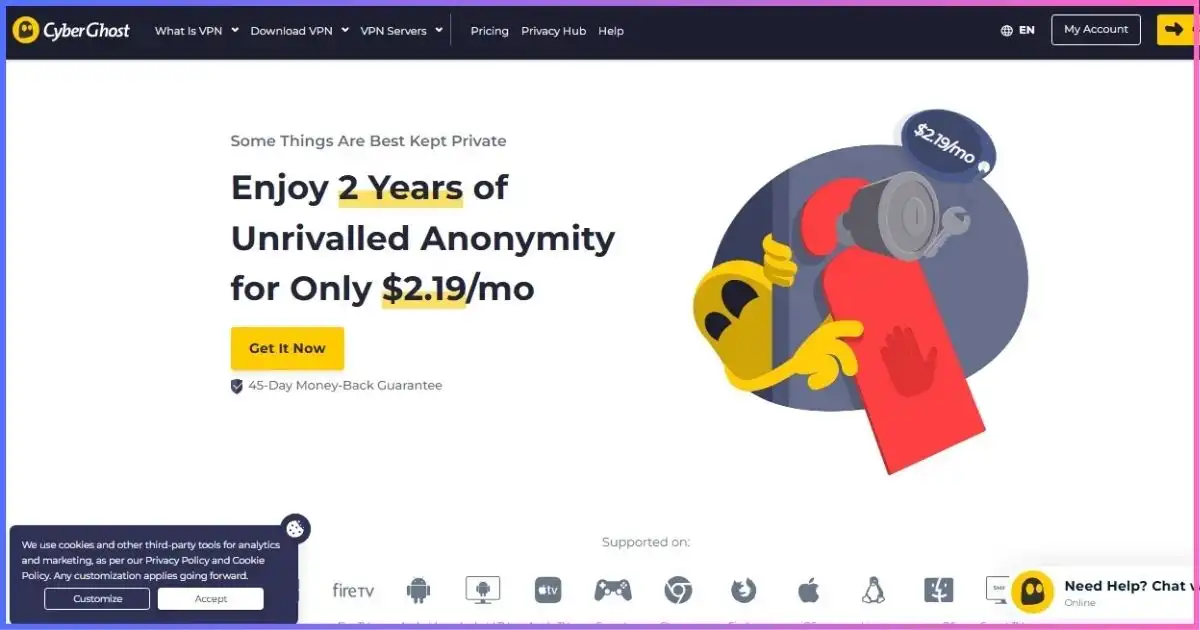
CyberGhost provides native Windows, macOS, Android and iOS apps plus Android TV and Fire TV support. Linux is primarily a command-line/manual experience. The apps group ordinary, streaming, downloading and gaming routes in a way that answers “which server should I use?” without forcing users to understand ports or DNS.
Feature parity is uneven. Windows Smart Rules cover startup, Wi-Fi behavior, URL exceptions and application triggers; Android and Android TV offer per-app split tunneling. Mac and iOS controls are narrower. CyberGhost’s automatic kill switch responds to unexpected drops but is not an always-on block after an intentional disconnect.
Unlimited connections and desktop-grade policy
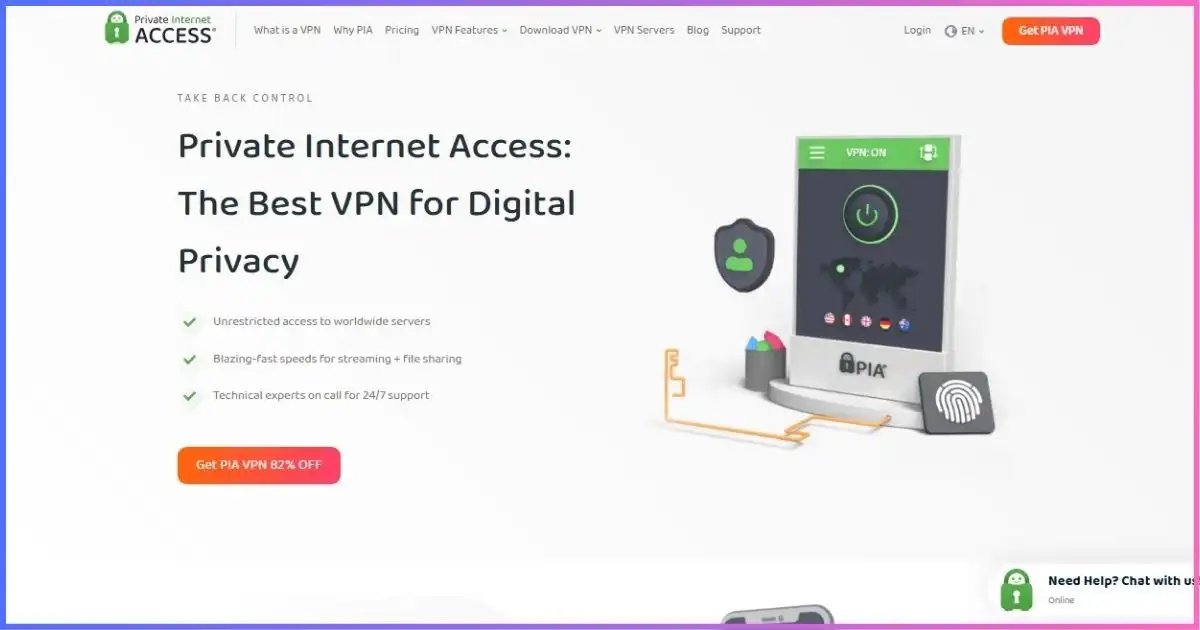
PIA supports Windows, macOS, Linux—including ARM pathways—Android, iOS, Fire TV, Android TV, Apple TV, Chrome and Firefox. Its production apps are open source. Unlimited connections are the clear device-policy win.
Desktop split tunneling on Windows, macOS and Linux supports application rules plus IPv4/IPv6 addresses or subnets. Windows and Linux can let DNS follow app rules or keep DNS inside the VPN. Android adds per-app controls, although mobile and television parity is narrower. PIA wins for both device allowance and routing granularity.
Learn what routing exceptions expose in our split tunneling vs full tunneling guide.
Round 9 · CyberGhost winsStreaming, Smart TVs, and Service-Labeled Servers
CyberGhost’s strongest differentiator is discoverability. Instead of guessing which city works, users can select streaming-optimized servers labeled for particular services and regions. Combined with a 45-day refund window, this gives beginners more time and clearer guidance to test the exact subscriptions they already pay for.
PIA offers streaming-optimized locations, unlimited devices and native Apple TV, Android TV and Fire TV pathways. It is an excellent value for households where every screen can run the app. Its location labels are less service-specific than CyberGhost’s workflow.
CyberGhost wins streaming for workflow, not because it guarantees access. Streaming services continually block VPN IP addresses, so a labeled endpoint can still fail temporarily. PIA may outperform it for a particular service or city. Test your exact services during the refund window and compare wider options in our best streaming VPN guide.
Streaming winner: CyberGhost. Service-labeled endpoints and 45 days on eligible long plans make testing easier.
Get CyberGhost for Streaming →Round 10 · PIA wins decisivelyTorrenting, P2P, and Port Forwarding
CyberGhost makes P2P discovery easy with downloading-optimized servers and protects the tunnel with an automatic kill switch. However, it blocks inbound connections and does not provide VPN-side port forwarding. Buying a CyberGhost Dedicated IP does not change that limitation.
PIA supports P2P broadly and offers VPN-side port forwarding in supported non-US regions. The assigned port and eligible locations can change, but forwarding can improve inbound peer reachability and seeding. PIA’s interface binding, Advanced Kill Switch, split-tunnel controls and DNS options also suit careful torrent configurations.
PIA is the clear torrenting winner. Connect to a forwarding-capable location, enter the assigned port in the client, disable conflicting router UPnP/NAT-PMP behavior where needed, bind the client to the VPN interface, and verify that traffic stops when the tunnel drops. An open port exposes the listening application, so keep it patched. Our torrenting VPN comparison covers other forwarding-capable services.
Round 11 · TieGaming, Ping, and NAT Behavior
CyberGhost labels gaming-optimized routes in supported apps, making likely low-latency choices easy to find. PIA displays server latency, uses fast WireGuard connections, allows unlimited devices, and can use port forwarding where supported. Neither offers a universal “open NAT” switch across consoles.
We score gaming as a tie. CyberGhost wins discovery; PIA wins configuration and household coverage. A VPN normally adds latency and only improves a route when it avoids poor ISP peering or hides a household IP during hostile sessions. Neither guarantees lower ping, easier matchmaking, open NAT, or DDoS immunity. Use our gaming VPN guide for a same-route testing method.
Round 12 · TieTravel and Restrictive Networks
CyberGhost covers more countries—100 versus PIA’s 91—and its Wi-Fi automation helps users connect automatically on unfamiliar networks. PIA supports unlimited travel devices and OpenVPN Multi-Hop through Shadowsocks or SOCKS5, which may help on some filtered networks.
Neither has a leading, dedicated cross-platform stealth protocol designed for aggressive national censorship. CyberGhost’s random-port/OpenVPN options and PIA’s proxy hop can work in some environments, but neither is guaranteed. We score this round as a tie: CyberGhost wins ordinary geographic travel; PIA has the more explicit manual proxy-obfuscation path.
Usability edge · CyberGhostCustomer Support and Everyday Ease
Both services advertise 24/7 support and maintain large help centers. CyberGhost is easier for a first-time user because server categories correspond to outcomes: streaming, downloading and gaming. Smart Rules also automate common Windows workflows without requiring deep networking knowledge.
PIA’s one-click connection is straightforward, but the app grows into a dense toolkit: protocols, ports, encryption, DNS, kill-switch modes, split rules, proxies, automation and forwarding. Power users will prefer that ceiling; beginners can create conflicts they do not understand. CyberGhost wins ease of use, while PIA wins technical supportability because behaviors and open-source clients are easier to inspect.
Buying decisionShould You Choose CyberGhost or Private Internet Access?
Choose CyberGhost if you want
- The simplest activity-based server browser
- Service-labeled streaming endpoints
- A 45-day refund period on long plans
- 100-country coverage
- NoSpy servers and easy Wi-Fi automation
- Fewer advanced decisions
Choose PIA if you want
- The lowest long-term renewal cost
- Unlimited simultaneous devices
- Open-source apps
- Granular desktop split tunneling and DNS rules
- VPN-side port forwarding
- Advanced WireGuard/OpenVPN controls
Best overall: Private Internet Access
PIA wins by a fraction because its value continues after the promotion. Unlimited devices, open-source apps, stronger desktop policy and port forwarding are durable advantages. Its US jurisdiction is a legitimate consideration, but RAM-only infrastructure, three Deloitte engagements, transparency reporting and court history provide substantial counter-evidence.
Best for beginners and streaming: CyberGhost
CyberGhost is the calmer product. Task-labeled endpoints make server selection intuitive, and the 45-day refund period gives users more time to test streaming services across their own devices and ISP. Do not rely on Smart DNS for streaming; use the full TV app or VPN tunnel.
Best for families and torrenting: Private Internet Access
Unlimited connections solve household device limits, while port forwarding and interface controls make PIA much better for serious P2P. CyberGhost’s seven slots and blocked inbound connections are meaningful constraints for these users.
FAQsCyberGhost VPN vs Private Internet Access: Frequently Asked Questions
Is CyberGhost better than Private Internet Access?
Which is cheaper, CyberGhost or PIA?
Which is faster, CyberGhost or PIA?
Which VPN is better for Netflix and smart TVs?
Which VPN is better for torrenting?
Are CyberGhost and PIA owned by the same company?
Do CyberGhost and PIA keep logs?
How many devices can I connect?
Private Internet Access Wins—CyberGhost Is Easier
Private Internet Access wins this CyberGhost VPN vs Private Internet Access comparison, 8.9/10 to 8.8/10. Its long-term renewal is far cheaper, unlimited devices serve whole households, open-source apps improve transparency, desktop split tunneling is unusually granular, and port forwarding makes it the obvious P2P choice. It is our recommendation for value seekers and technical users.
CyberGhost VPN is the better fit for beginners and streaming-first users. Its labeled server lists, 100-country reach, NoSpy options and 45-day long-plan refund period make it easy to understand and evaluate. Choose CyberGhost when convenience matters more than unlimited devices, port forwarding or the lowest multi-year renewal.
Disclosure: This article contains affiliate links. If you purchase through them, we may earn a commission at no extra cost to you. The ranking reflects current pricing, documented capabilities, trust evidence and editorial judgment—not commission rates. Prices and network figures were verified September 19, 2026 and can vary by region, tax, account status and promotion.
Sources & Comparison Methodology
We compared the standard CyberGhost and PIA subscriptions across 12 purchase decisions. Security, privacy, price and network quality received the most weight; devices, apps, streaming, P2P, gaming, travel and support completed the score. Optional antivirus and Dedicated IP products were excluded unless their underlying privacy design directly affected the comparison.
- 25% — Security, protocols and infrastructure
- 20% — Privacy, audits and transparency
- 20% — Price, renewal and refunds
- 15% — Network breadth, speed and reliability
- 10% — Streaming, P2P, gaming and travel
- 10% — Apps, devices, support and usability
Official provider material checked:
- CyberGhost checkout and plan/refund documentation: $51.74 first 26 months, $51.74 annual renewal, six-month/monthly terms and 45-/14-day guarantees.
- CyberGhost live 100-country/125-location directory, RAM-only/10-Gbps materials, NoSpy and Dedicated IP documentation.
- CyberGhost protocol, kill-switch, Smart Rules, Content Blocker, TV, P2P, Smart DNS and platform support documentation.
- CyberGhost’s third Deloitte engagement announcement/report and current transparency statistics.
- PIA live checkout: $69.81 first 39 months and every-three-year renewal, plus annual/monthly terms and refund policy.
- PIA 91-country/154-location directory, RAM-only NextGen network, open-source apps, unlimited-device and platform documentation.
- PIA’s third Deloitte engagement, transparency reporting, WireGuard/OpenVPN, kill switch, MACE, split tunneling, Multi-Hop, streaming and supported-region port-forwarding documentation.
We did not publish universal speed-loss, ping-reduction or streaming-success percentages. Both providers’ 10-Gbps labels describe infrastructure capacity, not guaranteed subscriber throughput. Neither current primary directory provides one stable global server-unit total suitable for a fair comparison.
Audits are point-in-time evidence. Promotions, renewals, server locations, platform features, port-forwarding availability and streaming access can change. Verify the final charge, renewal, tax, device support and local VPN law before purchase.