IPRoyal Proxy Review: Flexible Proxies With Traffic That Never Expires
IPRoyal stands out in a crowded proxy market for one unusually practical policy: residential traffic does not expire. Buy bandwidth now, consume it when the work arrives, and avoid paying again merely because a quiet month passed. That makes IPRoyal particularly attractive for irregular scraping, occasional localization checks, seasonal research, and agencies whose client demand comes in bursts.
This IPRoyal Proxy Review examines the complete current lineup—not just residential proxies. We break down PAYG and subscription rates, datacenter and ISP proxies, rotating and dedicated mobile options, Web Unblocker pricing, targeting, sessions, protocols, fair-use restrictions, and how the service compares with alternatives. Our conclusion: IPRoyal is a strong self-service choice when flexibility and retained bandwidth matter more than having the largest managed scraping platform.
Is IPRoyal Worth It?
IPRoyal is worth considering for buyers who need flexible residential bandwidth, granular location selection, SOCKS5 support, and a broad mix of proxy types without a large monthly commitment. Residential PAYG starts at $7.35 for 1GB, while subscriptions lower the price to $7 for the same allowance. Both are costlier per GB than some entry-level rivals, but the non-expiring allowance changes the economics for irregular use.
Best for: intermittent scraping, local SERP checks, price monitoring, sneaker and e-commerce workflows, ad verification, and teams that want one account for residential, datacenter, ISP, and mobile proxies. Look elsewhere when the absolute lowest residential unit price or a deep enterprise scraping/API stack is the priority.
Table of Contents
The essentialsIPRoyal at a Glance
IPRoyal is a self-service proxy provider with a product range broad enough to cover most common data-collection and account-management scenarios. Its residential network is advertised at 64M+ IPs in 195 countries, with country, state, and city targeting, SOCKS5 support, and rotating or sticky sessions. The catalog also includes datacenter, ISP, rotating mobile, dedicated mobile, and an automated Web Unblocker.
The value proposition is not simply “cheap proxies.” Residential entry pricing is relatively high on a per-GB basis, and the headline $1.75/GB rate requires a massive 10TB subscription commitment. IPRoyal’s real differentiator is commercial flexibility: residential bandwidth remains in the account instead of expiring at the end of a month. For a predictable high-volume pipeline, a lower monthly unit rate elsewhere may win. For stop-start work, retained bandwidth can produce the lower real cost.
Product mapIPRoyal Proxy Types Explained
| Product | Billing model | Identity / behavior | Best fit | Main caveat |
|---|---|---|---|---|
| Residential | PAYG or subscription by GB | Rotating or sticky household IPs | Localized scraping and irregular workloads | High entry rate per GB |
| Datacenter | Per IP and term | Fast hosting-provider IPs | Accessible targets, bulk requests | 100GB-per-proxy pool / fair use |
| ISP | Per IP | Datacenter-hosted ISP identity | Stable sessions and account workflows | Headline and specific-offer rates vary |
| Rotating mobile | Per GB | Shared cellular identity with rotation | Mobile-localized data and ad checks | Pricier than residential at some volumes |
| Dedicated mobile | Daily or monthly | Reserved mobile endpoint | Long sessions and controlled mobile work | Much higher fixed commitment |
| Web Unblocker | Per successful-request bundle | Managed access layer | Difficult targets and lower maintenance | Less low-level control than raw proxies |
Residential proxies
This is IPRoyal’s signature product. Addresses rotate automatically when desired, while sticky sessions preserve an identity for multi-step flows. Country, state, and city targeting support localized collection, and SOCKS5 widens client compatibility. The traffic never expires, making PAYG a genuine stored allowance rather than a monthly rental.
Datacenter proxies
Datacenter proxies emphasize cost and throughput. They are appropriate for targets that do not require consumer or carrier identity, including broad monitoring, bulk downloads, and testing. They are sold by IP and term, with longer commitments lowering the monthly equivalent.
ISP proxies
ISP proxies combine static datacenter hosting with addresses registered to internet service providers. They suit persistent sessions, accounts, carts, and workflows that need a more residential-looking identity without rotation. Public headline pricing starts from $1.80/IP, while some specific product offers display $2.40/IP; compare the exact location, sharing status, quantity, and term at checkout.
Mobile proxies
IPRoyal separates shared rotating traffic from dedicated mobile access. Rotating mobile is metered by GB and suits location/carrier sampling at scale. Dedicated mobile is rented by time and provides a more controlled endpoint for long sessions. These are different economic models and should not be compared on a single “per proxy” headline.
Cost breakdownIPRoyal Pricing: PAYG, Subscriptions, and Proxy Types
All prices below are the current figures stored in the project’s September 2026 research. Taxes, inventory, locations, coupons, and checkout totals can change. The rates are not interchangeable: a gigabyte of rotating residential traffic, a static datacenter IP, a dedicated mobile endpoint, and an automated successful request solve different problems.
Residential PAYG vs subscription pricing
| Traffic | PAYG rate | PAYG total | Subscription rate | Subscription total | Difference |
|---|---|---|---|---|---|
| 1GB | $7.35/GB | $7.35 | $7.00/GB | $7.00 | $0.35 |
| 2GB | $6.25/GB | $12.50 | $5.95/GB | $11.90 | $0.60 |
| 10GB | $5.51/GB | $55.10 | $5.25/GB | $52.50 | $2.60 |
| 10TB | Check checkout | Volume-dependent | $1.75/GB advertised | $17,500 implied | Enterprise-scale commitment |
The 10TB total is simple arithmetic from the advertised $1.75/GB tier, shown to make the commitment visible. Confirm contract, billing period, tax, and exact checkout terms before purchasing.
Residential price per GB: PAYG vs subscription
Common $0–$7.35 scale. Subscription saves roughly 4.7%–4.8% across these small packages.
Rotating mobile pricing
| Traffic | Rate | Calculated total | Unit-price reduction vs 2GB |
|---|---|---|---|
| 2GB | $6.80/GB | $13.60 | Baseline |
| 10GB | $6.00/GB | $60 | 11.8% |
| 50GB | $5.60/GB | $280 | 17.6% |
| 100GB | $5.20/GB | $520 | 23.5% |
Rotating mobile package totals
Column height uses a common $0–$520 scale. Larger packages cost more overall even as the unit rate falls.
$6.80/GB
$6/GB
$5.60/GB
$5.20/GB
Dedicated mobile, datacenter, ISP, and Web Unblocker
| Product | Current headline | How to interpret it |
|---|---|---|
| Dedicated mobile | From $10.11/day or $130/month | Longer terms shown at $123.50 and $117 monthly equivalent |
| Datacenter · 30 days | From $1.57/IP | Per-IP rental; fair-use traffic pool applies |
| Datacenter · 60 days | From $1.48/IP | Longer commitment lowers monthly-equivalent unit price |
| Datacenter · 90 days | From $1.39/IP | Lowest saved headline datacenter rate |
| ISP | From $1.80/IP | Some offers show $2.40; verify configuration |
| Web Unblocker | From $1 / 1,000 requests | Managed-request product, not raw bandwidth |
IPRoyal’s best economic feature is retained residential traffic. Buy a modest pilot, measure accepted output, and scale only after the target proves stable.
Check IPRoyal’s Current Offers →Flagship productIPRoyal Residential Proxies: Detailed Analysis
The residential network is the reason most buyers consider IPRoyal. It combines broad geographic reach, an established 64M+ advertised pool, fine location selection, sticky and rotating behavior, SOCKS5 compatibility, and bandwidth that remains available until consumed.
Rotation and sticky sessions
Rotation is best for independent requests such as discovery crawls, market scans, or SERP sampling. A sticky session keeps the same identity for multi-page navigation, carts, logins, and sequences where an IP change would look suspicious. The correct session strategy can matter more than raw pool size: excessive rotation can break state, while an overly long sticky session can accumulate reputation damage.
Location targeting
Country, state, and city controls support localized prices, inventory, search results, ads, and content. A requested city is not proof that every address will reproduce every local signal; targets may also use cookies, language, account history, device traits, GPS, or payment location. Validate actual page behavior, not only an IP geolocation lookup.
Why non-expiring traffic matters
Suppose a team buys 10GB but uses only 2GB this month. With a monthly-reset product, the unused 8GB may disappear; the effective cost of consumed traffic becomes the full plan price divided by 2GB. With IPRoyal, the remaining bandwidth stays available. This feature is most valuable when demand is unpredictable and least important when a pipeline reliably consumes its allowance each cycle.
Illustrative allowance utilization
Using a $52.50 subscription purchase for 10GB. This illustrates retained value; it is not an invoice or performance test.
The effective rate remains $5.25 per eventually consumed GB if all 10GB is later used; timing does not destroy the balance.
Carrier identityIPRoyal Mobile Proxies: Rotating or Dedicated?
Rotating mobile proxies draw from carrier-associated addresses and bill by transferred data. They fit mobile ad verification, app-store localization, carrier-specific pages, and targets where a mobile ASN changes the result. Unit rates decline from $6.80/GB at 2GB to $5.20/GB at 100GB.
Dedicated mobile proxies use a time rental instead. At $10.11/day or $130/month before longer-term discounts, the fixed commitment is much larger, but the endpoint is better suited to controlled sessions, repeat access, and work that cannot tolerate frequent identity sharing or rotation. Choose dedicated only when stability creates measurable value; otherwise rotating traffic keeps the pilot smaller.
| Requirement | Rotating mobile | Dedicated mobile |
|---|---|---|
| Billing | Per GB | Per day or month |
| Best for | Sampling many mobile identities | Long, controlled mobile sessions |
| Entry | 2GB / $13.60 calculated | From $10.11/day |
| Cost risk | Heavy pages consume traffic | Idle time still costs money |
| Selection rule | Choose for breadth | Choose for continuity |
Static optionsDatacenter and ISP Proxies
Datacenter proxies are the cost-first option: fast, predictable, and suitable for targets that do not require a household or carrier identity. Longer terms lower IPRoyal’s displayed rate from $1.57/IP for 30 days to $1.39/IP for 90 days. The discount is useful only if the IPs remain relevant for the full term.
ISP proxies occupy the middle ground. They are hosted in datacenters but registered to ISPs, providing static, residential-like identity. The researched pricing headline starts from $1.80/IP, while some specific offers show $2.40. That discrepancy is not necessarily an error; location, exclusivity, quantity, sharing, and term can change the offer. Compare the exact cart rather than transferring one teaser price across every configuration.
Managed accessIPRoyal Web Unblocker
Web Unblocker is aimed at targets where a raw proxy alone creates too much operational work. Instead of manually selecting IPs, tuning headers, managing retries, and responding to blocks, the managed layer handles more of the access process. The researched public headline begins at $1 per 1,000 requests.
That figure should not be compared directly with $/GB residential pricing. A request-based product shifts some retry and access logic to the provider, while raw proxies leave those costs in your infrastructure. Compare cost per accepted record, not cost per nominal request. A managed request can be cheaper even with a higher sticker price if it eliminates retries and engineering; the reverse is true on easy targets.
| Choose raw proxies when… | Choose Web Unblocker when… |
|---|---|
| Your team already manages headers, rotation, retries, and parsing | Access maintenance consumes disproportionate engineering time |
| Targets are stable and relatively accessible | Blocks and changing defenses drive retry waste |
| You need exact session and identity control | You prefer a simpler request interface |
| Traffic economics are predictable | Successful useful output matters more than raw transfer |
Control surfaceCoverage, Targeting, Protocols, and Sessions
The residential product advertises 195-country reach, country/state/city targeting, SOCKS5 support, and rotating or sticky sessions. Together, those cover the core requirements for localized collection. SOCKS5 is helpful for tools that do not speak conventional HTTP proxy semantics and for workloads needing more protocol flexibility.
A network count is not simultaneous guaranteed availability. “64M+ IPs” describes the advertised pool, not a promise that every city has abundant endpoints at every hour. Rare locations deserve a small availability test. Similarly, a city-targeted IP does not guarantee that a target will show the expected city if it uses its own geolocation database or other account/device signals.
IPRoyal workload-fit radar
Editorial qualitative assessment, not measured latency or success-rate data.
Evidence, not hypePerformance, Reliability, and Fair-Use Reality
This review does not invent latency, success-rate, CAPTCHA, uptime, or benchmark numbers. Proxy performance is target-specific: location, time, page size, concurrency, protocol, session length, block policy, and data validation all affect outcomes. A fast IP-check request does not predict performance on a rendered product page.
The correct unit is a usable record. Measure completed pages that pass your schema and freshness checks, then divide total cost—including failed requests, transfer, retries, parsing, and engineering—by accepted output. For static products, incorporate the 100GB-per-proxy fair-use pool and the effect of throttling or top-ups.
What to record in a pilot
- Accepted results and rejection reasons by target.
- p50, p95, and p99 response time rather than one average.
- 403, 429, CAPTCHA, timeout, empty-shell, and soft-block rates.
- Bytes per successful record and the effect of images or rendering.
- Location fidelity: language, currency, inventory, and regional content.
- Session survival across multi-step flows.
- Cost per 1,000 accepted records after all retries.
Practical workflowHow to Choose and Set Up IPRoyal
- Define the target and required identityStart with public pages, geography, volume, session length, and whether consumer, ISP, mobile, or datacenter identity is necessary.
- Choose the simplest qualifying productUse datacenter for accessible targets, residential for broad local identity, ISP for static residential-like sessions, mobile only when carrier context matters, and Web Unblocker when access maintenance dominates.
- Select PAYG or subscription rationallyPAYG protects against recurring commitment; subscription slightly lowers residential unit rates. Non-expiry reduces the penalty for overestimating demand.
- Create separate credentials or endpointsSegment projects so usage, errors, and costs can be attributed. Store credentials in a secrets manager rather than source code.
- Test representative pagesInclude list pages, details, pagination, logged-out variations, multiple regions, and known difficult states.
- Scale with controlsSet concurrency, retry ceilings, timeouts, request budgets, and automated quality checks before increasing volume.
For protocol background, see MDN’s neutral guide to HTTP proxies and tunneling. A proxy is not a consumer VPN: it routes configured application traffic and does not automatically create a device-wide privacy tunnel, kill switch, or DNS protection layer.
Workload matchingWhat IPRoyal Is Best For
Irregular and seasonal web scraping
This is the clearest fit. Researchers, agencies, and seasonal merchants can buy residential traffic before a project and retain the unused balance between bursts. The benefit grows as demand becomes less predictable.
Price and inventory monitoring
Country, state, and city targeting supports localized storefront comparisons. Sticky sessions help with pagination or carts; rotation helps independent product requests. Validate currency and inventory in the page itself rather than assuming the proxy’s geolocation is sufficient.
SEO and local search checks
Residential coverage can sample search results from many locations, but search engines also consider language, device, cookies, and account history. Use clean request state and consistent parameters to isolate location effects.
Ad verification
Residential proxies fit ordinary geo-targeted campaigns; rotating mobile fits carrier or mobile placements. Dedicated mobile is justified when the verification flow needs a stable cellular endpoint and screenshots across a longer session.
Sneaker, retail, and account workflows
Sticky residential or static ISP identities can preserve session continuity. Users must still follow retailer rules and applicable law; a proxy does not authorize account abuse, purchase-limit evasion, or access to protected systems.
Public-data research with responsible controls
Use rate limits, purpose limitation, data minimization, and documented retention. The Robots Exclusion Protocol specification (RFC 9309) explains robots.txt mechanics, but it is not a grant of permission or complete legal analysis.
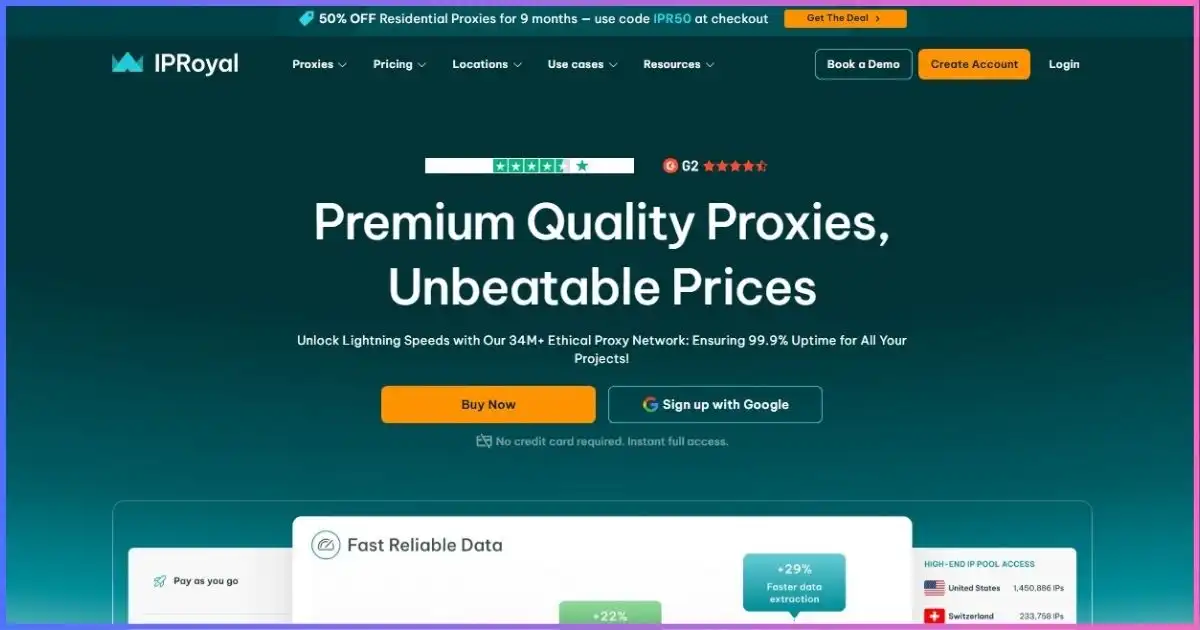
Archival project image. Use the live IPRoyal dashboard and checkout for current plan availability and terms.
Market contextIPRoyal vs Other Proxy Providers
IPRoyal wins a particular economic argument: retained residential bandwidth. It does not automatically win on entry price, pool headline, managed tooling, or every high-volume contract. The table uses the project’s current research and links only to JoshWP’s internal reviews and comparisons.
| Provider | Small residential entry* | Best reason to choose it | Main trade-off | Read next |
|---|---|---|---|---|
| IPRoyal | $7.35 / 1GB PAYG | Non-expiring traffic and broad proxy lineup | Highest small-tier rate in this group | This review |
| Webshare | $3.50 / 1GB monthly | Low-cost self-service dashboard | Monthly allowance economics | IPRoyal vs Webshare |
| ProxyShare | $9 / 10GB for 30 days | Lowest small-package total per GB | Finite 30-day validity | ProxyShare review |
| Oxylabs | $30 / 5GB | Enterprise APIs and managed collection | Larger commitment and complex catalog | IPRoyal vs Oxylabs |
| Bright Data | Promotional PAYG $4/GB | Granular controls and managed toolkit | Complex pricing; promotion eligibility | IPRoyal vs Bright Data |
*Entry offers are not equivalent: validity, pool quality, targeting, support, commitment, and promotions differ. Verify the exact live checkout.
Small-tier residential rate per GB
Directional pricing context from the current research. Lower is not automatically better; ProxyShare requires 10GB/30 days, Oxylabs 5GB, and Bright Data’s price is promotional.
IPRoyal’s advantage is not the first-GB sticker price; it is that purchased residential traffic remains usable later.
Choose IPRoyal when…
- Your residential usage is intermittent and unused traffic must retain value.
- You want residential, mobile, ISP, and datacenter options in one self-service account.
- Country/state/city targeting, sticky sessions, and SOCKS5 cover the workflow.
- You prefer a small PAYG start over a large enterprise contract.
Choose another option when…
- You reliably consume a monthly allowance and can secure a much lower unit rate.
- You need the deepest managed scraping API, browser, dataset, or enterprise service catalog.
- Your project needs verified inventory in a rare location that IPRoyal’s pilot cannot supply.
- The 100GB-per-proxy fair-use pool conflicts with a transfer-heavy static workload.
Balanced assessmentIPRoyal Pros and Cons
Pros
- Residential traffic does not expire
- 64M+ residential IPs across 195 countries
- Country, state, and city targeting
- Rotating and sticky residential sessions
- SOCKS5 support
- Residential, datacenter, ISP, and two mobile models
- Small PAYG entry without a large enterprise contract
- Managed Web Unblocker option
Cons
- $7.35 first-GB PAYG rate is relatively high
- $1.75/GB headline requires a 10TB subscription
- ISP headline pricing varies by offer
- “Unlimited” static products have fair-use thresholds
- Managed tooling is less extensive than enterprise-first platforms
- Pool count does not guarantee rare-location availability
- No independent performance benchmark established here
- Exact refund/trial terms should be checked live
How we arrived at 8.5/10
Editorial weighting uses researched current pricing, product features, documented terms, and workload fit—not fabricated performance testing.
- 25% — Residential flexibility and value retention
- 20% — Proxy catalog breadth
- 20% — Network, targeting, sessions, protocols
- 15% — Price accessibility
- 10% — Fair-use and terms clarity
- 10% — Managed tools and scaling options
FAQsIPRoyal Proxy Review: Frequently Asked Questions
Is IPRoyal legitimate?
How much do IPRoyal residential proxies cost?
Does IPRoyal residential traffic expire?
How large is IPRoyal’s residential proxy network?
Does IPRoyal support SOCKS5?
Are IPRoyal datacenter and ISP proxies really unlimited?
Should I buy rotating or dedicated mobile proxies?
What is IPRoyal Web Unblocker?
Is IPRoyal better than Webshare?
Can IPRoyal replace a VPN?
IPRoyal Is the Smart Pick for Irregular Residential Usage
IPRoyal is not the cheapest way to buy a first gigabyte, and its deepest residential discount demands an enormous commitment. Its appeal is more practical: bandwidth that does not expire, broad 195-country reach, granular targeting, sticky and rotating sessions, SOCKS5, and a catalog spanning cheap datacenter IPs through dedicated mobile access.
For a constant high-volume pipeline, compare enterprise quotes and monthly unit rates carefully. For agencies, researchers, seasonal projects, and teams that cannot predict next month’s usage, retained residential traffic can outweigh the higher sticker rate. Add a modest pilot, measure accepted-record economics, and choose mobile, ISP, or Web Unblocker only when the target genuinely requires them.
Disclosure: This article contains an affiliate link. If you purchase through it, we may earn a commission at no extra cost to you. The score reflects independent editorial analysis, not commission rates. Prices, inventory, promotions, and terms can change; confirm the live checkout before purchase. This is not legal advice.
Sources & Comparison Methodology
This article uses proxy pricing and features research of September 18, 2026.
The 8.5/10 editorial score weights residential flexibility/value retention (25%), product breadth (20%), network/targeting/session controls (20%), price accessibility (15%), fair-use and terms clarity (10%), and managed/scaling options (10%). The radar is qualitative; charts show published pricing or explicit illustrations, not latency or success claims.
- IPRoyal research: residential product and pricing pages plus the provider’s central pricing catalog.
- Comparison sources:current Webshare, ProxyShare, Oxylabs, and Bright Data pricing notes. Different billing periods, promotions, quantities, and capabilities are called out.
- Neutral context: MDN proxy/tunneling documentation and IETF RFC 9309, linked in the relevant sections.
- Images: the approved JoshWP featured image and IPRoyal site image.
Run a capped pilot before scaling. Judge providers by accepted-record rate, tail latency, location fidelity, session survival, transferred bytes, retry overhead, and total cost per usable 1,000 records.