ProxyShare Review: Pricing, Features & Who It Suits
ProxyShare sells rotating residential traffic, static residential IPs, static datacenter IPs, long-acting ISP traffic, and an unlimited-residential product. Its public rotating-residential range begins at $9 for 10 GB valid for 30 days and falls to an effective $0.67 per included GB at the displayed 3 TB tier.
The low published rate is the main attraction, but it does not answer every buying question. Product cards combine finite GB allowances with generic “unlimited bandwidth” language, several uptime statements differ across pages, and the public refund FAQ says purchased products are non-refundable. This review separates confirmed plan data from marketing claims and shows how to test cost per usable result.
Table of contents
ProxyShare at a glance
| Area | What is publicly stated | Review finding |
|---|---|---|
| Network | 75M+ residential IPs across 195+ locations | Provider-reported pool size; not an independently counted active inventory. |
| Targeting | Country and city selection for rotating residential | Useful controls, but supply can vary by requested place and time. |
| Concurrency | Unlimited sessions advertised | This is not the same as unlimited throughput or target acceptance. |
| Protocols | HTTP and SOCKS5 | Confirm port, authentication, and exact endpoint format for the chosen product. |
| Management | Endpoint generator, public API, proxy-user management, integrations | Suitable for automation once the product-specific workflow is verified. |
| Support | 24/7 support is advertised | No response-time benchmark or guaranteed support SLA was established here. |
ProxyShare products explained
A proxy relays a client’s request through another address. MDN’s proxy and tunneling guide explains the basic network role. Within that category, rotating residential, static residential, datacenter, and ISP products solve different problems and should not be compared only by the lowest number on a pricing card.
Rotating residential
Metered by GB over a displayed 30-day period. It is the clearest fit for geo-targeted collection where changing residential peers are useful. Country/city selection, unlimited sessions, HTTP/SOCKS5, and sessions up to 24 hours are advertised.
Static residential
Sold per IP for 10, 30, or 60 days. A stable IP can suit account continuity, localized QA, and workflows that do not tolerate frequent address changes. Confirm whether an IP is exclusive and how replacements work.
Static datacenter
Sold per IP for 10 to 90 days. Datacenter IPs are often efficient for less protected destinations, but their network identity is easier for some sites to classify than residential addresses.
Long-acting ISP
Sold in 30-day GB packages. The public cards position it separately from static residential service. Treat it as its own offer and confirm persistence, country choice, concurrency, and bandwidth terms.
Unlimited residential
The homepage advertises a starting point of $68.38 per day and randomly assigned countries. The qualifying volume, throughput policy, pool behavior, and limitations were not clear enough for a like-for-like chart.
Scraping products
The current catalog also markets Web Scraper API, SERP API, and Video Downloader API. These are managed tools with their own units; they should not be priced as raw proxy traffic.
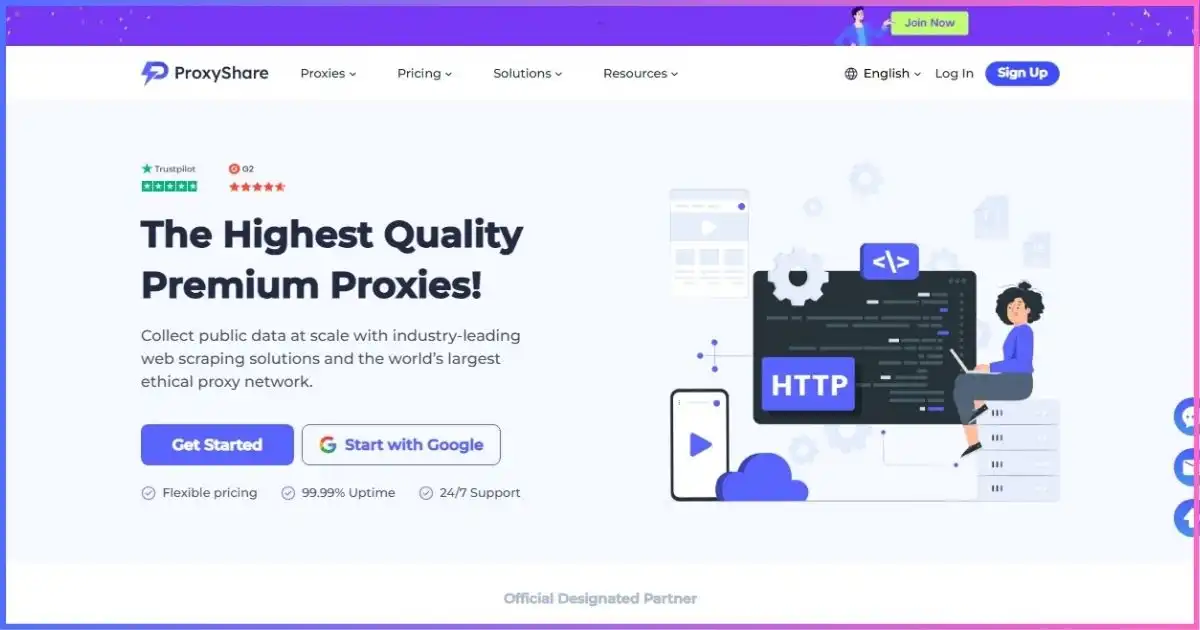
Archived provider screenshot from the supplied image list. Use the current pricing tables below for purchase decisions.
Features, targeting, sessions and authentication
ProxyShare’s rotating-residential offer contains the strongest public feature description. It advertises country/city selection, an endpoint generator, integration guides, user management through a public API, and no stated restriction on concurrent sessions. The homepage describes account/password and API extraction methods. Those points make the service approachable for scripts and third-party automation tools, but they do not prove that every product uses identical authentication or targeting.
| Capability | Rotating residential | Static residential | Static datacenter | Buying check |
|---|---|---|---|---|
| Billing basis | GB / 30 days | IP / duration | IP / duration | Do not compare per-IP and per-GB rates directly. |
| IP behavior | Rotating; sticky sessions advertised up to 24 hours | Fixed | Fixed | Test peer continuity and replacement behavior. |
| Location controls | Country and city stated | Check inventory | Check inventory | Confirm availability for the exact location. |
| Protocols | HTTP / SOCKS5 stated | HTTP / SOCKS5 stated | HTTP / SOCKS5 stated | Verify software and port compatibility. |
| Bandwidth wording | GB allowance plus “unlimited” label | Unlimited advertised | Unlimited advertised | Ask for fair-use and throughput rules. |
| API / endpoint tools | Advertised | Confirm product scope | Confirm product scope | Do not assume feature parity. |
ProxyShare pricing
These figures are the public displayed USD totals, not authenticated checkout invoices. Taxes, payment fees, discounts, renewal conditions, location availability, validity start time, and rollover were not verified at checkout. Full package totals take priority when a rounded daily or per-GB label does not reconcile exactly.
Rotating-residential effective rate
Calculated total divided by included traffic. Common scale: $0 to $0.90 per GB.
| Rotating traffic | Displayed total | Calculated rate | Validity | Best planning fit |
|---|---|---|---|---|
| 10 GB | $9 | $0.90/GB | 30 days | Integration or small target test |
| 60 GB | $52 | $0.8667/GB | 30 days | Light recurring workload |
| 100 GB | $85 | $0.85/GB | 30 days | Measured monthly collection |
| 300 GB | $240 | $0.80/GB | 30 days | Steady multi-target jobs |
| 1,000 GB | $750 | $0.75/GB | 30 days | Large validated production use |
| 3,000 GB | $2,000 | $0.6667/GB | 30 days | High-volume use after acceptance testing |
Static proxy packages
| Product | 10 days | 30 days | 60 days | 90 days |
|---|---|---|---|---|
| Static residential / IP | $5 | $10 | $16 | Not displayed |
| Static datacenter / IP | $3 | $7.80 | $12 | $16 |
Long-acting ISP packages
| Traffic | Displayed total | Calculated rate | Validity |
|---|---|---|---|
| 10 GB | $8 | $0.80/GB | 30 days |
| 40 GB | $28 | $0.70/GB | 30 days |
| 80 GB | $50 | $0.625/GB | 30 days |
| 300 GB | $150 | $0.50/GB | 30 days |
| 500 GB | $200 | $0.40/GB | 30 days |
| 1,000 GB | $350 | $0.35/GB | 30 days |
Calculate cost per useful result
Proxy bills depend on more than list price. Page size, redirects, retries, blocked responses, media downloads, and output validity all affect real cost. Begin with a small permitted sample and log transferred bytes, request status, retry count, and accepted records.
Record bytes and valid results on a small representative run.
Multiply actual transfer per job by monthly job volume.
Buy the smallest allowance that covers realistic use and margin.
Effective cost when 10 GB is actually consumed
Illustrative utilization scenario; it does not assume whether unused traffic rolls over.
fully used
10 GB used
10 GB used
The calculation is simple: package total divided by GB actually consumed within its usable period. If 10 GB is used, the $9 package remains $0.90 per consumed GB; the $52 package becomes $5.20; the $85 package becomes $8.50. A better advertised unit rate does not compensate for unused capacity unless carryover is confirmed.
| Cost component | How to estimate | Common mistake |
|---|---|---|
| Proxy traffic | Average transferred MB × attempted requests ÷ 1,000 | Counting only successful output pages |
| Retries | Retry attempts × average transferred response | Assuming failed requests consume no traffic |
| Engineering | Hours spent on integration, repair, and monitoring × internal rate | Comparing infrastructure price alone |
| Useful output | Total cost ÷ records that pass validation | Using request success as a data-quality score |
| Unused allocation | Package cost ÷ consumed GB | Assuming the advertised unit price regardless of utilization |
How to set up and test ProxyShare
- Define the legitimate task. List permitted targets, required locations, output fields, run frequency, and retention needs.
- Select the product by IP behavior. Use rotation when peer diversity matters; use a static offer when session continuity matters. Pick datacenter only where the target accepts it.
- Create a small endpoint set. Use the dashboard or endpoint generator and request only the location granularity you need. Narrow filters can reduce available supply.
- Configure authentication from current instructions. The site describes account/password and API-based extraction. Do not reuse a port or credential pattern from another product without checking.
- Assign sessions deliberately. For high concurrency, the provider FAQ advises mapping a session value to a thread or process rather than sharing one session across multiple workers.
- Measure before scaling. Compare countries, session settings, times of day, and request pacing. Record connection failures separately from target rejections and invalid output.
- Set stop conditions. Cap retries and bandwidth locally so a bad target or parsing loop cannot consume the package unexpectedly.
Performance and reliability assessment
The old article assigned response-time, uptime, success-rate, and data-accuracy figures without a reproducible test. Those numbers have been removed. ProxyShare’s public pages contain different uptime statements, while phrases such as “never blocked,” avoiding CAPTCHAs, and high anonymity are marketing claims rather than guarantees for a particular destination.
A meaningful benchmark must hold the target, request mix, geography, concurrency, retry policy, and time window constant. Even then, results describe that workload, not the whole network. Residential pool counts also cannot be translated into an availability or success percentage without knowing how the provider counts peers and how many are active in the required region.
| Metric | Recommended definition | Why it matters |
|---|---|---|
| Connection rate | Connections established ÷ attempts | Separates proxy availability from destination behavior. |
| Target acceptance | Expected HTTP/app response ÷ connected requests | Shows whether the route is useful for that destination. |
| Valid-record yield | Schema-valid, deduplicated results ÷ attempted jobs | Measures business output rather than transport alone. |
| P50 / P95 duration | Median and 95th-percentile end-to-end job time | Exposes slow-tail behavior hidden by an average. |
| Traffic per result | Total GB ÷ valid records | Connects quality and retries to price. |
| Session continuity | Workflows retaining expected IP ÷ sticky workflows | Tests the advertised session behavior. |
Advantages
- Low published residential entry price
- Rotating, static, datacenter, and ISP-oriented choices
- Country/city targeting and up-to-24-hour sessions advertised
- HTTP/SOCKS5 plus endpoint and API tooling
- Small static durations can support limited trials
Limitations
- Metered cards also use unclear “unlimited” wording
- Public refund position is restrictive
- No independent performance benchmark in this review
- Rollover, exclusivity, and detailed fair-use terms require confirmation
- Headline “from” rates can require much larger commitments
Privacy, security, support and refunds
A proxy provider sits in the request path, so teams should evaluate more than endpoint price. Review current privacy terms, credential handling, account controls, retention, processor/subprocessor information, acceptable-use rules, incident procedures, and the controls available for API tokens and team members. Do not send secrets or unnecessary personal data through a scraping workflow.
The public homepage lists support email and a chat widget and advertises 24/7 support. That establishes contact channels, but not a measured response time or contractual SLA. Before production, submit a product-specific question and record how clearly the team answers it. The response is especially important for bandwidth language, IP exclusivity, country inventory, and replacements.
Where ProxyShare can fit—and where it may not
| Use case | Likely product starting point | What to validate |
|---|---|---|
| Localized public-web research | Rotating residential | Country/city inventory, output validity, target terms |
| Price and catalog monitoring | Rotating residential or long-acting ISP | Traffic per product, retry rate, schedule, consistency |
| SEO / SERP research | Residential or provider’s separate SERP API | Location fidelity, managed-tool billing, engine rules |
| Site and ad verification | Residential with required location | Local availability, page completeness, measurement consent |
| Persistent permitted session | Static residential or datacenter | Exclusivity, reputation, replacements, session lifetime |
| Less protected bulk endpoint | Static datacenter | Destination acceptance, throughput and fair-use conditions |
| Highly regulated data | Contract-led evaluation | Legal basis, security controls, DPA, retention, audit needs |
Social-media automation deserves particular caution. A residential IP does not make multi-account activity permitted or safe, and stable access does not override platform policies. Build around authorized APIs and explicit account permissions wherever available.
ProxyShare alternatives
ProxyShare is not automatically the best value just because its displayed residential rate is low. Compare the same proxy class, geography, traffic amount, usable period, support level, and management layer. Our best proxy providers guide explains broader selection criteria.
| Option | Consider it when | Key comparison |
|---|---|---|
| ProxyShare | You have a measured 30-day workload and prioritize its low public residential package rates. | Clarify expiry, rollover, throughput, exclusivity, and refund terms. |
| Webshare | You want another mix of rotating residential, datacenter, and static products with a documented free datacenter tier. | Compare matching traffic and reset periods; see Webshare vs ProxyShare. |
| Bright Data | You need to assess a broad enterprise proxy and managed data-collection catalog. | Separate raw proxy price from API, browser, and managed-tool charges. |
| Oxylabs | You are comparing proxy infrastructure with managed web-data products. | Evaluate the exact product, contract, approval, and support scope. |
ProxyShare FAQ
How much does ProxyShare cost?
Rotating residential plans publicly show 10 GB for $9, 60 GB for $52, 100 GB for $85, 300 GB for $240, 1,000 GB for $750, and 3,000 GB for $2,000, each with 30-day validity. Static residential begins at $5 per IP for 10 days; static datacenter begins at $3 per IP for 10 days. Confirm the final order.
Is there a free ProxyShare trial?
The public FAQ advises contacting sales for a trial before buying. It does not establish a universal self-service allowance or duration, so ask for the terms applicable to your product and use case.
Does ProxyShare offer refunds?
The provider’s public FAQ says products it sells are not refundable. Confirm current checkout terms and test first when possible.
Does ProxyShare support SOCKS5?
HTTP and SOCKS5 are stated for the core residential and static pricing cards. Verify the endpoint, port, credentials, and compatibility with the specific application.
Are the residential plans really unlimited?
The rotating residential cards sell explicit GB amounts for 30 days even though a generic feature line says “Unlimited Bandwidth.” Budget around the purchased allowance. “Unlimited sessions” refers to concurrency and should not be confused with unlimited traffic.
Can I keep the same residential IP?
The rotating page advertises sessions lasting up to 24 hours, but peer continuity should be tested. For fixed addressing, review static residential or static datacenter products and confirm exclusivity and replacement terms.
Does unused residential traffic roll over?
A current public rollover promise was not verified. Treat the displayed 30-day period as the planning boundary until checkout or support confirms otherwise.
Is ProxyShare good for beginners?
The endpoint generator, common protocols, integration guidance, and small packages can make an initial test approachable. Beginners still need to understand target permissions, session behavior, traffic metering, retries, and output validation.
Can ProxyShare guarantee no blocks or CAPTCHAs?
No proxy can guarantee destination acceptance. Target controls, IP reputation, rate, request behavior, cookies, fingerprinting, and application logic all affect results.
Is the 75M+ pool always available?
No such conclusion follows from the headline count. It is a provider-reported global pool figure, not a promise that every IP is simultaneously online or available in a requested city.
Should you choose ProxyShare?
ProxyShare deserves consideration for price-sensitive public-web collection and teams that want both rotating and fixed options. The $9 residential starting package lowers the cost of a representative test, while the volume curve rewards workloads that can actually use the larger 30-day allowances.
The sensible buying path is evidence-led: request any applicable trial, test the exact destinations and locations, record useful-output yield and bandwidth, and confirm unclear commercial terms before a larger commitment. That approach captures ProxyShare’s price advantage without treating its network counts, uptime text, or anti-block language as a workload guarantee.
- Pricing and features were checked against ProxyShare’s public homepage and its rotating residential, static residential, and static datacenter pricing pages on September 17, 2026.
- No purchase, authenticated checkout, controlled performance benchmark, customer-support timing test, or independent IP-pool audit was performed.
- Effective rates are calculated from displayed totals. Provider claims are labelled as claims rather than measured results.
- Affiliate links open in a new tab and use
nofollow sponsored.