Payoneer vs PayPal: Which One Should Actually Get Your Business?
By JoshWP Team | Updated: September 26, 2026 | ~19 min read | Cross-Border Payments · Fintech Comparison
Quick Answer
Payoneer and PayPal are both publicly traded global payment companies, but they’re built for different jobs. Payoneer (Nasdaq: PAYO) is a cross-border payments platform purpose-built for freelancers, e-commerce sellers, and B2B companies — it gives you local receiving accounts in 10+ currencies and plugs directly into Amazon, Upwork, Fiverr, and Airbnb payouts. PayPal (Nasdaq: PYPL) is a much larger, broader consumer and merchant payments network with 439 million active accounts, $1.79 trillion in 2025 total payment volume, and near-universal checkout recognition. Payoneer generally wins on cost and fit for marketplace-paid freelancers and sellers; PayPal wins on ubiquity, buyer/seller protection, and one-off consumer payments. Neither is objectively “better” — the right one depends entirely on how you get paid and who’s paying you.
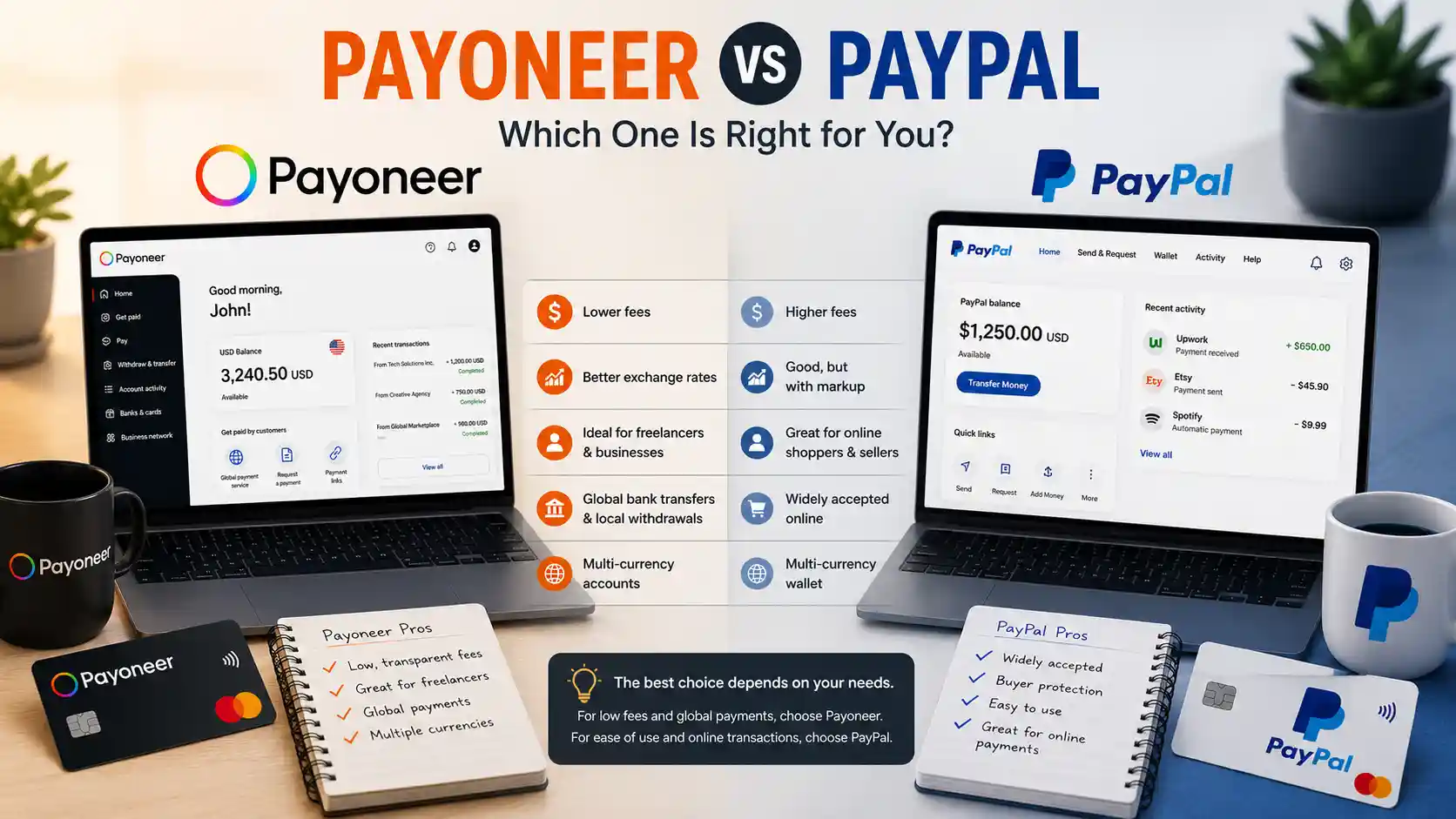
If you sell online, freelance for international clients, or run a business that touches more than one currency, you’ve almost certainly bumped into both of these names. PayPal is the payments company most of the internet grew up with — the default “Pay with” button on millions of checkout pages. Payoneer is the quieter specialist that freelancers and marketplace sellers gravitate toward once they get tired of PayPal’s international fees or need a payout method that Amazon, Upwork, or Fiverr actually built into their platform.
Both companies are publicly traded, both are regulated in multiple jurisdictions, and both have real strengths and real, well-documented weaknesses. This comparison doesn’t declare a universal winner — instead it walks through the company histories and financials, the actual fee schedules (not just the marketing headlines), the features each platform is genuinely good and bad at, real user sentiment from independent review platforms, and a clear breakdown of who each one is actually built for.
Table of Contents
- 1. What Is Payoneer? What Is PayPal?
- 2. The Companies Behind Them — History & Financials
- 3. How Each One Actually Works
- 4. Core Features, Side by Side
- 5. Payoneer vs PayPal By The Numbers
- 6. Fees & Pricing — The Full Breakdown
- 7. Security, Trust & Account Freezes
- 8. Head-to-Head Comparison Table
- 9. Real Customer Feedback
- 10. Who Should Use Which?
- 11. Pros and Cons of Each
- 12. Final Verdict
- 13. Frequently Asked Questions
What Is Payoneer? What Is PayPal?
Payoneer is a publicly traded (Nasdaq: PAYO) fintech built specifically around cross-border payouts. Its core product is a set of local receiving accounts — a US ACH account and routing number, a UK sort code, a Eurozone IBAN, and several others — so that a client, marketplace, or platform can pay you as if you were a domestic business, even when you’re not. It’s deeply embedded as the payout option on Amazon, Upwork, Fiverr, Airbnb, Envato, and hundreds of other marketplaces, which is precisely why it has become the default choice for millions of freelancers and sellers rather than a niche alternative.
PayPal is a publicly traded (Nasdaq: PYPL) digital payments network — one of the oldest and largest in the world — that lets consumers and businesses send and receive money online, in-app, and in person. Rather than specializing in one workflow, PayPal operates a genuinely two-sided marketplace: consumers use it to buy from millions of merchants, and merchants use it (often alongside Braintree, Venmo, and PayPal Checkout) to accept payments on their own storefronts. It ended 2025 with 439 million active accounts and processed $1.79 trillion in total payment volume across roughly 25–26 billion transactions.
Payoneer In One Line
A specialist cross-border payout rail — local receiving accounts + a global Mastercard + built-in marketplace payouts — for people and businesses getting paid from abroad.
PayPal In One Line
A massive, general-purpose consumer and merchant payments network — checkout buttons, peer-to-peer transfers, Venmo, and buyer/seller protection — for anyone sending or accepting everyday payments.
The Companies Behind Them — History & Financials
Payoneer’s Story
Payoneer was founded in 2005 by Yuval Tal with roughly $2 million in seed funding, gradually expanding from a niche prepaid-card provider into a full cross-border payments platform. It went public in 2021 via a SPAC merger at an implied enterprise value of roughly $3.3 billion, trades on Nasdaq under PAYO, and is headquartered in New York City. Annual revenue climbed from $473 million in 2021 to $1.05 billion in 2025, and the company has been acquisitive — buying HR/payroll platform Skuad in 2024, Chinese payments provider Easylink in 2025, and workforce-management company Boundless in early 2026 — while also building out stablecoin functionality and applying for a national trust bank charter.
PayPal’s Story
PayPal traces back to December 1998, founded as Confinity by Peter Thiel, Max Levchin, and Luke Nosek, which merged with Elon Musk’s X.com in 2000 and rebranded as PayPal in 2001. eBay acquired the company in 2002 for $1.5 billion, and PayPal was spun back out as an independent public company (Nasdaq: PYPL) in 2015. It’s headquartered in San Jose, California, employs roughly 23,800 people, and generated $33.2 billion in net revenue for 2025 (up 4% year-over-year), with net income of $5.2 billion. Dan Schulman led the company from the 2015 spinoff until 2023, when Alex Chriss (previously of Intuit) took over as CEO. In a significant and very recent development, PayPal’s board replaced Chriss with Enrique Lores (former HP CEO and PayPal board chair) as President and CEO effective March 1, 2026, following a weak 2026 profit forecast and a stock decline of nearly 50% — the company has since drawn reported takeover interest from potential acquirers, according to Bloomberg.
Why This Matters For You
PayPal is currently in a leadership and strategic transition — new CEO, new board chair, and public scrutiny over slowing growth in its core “branded checkout” business. That doesn’t make it unsafe to use (it’s still a massively capitalized, heavily regulated public company), but it’s worth knowing the platform is actively being reshaped as of mid-2026, and product priorities could shift under new leadership.
How Each One Actually Works
Getting Paid With Payoneer
Create a Free Account & Verify Identity
Sign up and submit KYC documents. Approval typically takes 24–72 hours, longer for higher-risk industries or countries.
Get Local Receiving Accounts
You’re issued local account details in USD, EUR, GBP and more — link them inside Amazon, Upwork, Fiverr, or share directly with a client.
Spend, Hold, or Withdraw
Use the Payoneer Mastercard, hold the balance in its original currency, or withdraw to your local bank.
Getting Paid With PayPal
Create a Personal or Business Account
Sign-up is near-instant for basic use; business/merchant accounts require more verification for higher limits.
Receive Payments Into Your Balance
Clients or customers pay you via PayPal Checkout, an invoice, a payment link, or peer-to-peer transfer — no separate local account numbers involved.
Spend, Hold, or Withdraw
Spend directly online, use the PayPal debit card, or transfer to your bank via standard (free, 1–3 days) or instant (fee-based) withdrawal.
The Core Mechanical Difference
Payoneer gives you your own foreign bank-style account numbers so a payer never even sees “Payoneer” in the transaction — it feels local to them. PayPal is the visible middleman: the payer explicitly chooses “Pay with PayPal” and both sides interact with PayPal’s own protection and dispute system. That single difference explains most of the fee and use-case gaps you’ll see throughout this article.
Core Features, Side by Side
🌍 Payoneer: Global Receiving Accounts
Local account details in USD, EUR, GBP, JPY, AUD, CAD and more, so clients and marketplaces can pay you as if you were a local business — no wire fees on their end.
🛒 PayPal: Universal Checkout
A “Pay with PayPal” button accepted on millions of storefronts worldwide, plus PayPal Checkout, Braintree, and Pay Later options for merchants of any size.
🛍️ Payoneer: Marketplace Integrations
Native, built-in payout support on Amazon, Upwork, Fiverr, Airbnb, Envato, Walmart Marketplace and hundreds more.
👥 PayPal: Venmo & Peer-to-Peer
Venmo alone generated $1.7B in revenue in 2025 (up 20% YoY) with 100M+ active accounts — a social, peer-to-peer layer Payoneer doesn’t have.
💳 Payoneer Mastercard
A physical or virtual card linked to your balance, usable online, in-store, and at ATMs in most countries.
🛡️ PayPal Buyer & Seller Protection
Formal dispute resolution, chargeback handling, and purchase protection built into every Goods & Services transaction — a genuine consumer-trust advantage.
📈 Payoneer Capital Advance
Short-term working-capital advances against future receivables for eligible sellers, plus Payoneer Checkout for direct-to-consumer merchants.
💰 PayPal Working Capital & Pay Later
Merchant financing plus a fast-growing Buy Now, Pay Later business that processed over $40B in TPV in 2025, up more than 20% YoY.
Payoneer vs PayPal By The Numbers
Both companies are publicly traded, which means both publish detailed, auditable financials. Here’s what the actual filings show — not marketing copy.
Annual Revenue, 2019–2025 ($ Billions)
Source: Payoneer Global Inc. and PayPal Holdings Inc. public SEC filings. Note the dual axes — PayPal’s revenue (right axis) is roughly 30x Payoneer’s (left axis).
Active Accounts / Customers (Log Scale)
Payoneer’s ~2M is “directly active” accountholders; a logarithmic scale is used because PayPal’s 439M would otherwise make Payoneer’s bar invisible.
Consumer vs Business Review Ratings
Trustpilot (consumer sentiment) vs G2 (verified business-user sentiment), out of 5 stars, as of mid-2026.
Head-to-Head Capability Scoring
Editorial scoring (0–10) based on researched features and fee structures, not an official benchmark from either vendor.
Where A $2,000 Cross-Border Payment Can Shrink
Illustrative worst-case international Goods/Services-style payment: Payoneer’s 1% receiving fee + up to 3.5% conversion markup, vs PayPal’s ~4.49%+$0.49 international commercial fee + ~3.5% conversion markup. Domestic, same-currency transfers on either platform cost far less.
Fees & Pricing — The Full Breakdown
Neither platform charges a monthly subscription — both make money on a transaction basis, and both structures are genuinely complex. Here’s the honest, itemized breakdown of each, current as of mid-2026.
Payoneer Fee Schedule
| Action | Typical Fee |
|---|---|
| Opening an account | Free, no monthly fee |
| Receiving via local receiving account | Free |
| Receiving via non-local-currency account | Up to 1% |
| Receiving via credit card payment request | Up to 3.99% + $0.49 |
| Same-currency bank withdrawal (under $50k/mo) | $1.50 flat |
| Cross-currency bank withdrawal | 1.2%–4% |
| Internal currency conversion | 0.5%–3.5% |
| ATM withdrawal | ~$3.15 / €2.50 / £1.95 per transaction |
| Annual account fee (if under $2,000 received/yr) | $29.95 |
PayPal Fee Schedule
| Action | Typical Fee |
|---|---|
| Opening an account | Free, no monthly fee |
| Friends & Family, domestic (funded by bank/balance) | Free |
| Friends & Family, funded by card | ~3.49% + $0.49 |
| Goods & Services, domestic | ~2.99%–3.49% + $0.49 |
| Goods & Services, international | ~4.49%–4.99% + $0.49 |
| Currency conversion markup | ~3%–4% above mid-market |
| Standard bank withdrawal | Free (1–3 business days) |
| Instant bank withdrawal | 1.5%–1.75% (capped ~$25) |
| QR code / in-person payment | ~1.90% + $0.10 |
Both fee schedules vary by country, account type, and funding source — always confirm your exact rate on the live Payoneer or PayPal dashboard before a large transaction.
Where Payoneer Usually Wins on Cost
If you’re paid through a marketplace that already integrates Payoneer, and you keep your balance in the currency you were paid in, your effective cost can be close to zero. The 1% receiving fee and conversion markup only bite once currencies stop matching.
Where PayPal Usually Wins on Cost
For a single, low-value domestic sale or a Friends & Family transfer funded from a bank account, PayPal is genuinely free or very cheap. It only gets expensive once a transaction becomes international, card-funded, or needs an instant withdrawal.
The honest takeaway: On a like-for-like international payment, independent fee analyses generally find Payoneer cheaper for marketplace-native freelancer/seller payouts, and PayPal cheaper (or free) for domestic, one-off consumer payments. Neither is “the cheap one” in every scenario — it depends entirely on the corridor and currency match.
Security, Trust & Account Freezes
Both companies are regulated financial institutions. Payoneer holds an Electronic Money Institution license from the Central Bank of Ireland for EU customers plus money-transmitter licenses across the US and other markets. PayPal is licensed as a money transmitter across US states and holds an EU banking-style license via its Luxembourg entity, and is one of the most heavily audited fintechs in the world given its scale.
The realistic risk with either platform isn’t fraud on the company’s side — it’s each platform’s own compliance-driven account holds, which can freeze funds during identity or source-of-funds verification. This is standard practice across regulated fintechs, but it shows up constantly in both companies’ review data: Payoneer holds roughly a 3.8-star Trustpilot rating across 62,000+ reviews, with account holds during verification as the most common complaint. PayPal’s Trustpilot rating sits much lower, around 1.5 stars across ~39,000 reviews, with account restrictions, frozen funds (sometimes 21–180 days), and slow dispute resolution as recurring themes — though PayPal scores far better with verified business users on G2 (4.4/5) than with everyday consumers on Trustpilot, suggesting the experience differs sharply depending on how you use it.
A Practical Safety Rule For Both
Never rely on a single payment platform as your only lifeline for incoming revenue — whether it’s Payoneer or PayPal. Keep documentation ready, respond to verification requests immediately, and maintain a backup payout method for your business.
Head-to-Head Comparison Table
An honest side-by-side across the dimensions that actually matter when choosing between them.
| Feature | Payoneer | PayPal |
|---|---|---|
| Founded | 2005 | 1998 (as Confinity) |
| Publicly traded | ✅ Nasdaq: PAYO (2021 IPO) | ✅ Nasdaq: PYPL (2015 spinoff) |
| 2025 revenue | $1.05 billion | $33.2 billion |
| Active users | ~2M directly active (up to ~8M ecosystem-wide) | 439 million active accounts |
| Local receiving accounts | ✅ 10+ currencies | ⚠️ Limited / not a core feature |
| Marketplace payout integrations | ✅ Amazon, Upwork, Fiverr, Airbnb & more | ✅ Widely accepted as a checkout option |
| Peer-to-peer / social payments | ❌ Not a focus | ✅ Venmo (100M+ active accounts) |
| Buyer/seller dispute protection | ⚠️ Limited | ✅ Formal Purchase & Seller Protection |
| FX conversion markup | 0.5%–3.5% | ~3%–4% |
| Physical/virtual card | ✅ Payoneer Mastercard | ✅ PayPal Debit Mastercard |
| Working capital / financing | ✅ Capital Advance | ✅ PayPal Working Capital & Pay Later |
| Account fee | Free ($29.95/yr if under $2k received) | Free |
| Consumer Trustpilot rating | ~3.8 / 5 (62k+ reviews) | ~1.5 / 5 (39k+ reviews) |
| Business G2 rating | ~3.7 / 5 | ~4.4 / 5 |
| Best for | Freelancers, marketplace sellers, B2B cross-border | General online payments, consumer checkout, one-off transfers |
When Payoneer Pulls Ahead
If Amazon, Upwork, Fiverr, or another marketplace already offers Payoneer as a payout method, and your income mostly arrives in a small number of foreign currencies, Payoneer’s local receiving accounts and lower conversion markup usually save real money over time — and the sign-up experience is purpose-built for exactly this workflow.
When PayPal Pulls Ahead
If you need near-universal recognition at checkout, formal buyer/seller dispute protection, a peer-to-peer app your friends already use (Venmo), or you’re mostly transacting domestically and occasionally, PayPal’s breadth and consumer trust in the transaction itself (if not always in support) is hard to match.
Real Customer Feedback
Rather than cherry-pick glowing quotes for either brand, here’s a representative, balanced mix of what real users on independent review platforms actually say about each.
PAYONEER — POSITIVE THEME
Freelancers consistently describe how much simpler it is to get paid by international clients and marketplaces once a Payoneer receiving account replaces a traditional bank wire, with funds arriving quickly once set up.
Paraphrased from G2 and Trustpilot reviews, 2026
PAYONEER — CRITICAL THEME
A recurring complaint describes account restrictions or delayed refunds dragging on for weeks, along with frustration that support requires repeating the same issue to multiple agents.
Paraphrased from G2 and Trustpilot reviews, 2026
PAYPAL — POSITIVE THEME
Business users on G2 frequently praise how easy PayPal Checkout is to integrate, and how instantly recognizable and trusted the brand is to their own customers at the point of sale.
Paraphrased from G2 reviews, 2026
PAYPAL — CRITICAL THEME
Consumer reviewers on Trustpilot very frequently describe sudden account restrictions or fund holds lasting anywhere from 21 to over 180 days, alongside disputes resolved in the merchant’s favor without what reviewers felt was adequate investigation.
Paraphrased from public Trustpilot reviews, 2026
Who Should Use Which?
🧑💻 Choose Payoneer If You’re…
- A freelancer paid through Upwork, Fiverr, or direct international clients
- An Amazon, Walmart Marketplace, or other marketplace seller
- A B2B business invoicing overseas clients or paying international contractors
- Someone who wants a Mastercard tied directly to multi-currency balances
🛒 Choose PayPal If You’re…
- Running an online store and want a checkout button your customers already trust
- Sending occasional peer-to-peer payments to friends or family (especially via Venmo)
- A small business that wants formal buyer/seller dispute protection built in
- Someone who needs to be paid by clients who don’t have or won’t use Payoneer
Most Businesses Actually Use Both
In practice, a large share of freelancers and sellers keep both accounts open — Payoneer for marketplace and cross-border payouts, PayPal for one-off client payments and domestic checkout — rather than treating this as an either/or decision.
Pros and Cons of Each
Payoneer
Pros
- Free to open, with local receiving accounts in 10+ currencies
- Deep, native integrations with Amazon, Upwork, Fiverr, Airbnb and more
- Publicly traded and financially transparent (Nasdaq: PAYO)
- Same-currency withdrawals and transfers are genuinely cheap
- Working-capital advances available for eligible sellers
Cons
- Currency conversion markups (up to 3.5%) undercut the “free account” pitch
- $29.95 annual fee if you receive under $2,000/year
- No formal buyer/seller dispute protection like PayPal’s
- Far smaller consumer brand recognition than PayPal
- Account holds during verification are a recurring complaint
PayPal
Pros
- Near-universal recognition at checkout, worldwide
- Formal Purchase Protection and Seller Protection programs
- Venmo gives you a genuine peer-to-peer social payments layer
- Free domestic Friends & Family transfers funded from bank/balance
- Fast-growing Buy Now, Pay Later option for shoppers ($40B+ TPV in 2025)
Cons
- International and currency-conversion fees add up quickly
- No local receiving accounts — weaker fit for marketplace-native payouts
- Consumer Trustpilot rating (~1.5/5) is notably worse than Payoneer’s
- Account freezes/holds are widely and consistently reported (21–180+ days)
- Currently mid-transition: new CEO (March 2026), stock decline, reported takeover interest
Final Verdict
This isn’t a contest with one universal winner, because the two platforms aren’t really trying to do the same job. PayPal is a much bigger company by almost every financial measure — $33.2 billion in 2025 revenue, 439 million active accounts, and near-universal checkout recognition — and it remains the more practical choice for anyone who needs broad consumer trust, formal dispute protection, or a peer-to-peer app (Venmo) that their friends already use. But that scale comes with real friction: consistently poor consumer review scores, widely reported account freezes lasting weeks or months, and a company currently navigating a leadership shake-up, a weak 2026 guidance, and reported acquisition interest after a steep stock decline.
Payoneer is the smaller, more specialized player, and it shows in the numbers — roughly 2 million directly active customers against PayPal’s 439 million. But for its specific niche — freelancers and marketplace sellers getting paid from abroad — its local receiving accounts, native Amazon/Upwork/Fiverr integrations, and generally cheaper same-currency handling make it the more purpose-built and often lower-friction tool, backed by materially better consumer review sentiment (3.8 vs 1.5 on Trustpilot).
Bottom Line
If your income already flows through a marketplace or international clients, start with Payoneer — it’s free to open, purpose-built for that exact workflow, and it’s rare that it costs you more than PayPal would for the same job. If you need a checkout button strangers already trust, buyer/seller protection, or peer-to-peer transfers, keep PayPal alongside it. Most serious freelancers and sellers end up running both, each for what it does best.
Related Reads
If you’re comparing global payment tools further, these are the most relevant next reads:
- Payoneer vs Wise — a closer look at pure currency-conversion cost and marketplace payout fit.
- Wise vs PayPal — the best companion read if you’re deciding between a transfer specialist and a universal checkout platform.
- How to Open a Payoneer Account — a step-by-step walkthrough if you want to set up Payoneer after comparing the options.
- How to Open a Wise Account — the Wise setup guide for anyone who wants a lower-cost transfer tool.
- Payoneer Review — a deeper review of Payoneer’s fee structure and product fit.
- Wise Review — a closer look at Wise’s strengths, trade-offs, and limits.
Frequently Asked Questions
Is Payoneer better than PayPal?
It depends on your use case. Payoneer is generally better for freelancers and marketplace sellers paid through Amazon, Upwork, or Fiverr, thanks to local receiving accounts and deep marketplace integrations. PayPal is generally better for broad consumer checkout acceptance, buyer/seller dispute protection, and peer-to-peer payments via Venmo.
Which has lower fees, Payoneer or PayPal?
For international, marketplace-native payouts kept in the receiving currency, Payoneer is usually cheaper (around 1% plus a smaller conversion markup vs PayPal’s roughly 4.49%+$0.49 international fee plus a 3–4% conversion markup). For free domestic transfers or Friends & Family funded from a bank account, PayPal can be entirely free.
Can I use both Payoneer and PayPal at the same time?
Yes, and many freelancers and sellers do exactly this — using Payoneer for marketplace and cross-border payouts, and PayPal for one-off client payments, domestic checkout, or peer-to-peer transfers.
Are Payoneer and PayPal both safe and legitimate?
Yes. Both are publicly traded companies (Nasdaq: PAYO and Nasdaq: PYPL respectively) and both are licensed and regulated in the jurisdictions where they operate. That said, both also generate a steady stream of user complaints about account holds and frozen funds during identity or fraud verification, which is a real (though not unique-to-either) risk to be aware of.
Why do Payoneer and PayPal have such different Trustpilot ratings?
Payoneer sits around 3.8/5 on Trustpilot while PayPal sits closer to 1.5/5. Part of this gap likely reflects PayPal’s vastly larger consumer volume (more transactions naturally means more disputes and complaints), and part of it reflects genuinely different user experiences — PayPal actually scores much higher (4.4/5) with verified business users on G2, suggesting its business-facing tools are viewed more favorably than its consumer-facing dispute and support experience.
Does Payoneer or PayPal integrate better with Amazon, Upwork, and Fiverr?
Payoneer has deeper, more native payout integrations with these specific marketplaces, largely because its local-receiving-account model was purpose-built for exactly this workflow. PayPal is also widely accepted as a payment option across the web generally, but is less commonly the direct payout rail for marketplace sellers specifically.
Is PayPal going through changes I should know about in 2026?
Yes. In February 2026, PayPal’s board replaced CEO Alex Chriss with Enrique Lores (effective March 1, 2026) following a weaker-than-expected 2026 profit forecast. The stock subsequently declined sharply, and PayPal has reportedly attracted takeover interest from potential acquirers. This doesn’t change PayPal’s day-to-day reliability as a payments platform, but it’s a notable piece of current context.
Disclosure: This article contains affiliate links. If you sign up through our Payoneer link we may earn a commission at no extra cost to you. Figures on revenue, fees, ratings, and customer counts reflect publicly available information at the time of writing and may change — always confirm current details on payoneer.com and paypal.com before signing up.