CyberGhost VPN Review
Excellent beginner value with a few power-user limitations
CyberGhost combines a $1.99 long-term introductory rate, a 45-day eligible refund window, 100-country coverage, RAM-only infrastructure, service-labeled servers, and a third Deloitte no-logs assurance engagement. It is easy to recommend for streaming and everyday privacy, but seven device slots, uneven split tunneling, no VPN port forwarding, and limited censorship tools keep it below the very best all-purpose VPNs.
In this CyberGhost VPN review
CyberGhost VPN review: the quick verdict
CyberGhost is a very good VPN for beginners, streamers, and price-conscious users. Its apps organize endpoints by purpose—streaming, downloading, and gaming—rather than expecting users to understand every protocol and server type. The $51.74 initial 26-month total is among the most competitive established-provider offers, and the 45-day refund period on terms of six months or longer gives buyers unusually generous testing time.
The privacy story is also stronger than older reviews suggest. CyberGhost now describes its fleet as RAM-only and completed a third Deloitte Romania ISAE 3000 assurance engagement in late 2025. Its directly operated NoSpy servers and token-based Dedicated IP system add meaningful options for users who want greater infrastructure control or a stable address.
The tradeoffs matter. CyberGhost supports only seven simultaneous devices, platform features differ substantially, and it has no ordinary VPN-side port forwarding. Most importantly for travelers, it lacks a leading dedicated stealth protocol for aggressive censorship. Smart DNS remains visible in support materials but is explicitly no longer compatible with streaming services.
Pros
- Low $51.74 introductory total
- Clear $51.74 annual renewal disclosure
- 45-day refund on eligible longer terms
- 100 countries and 125 locations
- RAM-only infrastructure and three Deloitte engagements
- Beginner-friendly task-labeled servers
- NoSpy servers included on eligible subscriptions
- 24/7 live chat
Cons
- Only seven simultaneous devices
- No ordinary VPN port forwarding
- Smart DNS no longer supports streaming
- No leading cross-platform stealth protocol
- Split-tunneling parity varies by device
- Dedicated IP costs extra
- Linux experience is less polished
CyberGhost VPN at a glance
| Feature | Current CyberGhost position |
|---|---|
| Company/jurisdiction | CyberGhost S.R.L., Romania; owned by Kape Technologies |
| Network | 100 countries, 125 locations, 21 Dedicated IP locations in the live directory |
| Stable server total | Main English directory does not emphasize one stable total; avoid treating older 9,000+ claims as fixed |
| Protocols | WireGuard, OpenVPN, IKEv2—with platform-specific availability |
| Infrastructure | RAM-only claim, many 10Gbps endpoints, colocated and NoSpy options |
| Privacy evidence | Three Deloitte assurance engagements: 2022, 2024, and late 2025 |
| P2P | Download-labeled servers; no inbound port forwarding |
| Streaming | Service-labeled servers; Smart DNS no longer streaming-compatible |
| Support | 24/7 live chat, tickets/email, extensive setup guides |
CyberGhost category scores
Editorial assessment out of 10 based on current documentation, value, and material limitations.
CyberGhost VPN pricing, renewals, and money-back guarantee
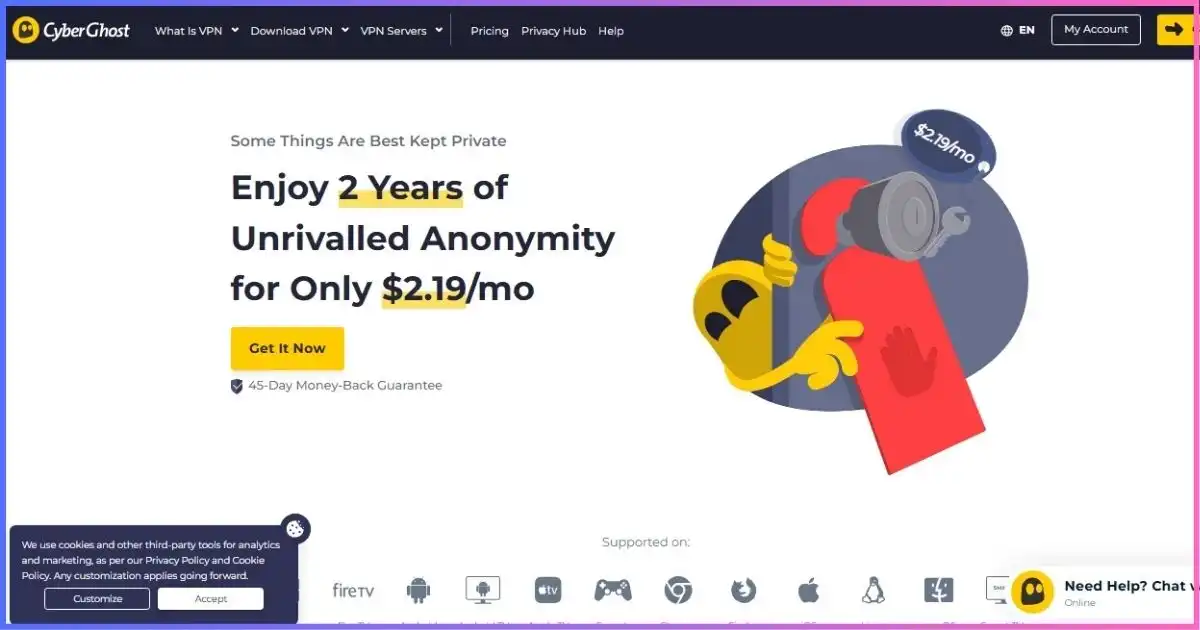
CyberGhost’s long-term offer is the obvious value choice, but the advertised “per month” price is an equivalent—not monthly billing. You pay the entire initial term upfront. Taxes, currency, account status, promotion, and checkout route can alter the final amount.
| Plan | Initial charge | Equivalent | Renewal | Refund period |
|---|---|---|---|---|
| 2 years + 2 months | $51.74 for 26 months | $1.99/month | $51.74 annually | 45 days |
| 6 months | $41.94 | $6.99/month | $41.94 every 6 months | 45 days |
| 1 month | $12.99 | $12.99/month | $12.99 monthly | 14 days |
Effective first-term monthly cost
Column height is proportional to the monthly equivalent.
offer
plan
plan
add-on
The renewal deserves special attention. The first 26 months cost $51.74, after which the plan renews yearly at $51.74—not for another 26 months. That remains competitive, but the change in billing period affects the effective rate. Save the checkout disclosure and set a reminder before renewal.
The 45-day guarantee applies to eligible subscriptions of six months or longer, while the monthly plan gets 14 days. Canceling automatic billing prevents a future renewal but does not necessarily initiate a refund. Contact support within the applicable window and preserve the receipt.
Privacy, ownership, logging, and independent audits
CyberGhost is based in Bucharest, Romania, and owned by Kape Technologies. Romania is outside the 5/9/14 Eyes shorthand groupings, but jurisdiction and parent-company history should never be the entire privacy analysis. What the service retains, how its systems are configured, whether independent reviewers can test the claims, and what happens when authorities ask for records matter more.
Three Deloitte assurance engagements
CyberGhost completed Deloitte Romania engagements in 2022, 2024, and late 2025. The third used the ISAE 3000 (Revised) framework and examined the server network, system configuration and change management, incident response, and token-based Dedicated IP design. The full latest report is publicly downloadable.
An assurance report is point-in-time evidence, not a permanent certification. Still, repeated reviews are materially better than a marketing-only no-logs promise. CyberGhost also publishes request statistics. Its current transparency page listed 117,539 DMCA complaints and nine police requests for the first half of 2026, with the company stating that it had no activity logs to match to users.
RAM-only servers and the NoSpy option
CyberGhost says the current network uses RAM-only infrastructure, so session data is not written to persistent server drives and residual data disappears after reboot. NoSpy servers in Bucharest are operated directly by CyberGhost staff with dedicated uplinks and tighter physical/operational control. Other colocated hardware gives the provider more control than ordinary rented servers.
Encryption, protocols, kill switch, and leak protection
CyberGhost combines AES-256 encryption in OpenVPN/IKEv2 contexts with WireGuard’s modern cryptographic design, private DNS handling, DNS/IP leak protection, and an automatic kill switch. For technical background on the standardized cipher family, see the NIST AES glossary.
| Platform | WireGuard | OpenVPN | IKEv2 | Important note |
|---|---|---|---|---|
| Windows | Yes | Yes | Yes | Broadest protocol and Smart Rules support |
| macOS | Yes | Manual third-party option | Yes | Native app exposes WireGuard/IKEv2 |
| Android | Yes | Yes | No | App split tunneling and Wi-Fi controls |
| iOS | Yes | No native selection | Yes | Fewer advanced controls |
| Linux | Yes | Yes | No | CLI/manual experience |
| Android TV/Fire TV | Yes | Yes | No | Random port and app splitting on supported builds |
The kill switch blocks internet traffic if the VPN drops unexpectedly and allows traffic again after reconnection. If the user intentionally disconnects, protection is disabled and the normal connection resumes. That distinction matters: it is not an always-on firewall that blocks every unprotected session after a manual disconnect.
Content Blocker filters known advertising, tracking, and malicious domains while connected. It is useful but should not be described as a complete antivirus or file scanner. CyberGhost’s main missing security feature is a mature, dedicated stealth protocol for aggressive VPN blocking. Random-port options and OpenVPN flexibility can help on some networks, but they are not equivalent to purpose-built cross-platform obfuscation.
Server network and infrastructure
The live CyberGhost directory lists 100 countries, 125 locations, and 21 Dedicated IP locations. Some localized checkout pages still state 9,800+ servers, but the primary English directory no longer foregrounds one stable global total. Country and location coverage are therefore the more defensible current measures.
The network includes physical and virtual locations. A virtual location supplies an IP from the named country while the hardware is elsewhere. This can extend coverage, but users facing strict data-residency requirements should check the physical-location marker rather than assuming the label describes the server’s rack.
CyberGhost highlights RAM-only operation, many 10Gbps endpoints, directly controlled NoSpy servers, and colocated equipment. A 10Gbps uplink is shared capacity, not a promised subscriber speed. Distance, congestion, the access network, peering, chosen protocol, and destination still determine individual performance.
Where CyberGhost fits best
● Streaming workflow — 30%● Long-term value — 25%● Everyday privacy — 22%● General travel — 15%● Power-user tasks — 8%Editorial fit profile, not market-share data.
CyberGhost speed and connection reliability
CyberGhost has the technical ingredients for strong performance: WireGuard across major platforms, many 10Gbps endpoints, broad regional coverage, load-aware server choice, favorites, and activity-specific filters. Nearby routes should generally be the fastest; NoSpy or virtual locations may take a longer network path.
We do not publish a universal “speed loss” number because it would be misleading outside one device, ISP, server, and test hour. A fair test uses the same Ethernet or Wi-Fi link, repeats several runs, compares two nearby endpoints, and tracks download, upload, latency, jitter, and packet loss. Streaming needs stable throughput; games and calls care more about latency consistency.
Capability profile
CyberGhost is strongest on value, streaming simplicity, privacy evidence, and geographic reach. Its shape contracts on P2P power features and cross-platform app parity.
Streaming performance and smart-TV support
Streaming is CyberGhost’s most approachable use case. The desktop and mobile apps label endpoints for specific services and countries, reducing trial and error. Android TV and Fire TV have dedicated applications, while a router or Windows-shared connection can cover devices without a native VPN app.
CyberGhost cannot permanently guarantee any catalog. Streaming services rotate IP blocks and enforce licensing based on account, country, device, DNS, and other signals. Connect to a supported route, fully restart the app, and test playback during the refund window. Follow the service’s terms and applicable law.
CyberGhost earns a strong streaming score because the task-labeled interface and long testing window are genuinely useful, not because Smart DNS adds value. Compare it with other leading options in our best VPNs for streaming guide.
Gaming, latency, and DDoS exposure
CyberGhost provides gaming-optimized server labels on supported clients and allows favorites for repeat routes. WireGuard’s low overhead, wide geography, and 10Gbps capacity are helpful foundations. Connecting through a VPN also hides the residential public IP seen by direct peers, reducing one avenue for IP-targeted harassment or DDoS attempts.
A VPN cannot stop an attack against a game’s own servers, repair congested Wi-Fi, guarantee lower latency, or override a poor game backend. It normally adds an extra network hop. Pick a location near the game server, compare ping and jitter with the direct route, and avoid distant or virtual exits unless they improve ISP peering.
Console support usually requires a router or a computer-shared VPN connection. Smart DNS does not provide encrypted IP masking and is not a security substitute. CyberGhost is a solid beginner gaming VPN, but services with adjustable NAT, mesh networking, or stronger router software may suit demanding players better. See our best gaming VPN roundup.
Torrenting, P2P servers, and port forwarding
CyberGhost marks download/P2P servers in supported regions and offers an automatic kill switch. Smart Rules on Windows can connect to a chosen torrenting endpoint when a download client opens, reducing the risk of forgetting the VPN. This is an unusually friendly workflow for occasional P2P use.
The important limitation is inbound connectivity: CyberGhost does not allow VPN-side port forwarding. Provider support says incoming connections are blocked for security. A Dedicated IP does not change that. Torrents can work without forwarding, but seeding and connectivity in smaller swarms can be less efficient.
Bind the torrent client to the VPN interface when supported, verify the visible IP, and download only content you have the right to share. A VPN does not inspect every file or prevent accidental folder exposure. CyberGhost is good for simple downloads, not our first power-user choice; compare forwarding-capable options in our top VPNs for torrenting guide.
Apps, supported devices, and split tunneling
One subscription supports seven simultaneous devices. Native apps cover Windows, macOS, Android, and iOS, with Android TV and Fire TV support. Linux relies more heavily on CLI/manual workflows. Selected routers, Synology NAS, Raspberry Pi, Kodi-style systems, and other platforms can use manual OpenVPN configurations.
| Platform | Experience | Notable limitation or strength |
|---|---|---|
| Windows | Full native app | Best Smart Rules, URL exceptions, app triggers, and protocol choice |
| macOS | Native app | WireGuard/IKEv2; fewer automation and split controls |
| Android | Native app | App split tunneling, Wi-Fi protection, OpenVPN/WireGuard |
| iPhone/iPad | Native app | WireGuard/IKEv2; reduced advanced controls |
| Linux | CLI/manual | WireGuard/OpenVPN, but less polished than desktop GUI rivals |
| Android TV/Fire TV | Native TV apps | App split tunnel, random port, small-packet controls on supported builds |
| Chrome/Firefox | Free proxy extension | Browser only; four locations; not the full VPN |
| Routers/consoles | Manual/shared connection | Router compatibility varies; no direct full VPN console app |
Split tunneling is not identical everywhere. Windows Smart Rules include URL exceptions and program triggers; Android and Android TV expose app-level routing. Do not assume a control shown on Android exists on macOS or iOS. Seven slots are adequate for one person but restrictive for a device-heavy family.
The free Chrome and Firefox extensions route only browser traffic through four proxy locations—the US, Germany, Netherlands, and Romania. They do not protect other apps and should not be presented as a free version of the complete CyberGhost VPN.
NoSpy servers, Dedicated IP, and extra tools
NoSpy servers
NoSpy servers are located in CyberGhost’s Bucharest facility and operated directly by its staff, with dedicated uplinks and higher-control hardware. They reduce reliance on external server operators and can serve streaming, gaming, and P2P workflows. They still require trusting CyberGhost itself and may be geographically distant.
Dedicated IP
The Dedicated IP add-on was listed at $5 per month. Current support lists Australia, Belgium, Canada, France, Germany, Japan, Netherlands, Singapore, Spain, Sweden, the UK, and the US. A dedicated address can reduce CAPTCHAs and simplify work allowlists, but it is easier to correlate across sessions than a widely shared IP.
CyberGhost uses a token system intended to separate the address from normal account association. The location becomes fixed after redemption, and the token cannot be recovered or regenerated if lost. Store it securely before leaving the redemption page. Dedicated IP does not provide port forwarding.
Content Blocker, ID Guard, Privacy Guard, and paid add-ons
Content Blocker filters known malicious, advertising, and tracking domains while the VPN is connected. ID Guard monitors for exposed account information, while Windows-focused Privacy Guard adjusts selected system privacy settings. Checkout may also offer a Windows Security Suite, password manager, or other products. These are separate from the core VPN and should be assessed on their own renewal terms.
Customer support and how to configure CyberGhost safely
CyberGhost provides 24/7 live chat, tickets/email, and an extensive help center. The documentation is broad, though older Smart DNS setup pages can coexist with the newer statement that it is no longer streaming-compatible. When two pages conflict, follow the current limitation notice and test the exact app version.
- Buy through the intended billing channel. Record the first total, renewal period, tax, and refund window.
- Install from CyberGhost or the official app store. Avoid third-party installers and browser tools pretending to be the full VPN.
- Start with WireGuard and Best location. This creates a stable performance baseline before specialty routes.
- Enable Wi-Fi protection and confirm kill-switch behavior. Interrupt the connection briefly on a non-sensitive task and check whether traffic stops.
- Configure Smart Rules selectively. Auto-connect on untrusted Wi-Fi and associate sensitive apps with the correct route.
- Test the real workload. Play a complete stream, join a game, or run an authorized download—not just a login page.
- Set a renewal reminder. Request a refund separately if needed; simply disabling renewal may not return the charge.
On public Wi-Fi, a VPN protects the path to its server but cannot make a phishing site legitimate or secure an infected device. The FTC’s public Wi-Fi guidance explains why HTTPS, updates, multifactor authentication, and scam awareness still matter. Travelers should also read our travel VPN guide.
CyberGhost alternatives
| Alternative | Choose it instead when… | CyberGhost remains better when… |
|---|---|---|
| Surfshark | You need unlimited devices, broader split tunneling, MultiHop, or obfuscation | You want lower entry pricing, clear renewal, or task-labeled servers |
| ExpressVPN | You prioritize premium router software, simplicity, and censorship resilience | You prioritize price and a 45-day long-plan refund |
| IPVanish | You need unlimited devices and detailed city/server selection | You prefer service-specific streaming labels and NoSpy options |
For a detailed household comparison, read CyberGhost vs Surfshark. Premium simplicity is covered in ExpressVPN vs CyberGhost, while IPVanish vs CyberGhost compares two approachable mainstream choices.
Is CyberGhost VPN worth it?
Yes—especially on the 26-month offer. CyberGhost earns 8.8/10 for its combination of low introductory pricing, a clearly stated renewal, a 45-day longer-plan refund, 100-country reach, RAM-only infrastructure, repeated independent assurance, NoSpy servers, and an interface that makes streaming and P2P selection unusually approachable.
It is not the ideal VPN for everyone. Choose another service if you need unlimited devices, reliable port forwarding, the broadest split-tunneling parity, or a dedicated stealth protocol for aggressive censorship. Also ignore old claims that CyberGhost Smart DNS currently unlocks streaming—it does not.
For a beginner, streamer, or individual user who values price and simple automation, CyberGhost is an excellent buy. Test every essential device and service within 45 days, and keep the exact checkout terms.
CyberGhost VPN FAQs
Is CyberGhost VPN safe?
CyberGhost uses modern protocols, encryption, DNS/IP leak protection, an automatic kill switch, and RAM-only infrastructure. Its no-logs implementation has undergone three Deloitte assurance engagements. No VPN eliminates all risk, but CyberGhost has a strong consumer security foundation.
How much does CyberGhost VPN cost?
The offer checked was $51.74 upfront for 26 months, equivalent to $1.99/month, then $51.74 annually. Six months cost $41.94 and monthly service cost $12.99. Taxes and offers can vary.
Does CyberGhost offer a money-back guarantee?
Yes. Eligible subscriptions of six months or longer receive 45 days, while the monthly plan receives 14 days. Checkout/payment restrictions can apply, and canceling renewal is separate from requesting a refund.
How many devices can use CyberGhost?
One CyberGhost VPN subscription permits up to seven simultaneous connections. A compatible router can cover attached devices, but setup and router support vary.
Does CyberGhost keep logs?
CyberGhost states that it does not retain activity logs that can tie browsing to an account. Deloitte has assessed its implementation three times, most recently for late-2025 systems. The provider still processes limited account, billing, security, and operational data described in its policy.
Does CyberGhost support streaming?
Yes, its apps include service-labeled streaming servers. However, CyberGhost’s separate Smart DNS is no longer compatible with streaming services. Use a native VPN app, router, or shared VPN connection instead.
Does CyberGhost support torrenting and port forwarding?
CyberGhost provides P2P/download-labeled servers, but it does not allow ordinary VPN-side inbound port forwarding. A Dedicated IP does not add forwarding.
What are NoSpy servers?
NoSpy servers are CyberGhost-operated servers in Bucharest with dedicated uplinks and tighter provider control. They reduce reliance on external server operators but may add distance for users far from Romania.
Is CyberGhost good for restrictive countries?
It can work on some restrictive networks through protocol and port choices, but it lacks a leading dedicated cross-platform stealth mode. Users traveling into aggressive censorship should install multiple options before departure and check local law.
Sources & review methodology
Research date: September 18, 2026. We reviewed CyberGhost’s current checkout and plan terms, refund documentation, live server directory, NoSpy and Dedicated IP pages, privacy and transparency materials, third Deloitte audit announcement/report, protocol/platform guide, Windows Smart Rules, Android TV settings, kill-switch behavior, device support, Smart DNS correction, streaming troubleshooting, and P2P documentation.
Scoring: Privacy and security account for 25%, network and performance 20%, streaming/gaming/P2P 20%, apps and usability 15%, price/refund value 15%, and support/transparency 5%. We deduct for unclear or uneven platform behavior and do not credit old feature claims that current support documentation has superseded.
Limits: VPN speed, streaming access, and server availability vary by device, ISP, route, location, load, and date. Provider server counts and location definitions change. Independent assurance is point-in-time evidence. Pricing differs by tax, currency, eligibility, and checkout channel. Scores are editorial judgments, not guarantees.
Affiliate disclosure: We may earn a commission if you purchase through the CyberGhost buttons on this page, at no additional cost to you. This does not change the 8.8/10 score, the documented limitations, or our alternative recommendations.