IPVanish vs CyberGhost: Which VPN Is Better?
IPVanish vs CyberGhost pits two practical, mainstream VPNs against each other. IPVanish is built for device-heavy households: it permits unlimited simultaneous connections, exposes individual cities and servers, and supplies capable TV apps. CyberGhost focuses on low-cost simplicity, with activity-labeled servers, a longer refund window, broader international country coverage and a lower published renewal price.
CyberGhost wins overall, but IPVanish is better for large households
CyberGhost is our winner. Its $51.74 first 26 months, $51.74 annual renewal, 45-day refund on six-month-or-longer plans, 100-country footprint, current public Deloitte report and service-labeled streaming servers make it the stronger general recommendation. Choose IPVanish instead when unlimited devices, detailed city/server control, Double Hop, OpenVPN Scramble or a protocol-rich Apple TV app matter more than worldwide country breadth and renewal cost.
Table of Contents
At a glanceIPVanish vs CyberGhost: Quick Comparison
| Category | IPVanish Essential | CyberGhost | Winner |
|---|---|---|---|
| Overall score | 8.1/10 | 8.8/10 | CyberGhost |
| Longest introductory offer* | $52.56 / 24 months ($2.19/mo) | $51.74 / 26 months ($1.99/mo) | CyberGhost |
| Published renewal | $89.99/year | $51.74/year | CyberGhost |
| Refund window | 30 days on eligible 1/2-year terms | 45 days on 6+ month terms; 14 monthly | CyberGhost |
| Devices | Unlimited | 7 | IPVanish |
| Network | 3,400+ servers, 150 locations, 55 countries | 100 countries, 125–126 locations | Depends on priority |
| Protocols | WireGuard, OpenVPN, IKEv2 | WireGuard, OpenVPN, IKEv2 | Tie |
| Advanced routing | Double Hop; OpenVPN Scramble | NoSpy servers; Smart Rules | IPVanish |
| RAM-only status | Migration in progress | Fleet described as RAM-only | CyberGhost |
| Audit evidence | 2022 and 2025 reviews; latest full report access limited | Three Deloitte reviews; latest report public | CyberGhost |
| Port forwarding | No | No | Tie |
*US promotional pricing verified September 19, 2026. Prepaid totals, taxes, renewal dates and store-specific rules should be checked at checkout.
IPVanish: household flexibility
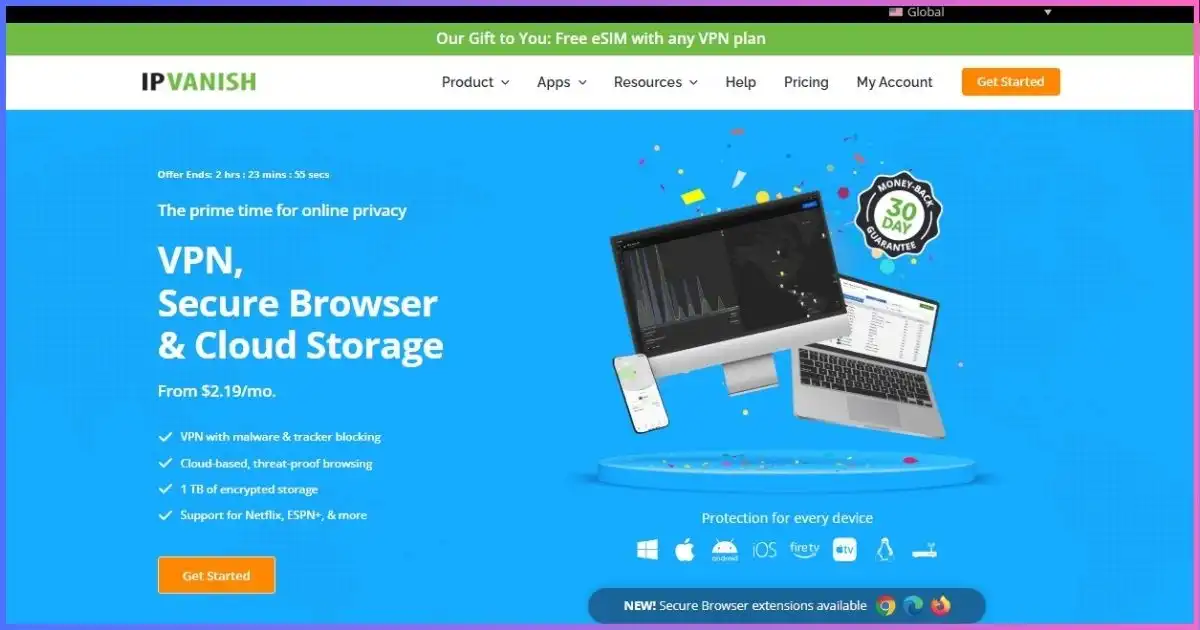
Unlimited connections, direct server choice, Double Hop and unusually capable TV apps.
CyberGhost: guided value
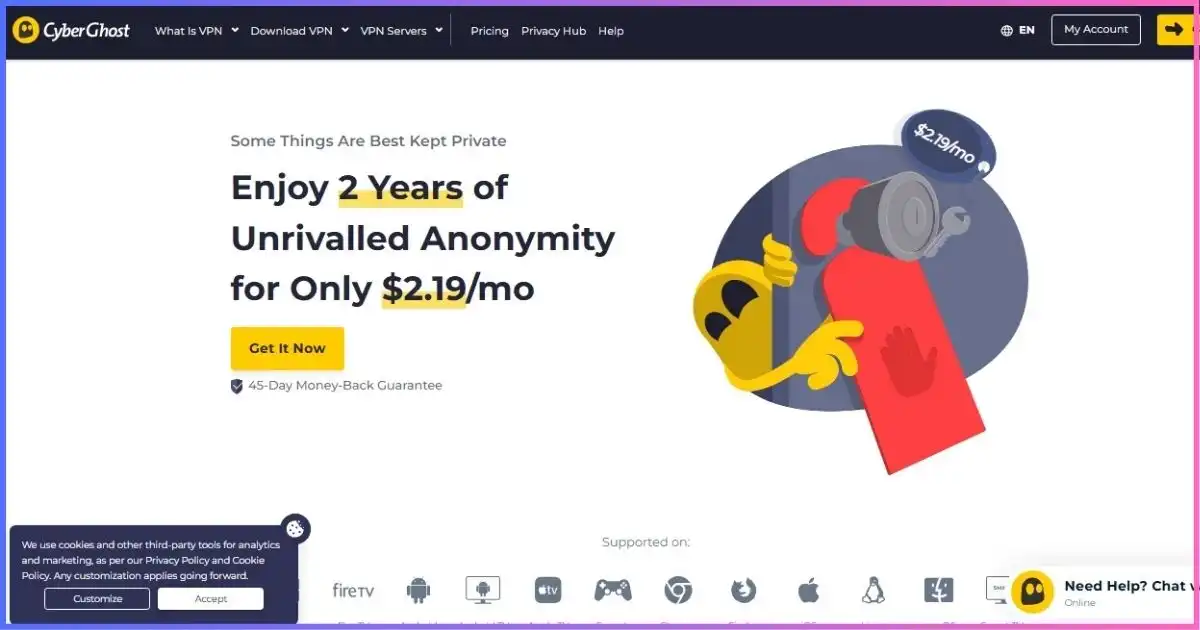
Low pricing, longer refunds, service-labeled routes and wider country coverage.
Round 1 · CyberGhost winsPricing, Plans and Refund Policies
The introductory totals are almost identical, but CyberGhost provides two extra months and costs slightly less: $51.74 for 26 months versus $52.56 for 24 months with IPVanish Essential. The larger difference appears at renewal. CyberGhost lists $51.74 per year; IPVanish Essential lists $89.99 per year.
| Term | IPVanish Essential | CyberGhost | What matters |
|---|---|---|---|
| Monthly | $12.99 | $12.99 | Price tie; refund rules differ |
| Intermediate | 1 year: about $39.99 initially | 6 months: $41.94 | Different durations |
| Longest offer | $52.56 / 24 months | $51.74 / 26 months | CyberGhost offers more time for less |
| Renewal | $89.99/year | $51.74/year | CyberGhost saves $38.25/year |
| Money-back period | 30 days on eligible annual/two-year terms | 45 days on 6+ month terms | CyberGhost gives longer-plan buyers more time |
Initial long-term total vs annual renewal
The initial charges cover different durations; each renewal column covers one year.
first 24 mo
first 26 mo
1-year renewal
1-year renewal
Compare standard VPN tiers. IPVanish Advanced uses the same VPN network but adds Threat Protection Pro, Secure Browser, 1 TB cloud backup, phone support and 5 GB of eSIM data instead of Essential’s 3 GB. Buy it only if those replace separate services. See our best cheap VPN comparison for alternatives.
Round 2 · CyberGhost winsPrivacy, Jurisdiction and Independent Audits
CyberGhost is Romania-based and owned by Kape Technologies. IPVanish is US-based and owned by Ziff Davis. Headquarters alone is not a privacy verdict; what a service records and what independent reviewers can verify matter more.
CyberGhost completed its third Deloitte Romania assurance engagement in late 2025. The public report covers server configuration and change processes, incident response and the token-based Dedicated IP system. CyberGhost also publishes request statistics and describes its active fleet as RAM-only, meaning ordinary server state does not persist to disk after power loss.
IPVanish’s 2025 Schellman assessment examined nine technical areas and reported that the current system did not log traffic/activity, traffic metadata, DNS queries or user IP addresses. A 2022 Leviathan review reached a similar conclusion under later ownership. The latest complete report may require an account, reducing pre-purchase transparency.
CyberGhost’s Deloitte work follows the ISAE 3000 (Revised) framework. Any audit remains a scoped, point-in-time review. Learn how to read the claims in our VPN logging-policy guide.
Round 3 · CloseSecurity, Protocols and Advanced Features
Both support WireGuard, OpenVPN and IKEv2, with automatic kill switches and DNS/IP leak protection. Protocol availability differs by operating system. CyberGhost offers WireGuard across major desktop, mobile and TV apps, while OpenVPN and IKEv2 are more selective; manual WireGuard setup is not supported. IPVanish similarly varies by platform but its current Apple TV app is unusually capable, offering WireGuard, OpenVPN UDP/TCP, IKEv2, port selection and Scramble.
WireGuard’s compact, modern design is documented in the official protocol specification. Implementation and account-mapping choices still differ by provider.
IPVanish advantages
- Selected two-server Double Hop routes
- OpenVPN Scramble for basic blocking resistance
- DNS-level Threat Protection on Essential
- Advanced-only desktop malware/file scanning
- Individual server selection and RAM-only filter
CyberGhost advantages
- Fleet described as fully RAM-only
- NoSpy servers operated from Bucharest
- Windows Smart Rules and Wi-Fi automation
- Token-based Dedicated IP add-on
- Content Blocker and Identity Guard
IPVanish’s RAM-only transition is not yet the whole fleet; the apps expose a filter for deployed servers. Double Hop improves separation between entry and exit at a speed cost. Scramble makes OpenVPN less obvious but is not a guarantee against sophisticated filtering.
Round 4 · CyberGhost wins globallyServer Coverage: Countries vs Locations
CyberGhost lists 100 countries and 125–126 locations. IPVanish lists 3,400+ servers, 150 locations, 55 countries and 56,000+ IPs. Those numbers answer different questions: CyberGhost covers more countries; IPVanish exposes more selectable locations within fewer countries, with especially useful US city control.
CyberGhost checkout also advertises 9,900+ servers, but its main directory emphasizes countries and locations. A high machine count does not guarantee low congestion; proximity, peering, capacity and load determine the route.
Round 5 · TieSpeed, Capacity and Reliability
Both offer WireGuard and substantial modern infrastructure. CyberGhost highlights 10-Gbps capacity and task-optimized routes. IPVanish has announced direct peering, redundancy across major cities, newer packet-processing infrastructure and ports up to 50 Gbps, plus OpenVPN Data Channel Offload on Windows.
Those are capacity and engineering claims—not a promise that one home connection will reach the interface maximum. Distance, ISP peering, device CPU, Wi-Fi, protocol, server load and test time dominate. A fair test uses the same device and endpoint, records multiple baselines, then compares median nearby and distant results.
Round 6 · IPVanish winsApps, Unlimited Devices and Split Tunneling
IPVanish permits unlimited simultaneous connections, while CyberGhost allows seven. That makes IPVanish the easy winner for a large household with phones, laptops, tablets and TVs. Both cover Windows, macOS, Android, iOS, Fire TV and Android TV; IPVanish’s current Apple TV app has the stronger protocol controls.
CyberGhost’s best app feature is Smart Rules on Windows: automate startup, trusted/untrusted Wi-Fi behavior, application triggers and URL exceptions. Android and Android TV offer per-app split tunneling. Its Linux experience is mainly manual/command-line, and parity is uneven. IPVanish split tunneling also varies by platform but is paired with direct server selection and unlimited sessions.
CyberGhost’s free browser extensions protect browser traffic only and provide four proxy locations. They are not the paid device-wide VPN. For standalone product details, see our IPVanish review and CyberGhost review.
Round 7 · CyberGhost winsStreaming and Smart TV Support
CyberGhost organizes supported streaming routes by service, eliminating much of the trial-and-error beginners face. Native Android TV and Fire TV apps provide encrypted tunnels, and its 45-day long-plan refund creates a useful testing window.
IPVanish is strong in the living room: unlimited connections, WireGuard, city/server selection and capable Apple TV, Fire TV and Android TV apps. It lacks CyberGhost’s same service-labeled discovery workflow.
Streaming access changes with the service, region, account, IP block and time. Test your exact setup rather than trusting permanent “unblocks everything” claims. Our best streaming VPN guide compares more options.
Round 8 · TieTorrenting and Port Forwarding
CyberGhost labels download/P2P-friendly locations. IPVanish supports P2P, offers detailed server selection, unlimited connections and a kill switch. Neither provides ordinary VPN-side inbound port forwarding, so users who seed heavily or need maximum inbound reachability should look elsewhere.
Do not confuse IPVanish Scramble with forwarding: it changes how OpenVPN traffic looks to a blocking network, not whether peers can initiate inbound connections. We also avoid repeating older SOCKS5 claims without current support confirmation.
Bind a compatible torrent client to the VPN adapter, enable the kill switch and verify the public IP. A VPN does not make infringement lawful or protect against malicious downloads. See our torrenting VPN guide for forwarding-capable alternatives.
Round 9 · CloseGaming, Ping and DDoS Limits
CyberGhost labels gaming-oriented routes, which simplifies selection. IPVanish exposes cities and individual servers, allows unlimited devices and has invested in higher-capacity links and direct peering. Either can mask a home IP from direct peers and occasionally improve a poor ISP route.
A VPN usually adds latency. It cannot repair weak Wi-Fi, overloaded game servers or general ISP congestion, and it cannot protect a publisher’s infrastructure from attack. Neither provider promises an open console NAT because neither offers standard port forwarding.
See our gaming VPN comparison for router and console setup details.
Round 10 · TieTravel, Public Wi-Fi and Restricted Networks
CyberGhost covers nearly twice as many countries and has approachable Wi-Fi automation. IPVanish Essential includes 3 GB of eSIM data, supports unlimited travel devices and offers OpenVPN Scramble when ordinary VPN traffic is blocked. CyberGhost lacks a comparable leading stealth mode.
Scramble provides modest blocking compatibility, not guaranteed national-firewall bypass. Neither provider is a top censorship specialist. Install multiple protocols before departure, save recovery codes offline and check local law. On public Wi-Fi, a VPN secures the path to its server, but the FTC’s public Wi-Fi guidance still recommends updated devices, strong accounts and scam awareness.
Our travel VPN guide covers pre-departure configuration.
Rounds 11–12 · Split decisionSupport and Everyday Usability
Both provide 24/7 chat and extensive setup material. CyberGhost is easier for a novice because activity labels translate intent into a server list. IPVanish is better for a hands-on user who wants live latency/load information, city selection and exact server choice.
IPVanish Advanced adds business-hours phone support, but that is a paid bundle feature rather than a reason to choose Essential. CyberGhost’s broader refund period is more valuable to most first-time buyers.
Decision guideShould You Choose IPVanish or CyberGhost?
Strength profile
- IPVanish: device freedom and hands-on controls.
- CyberGhost: privacy evidence, global reach and value.
- Scores describe comparative fit, not measured Mbps.
Choose IPVanish if you…
- Need unlimited simultaneous connections
- Want exact city/server selection
- Use Apple TV, Fire TV or Android TV heavily
- Want Double Hop or OpenVPN Scramble
- Value the included travel eSIM allowance
Choose CyberGhost if you…
- Want the lower long-term renewal
- Prefer a 45-day long-plan refund
- Travel across many countries
- Want service-labeled streaming servers
- Prioritize public audit evidence and NoSpy options
Round-by-round scorecard
CyberGhost wins overall; IPVanish wins the household niche
CyberGhost earns 8.8/10 and wins this comparison. It combines the lower long-term cost, longer refund window, stronger current transparency, completed RAM-only claim, broader country coverage and more intuitive streaming workflow. It is the safer default recommendation for a typical buyer.
IPVanish earns 8.1/10. Its unlimited connections, server-level control, Double Hop, Scramble and capable TV apps make it the better specialist for a large US-focused household. The narrower country footprint, higher renewal, partial RAM-only transition, limited audit access and historical trust incident keep it behind overall.
FAQsIPVanish vs CyberGhost FAQs
Is CyberGhost better than IPVanish?
Which is cheaper?
Which is faster?
Which is better for streaming?
Does either support port forwarding?
Which has more servers?
How many devices can I connect?
Is IPVanish trustworthy after its historical logging incident?
Sources & comparison methodology
Research cutoff: September 19, 2026. Prices, renewals, server directories and app features can change.
- IPVanish current plan and renewal disclosures for Essential and Advanced; eligibility language for its 30-day annual/two-year guarantee.
- IPVanish current network disclosures: server, IP, country and location counts; city/server controls, redundancy, peering, RAM-only migration and platform documentation.
- IPVanish privacy policy, 2025 Schellman and 2022 Leviathan assessment materials, transparency reporting and historical court-disclosure reporting under prior ownership.
- CyberGhost checkout and subscription support: introductory totals, renewals, monthly/six-month terms and 45-/14-day refund periods.
- CyberGhost live directory, protocol/device support, Smart Rules, Smart DNS correction, P2P limitation, NoSpy and Dedicated IP documentation.
- CyberGhost third Deloitte audit announcement, public assurance report and transparency reporting.
- Contextual sources: IAASB’s ISAE 3000 (Revised), WireGuard protocol documentation and FTC public Wi-Fi guidance.
Scoring method: We weighted price and renewal value, refunds, privacy architecture and external evidence, security/protocol breadth, country/location choice, app parity, device allowance, streaming workflow, P2P support, gaming, travel and support. We did not invent universal speed-loss or streaming-success percentages.
Disclosure: This page contains affiliate links. We may earn a commission if you purchase through them, at no extra cost to you. That does not change the comparison, caveats or verdict. A VPN protects the path to its server; it does not make illegal activity lawful, eliminate malware or replace strong account security.