CyberGhost VPN vs Surfshark VPN
Surfshark wins overall; CyberGhost is cheaper and easier for beginners
Surfshark is the better all-purpose household VPN because it combines unlimited paid devices, broader split tunneling, post-quantum WireGuard protection, Dynamic MultiHop, rotating IPs, and stronger tools for restrictive networks. CyberGhost fights back with the lower introductory price, a published renewal figure, task-labeled servers, and a 45-day refund window on longer terms.
In this CyberGhost VPN vs Surfshark VPN comparison
CyberGhost vs Surfshark: quick verdict
Choose Surfshark if you want one subscription for an entire household. Paid subscriptions have no simultaneous-device limit, and Bypasser covers more platforms than CyberGhost’s split-tunneling tools. Dynamic MultiHop, Rotating IP, NoBorders, Camouflage mode, FastTrack, Everlink, and supported-app post-quantum protection make it the more adaptable VPN.
Choose CyberGhost if price, easy server selection, and a long test period matter most. Its 26-month offer is cheaper both upfront and by monthly equivalent, its annual renewal price is clearly stated, and eligible plans of six months or longer have a 45-day money-back guarantee. Streaming, downloading, and gaming labels remove guesswork for beginners.
For provider-specific detail, read our CyberGhost VPN review and Surfshark VPN review.
CyberGhost VPN and Surfshark compared
| Category | CyberGhost VPN | Surfshark VPN | Winner |
|---|---|---|---|
| Long-term introductory price | $1.99/mo; $51.74 for 26 months | $2.49/mo; $67.23 for 27 months | CyberGhost |
| Published renewal | $51.74 annually after first term | Annual at applicable rate; no stable public amount | CyberGhost |
| Refund | 45 days on 6+ month terms; 14 days monthly | 30 days on eligible first purchase | CyberGhost |
| Network | 100 countries, 125 locations | 4,500+ servers, 100 countries | Different strengths |
| Devices | 7 simultaneous | Unlimited on paid subscriptions | Surfshark |
| Protocols | WireGuard, OpenVPN, IKEv2 | WireGuard, OpenVPN, IKEv2, Dausos beta | Surfshark |
| RAM-only infrastructure | Yes | Yes | Tie |
| No-logs assurance | Three Deloitte engagements; public 2025 report | Deloitte in 2023 and 2025; public 2025 report | Tie |
| Split tunneling | Platform-dependent Smart Rules/app exclusions | Bypasser on Windows, macOS, Android, iOS, extensions | Surfshark |
| SmartDNS | Exists but no longer streaming-compatible | Discontinued February 2, 2026 | Neither for streaming |
Prices and features checked September 18, 2026. Taxes, currencies, promotion eligibility, store billing, renewal terms, and product availability vary.
Editorial category scorecard
Scores out of 10; see the methodology for weighting.
Round results
● Surfshark: 6 wins
● CyberGhost: 4
wins
● Ties: 2 rounds
1. Pricing, renewal costs, trials, and refunds
CyberGhost is cheaper and clearer about renewal
Winner: CyberGhostCyberGhost’s 2-year-plus-2-month offer costs $51.74 upfront for 26 months, or $1.99 per month equivalent, and the observed offer says it renews at $51.74 annually. The six-month term is $6.99 per month and renews at $41.94 every six months. The month-to-month plan is $12.99.
Surfshark Starter costs $67.23 upfront for 27 months, or $2.49 per month equivalent. Its current plan guide lists the 12-month equivalent at $3.39 per month and month-to-month at $16.45. Surfshark says the long plan renews annually at the applicable rate but does not expose one stable public renewal amount across every visitor and region. Screenshot the checkout disclosure.
Entry-plan price comparison
Advertised USD charges. Terms differ; height represents the dollar amount.
26 months
27 months
annual renewal
annual renewal
CyberGhost’s refund period is unusually generous: 45 days for subscriptions of six months or longer and 14 days for the monthly plan. Surfshark generally offers 30 days for an eligible first purchase. It also has a seven-day trial for eligible new users taking selected 12- or 24-month web offers with supported payment methods; the trial is capped at three devices, while a paid plan becomes unlimited.
Surfshark One ($2.79/month equivalent for the observed 27-month offer) adds Antivirus, Alert, and Search. One+ ($4.49) adds Incogni. CyberGhost’s core VPN does not mirror that suite, though it includes Identity Guard, Content Blocker, and optional Dedicated IP. Compare only bundles you will use.
2. Privacy, ownership, no-logs claims, and audits
Both now have strong recent assurance evidence
Result: TieCyberGhost is based in Romania and owned by Kape Technologies. Surfshark B.V. is based in the Netherlands and belongs to the Nord Security group while operating as its own service. Corporate ownership and jurisdiction deserve scrutiny, but neither alone proves what a VPN records. Policies, technical architecture, audits, and request transparency are more useful evidence.
CyberGhost completed its third Deloitte Romania ISAE 3000 no-logs assurance engagement in late 2025, announced in February 2026. The scope included its server network, configuration/change management, incident response, and token-based Dedicated IP system. Its public transparency reporting showed 117,539 DMCA complaints and nine police requests in the first half of 2026, with the company saying it had no activity logs to associate with individual users.
Surfshark completed Deloitte assurance work in 2023 and 2025. The public 2025 report covered standard, static, and multiport servers plus configuration and deployment processes. Its August 2026 policy says it does not retain visited IPs, browsing history, session history, bandwidth, stored connection timestamps, or traffic logs. A disclosed April 2026 warrant response produced account-existence and payment information, not online-activity data.
Both reports are point-in-time assessments, not permanent guarantees. Both providers still process account, payment, fraud-prevention, login-security, and optional diagnostic data. Dedicated IP features also have distinct privacy implications. CyberGhost uses a token-based design intended to separate its dedicated address from account identity; Surfshark offers conventional and anonymous purchase paths with different refund treatment.
3. Security, encryption, protocols, and advanced controls
Surfshark offers the more advanced security toolkit
Winner: SurfsharkCyberGhost strengths
- WireGuard, OpenVPN, and IKEv2
- Automatic kill switch and DNS/IP leak protection
- RAM-only infrastructure
- NoSpy and colocated server options
- Smart Rules and Wi-Fi automation
- Content Blocker and Identity Guard
- Token-based Dedicated IP add-on
Surfshark strengths
- WireGuard, OpenVPN, IKEv2
- Post-quantum layer with WireGuard on supported apps
- Dynamic MultiHop and Rotating IP
- NoBorders and OpenVPN Camouflage
- Dausos beta on the macOS App Store build
- CleanWeb and Everlink
- Dedicated and static IP options
Both supply strong encryption, kill switches, private DNS handling, and modern fast protocols. Surfshark wins because it has more defense-in-depth and routing options. Rotating IP changes the visible address every five to ten minutes without dropping the tunnel, but it cannot run with Dedicated IP, Static IP, or MultiHop. Dynamic MultiHop lets users select custom entry and exit locations.
Surfshark’s post-quantum option adds a quantum-resistant layer to WireGuard on supported apps. It protects VPN key establishment, not every application or destination. The NIST finalized post-quantum standards overview explains the broader transition. Dausos is promising and independently assessed, but it was still a macOS App Store beta when checked; it should not be treated as Surfshark’s universal default.
CyberGhost’s NoSpy servers are physically located and directly operated in Bucharest with dedicated uplinks. That is a meaningful high-trust option. Its weakness is censorship resistance: it lacks a leading, broadly documented stealth protocol comparable to Surfshark’s NoBorders/Camouflage combination.
4. Server network and infrastructure
CyberGhost offers more labeled locations; Surfshark publishes the clearer fleet total
Winner: CyberGhost, narrowlyCyberGhost’s primary English directory lists 100 countries, 125 locations, and 21 Dedicated IP locations. It no longer foregrounds one stable global server total, although some localized checkout pages still advertise 9,800+. We use the live country/location measures rather than perpetuating an old fleet number that the main directory does not consistently support.
Surfshark publishes 4,500+ servers in 100 countries. It says every server has at least a 10Gbps connection, with selected high-demand infrastructure reaching 100Gbps. The entire network is advertised as RAM-only, and FastTrack can select multiple internal server hops to improve routes while Everlink repairs tunnel interruptions.
CyberGhost also describes its current network as RAM-only and highlights many 10Gbps endpoints. Its interface labels servers for streaming, downloading/P2P, and gaming, while NoSpy and colocated hardware provide higher-control paths. The 125-location breadth and task filtering earn it a narrow win; Surfshark’s transparent fleet total and reliability engineering keep the round close.
Capability profile
CyberGhost stretches toward introductory value, location choice, and streaming simplicity. Surfshark is more balanced for devices and advanced privacy/routing controls.
■ CyberGhost ■ Surfshark
5. Speed, stability, and day-to-day performance
WireGuard makes both fast enough for demanding connections
Result: TieOn a nearby uncongested server, either VPN can preserve most of a fast broadband connection with WireGuard. Surfshark’s 10Gbps baseline and selected 100Gbps upgrades provide substantial headroom, while CyberGhost’s 10Gbps deployment, NoSpy uplinks, and load-aware selection help users avoid crowded routes.
Surfshark has the stronger continuity story through Everlink, and FastTrack may improve selected long-distance paths. CyberGhost makes manual optimization easier for beginners because its apps expose task categories and favorites. In both cases, MultiHop, antivirus inspection, obfuscation, distance, Wi-Fi conditions, and peak-hour load can reduce throughput or raise latency.
6. Streaming, televisions, and SmartDNS
CyberGhost’s service-labeled servers are easier for beginners
Winner: CyberGhostCyberGhost organizes streaming endpoints around supported services and countries, so a new user can choose a labeled route instead of guessing among cities. It supports Android TV and Fire TV apps plus router/shared-connection options. Surfshark supports Apple TV, Android TV, and Fire TV natively and offers broad country choice, but its normal location interface is less task-specific.
Do not rely on old SmartDNS advice for either provider. CyberGhost Smart DNS still exists for general DNS and device configuration, but its current help page explicitly says it is no longer compatible with streaming services. Surfshark discontinued SmartDNS entirely on February 2, 2026; users with old settings must restore automatic DNS. Surfshark Public DNS is not an encrypted VPN substitute.
Streaming access changes with platform enforcement, account region, rights, IP reputation, and app updates. Neither provider can guarantee permanent catalog access. Test actual playback on every required device within the refund period and follow service terms. Our best VPNs for streaming guide covers more platform-specific choices.
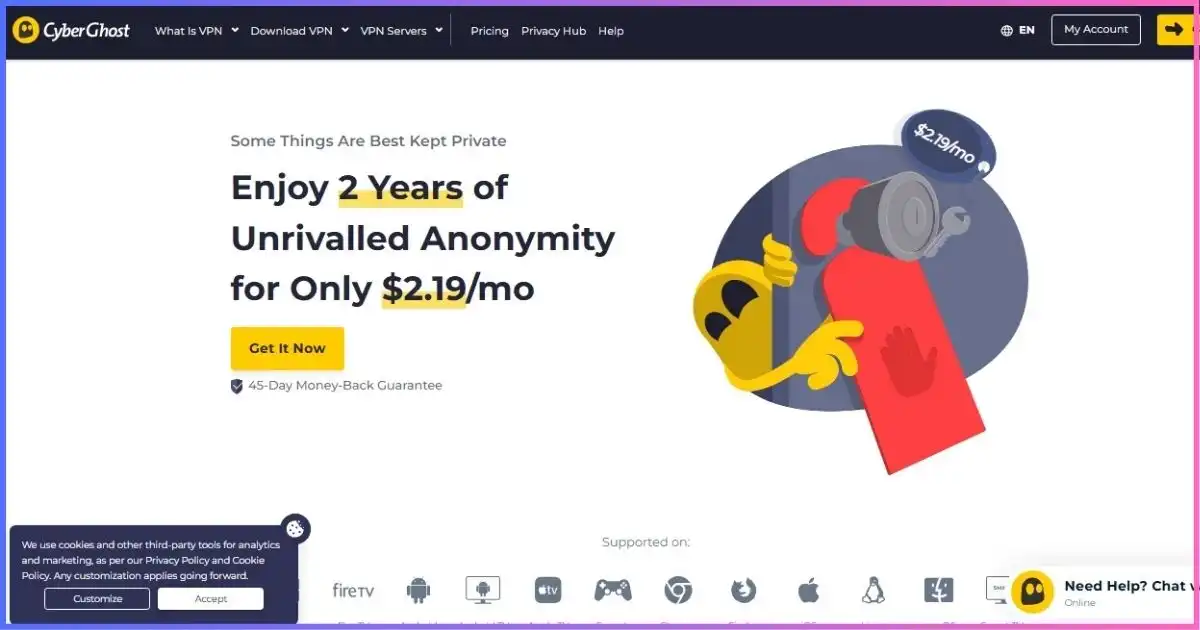
CyberGhost advantage
Beginner-friendly service labels and a 45-day long-plan test window.
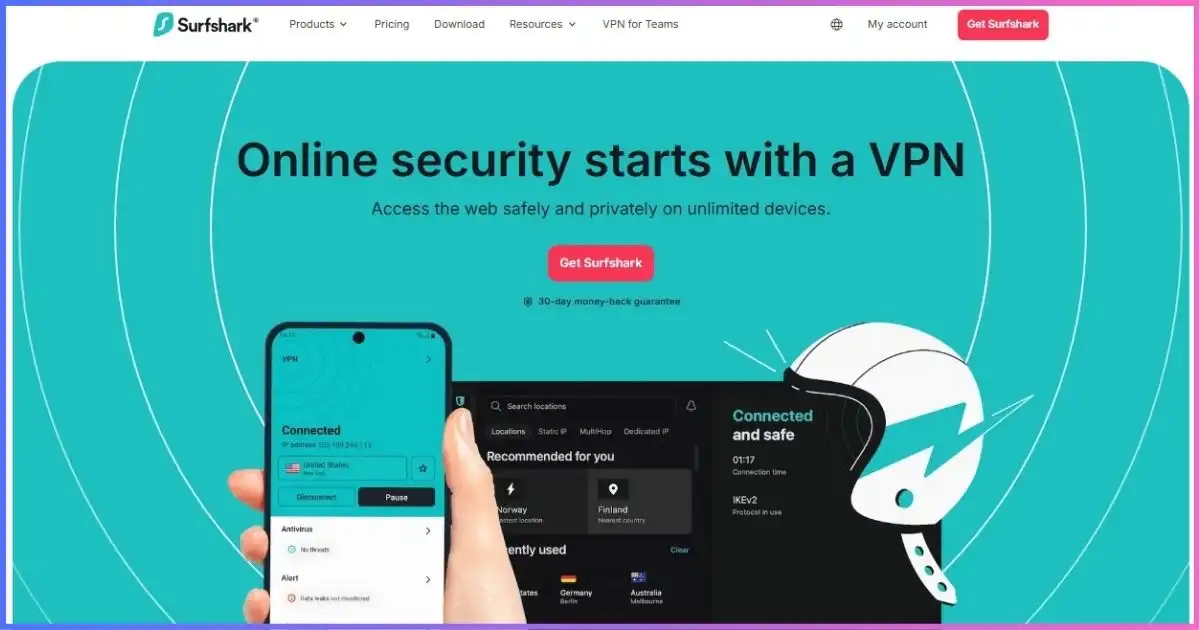
Surfshark advantage
Unlimited household devices and strong native TV coverage.
7. Gaming, DDoS exposure, and latency
Surfshark is stronger for a gaming household
Winner: SurfsharkCyberGhost’s gaming-labeled routes simplify endpoint selection, and its app can show useful server information. Surfshark does not create the same task-specific category, but unlimited devices, WireGuard, broad 10Gbps capacity, Everlink, and NoBorders make it more flexible across PCs, phones, handhelds, and shared households.
Either VPN hides the residential IP from direct peers and can reduce exposure to IP-targeted DDoS attacks. Neither can protect a game’s own servers, fix weak Wi-Fi, guarantee a lower ping, or bypass game rules safely. Connect near the game server, not simply near your house. Console coverage generally requires a router or protected hotspot; SmartDNS does not provide encrypted IP masking.
CyberGhost is easier for one beginner gaming PC; Surfshark wins the broader household round. See our gaming VPN guide for console setup and latency-focused alternatives.
8. Torrenting and port forwarding
Both support P2P, but neither forwards incoming ports
Result: TieCyberGhost labels download-optimized/P2P servers in supported countries, which makes setup straightforward. Surfshark supports P2P across suitable routes and offers unlimited devices, auto-connect, and a kill switch. With Bypasser, users must confirm the torrent client is not accidentally excluded from the VPN.
Neither provider documents ordinary VPN-side inbound port forwarding. Downloads can still work through outbound connections, but seeding and small swarms may be less efficient. A Dedicated IP does not automatically add forwarding. Bind the client to the VPN adapter where supported, verify the visible IP, and use only files you are legally allowed to share.
CyberGhost wins usability; Surfshark wins household capacity and routing controls, leaving the round even. Compare port-forwarding and power-user options in our top VPNs for torrenting.
9. Apps, device limits, and split tunneling
Surfshark’s unlimited connections and Bypasser are decisive
Winner: SurfsharkCyberGhost permits seven simultaneous connections. It has native Windows, macOS, Android, and iOS apps; Android TV and Fire TV support; Linux manual/command-line options; selected router configurations; and free Chrome/Firefox proxy extensions. Those extensions protect browser traffic only and are not substitutes for the device-wide VPN.
Surfshark permits unlimited devices on paid subscriptions and supports Windows, macOS, Linux, Android, iOS, Apple TV, Android TV, Fire TV, extensions, and manual router setups. That is a substantial advantage for families, shared homes, labs, and users who do not want to count active connections.
| Routing control | CyberGhost | Surfshark |
|---|---|---|
| Windows | Smart Rules, URL exceptions, application triggers | Bypass apps and websites |
| macOS | More limited exclusions/automation | Bypasser supported |
| Android | App split tunnel | Bypasser supported |
| iOS | No broad conventional split-tunnel parity | Bypasser supported |
| TV | App split tunnel on Android TV | Platform capabilities vary |
| Browser | Free proxy extensions; limited locations | Extensions with website bypass controls |
Split tunneling deliberately exposes excluded traffic to the normal connection. Test both included and excluded routes after configuration. Surfshark wins because Bypasser is documented across Windows, macOS, Android, iOS, and extensions, while CyberGhost’s controls vary more sharply by platform.
10. Travel, restrictive networks, and customer support
Surfshark has more tools when networks resist VPN traffic
Winner: SurfsharkSurfshark’s NoBorders can surface suitable routes on restrictive networks, while Camouflage mode makes OpenVPN traffic less obvious. Its Dausos beta adds another censorship-resistance direction, though current platform limits make it a supplement rather than a universal solution. Unlimited devices also suit travelers carrying phones, laptops, and tablets.
CyberGhost provides random-port options on some clients, Wi-Fi protection, Smart Rules, and broad geographic reach, but it lacks an equally mature dedicated stealth/obfuscation mode. Both providers offer 24/7 live chat, email support, and large help centers. CyberGhost’s 45-day long-term refund period offers more time to test, but users should install and sign in before entering a restrictive country.
A VPN encrypts traffic to its server; it cannot make a phishing site legitimate or secure an infected device. The FTC’s public Wi-Fi guidance explains why HTTPS, software updates, multifactor authentication, and scam awareness still matter. Check local law before VPN use. Our travel VPN guide covers pre-departure preparation.
Which VPN should you choose?
Choose CyberGhost if you…
- Want the lower introductory price
- Prefer a published annual renewal figure
- Want 45 days to test a longer subscription
- Like labeled streaming, P2P, and gaming servers
- Want NoSpy or token-based Dedicated IP options
- Need no more than seven simultaneous connections
Choose Surfshark if you…
- Need unlimited paid-plan devices
- Want broader split tunneling
- Value post-quantum WireGuard protection
- Want Dynamic MultiHop or Rotating IP
- Travel on restrictive networks
- Want Antivirus/Alert/Search/Incogni bundle options
If neither fits, compare the wider field in our best VPN providers guide or see how CyberGhost compares with another premium rival in ExpressVPN vs CyberGhost.
Surfshark is better overall, but CyberGhost wins on price and simplicity
Surfshark wins 9.1/10 to 8.8/10. Unlimited devices, wider Bypasser support, post-quantum WireGuard protection, Dynamic MultiHop, Rotating IP, and better restrictive-network tools make it the more capable long-term household service.
CyberGhost remains an excellent beginner bargain. At $51.74 for the first 26 months, with a clearly stated $51.74 annual renewal and a 45-day eligible refund window, it is cheaper and easier to budget. Its activity-labeled servers are genuinely useful, and the third Deloitte engagement means it should no longer be dismissed using outdated audit comparisons.
CyberGhost VPN vs Surfshark VPN FAQs
Is Surfshark better than CyberGhost?
Surfshark is better overall for unlimited devices, split tunneling, advanced routing, post-quantum protection, and restrictive networks. CyberGhost is better for introductory price, renewal clarity, its 45-day long-plan refund, and beginner-friendly task servers.
Is CyberGhost cheaper than Surfshark?
Yes at the prices checked. CyberGhost charged $51.74 for 26 months at $1.99/month equivalent, versus Surfshark Starter at $67.23 for 27 months and $2.49/month equivalent. CyberGhost also published a $51.74 annual renewal, while Surfshark’s public renewal amount varied.
Which VPN has the better money-back guarantee?
CyberGhost. Terms of six months or longer have a 45-day refund period, while its monthly plan has 14 days. Surfshark generally provides 30 days on an eligible first purchase. Store, add-on, renewal, and payment-channel exceptions can apply.
Which is better for streaming?
CyberGhost wins narrowly because service-labeled servers simplify selection. Surfshark is excellent for unlimited-device households. CyberGhost Smart DNS is no longer streaming-compatible, and Surfshark discontinued SmartDNS in February 2026, so use native apps, routers, or shared VPN connections.
Which VPN is more private?
It is close. CyberGhost completed its third Deloitte no-logs assurance engagement in late 2025, while Surfshark has Deloitte work from 2023 and 2025. Both publish the latest report and claim RAM-only infrastructure. Surfshark has a slight feature-level advantage; CyberGhost has extensive request reporting and a token-based Dedicated IP design.
Does either VPN support port forwarding?
Neither documents ordinary VPN-side inbound port forwarding. Both support P2P, but users who require inbound connectivity should choose a provider with explicit current forwarding support.
How many devices can I connect?
CyberGhost supports seven simultaneous connections. Surfshark has no simultaneous-device limit on paid subscriptions, although its eligible trial is capped at three devices.
Which VPN is better in restrictive countries?
Surfshark. NoBorders and OpenVPN Camouflage provide better-documented blocking resistance, while Dausos is an additional beta option on a limited macOS build. CyberGhost lacks an equivalent leading stealth mode.
Sources & comparison methodology
Research date: September 18, 2026. We reviewed current CyberGhost pricing/renewal pages, server directory, NoSpy documentation, device support, protocol and feature guides, Smart DNS correction, third Deloitte audit announcement/report, privacy materials, and transparency reporting. For Surfshark, we reviewed its pricing and plan guide, server and infrastructure pages, privacy policy, Trust Center, 2025 Deloitte report, transparency reporting, protocol and post-quantum documentation, Bypasser, MultiHop, Rotating IP, CleanWeb, device support, refund/trial terms, and SmartDNS discontinuation notice.
Scoring: Privacy and security account for 25%, performance/reliability 20%, network/infrastructure 15%, streaming/gaming/P2P 15%, apps/usability 10%, price/refund value 10%, and support/transparency 5%. We score present capability and documented restrictions, not the number of marketing feature names. The price round considers upfront total, term length, renewal disclosure, device capacity, and refund conditions.
Limits: VPN speed, streaming access, and server availability vary by route, device, ISP, location, load, and date. Providers count servers, virtual locations, and infrastructure differently. Independent assurance reports are point-in-time evidence. Scores are comparative editorial judgments, not performance guarantees.
Affiliate disclosure: We may earn a commission if you buy through provider buttons on this page, at no added cost to you. This does not determine the result. CyberGhost remains our price, refund, and beginner-workflow winner even though Surfshark wins overall.