Webshare Proxy vs ProxyShare: Pricing, Features & Which to Choose
Webshare and ProxyShare sell similar-sounding proxy products, but choosing between them depends on what you need to buy: a reusable list of IP addresses, residential traffic measured in gigabytes, or a stable address for a longer session. A low price per IP does not tell you the cost of a residential scraping job, and a low price per gigabyte does not tell you how many addresses you can keep continuously.
This comparison separates those products, explains the current billing terms, and shows how to estimate a realistic budget. It also covers targeting, session handling, refunds, integration, and the checks that matter before you move a workload. For a broader introduction to the category, see our guide to the best proxy providers.
Affiliate disclosure: We may earn a commission if you purchase through our links, at no extra cost to you. This is a comparison of public pricing and documentation checked on September 17, 2026; we did not run a new hands-on performance benchmark for this update.
Which provider makes more sense?
Choose Webshare for a low-cost datacenter starting point and configurable proxy lists. Its free tier gives you a practical way to check authentication and basic integration before buying. For ongoing residential work, its documented endpoint controls are useful when precise targeting and session settings matter.
Consider ProxyShare when rotating-residential bandwidth cost is the priority. Its advertised packages cost less at the matching volumes compared below. That is a price advantage, not proof of better delivery: trial the exact countries and destinations you need, especially because its public FAQ says purchases are not refundable.
For a persistent IP: compare static residential/ISP plans separately. Check exclusivity, country availability, bandwidth conditions, and replacement rules before treating two offers as equivalent.
Table of contents
At a glanceWebshare and ProxyShare Serve Different Buying Priorities
Webshare’s main advantage is the ability to start with a small proxy-server plan and adjust the configuration as you learn what your application needs. ProxyShare’s attraction is its residential package pricing and range of time-based or traffic-based products. Neither name identifies a single network with one universal feature set.
| Consideration | Webshare | ProxyShare |
|---|---|---|
| Core products | Datacenter proxy servers, static residential/ISP, rotating residential. | Rotating residential, static residential, static datacenter; also lists unlimited residential and long-acting ISP products. |
| Best starting point | Small datacenter integrations and configurable IP lists. | A residential pilot where bandwidth price matters. |
| How to evaluate | Use the free datacenter tier for connectivity; test residential separately. | Ask sales for a trial of the specific product before purchasing. |
| What needs checking | Paid configuration, sharing level, bandwidth and concurrency allowances. | Validity period, available countries, session behavior and product-specific limits. |
Product listings: Webshare product pages and ProxyShare homepage, checked September 17, 2026. Research notes.
Buy the right networkDatacenter, Static ISP or Rotating Residential?
Datacenter proxies: start here when the destination accepts them
A datacenter proxy routes traffic through a server-hosted address. This can be an economical choice for permitted data collection, testing your own application from another location, or an integration that only needs a different exit IP. Buying residential traffic first can add cost without improving a task that already works on a datacenter connection.
The important distinction is sharing. A static address may still be shared with other customers. If an address’s reputation is affected by someone else’s requests, keeping the same address will not solve that problem. Confirm whether a plan is shared, limited-sharing, or dedicated, and price the appropriate tier.
Static residential/ISP proxies: prioritize continuity
These products aim to keep an ISP-associated IP available over a longer period. Webshare explicitly describes its static residential IPs as server-hosted ISP addresses. They should not be confused with a constantly rotating pool of household devices. Its standard, private and dedicated options also have different sharing arrangements.
For authorized account administration or a multi-step workflow, ask what happens when an IP fails or is replaced. A “static” label is not a guarantee that the address survives every outage, renewal, or plan change. You also need cookies, session storage, and authentication state to remain consistent in your application.
Rotating residential proxies: buy traffic and geographic reach
With rotating residential service, you connect through a gateway and consume a traffic allowance while the provider selects exit addresses. Rotation fits independent requests; sticky sessions fit related requests that should share an exit. A huge pool is useful only if it contains available addresses in the locations you actually need.
A proxy also has a different scope from a device-wide VPN. It normally routes the application traffic you configure to use it. MDN’s explanation of proxy servers and tunneling helps clarify how forwarding and HTTP tunnels work. HTTP or SOCKS5 support alone should not be described as blanket encryption of everything on your device.
Verified public offersCurrent Pricing: Compare the Package, Unit and Term
All figures below are in USD and were checked on September 17, 2026. Webshare figures use its displayed monthly plans, including current residential discounts. ProxyShare figures use the displayed package totals and validity periods. Taxes, payment charges, customized settings and checkout-specific offers may alter the final bill. We have not assumed a renewal price or applied an affiliate coupon.
| Product | Webshare | ProxyShare | Interpretation |
|---|---|---|---|
| Free / evaluation | 10 free datacenter proxies; 1 GB monthly traffic; no card required. | Public FAQ directs buyers to sales for a trial; a fixed 500 MB allowance was not verified. | Free datacenter access does not test either residential pool. |
| Datacenter | 100 shared proxies: $2.99/month. | Static datacenter: $7.80 per IP for 30 days. | Different quantities and configurations; not equivalent service tiers. |
| Static residential / ISP | 20 standard static residential proxies: $6/month. | Static residential: $10 per IP for 30 days. | Check sharing and included bandwidth before comparing per-IP costs. |
| Rotating residential entry | 1 GB: $3.50/month. | 10 GB: $9 for 30 days. | Webshare has the smaller entry purchase; ProxyShare has the lower entry unit rate. |
Sources: Webshare Pricing and Free Proxy pages; ProxyShare Residential, Static Residential and Static Data Center pricing pages and homepage FAQ. Source notes and discrepancies.
Rotating residential: matching-volume prices
Use these packages for a cleaner comparison because both sides sell the same amount of residential traffic. A calendar-month subscription and a 30-day package are still slightly different billing arrangements. Treat the figures as the advertised purchase cost, rather than a guaranteed ongoing rate.
| Traffic | Webshare monthly total | ProxyShare 30-day total | Unit rates: Webshare / ProxyShare |
|---|---|---|---|
| 10 GB | $27.50 | $9.00 | $2.75 / $0.90 per GB |
| 100 GB | $225.00 | $85.00 | $2.25 / $0.85 per GB |
| 1,000 GB | $1,500.00 | $750.00 | $1.50 / $0.75 per GB |
| 3,000 GB | $4,200.00 | $2,000.00 | $1.40 / about $0.67 per GB |
USD per included GB. Every group uses the same $0–$3 scale; shorter bars mean a lower advertised unit price.
10 GB package
100 GB package
1,000 GB package
3,000 GB package
Calculated from the package totals above. The 3,000 GB ProxyShare rate is rounded for display; $2,000 is the listed total. Sources: both providers’ residential pricing pages. These are price comparisons, not performance measurements.
What the lower residential price actually saves
At the listed 10 GB packages, ProxyShare’s purchase cost is $18.50 lower, a difference of about 67%. At 100 GB it is $140 lower, or about 62%. Those savings hold only for the listed offers and equal package quantities. If you need just a small paid experiment, Webshare’s 1 GB purchase still requires less cash than ProxyShare’s 10 GB entry package.
Do not multiply a large-package unit price by a small amount of traffic and call the result a purchasable plan. Likewise, do not compare Webshare’s shared datacenter price with ProxyShare’s residential rate: one sells a server-IP allocation, while the other sells access to a different network measured by traffic.
Unused traffic can change your effective price
A package is only inexpensive if you use enough of it. Suppose you buy the listed 100 GB packages, but consume only 25 GB within the applicable period and the remaining allowance is not usable afterward. Your cost per consumed gigabyte is the package price divided by 25, not by 100. This is a budgeting scenario, not a claim about unverified rollover terms.
Illustrative 100 GB purchase, 25 GB consumed. Both bars use a $0–$10 scale.
Calculation: $225 ÷ 25 = $9.00; $85 ÷ 25 = $3.40. Confirm expiration and rollover rules before buying excess capacity.
Estimate traffic before selecting a tier
For a rough decimal-unit estimate, multiply requests by average transferred megabytes and divide by 1,000. For example, 10,000 requests averaging 1 MB consume roughly 10 GB before additional retries and overhead. With an extra 20% of equally sized requests, that estimate becomes 12 GB. A full browser page loading images, scripts, and video can consume much more than a single HTML response.
Measure actual billed traffic during your pilot. Where your task allows it, avoid unnecessary media, cache reusable responses, cap retries, and stop workers when the budget threshold is reached. The least expensive plan is not useful if a retry loop exhausts its allowance overnight.
Beyond the priceFeatures, Targeting and Session Controls
| Feature | Webshare | ProxyShare |
|---|---|---|
| Protocols | HTTP and SOCKS5 endpoints. | HTTP and SOCKS5 listed. |
| Residential targeting | Country, city and ASN controls; state and ZIP filters documented for the US. | Country/city selection advertised; confirm finer filters for your package. |
| Session behavior | Endpoint generator documents rotating and sticky modes; sticky timer from 1 minute to 24 hours. | Residential pricing page advertises sessions up to 24 hours; confirm product-specific configuration. |
| Authentication | Default user, sub-user and authorized-IP options documented for the residential generator. | Account/password and API extraction described; confirm allowlisting requirements in the setup guide. |
| Concurrency | Configurable; datacenter product page lists 500–3,000 threads, depending on configuration. | Unlimited residential sessions advertised; practical capacity still needs testing. |
| Automation | Proxy connection API documentation and exportable endpoint settings. | Public API, endpoint generator and integration documentation listed. |
| Bandwidth | Product and plan dependent; select datacenter plans advertise unlimited bandwidth. | Residential GB packages have a purchased traffic allowance; static products advertise unlimited bandwidth. |
Sources: Webshare Endpoint Generator help, Proxy Server and API documentation; ProxyShare Residential product and pricing pages. Features are documented or advertised, not independently stress-tested here.
Sticky sessions are a preference for continuity, not permanent ownership
Keeping the same session identifier helps related requests use the same exit, but a residential peer can disappear. Your application should detect an unexpected IP change and decide whether to restart a workflow. If continuous address ownership is essential, investigate a dedicated static product and its replacement terms.
For parallel workflows, keep session identifiers separate when each worker represents a separate browsing session. Reusing one identifier across unrelated workers can concentrate traffic on a single exit and mix assumptions about geography or login state. Repeated failures may come from session handling rather than a weak proxy pool.
Precise targeting reduces the available pool
Each extra location or network filter narrows the set of eligible exits. If a country-level request works but a ZIP-specific request does not, reduce the filters and test again before concluding that the service is offline. Record both the requested location and the location detected by your application; geographic databases do not always classify an IP identically.
Webshare’s documentation says the generated username carries the targeting configuration. Selecting a location in a dashboard without copying the updated endpoint settings is therefore not enough. With either service, regenerate credentials after changing the requested country or session mode and retest the exit.
Evidence over scoresPerformance: What We Can and Cannot Conclude
There is no defensible speed winner from the evidence used for this update. The previous article’s numerical speed, success-rate, feature-score and market-share graphics did not include enough reproducible evidence to retain. This version replaces them with dated plan comparisons and transparent calculations.
Provider uptime claims describe availability on the provider’s terms; they do not measure whether your destination returns the content you need. A successful connection can still deliver a CAPTCHA, an error page, an incorrect locale, or incomplete data. Even an HTTP 200 response needs a content check.
Evaluate each stage separately when running your own trial.
- 1. ConnectCan the client authenticate and reach an exit in the intended country?
- 2. RetrieveDoes the destination return the required page within your timeout?
- 3. ValidateIs the response complete, correctly localized and usable for the task?
How to run a fair pilot
- Hold the workload constant.Use the same client region, destination list, request headers, timeout, concurrency and schedule. Compare residential with residential, and static with static.
- Define success before testing.Specify required fields, acceptable location and maximum completion time. Count challenge pages and missing fields as failures even when the connection succeeds.
- Separate network and application errors.Record authentication failures, timeouts, target rejections and parser errors independently. Otherwise a broken parser can make a working network look unreliable.
- Measure more than the average.Track median and slow-tail latency, useful responses, billed traffic and session changes. Repeat during the hours your real job will run.
- Compare cost per usable result.Divide actual spend by accepted outputs, including retries. Keep the pilot small enough to stay inside any applicable evaluation or refund limits.
An illustrative result shows why that last step matters: $10 spent to obtain 8,000 usable records is $1.25 per 1,000 records; $8 spent for only 4,000 usable records is $2 per 1,000. These are hypothetical numbers, not Webshare or ProxyShare test results.
Read the fine printNetwork Size and Uptime Claims Need Context
Sources: Webshare Residential Proxy and ProxyShare Residential Proxies pages, checked September 17, 2026. These are provider-reported figures, not a count of simultaneously available exits.
A cumulative pool size cannot tell you how many working addresses you will receive in a particular city at a particular time. It also does not tell you whether addresses are exclusive, how frequently they repeat, or whether a target regards them as residential. Compare the distribution and repeat rate in your own sample rather than ranking providers by headline pool size.
Public pages also contain inconsistent uptime and coverage language. ProxyShare uses different uptime percentages across its homepage and pricing sections; Webshare pages contain older generic banners alongside newer product details. We have not converted those marketing figures into a comparative reliability chart or treated them as contractual service-level commitments.
For an operational decision, check the service’s incident history and ask what any promised availability actually covers: gateway access, individual exit availability, or successful target requests. The answer matters more than an extra decimal place in a marketing percentage.
Provider trade-offsStrengths and Limitations
Webshare: Best Fit for Configurable Proxy Lists
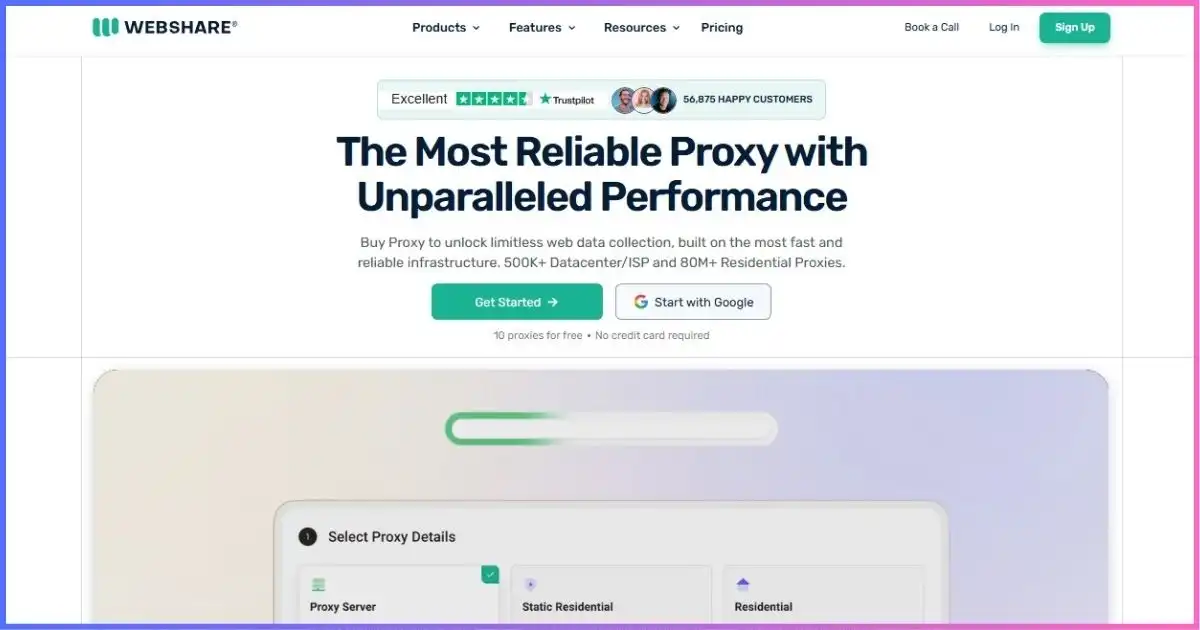
Archived homepage image from our media library; on-image counts and claims are not the current specification.
The strongest reason to start here is the gradual path from a basic integration to a more specific paid configuration. You can verify that your application supports the proxy connection before deciding how much traffic, geographic selection or sharing isolation it requires. Read our Webshare Proxy review for the broader provider overview.
Strengths
- A recurring free datacenter tier supports basic testing.
- Small paid entry options reduce the initial commitment.
- Documented endpoint controls help with targeted residential workflows.
Limitations
- The cheapest IP list is not a dedicated residential product.
- Residential unit prices are higher in the matching packages shown here.
- Configuration changes can alter the budget; refunds have tight conditions.
Buying advice: establish that the entry product works, then add only the features your pilot demonstrates you need. If the destination rejects datacenter IPs, buying more of the same list may not help.
ProxyShare: Worth Testing for Residential Traffic
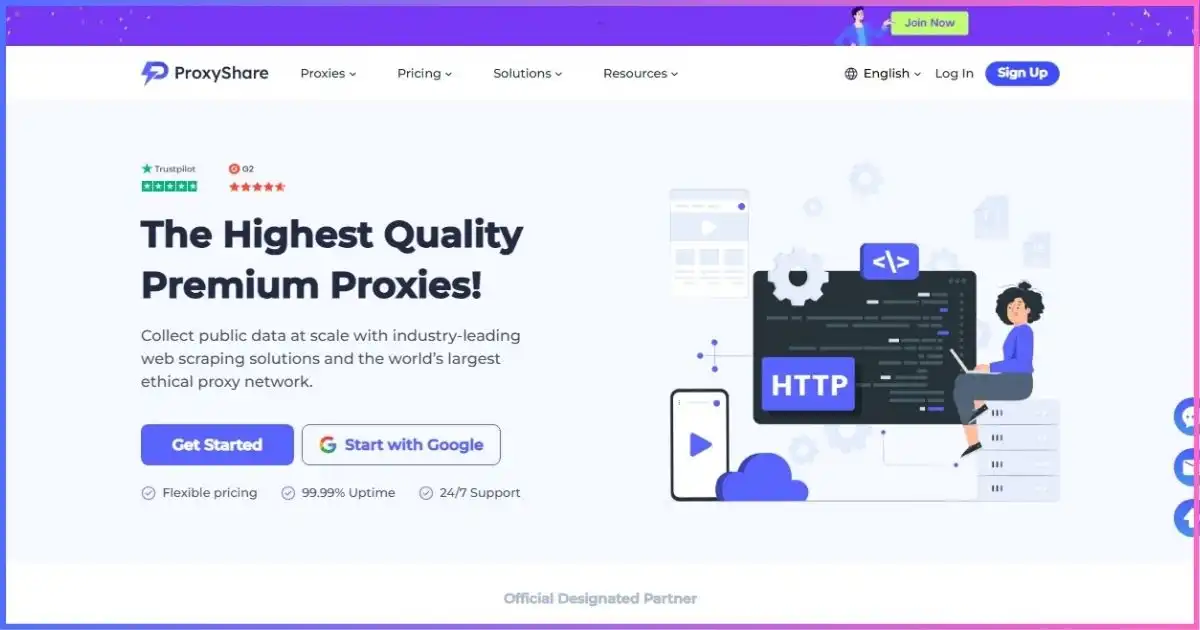
Archived homepage image from our media library; consult the dated comparison above for current offers.
ProxyShare deserves a place on the shortlist when a recurring residential job consumes enough traffic to benefit from package pricing. The main buying challenge is making sure that the selected product, validity period and location controls match the advertised offer. Our ProxyShare review provides additional context.
Strengths
- Lower listed residential costs at the matching quantities compared.
- Country/city selection and extensive residential coverage are advertised.
- Static and traffic-based products address different workflows.
Limitations
- Public pages contain inconsistent labels and broad marketing claims.
- A specific free-trial allowance was not verified.
- The public FAQ says purchased products are not refundable.
Buying advice: get a trial of the actual product, save the offer and expiry terms, and verify the target locations before purchasing a larger allowance.
Match the workloadWhich Provider Fits Your Use Case?
| Your workload | Sensible starting point | What decides the purchase |
|---|---|---|
| Learning proxy integration | Webshare free datacenter tier. | Authentication, client compatibility and usage reporting. |
| Permitted bulk requests to datacenter-friendly destinations | Webshare shared datacenter pilot. | Useful responses per dollar, bandwidth and address reputation. |
| Recurring residential price or availability checks | ProxyShare residential pilot; compare with Webshare on the same targets. | Actual traffic, successful records and unused allowance. |
| Precise location or network testing | Webshare’s documented targeting controls; confirm required exits exist. | Available country/city/ASN and US state/ZIP combinations. |
| A stable authorized workflow | Static residential/ISP plan from either, with sharing terms confirmed. | Continuity, exclusivity, replacement policy and recovery behavior. |
| Very large downloads or collection jobs | A specifically quoted high-volume or unlimited product. | Throughput, fair-use limits, country control and total spend. |
Neither provider’s marketing makes every use case a good fit. Proxy rotation will not fix missing authorization, a broken integration, or a destination that requires a different access method. For crawler behavior, RFC 9309 defines the robots.txt exclusion protocol and explicitly distinguishes its rules from access authorization. Build the destination’s published access requirements into the workflow.
If neither service meets your support or managed-data needs, our Bright Data Proxy vs ProxyShare comparison and Webshare Proxy vs Bright Data Proxy comparison explore a different buying category. Keep the same test workload when evaluating an alternative.
From purchase to pilotSetup and Troubleshooting Checklist
- Select the product and billing unit.Write down whether you bought IPs, gigabytes or a time-based service. Save the quantity, renewal or expiry date, and configuration shown at checkout.
- Generate the connection details.Copy the dashboard-provided hostname, port, credentials, protocol and location/session parameters. Keep credentials out of public repositories and screenshots.
- Test one request first.Check the exit IP and expected country with a trusted diagnostic endpoint, then access a permitted sample destination. Verify the returned content before increasing volume.
- Check session continuity.Repeat related requests with the same intended session settings. Confirm whether the exit changes and whether the application can recover if it does.
- Scale gradually with spending limits.Increase workers in small steps, inspect errors and billed traffic, and configure backoff and a maximum retry count. Keep a record of the last working setup.
| Symptom | Check before changing providers |
|---|---|
| Proxy authentication error / HTTP 407 | Credentials, authorized source IP, copied username parameters and selected port. |
| Connection timeout | Hostname resolution, port reachability, protocol mismatch and exhausted allowance. |
| Wrong country or locale | Generated targeting parameters, detected IP location, cookies and application language settings. |
| Session breaks during a workflow | Session identifier reuse, sticky duration, exit changes and client cookie persistence. |
| CAPTCHA or target rejection | Destination requirements, address reputation, request frequency and whether a different authorized access method is available. |
| Unexpected traffic consumption | Browser assets, redirects, retries, duplicate jobs and request/response accounting. |
Do not disable TLS certificate verification to make a failing proxy test pass. First determine whether the failure comes from proxy authentication, target TLS, a corporate interception layer, or a client configuration mistake. Keep HTTPS enabled for sensitive application traffic, and remember that unconfigured applications may continue connecting directly.
Before you payFree Access, Refunds, Expiry and Renewal
Webshare: distinguish free access from refund eligibility
The free product is a datacenter tier, not a residential trial. Webshare’s published refund conditions require cancellation within two days of the original payment, usage below 1 GB for proxy-server/static-residential plans or below 0.1 GB for rotating residential, and fewer than 1,000 proxies used. Check the full terms for your purchase and contact support promptly; this is not an unrestricted money-back promise.
Webshare says subscriptions renew automatically by default. Before starting a one-off project, note the next billing date and cancellation controls. For annual offers, check the amount collected upfront rather than assuming that a displayed monthly equivalent can be purchased one month at a time.
ProxyShare: confirm trial access before buying
ProxyShare’s homepage FAQ says it does not refund sold products and directs buyers to sales for a trial first. We could not verify the older article’s fixed “500M” trial claim, so it is no longer presented as an available entitlement. Ask which network the trial covers, how long it lasts and whether it includes the locations needed for your test.
Its residential packages display a 30-day validity period. Confirm when that clock starts, whether unused traffic expires, whether balances combine across purchases, and whether any renewal is automatic. Static offers use their own terms: a small headline price for ten days should not be mistaken for a full month.
Common questionsWebshare vs ProxyShare: FAQs
Is Webshare cheaper than ProxyShare?
Are Webshare and ProxyShare the same company?
Can I test residential performance using Webshare’s free proxies?
Does ProxyShare still offer a 500 MB free trial?
Which provider is faster?
Is a sticky residential session the same as a static ISP proxy?
Does SOCKS5 support mean all traffic is encrypted?
Should I choose the largest package for the lowest unit price?
Start With the Product Your Workload Actually Needs
Webshare is the sensible first stop for a small datacenter integration or a configurable proxy list. Its path from basic testing to paid settings is useful when you are still learning the workload. It also documents residential targeting and session controls in detail.
ProxyShare is worth piloting for recurring residential traffic because its listed matching-volume packages cost less. Validate the destination success rate, required locations and expiry rules before treating the advertised savings as a production saving.
For either service, buy the smallest suitable evaluation, measure usable results and billed traffic, and scale only after the configuration works. The winning proxy is the one that completes the intended job predictably at an acceptable total cost.
Pricing and editorial note: Prices and features reflect public pages reviewed on September 17, 2026. Discounts, inventory and checkout terms can change. Product recommendations are editorial judgments based on the documented offers; no performance ranking or independent network audit is implied.
Sources & comparison methodology
Research date: September 17, 2026. This update uses official product, pricing and help pages. We compared the monthly Webshare pricing selection with ProxyShare’s displayed 30-day packages, kept static products separate, and calculated chart values from the listed package totals. Provider pages are named below;
- Webshare — Pricing; Residential Proxy: monthly package totals and current displayed discounts. Crossed-out reference prices are not treated as current purchase prices. We use the package total where a rounded unit rate or annual-card label is inconsistent.
- Webshare — Proxy Server; Free Proxy Server: datacenter configurations, free-tier allowance, protocol support and subscription information.
- Webshare Help Center — Endpoint Generator: Rotating Residential; What types of Static Residential Proxies do you have?; Proxy Connection API docs: targeting, authentication, session controls and sharing distinctions.
- Webshare — Static Residential Proxy FAQ: published conditional refund rules. Confirm the full terms for your purchase.
- ProxyShare — Residential Proxies pricing: traffic packages, totals and 30-day validity. The generic “unlimited bandwidth” label on metered cards is not interpreted as unlimited traffic.
- ProxyShare — Static Residential Proxies and Static Data Center Proxies pricing: separate per-IP, time-limited totals. The $5 and $3 introductory figures apply to ten-day static offers, not thirty-day subscriptions.
- ProxyShare — Residential Proxies product page and homepage FAQ: advertised coverage, integration features, trial direction and no-refund statement. We did not verify a fixed free-trial quantity, independent uptime, or a guaranteed no-block outcome.
- MDN — Proxy servers and tunneling; IETF RFC 9309: contextual technical references linked in the proxy-type and use-case sections.
Limitations: No authenticated checkout purchase, throughput test, support-response test, peer-consent audit or target-specific success test was performed for this update. Public network counts are marketing claims. Cost scenarios are calculations with stated assumptions, not observed customer bills.