ScraperAPI vs ScrapingAnt: Which Web Scraping API Is Better?
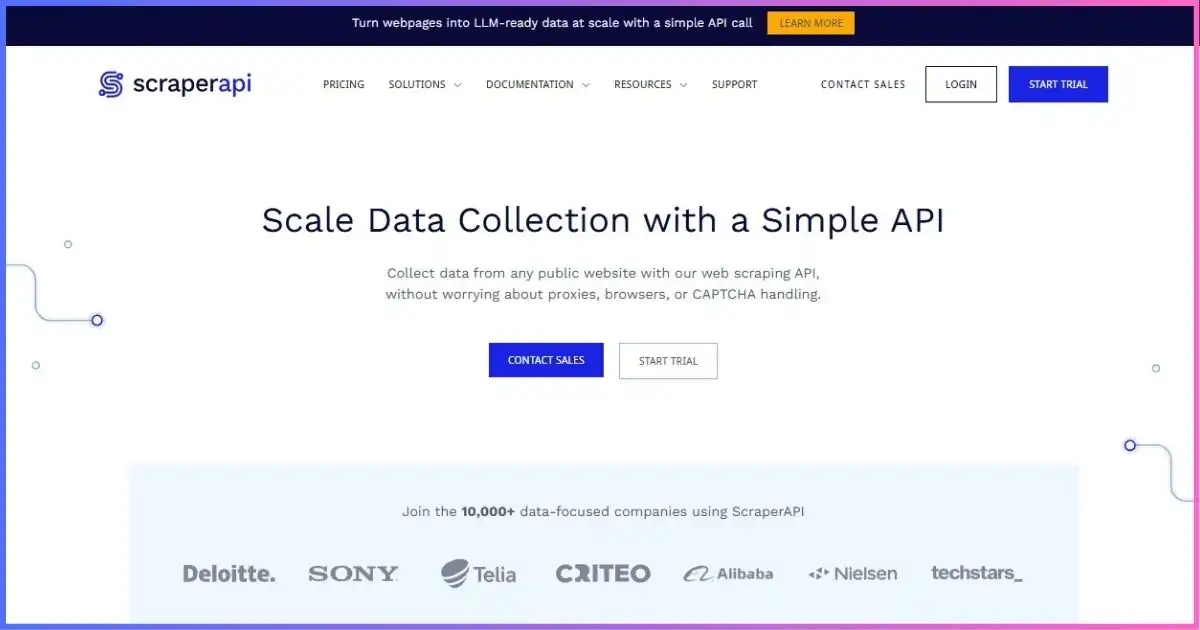
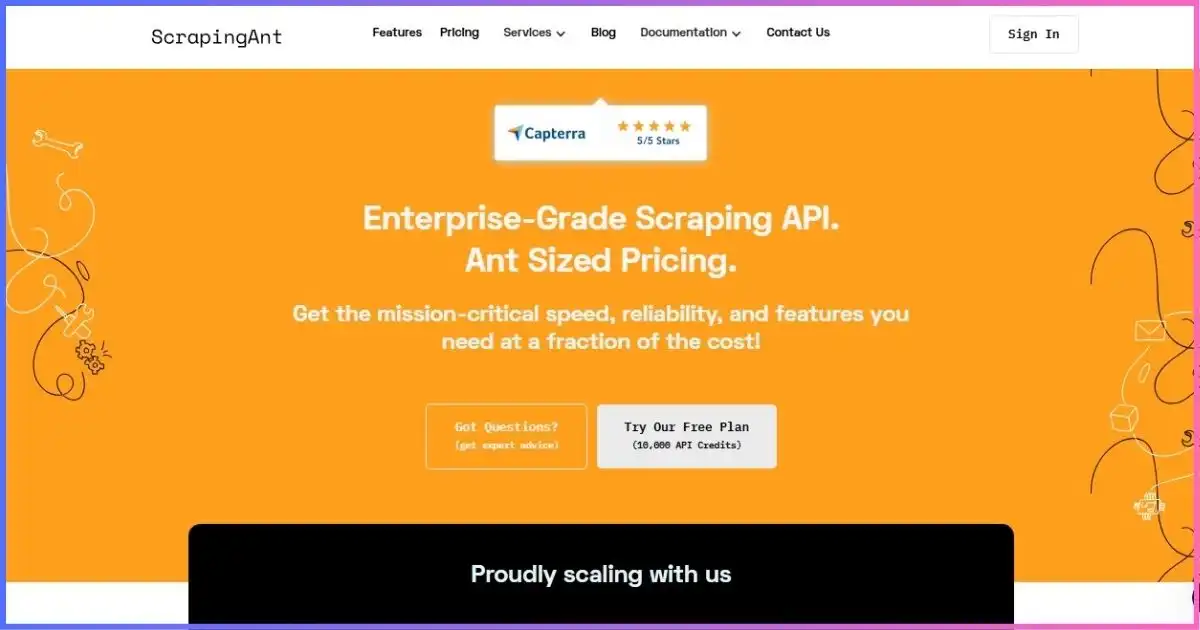
ScraperAPI and ScrapingAnt both remove proxy and browser maintenance from web scraping, but their strongest features sit at different points in the data workflow. ScrapingAnt combines managed Chrome, HTML and LLM-ready Markdown output, prompt-driven JSON extraction, proxies, and developer integrations. ScraperAPI combines managed retrieval with Structured Data Endpoints, Async API, proxy-port access, Crawler, AI Parser, and the scheduled DataPipeline product.
Our ScraperAPI vs ScrapingAnt verdict: ScrapingAnt is the better entry-level value and the stronger choice for Markdown or prompt-to-JSON workflows. It offers 10,000 recurring free credits and a $19 plan with the same 100,000-credit allowance ScraperAPI sells for $49. ScraperAPI is the stronger broader platform when supported structured endpoints, pipeline scheduling, target-specific routes, or higher documented concurrency replace engineering work.
ScraperAPI or ScrapingAnt?
Choose ScrapingAnt for the lower paid entry, ten times the clearly documented recurring free credits, LLM-ready Markdown, prompt-based structured extraction, and integrations such as MCP, Make, n8n, and GitHub Actions. A simple request costs one credit and a rendered datacenter request costs ten.
Choose ScraperAPI if you need supported Amazon/Google/Walmart/eBay/Redfin structured endpoints, DataPipeline scheduling, a Crawler, an Async API, explicit 20–500 paid concurrency tiers, or lower premium-rendered multipliers than ScrapingAnt’s residential-rendered mode. Always compare accepted-record cost rather than nominal credits.
Table of Contents
- Side-by-side comparison
- Product differences
- Plans and pricing
- Credit costs
- Request capacity
- Browser and rendering
- Structured data and AI
- Async and pipeline workflow
- Proxies and geotargeting
- Integrations and developer experience
- Concurrency and reliability
- Proxy Mode security
- Use-case winners
- True-cost framework
- Pros and cons
- FAQs
- Final verdict
- Sources and methodology
At a glanceScraperAPI vs ScrapingAnt Comparison
| Category | ScraperAPI | ScrapingAnt | Edge |
|---|---|---|---|
| Core product | Managed retrieval plus structured endpoints, Crawler, AI Parser, and DataPipeline | Managed Chrome/proxy/content API with Markdown and prompt extraction | Depends on workflow |
| Free access | Conflicting 7-day/5K trial and FAQ 1K free-plan messaging | 10,000 credits monthly; no card | ScrapingAnt |
| 100K-credit plan | $49 Hobby | $19 Enthusiast | ScrapingAnt |
| Simple datacenter | 1 credit | 1 credit | Tie |
| Rendered datacenter | 10 credits | 10 credits | Tie |
| Premium/residential | Premium: 10 credits | Residential: 25 credits | ScraperAPI nominal cost* |
| Premium/residential + render | 25 credits | 125 credits | ScraperAPI nominal cost* |
| Prompt extraction | AI Parser described in current docs | Documented typed/nested JSON with character formula | ScrapingAnt transparency |
| Supported structured targets | Amazon, Google, Walmart, eBay, Redfin workflows | General prompt-described extraction | Target-specific vs flexible |
| Native scheduling | DataPipeline hourly/daily/weekly/monthly/cron | Customer or Make/n8n/GitHub Actions | ScraperAPI |
| Concurrency | 20–500+ published paid threads | Advertises unlimited; error docs still define HTTP 409 | ScraperAPI clarity |
| Geo | 50+ locations advertised; US/EU on lower plans, global Business+ | 24 selectable API countries in current proxy docs | ScraperAPI reach |
*Premium and residential routes are not proven equivalent products. Compare target effectiveness and accepted-record economics, not multiplier alone.
The architectural choiceBroader Retrieval Platform vs Browser-and-AI API
You need more built-in workflow
ScraperAPI spans synchronous retrieval, Async API jobs, proxy-port use, Structured Data Endpoints, DataPipeline, and SDKs. Current documentation also describes Crawler, AI Parser, MCP, and n8n support.
It is the more complete choice when scheduled batch inputs, target-specific structured results, webhook delivery, analytics, and higher explicit concurrency matter more than entry price.
You need flexible content transformation
ScrapingAnt’s /v2/general fetches pages, /v2/markdown produces LLM-ready text,
/v2/extract returns prompt-described JSON, and /v2/usage reports plan status.
The compact surface is compelling for RAG ingestion, research assistants, monitoring systems, and teams that want browser access plus AI extraction without buying a wider pipeline suite.
Neither is a programmable hosted-code runtime like Apify or a visual desktop crawler like Octoparse. See Apify vs ScraperAPI, Apify vs ScrapingAnt, and ScraperAPI vs Octoparse for those alternatives.
Current public pricingScraperAPI vs ScrapingAnt Plans
| Provider / plan | Monthly | Credits | Concurrency / support highlights |
|---|---|---|---|
| ScraperAPI Free/trial | $0 | 5K trial advertised; FAQ also describes 1K free | FAQ free plan says 5 threads |
| ScraperAPI Hobby | $49 | 100,000 | 20 threads; US/EU geo |
| ScraperAPI Startup | $149 | 1 million | 50 threads; US/EU geo |
| ScraperAPI Business | $299 | 3 million | 100 threads; global geo; unlimited analytics |
| ScraperAPI Scaling | $475 | 5 million | 200 threads; pay as you go |
| ScraperAPI Professional | $975 | 10.5 million shown | 300 threads; priority support |
| ScraperAPI Advanced | $1,975 | 21.5 million shown | 500 threads; priority routing |
| ScrapingAnt Free | $0 | 10,000 monthly | No card; advertised no concurrency cap |
| ScrapingAnt Enthusiast | $19 | 100,000 | Email; docs-only integration assistance |
| ScrapingAnt Startup | $49 | 500,000 | Priority email; snippets; expert assistance |
| ScrapingAnt Business | $249 | 3 million | Debug sessions, custom pools/avoidances, account manager |
| ScrapingAnt Business Pro | $599 | 8 million | Priority support and debug sessions |
| ScrapingAnt Custom | $699+ | 10 million+ | Dedicated support; enterprise onboarding |
ScraperAPI annual billing advertises 10% off: Hobby $44.10, Startup $134.10, Business $269.10, Scaling $427.50, Professional $877.50, and Advanced $1,777.50 per month effective. ScrapingAnt unused credits do not roll over; its product page says a plan can be restarted mid-month to refresh credits. Verify current checkout terms.
Monthly paid commitments on a shared $1,975 scale
Price only—not equivalent workload or value. SA = ScraperAPI; Ant = ScrapingAnt.
Headline credit value
At one credit per simple datacenter request and full allowance use, ScrapingAnt Enthusiast costs $0.19 per 1,000 credits versus ScraperAPI Hobby at $0.49. ScrapingAnt Startup falls to $0.098 per 1,000, while ScraperAPI Startup is $0.149. At the 3M level, ScrapingAnt Business is $0.083 per 1,000 and ScraperAPI Business is roughly $0.100. These ratios exclude rendering, proxies, special targets, AI extraction, DataPipeline work, retries, and engineering labor.
The meter that mattersScraperAPI vs ScrapingAnt Credit Costs
| Request or mode | ScraperAPI | ScrapingAnt | Interpretation |
|---|---|---|---|
| Simple datacenter | 1 | 1 | Direct nominal tie |
| No-JS browser + page source | Not separately mapped | 2 | ScrapingAnt-specific mode |
| Rendered datacenter | 10 | 10 | Direct nominal tie |
| Premium / residential | 10 premium | 25 residential | Different route definitions |
| Screenshot | 10 | Browser flow; no same unit listed | Not directly comparable |
| Google domain | Google/Bing SERP: 25 | Any Google domain via DC: 10 | Different request scope may apply |
| Premium/residential + render | 25 | 125 | ScraperAPI lower nominal multiplier |
| Ultra premium + render | 75 | No same mode | ScraperAPI hard-target option |
| AI extraction | Product-specific AI Parser terms | Character formula + base fetch | ScrapingAnt formula is documented |
| DataPipeline normal flat | Starts at 6; combinations up to 80 | No native equivalent | Separate ScraperAPI meter |
ScraperAPI also lists Amazon at five credits, LinkedIn at 30, and named anti-bot protection modes at ten. Its premium-plus-render cost is a request-mode total of 25, not an instruction to add two tens. Free parameters include country, session, device, output format, headers, autoparse, and selector waits.
ScrapingAnt’s unusual documented 50-credit mode is a headless browser without JS rendering and
return_page_source=false; preserve that exact configuration when estimating instead of generalizing
it to all no-JS browser requests. ScrapingAnt’s Ant-credits-cost header reports consumption, while
ScraperAPI exposes sa-credit-cost, a URL-cost endpoint, and max_cost.
Selected core request costs: lower is better
Shared 125-credit scale. Different premium/residential networks are not assumed equivalent. AI and Pipeline charges excluded.
Which responses consume credits?
ScrapingAnt says failed/error requests consume zero credits. ScraperAPI charges 200 and 404 responses, plus client-cancelled work when it was not allowed up to 70 seconds to finish. A billed response from either service can still contain a challenge, wrong locale, empty template, stale page, or invalid record. Track business validity separately from HTTP success.
Same credits, different workloads100,000-Credit Capacity
| Workload | ScraperAPI Hobby $49 / 100K | ScrapingAnt Enthusiast $19 / 100K | Comment |
|---|---|---|---|
| Simple datacenter | 100,000 | 100,000 | Same theoretical capacity |
| Rendered datacenter | 10,000 | 10,000 | Same theoretical capacity |
| Premium / residential* | 10,000 | 4,000 | Networks are not assumed equivalent |
| Premium/residential + render* | 4,000 | 800 | ScrapingAnt multiplier is 5× higher |
| Ultra premium + render | About 1,333 | No direct equivalent | ScraperAPI-only standard mode here |
Theoretical capacity divides allowance by published mode cost. It is not a performance, success, or accepted-record guarantee and excludes AI character charges, DataPipeline, domain-specific costs, retries, and parsing.
Dynamic websitesHeadless Browsers, Rendering, and Page Control
ScrapingAnt enables managed Chrome by default and supports selector waits, custom JavaScript snippets, cookies, headers, page-source modes, country selection, datacenter or residential routing, and a 5–60 second timeout. A default rendered datacenter request costs ten credits; rendered residential costs 125.
ScraperAPI supports JavaScript rendering, screenshots, premium and ultra-premium routing, sessions, selector waits, device types, headers, retries, and desktop/mobile agents. Rendering costs ten, premium plus rendering 25, and ultra premium plus rendering 75. These are mode totals.
The services tie at ten credits for ordinary rendered datacenter pages. ScraperAPI has the nominal cost advantage when a stronger route and rendering are combined, while ScrapingAnt’s custom JavaScript and page-source controls may suit particular browser workflows. Only a target-level test can identify which produces correct content with fewer attempts.
From page to structured recordMarkdown, Structured Endpoints, and AI Extraction
ScrapingAnt: flexible Markdown and prompt extraction
ScrapingAnt’s Markdown endpoint strips much of the visual noise and prepares content for language-model
ingestion, search, summarization, and RAG. Its AI extractor accepts free-form field descriptions, supports typed
and nested results, converts names to camelCase, and may return null when a field is absent. It
operates on Markdown/text rather than layout and style markup.
AI cost = ceil((Markdown input characters + output characters) ÷ 30) + underlying request cost
Large pages and verbose schemas can make extraction cost much more than the base fetch.
ScraperAPI: target-specific structured endpoints and AI Parser
ScraperAPI Structured Data Endpoints return JSON or CSV for supported Amazon, Google, Walmart, eBay, Redfin, and related use cases. Sync and Async APIs support structured workflows, while autoparse and the current AI Parser product broaden extraction options. This approach can be more deterministic for a supported target because the endpoint already understands a known domain schema.
Neither approach is universal. Prompt extraction must be checked for nulls, incorrect types, omissions, and hallucinated values. Target-specific endpoints must be checked for coverage, locale, variants, pagination, and schema drift. Unsupported sites still need customer-owned parsing and validation.
Orchestration boundaryAsync Jobs, DataPipeline, Scheduling, and Storage
ScraperAPI provides synchronous API calls, Async API jobs, proxy-port access, and DataPipeline. DataPipeline accepts up to 10,000 URLs, keywords, or IDs per project through fields, CSV, or webhooks; supports one-time, hourly, daily, weekly, monthly, and cron schedules; and exposes notifications, saved downloads, and webhook results.
Arbitrary-site DataPipeline HTML is wrapped in JSONL, while supported structured/autoparsed workflows can produce JSON or CSV. DataPipeline uses its own credit schedule: a normal flat request starts at six credits and documented combinations reach 80. Do not assume a one-credit core fetch remains one credit inside a Pipeline project.
ScrapingAnt does not expose a comparable native durable dataset store or Apify-style scheduler in the supplied documentation. Scheduling can come from the customer’s application, cron, Make, n8n, or GitHub Actions. This is not necessarily a weakness when an existing queue and data warehouse should remain authoritative.
Network identityProxies, Geotargeting, Sessions, and Coverage
ScraperAPI advertises 40 million IPs across 50+ geolocations. Hobby and Startup list US/EU geotargeting, while Business and higher tiers list global geo. Premium and ultra-premium modes give developers escalation paths for harder targets, and session numbers can maintain identity across related calls.
ScrapingAnt’s homepage advertises more than three million rotating proxies. Its current Web Scraping API docs list 24 selectable countries. A separate standalone residential proxy product advertises 100+ countries and charges by GB; that separately billed product should not be confused with the scraping API’s credit plan or country availability.
Pool and location counts are provider-reported, not independently audited, and providers may count addresses over different windows. Test target compatibility, location accuracy, ASN mix, session behavior, block-page rate, and accepted output rather than selecting solely by the larger advertised number.
Developer surfacesSDKs, MCP, Automation, and Cost Controls
| Capability | ScraperAPI | ScrapingAnt |
|---|---|---|
| REST retrieval | Sync, Async, structured, Pipeline endpoints | General, Markdown, Extract, Usage endpoints |
| Proxy interface | Proxy-port access | Proxy Mode using API credits |
| Developer libraries | SDKs documented | Python and JavaScript clients |
| Automation | MCP, n8n, Crawler, DataPipeline | MCP, Make, n8n community node, GitHub Action |
| Cost visibility | Header, URL-cost endpoint, max_cost | Ant-credits-cost header and usage endpoint |
| Durable workflow | Pipeline schedules/results; external warehouse still advisable | Customer or integration owns scheduling/storage |
Both can be called with ordinary HTTP libraries using patterns like the MDN Fetch API. Keep tokens server-side, set bounded retries, log request costs, and separate transport success from content validation.
Published limits and realityConcurrency, Reliability, and Support
ScraperAPI publishes 20, 50, 100, 200, 300, and 500 threads from Hobby through Advanced. Exceeding the limit returns HTTP 429 rather than queueing or adding a fee. Scaling and above advertise pay-as-you-go credits. Professional adds priority support, Advanced adds priority routing, and Enterprise lists dedicated and Slack support.
ScrapingAnt’s website and migration guide advertise unlimited concurrent requests or no concurrency cap. Its current error documentation nevertheless defines HTTP 409 as a concurrency-limit error and advises retrying or upgrading. Buyers should interpret this as a requirement to load-test sustained traffic and obtain written clarification for critical workloads.
ScraperAPI lists a 99.9% uptime guarantee, while supported structured-domain marketing advertises 99.99% success. These are not universal arbitrary-site results. We did not run a controlled benchmark and therefore do not invent speed or success scores. Measure correct-content rate, accepted-record rate, p50/p95 latency, retry count, credit cost, and provider-error distribution on representative targets.
Transport trustProxy Mode and Credential Security
ScrapingAnt’s Proxy Mode documentation says SSL verification must be disabled. That weakens endpoint authentication and should not be treated as a harmless implementation shortcut. ScraperAPI offers proxy-port integration, which should likewise be reviewed for trust, credential exposure, logging, and target-data sensitivity.
Workload winnersWhich Tool Is Better for Your Use Case?
| Use case | Better starting point | Why |
|---|---|---|
| Recurring free development | ScrapingAnt | Clear 10,000-credit monthly plan |
| Lowest 100K-credit price | ScrapingAnt | $19 versus ScraperAPI’s $49 |
| LLM-ready page ingestion | ScrapingAnt | Dedicated Markdown endpoint |
| Prompt-defined arbitrary schemas | ScrapingAnt | Typed and nested AI extraction |
| Supported retail/search endpoints | ScraperAPI | Target-specific structured JSON/CSV |
| Scheduled batch pipelines | ScraperAPI | DataPipeline inputs, schedules, downloads, webhooks |
| Premium rendered access | ScraperAPI | 25-credit premium+render versus Ant residential+render at 125* |
| Explicit concurrency planning | ScraperAPI | 20–500 documented paid threads |
| Make/GitHub Action automation | ScrapingAnt | Named official integration paths |
| Global geotargeting at scale | ScraperAPI Business+ | 50+ advertised locations versus 24 API-selectable countries |
*Premium and residential routes are not identical network products; this compares documented multipliers only.
For deeper product reviews, read our ScraperAPI review and ScrapingAnt review. Related comparisons include ScraperAPI vs Scrape.do, ScrapingAnt vs Scrape.do, and the best web scraping tools guide.
Suggested pilot decision weights
A planning framework, not measured performance. Adjust weights before testing.
- 30% Validated output quality — accurate, complete, correct locale.
- 25% Accepted-record cost — credits, retries, labor, infrastructure.
- 20% Workflow fit — Markdown/AI versus structured/pipeline needs.
- 15% Throughput — sustained concurrency and tail latency.
- 10% Governance — security, retention, support, compliance.
A fair buying frameworkHow to Compare True Cost
Use total monthly cost per accepted record, not cost per credit. ScrapingAnt’s cheaper allowance may still become expensive if most pages require 125-credit residential rendering or lengthy AI extraction. ScraperAPI’s higher subscription may be economical when structured endpoints or Pipeline replace substantial custom work.
- Define acceptance.List required fields, locale, freshness, uniqueness, types, and null rules.
- Sample representative URLs.Include static, rendered, protected, regional, long, and unusual pages.
- Find the cheapest valid mode.Do not enable browser or premium identities globally without evidence.
- Log credit headers.Record target class, parameters, status, latency, retries, and validation.
- Price extraction and orchestration.Include AI characters, Pipeline costs, custom parsers, queues, schedules, storage, and maintenance.
- Test sustained load.Observe 409/429 behavior, timeouts, backoff, p95 latency, and output quality.
- Divide total spend by accepted output.Returned HTML is not automatically a valid business record.
Respect authorization and target policies. The Robots Exclusion Protocol in RFC 9309 standardizes robots.txt behavior, but it does not replace terms-of-service, privacy, intellectual-property, data-rights, or legal review.
Balanced trade-offsScraperAPI and ScrapingAnt Pros and Cons
ScraperAPI
Pros
- Broad retrieval, structured, crawler, AI, and pipeline suite
- Supported target-specific JSON/CSV endpoints
- DataPipeline batching, schedules, downloads, and webhooks
- Explicit 20–500 paid concurrency tiers
- Useful cost header, URL estimator, and max-cost cap
- Lower nominal premium-render cost than Ant residential-render mode
Cons
- $49 for 100K credits versus ScrapingAnt’s $19
- Free offer wording conflicts across public pages
- DataPipeline uses a separate higher credit schedule
- Global geo begins at Business
- Structured parsing is not universal
- Professional/Advanced displayed bonuses need confirmation
ScrapingAnt
Pros
- 10,000 recurring free credits and $19 paid entry
- Same simple and rendered-DC multipliers as ScraperAPI
- Dedicated LLM-ready Markdown endpoint
- Documented typed/nested prompt extraction
- MCP, Make, n8n, GitHub Action, Python, and JS integrations
- Failed/error requests documented as zero credit
Cons
- Residential rendering costs 125 credits
- AI extraction adds character-based charges
- Unused credits do not roll over
- Only 24 API-selectable countries in current docs
- Unlimited concurrency claim conflicts with HTTP 409 docs
- Proxy Mode says SSL verification must be disabled
Choose by the work you want to outsource: ScrapingAnt offers lower-cost access plus flexible content transformation. ScraperAPI outsources more scheduling, batching, structured-target, and crawler work.
Frequently asked questionsScraperAPI vs ScrapingAnt FAQ
Is ScraperAPI better than ScrapingAnt?
Which is cheaper, ScraperAPI or ScrapingAnt?
Which has the better free plan?
Which is better for JavaScript rendering?
Does ScrapingAnt return structured JSON?
Does ScraperAPI return structured data?
Which offers better scheduling?
Does ScrapingAnt really have unlimited concurrency?
Are advertised proxy-pool sizes independently verified?
ScrapingAnt Wins Entry Value; ScraperAPI Wins Workflow Breadth
Choose ScrapingAnt when budget, recurring free access, Markdown, or flexible prompt extraction is the priority. Its $19 plan delivers the same 100,000 headline credits ScraperAPI sells for $49, and both use one credit for simple datacenter and ten for standard rendered datacenter requests.
Choose ScraperAPI when supported structured endpoints, DataPipeline schedules, Crawler, AI Parser, explicit concurrency tiers, or premium-rendered economics will replace more customer engineering. Its value is not the cheapest raw credit—it is the wider set of problems the account can solve.
Our recommendation: default to ScrapingAnt for a lightweight browser/content/AI API and to ScraperAPI for a broader managed retrieval pipeline. Pilot representative URLs and decide on total provider plus engineering cost per validated record.
Sources & comparison methodology
Research scope: official public pricing and documentation reflected in the project’s September 18, 2026 research. We reviewed plans, credits, rendering, proxy modes, target pricing, Markdown, AI extraction, structured endpoints, DataPipeline, integrations, concurrency, support, and geotargeting. No paid checkout, private contract review, or controlled cross-provider benchmark was performed.
Method: paid prices share a $1,975 scale; selected modes share a 125-credit scale. Capacity divides 100,000 credits by documented request-mode cost and is not a guaranteed response or accepted-record count. Pool, uptime, success, and concurrency claims remain labeled as provider-reported. The pilot donut is an editorial planning framework.
Official ScraperAPI material represented: pricing, core docs, request costs, Structured Data Endpoints, DataPipeline, Pipeline costs, outputs, and endpoints. Official ScrapingAnt material represented: homepage/pricing, credit costs, AI extraction and best practices, proxy settings, Proxy Mode, MCP, Make, n8n, GitHub Action, and errors.
Affiliate disclosure: This article contains affiliate links. We may earn a commission if you purchase through them, at no additional cost to you. This does not change the comparison. Pricing, credits, offers, and limits can change; verify live signup and contract terms.