IPVanish vs Surfshark: Which VPN Should You Choose?
IPVanish vs Surfshark looks close at first: both support unlimited paid-plan connections, WireGuard, multi-hop routing, obfuscation, TV apps and P2P. The differences emerge underneath. IPVanish costs less initially and gives advanced users individual server control. Surfshark covers nearly twice as many countries, runs a fully RAM-only network, has stronger current privacy evidence and offers a wider set of routing, split-tunneling and restrictive-network tools.
Surfshark wins on features and reach; IPVanish wins on transparent entry pricing
Surfshark is better for most people. Its 4,500+ RAM-only servers in 100 countries, Dynamic MultiHop, Rotating IP, NoBorders, Camouflage, broad Bypasser support and post-quantum layer on supported in-app WireGuard connections make it the more complete service. IPVanish is the better price-first choice: Essential costs $52.56 for two years and lists a $89.99 annual renewal. Surfshark Starter costs $67.23 for 27 months, but its public page does not expose one stable renewal dollar amount.
Table of Contents
At a glanceIPVanish vs Surfshark: Quick Comparison
| Category | IPVanish Essential | Surfshark Starter | Winner |
|---|---|---|---|
| Overall score | 8.1/10 | 9.1/10 | Surfshark |
| Longest introductory offer* | $52.56 / 24 months ($2.19/mo) | $67.23 / 27 months ($2.49/mo) | IPVanish |
| Renewal disclosure | $89.99/year | Annual at applicable price; no stable public dollar amount | IPVanish |
| Devices | Unlimited | Unlimited on paid plans | Tie |
| Network | 3,400+ servers / 150 locations / 55 countries | 4,500+ servers / 100 countries | Surfshark |
| RAM-only | Migration in progress | Whole fleet | Surfshark |
| Multi-hop | Selected Double Hop routes | Dynamic MultiHop with selectable pairs | Surfshark |
| Obfuscation | OpenVPN Scramble | OpenVPN Camouflage + NoBorders | Surfshark |
| Split tunneling | Selected platforms | Windows, macOS, Android, iOS and extensions | Surfshark |
| Refund | 30 days on eligible annual/two-year terms | 30 days on eligible initial purchase | Tie |
| Port forwarding | No | No | Tie |
*USD promotional prices checked September 19, 2026. Long plans are prepaid; taxes, coupons, bonus months and payment-channel rules can vary.
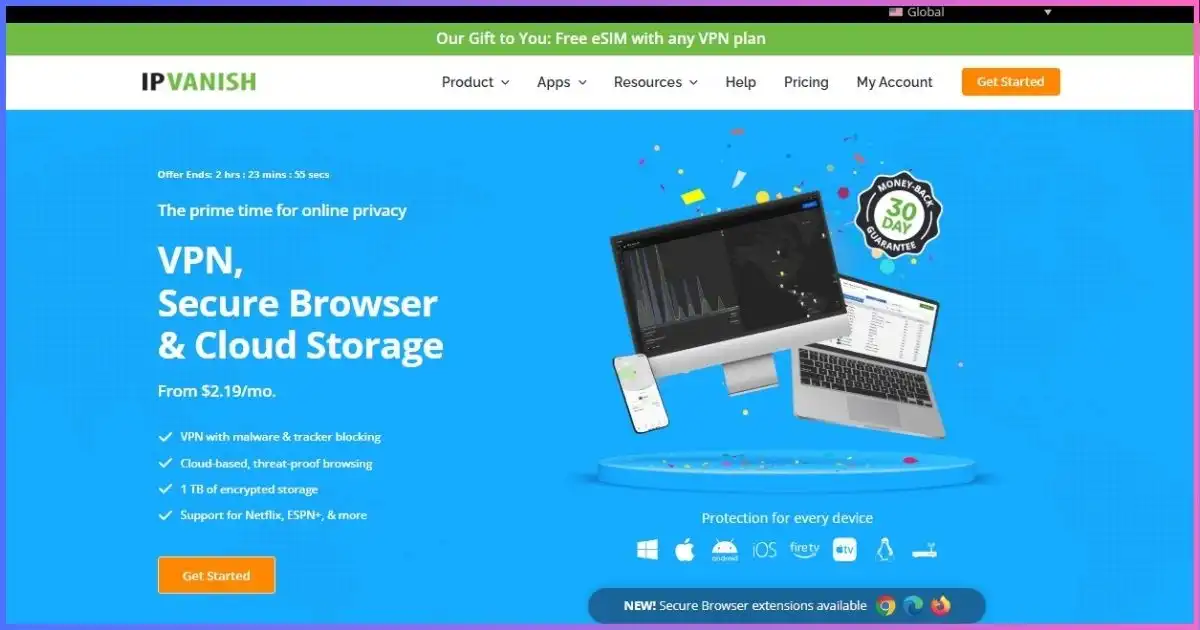
IPVanish: server-level control
Lower first charge, unlimited devices, detailed city/server selection and capable TV applications.
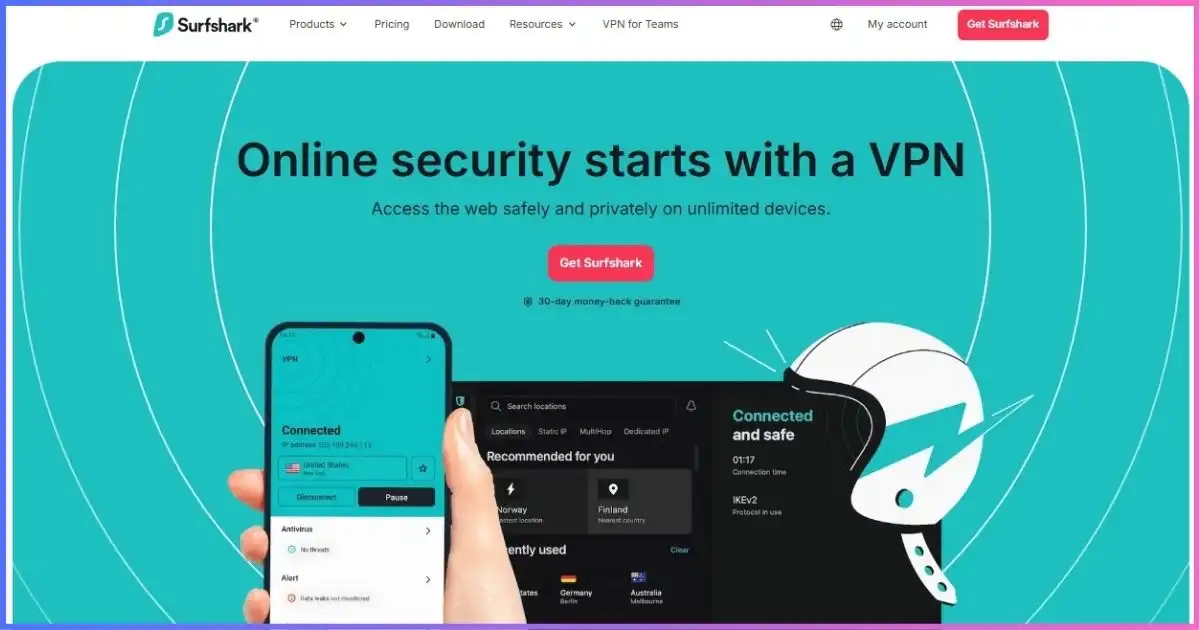
Surfshark: broader all-round value
Unlimited devices plus stronger privacy architecture, global reach and advanced routing tools.
Round 1 · IPVanish winsPricing, Renewals and Free-Trial Terms
IPVanish Essential is cheaper at every currently comparable entry point. Its two-year plan costs $52.56 upfront, its first year is about $39.99, and its monthly plan is $12.99. Surfshark Starter costs $67.23 for 27 months; its published guide lists $3.39 per month equivalent on one year and $16.45 monthly.
| Term | IPVanish Essential | Surfshark Starter | Takeaway |
|---|---|---|---|
| Monthly | $12.99 | $16.45 | IPVanish saves $3.46/month |
| One year | About $39.99 initially | About $40.68 at $3.39/mo | Nearly tied; IPVanish slightly lower |
| Longest offer | $52.56 / 24 months | $67.23 / 27 months | Surfshark adds 3 months but costs $14.67 more |
| Renewal | $89.99/year disclosed | Annual at then-applicable price | IPVanish is clearer, not necessarily cheaper |
| Guarantee/trial | 30 days on eligible 1/2-year plans | 30 days; eligible 7-day trial on selected web signups | Surfshark offers more trial flexibility |
Current introductory charges (USD)
Column height shows the total first charge; plan durations differ.
monthly
monthly
1 year
1 year
24 months
27 months
Surfshark’s headline rate is introductory; the public pricing page says it renews annually at the applicable rate without presenting one durable dollar amount. IPVanish explicitly lists $89.99 per year after the first two-year Essential term. Compare core tiers: IPVanish Advanced and Surfshark One/One+ add security, storage, monitoring or identity products without changing the core VPN network.
Round 2 · Surfshark winsPrivacy, Jurisdiction and Audit Evidence
Surfshark B.V. operates from the Netherlands; IPVanish is US-based and owned by Ziff Davis. Jurisdiction matters less than what the system stores, how infrastructure is built and what outside reviewers verify.
Surfshark’s no-logs design received Deloitte assurance work in 2023 and 2025. The 2025 report covers standard, static and multiport servers plus configuration/deployment processes. Surfshark publishes the report PDF, maintains a Trust Center, runs RAM-only infrastructure and disclosed a 2026 court-warrant response limited to account-existence/payment information rather than online activity.
IPVanish’s 2025 Schellman assessment found its current system did not log traffic, activity metadata, DNS queries or user IP addresses across servers, regions and tiers. A 2022 Leviathan review supplied earlier post-acquisition evidence. The newest full report may require an account.
Surfshark’s Deloitte report follows ISAE 3000 (Revised). Audits remain point-in-time and scoped. Our VPN logging-policy guide explains what no-logs claims often omit.
Round 3 · Surfshark winsSecurity, Protocols and Advanced Routing
Both services support WireGuard, OpenVPN and IKEv2 with platform-specific differences. The official WireGuard protocol explains the compact cryptographic foundation; provider account mapping, features and infrastructure still differ.
IPVanish tools
- Selected Double Hop routes
- OpenVPN Scramble
- DNS-level Threat Protection
- Direct city/server selection
- Advanced-only Threat Protection Pro on Windows/macOS
Surfshark tools
- Dynamic MultiHop with custom pairs
- Rotating IP every few minutes
- NoBorders and OpenVPN Camouflage
- Post-quantum layer on supported app WireGuard
- CleanWeb, Everlink and FastTrack
Surfshark’s lead comes from flexibility. Dynamic MultiHop lets users select entry and exit countries; Rotating IP changes the visible address without dropping the location; NoBorders proposes routes on restricted networks. Its post-quantum layer applies to supported in-app WireGuard connections, not manual configurations.
Dausos is interesting but should not be oversold: as of September 2026 it remains beta and is available only in the macOS App Store build. IPVanish Scramble and Surfshark Camouflage both depend on OpenVPN and may cost speed.
Round 4 · Surfshark winsServer Network: Global Breadth vs City Granularity
Surfshark publishes 4,500+ servers in 100 countries, all with at least 10-Gbps ports and selected high-traffic infrastructure up to 100 Gbps. IPVanish publishes 3,400+ servers, 56,000+ IPs and 150 locations in 55 countries. It has also emphasized dual-provider redundancy, direct peering and ports up to 50 Gbps.
Surfshark is better for international travelers and uncommon country endpoints. IPVanish is better when you want to inspect individual servers, latency and load within a supported city. Raw machine count does not determine speed; proximity, peering and congestion matter.
Round 5 · Surfshark wins narrowlySpeed, Reliability and Infrastructure
Both can be fast over WireGuard, and no honest comparison can promise a universal retention percentage. IPVanish’s direct peering, redundant city deployments and newer packet-processing work are credible engineering advantages. Surfshark counters with a larger RAM-only network, performance indicators, Everlink self-healing infrastructure and FastTrack route selection on supported paths.
Test on the same device, ISP and endpoint: take three no-VPN baselines, three nearby VPN runs and three distant runs, then compare medians for throughput, latency and reconnection. Port capacity is shared and cannot be converted directly into home-user speed.
Rounds 6–7 · Surfshark winsApps, Devices and Split Tunneling
Both allow unlimited simultaneous paid connections, making either a strong household choice. Surfshark’s eligible trial is capped at three devices, but that cap disappears on a paid subscription.
IPVanish gives power users excellent city/server selection and strong Apple TV, Fire TV and Android TV applications. Its 2026 Apple TV build supports WireGuard, OpenVPN UDP/TCP, IKEv2, port choice and Scramble. Surfshark covers Windows, macOS, Linux, Android, iOS, Apple TV, Android TV and Fire TV, plus Chrome, Firefox and Edge extensions.
Surfshark wins split tunneling. Bypasser is documented across Windows, macOS, Android, iOS and browser extensions, although exact app/site routing directions vary. IPVanish offers split tunneling on selected platforms but not the same documented breadth. Surfshark also offers manual router and WireGuard paths.
For standalone details, read our IPVanish review and Surfshark review.
Round 8 · Surfshark winsStreaming and Smart TV Support
Both offer unlimited connections and native apps for major TV platforms. IPVanish is especially good for users who want server-level control on Apple TV. Surfshark wins overall because its 100-country network provides more regional options, WireGuard and Bypasser make performance/routing easy to tune, and its mainstream apps have broader parity.
Neither provider can guarantee permanent access to a streaming service or catalog. Blocks vary by IP, platform, region, account and time. Test your exact setup during the refund window. See our best streaming VPN guide for more options.
Round 9 · TieTorrenting and Port Forwarding
Both support P2P, WireGuard, kill switches and unlimited connections. Neither offers ordinary VPN-side inbound port forwarding, so BitTorrent relies on outbound peer connections. That works for downloads but may reduce reachability for seeding or small swarms.
Surfshark users should ensure Bypasser does not exclude the torrent client. IPVanish users should not confuse Scramble with forwarding; it only changes how OpenVPN traffic appears. We also avoid stale IPVanish SOCKS5 claims without current documentation.
Enable the kill switch, bind the client to the VPN adapter where supported and use only authorized torrents. Our torrenting VPN guide includes services with port forwarding.
Round 10 · Surfshark wins narrowlyGaming, Ping and Connection Stability
IPVanish’s server-level latency/load view is valuable for selecting a route manually, and its infrastructure improvements target resilience and direct peering. Surfshark offers broader endpoint coverage, WireGuard, performance indicators, Everlink and FastTrack, giving it more ways to find or maintain an efficient route.
A VPN usually adds latency. It can reduce ping only if it bypasses poor ISP routing. Neither guarantees an open NAT, protects a game company’s servers or fixes Wi-Fi congestion. For consoles, native support is limited; a compatible router or shared connection may be required.
Our gaming VPN guide explains DDoS, NAT and router limitations.
Round 11 · Surfshark winsTravel, Public Wi-Fi and Restrictive Networks
Surfshark’s 100 countries make nearby exits easier to find abroad. NoBorders detects network restrictions and suggests routes, while OpenVPN Camouflage disguises VPN traffic. IPVanish covers fewer countries but includes 3 GB of eSIM data with Essential and offers OpenVPN Scramble.
Neither obfuscation mode guarantees operation against a national firewall, and VPN use can be regulated. Install before departure, sign in, save recovery codes and keep multiple protocols available. The FTC’s public Wi-Fi guidance is a useful reminder that a VPN complements—not replaces—updated devices, HTTPS and account security.
See our travel VPN guide for a complete setup checklist.
Round 12 · TieCustomer Support and Ease of Use
Both provide 24/7 chat and substantial setup documentation. Surfshark is easier for most users because its feature set is organized around clear labels and an Automatic protocol. IPVanish is more satisfying for experts who want individual server data and manual selection.
IPVanish Advanced adds business-hours phone support, but that is not part of Essential. Surfshark’s Dausos beta and multiple bundle tiers can add complexity, while IPVanish’s split feature parity requires checking each platform.
Decision guideShould You Choose IPVanish or Surfshark?
Strength profile
- IPVanish: pricing and granular server choice.
- Surfshark: stronger balance across privacy, security, network and apps.
- Scores show relative fit, not measured Mbps.
Choose IPVanish if you…
- Want the lower introductory total
- Prefer a clearly disclosed renewal
- Need individual server/load selection
- Value the included travel eSIM data
- Want advanced Apple TV protocol control
Choose Surfshark if you…
- Want the stronger all-purpose VPN
- Travel and need broad country coverage
- Want Dynamic MultiHop or Rotating IP
- Need wider split-tunneling support
- Prioritize RAM-only infrastructure and current privacy evidence
Round-by-round scorecard
Surfshark is the better VPN; IPVanish is the cheaper first purchase
Surfshark wins with 9.1/10. Both handle unlimited devices, but Surfshark goes much further: nearly twice the country coverage, full RAM-only deployment, stronger current privacy assurance, Dynamic MultiHop, Rotating IP, NoBorders, broader Bypasser support and post-quantum protection on supported app connections.
IPVanish scores 8.1/10. Its $52.56 two-year price, disclosed $89.99 renewal, direct server controls, Double Hop, Scramble and excellent TV apps make it a credible specialist. The narrower network, partial RAM-only rollout, privacy history and thinner cross-platform feature set keep it behind.
FAQsIPVanish vs Surfshark FAQs
Is Surfshark better than IPVanish?
Which is cheaper?
Which is faster?
Which is better for streaming?
Do both allow unlimited devices?
Does either support port forwarding?
Which is safer for privacy?
Which is better in restrictive countries?
Sources & comparison methodology
Research cutoff: September 19, 2026. Prices, renewals, server totals and app features can change.
- Surfshark official pricing and plan documentation: Starter/One/One+ first-term totals, trial/refund terms and current monthly/annual guide pricing.
- Surfshark server directory and Trust Center: 4,500+ servers, 100 countries, RAM-only design, port capacity, Everlink/FastTrack and security assessments.
- Surfshark protocol and feature support: WireGuard/OpenVPN/IKEv2, post-quantum scope, Dynamic MultiHop, Rotating IP, NoBorders, Camouflage, Bypasser and macOS-only Dausos beta.
- Surfshark 2025 Deloitte assurance materials, privacy policy, transparency reporting and February 2026 SmartDNS retirement notice.
- IPVanish current plan/renewal, network, app, infrastructure and platform disclosures; 2025 Schellman and 2022 Leviathan no-logs assessment materials.
- IPVanish historical disclosure reporting under prior ownership, current RAM-only rollout, Double Hop, Scramble, TV-app and eSIM documentation.
- Contextual sources: IAASB’s ISAE 3000 (Revised), WireGuard protocol documentation and FTC public Wi-Fi guidance.
Scoring method: We weighted price and renewal transparency, refunds, privacy architecture and external verification, security/protocol depth, country/location reach, expected route reliability, app parity, devices, streaming, P2P, gaming, travel and support. We did not invent universal speed-loss or streaming-success percentages.
Disclosure: This page contains affiliate links. We may earn a commission if you purchase through them, at no additional cost to you. That does not alter the pricing caveats or verdict. A VPN protects the path to its server; it does not legalize unlawful activity, eliminate malware or replace account security.