ScraperAPI vs Octoparse: Which Scraping Tool Is Better?
ScraperAPI and Octoparse solve the same business problem through very different workflows. ScraperAPI is a developer-first retrieval service: your application sends a URL, and its proxy rotation, browser rendering, retries and anti-bot handling work behind an API. Octoparse is a visual desktop crawler builder: users click page elements, arrange loops and pagination steps, then run the task locally or—on a paid plan—in Octoparse’s cloud.
That distinction matters more than the headline price. ScraperAPI Hobby starts at $49 monthly with 100,000 credits and 20 concurrent threads. Octoparse Standard costs $83 monthly, or an advertised $69 per month on annual billing, with 100 saved tasks and up to three concurrent cloud processes. Credits, tasks and cloud processes are not comparable capacity units, so this ScraperAPI vs Octoparse review models each separately.
ScraperAPI or Octoparse: Who Wins?
ScraperAPI wins for developers, application integration and high-concurrency URL retrieval. Octoparse wins for visual, no-code crawler building. Pick ScraperAPI if your team already controls parsing, validation and storage in code, or wants structured endpoints for supported marketplaces and search engines. Pick Octoparse if analysts need to select fields on screen, model multi-page journeys visually and export finished tabular data without maintaining the retrieval stack themselves.
Overall: ScraperAPI is our more flexible engineering pick, but it is not a visual scraper. Octoparse is the easier operational pick for non-developers, but its lower-tier cloud concurrency is much smaller and its workflow automation is task-based rather than request-based.
Table of Contents
- Comparison at a glance
- How each platform works
- Plans and pricing
- ScraperAPI credit costs
- Octoparse tasks and cloud limits
- Free access compared
- Rendering, proxies and anti-bot tools
- Scheduling and workflow automation
- Parsing, output and storage
- APIs and integrations
- Performance and concurrency
- Best use cases
- Calculate real cost
- Pros and cons
- FAQs
- Final verdict
Side-by-sideScraperAPI vs Octoparse at a Glance
| Category | ScraperAPI | Octoparse | Best fit |
|---|---|---|---|
| Primary workflow | Send URLs through API, async API, proxy port, pipeline or supported structured endpoints | Build extraction tasks in a point-and-click desktop interface | Code: ScraperAPI No-code: Octoparse |
| Paid entry | $49/mo; $44.10/mo annual-effective | $83/mo; advertised $69/mo annual-effective | ScraperAPI price |
| Entry allowance | 100,000 credits; 20 threads | 100 tasks; up to 3 cloud processes | Units differ |
| Visual task builder | No comparable general-purpose point-and-click builder | Yes: clicks, loops, pagination, conditions and field selection | Octoparse |
| Managed retrieval API | Core product; retries, proxies, rendering and anti-bot modes | Open API controls supported tasks; custom tasks are configured visually | ScraperAPI |
| Scheduling | DataPipeline supports one-time, interval and cron schedules | Cloud task scheduling on Standard and above | Tie by workflow |
| Structured results | JSON/CSV for supported Amazon, Google, Walmart, eBay and Redfin endpoints | User-selected fields exported as structured tables | Different strengths |
| Arbitrary-site parsing | Usually customer-owned; arbitrary DataPipeline pages can return HTML wrapped in JSONL | Visual extraction rules generate rows and columns | Octoparse |
| Best buyer | Developers, data engineering teams and API products | Analysts, researchers and no-code operations teams | Depends on team |
Choose ScraperAPI if…
You have code or automation that can call an API and process HTML/JSON. Its value is outsourced access: rotation, rendering, retries and difficult-site modes behind one request interface.
Choose Octoparse if…
You want a visual representation of the crawl itself. It is better when the person defining page clicks, pagination and extracted fields is not expected to write and deploy a scraper.
The decision that mattersAPI Retrieval vs Visual Workflow Building
With ScraperAPI, your code remains the control plane. A typical integration builds a target URL, passes it to the service, then parses or stores the returned response. The synchronous API suits immediate work; Async API suits longer jobs; proxy port can reduce integration changes; structured endpoints return parsed output for supported targets; and DataPipeline adds scheduled, low-code batches. The service removes much of the IP and browser infrastructure, but it does not eliminate application logic.
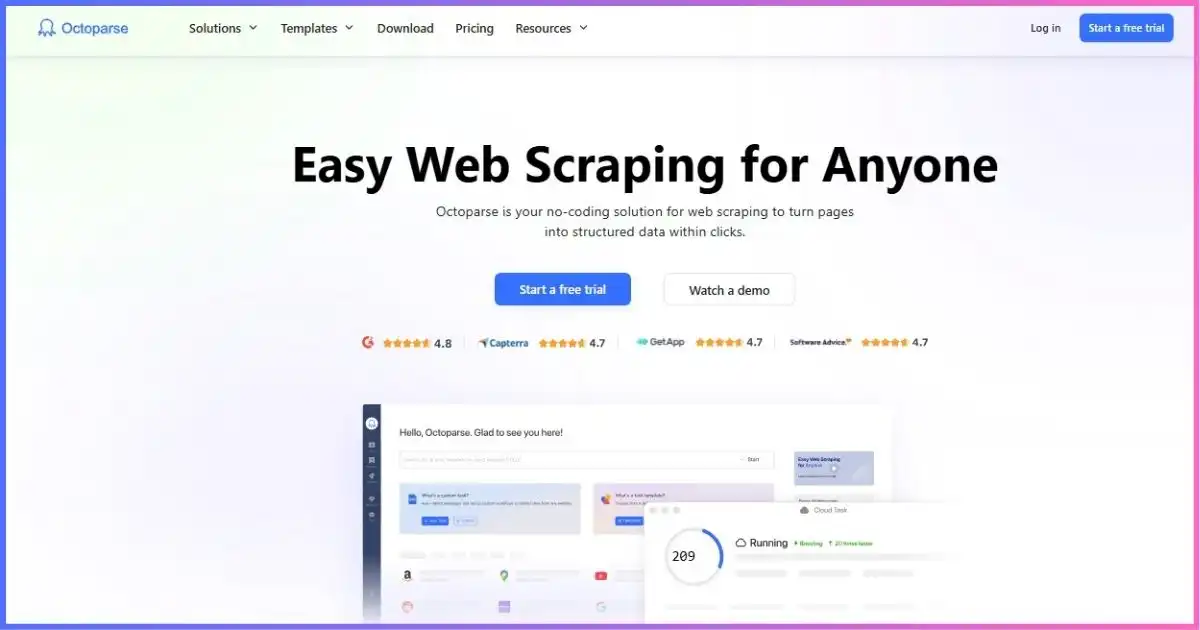
Octoparse moves much of that logic into a desktop interface. Its built-in browser lets a user load a page, select titles or prices, define pagination, model clicks and loops, add conditions, preview rows, then run the task. Free users run locally; Standard and higher plans can move tasks to Octoparse’s cloud, where scheduling, rotating cloud IPs, CAPTCHA handling and automatic export are available.
Practical implication: ScraperAPI reduces retrieval engineering; Octoparse reduces crawler-building code. Neither removes the need to define fields, validate data, respect site rules or monitor changing pages.
Editorial workflow-fit profile
Qualitative fit—not a lab benchmark. A larger shape means stronger out-of-box fit for that category.
Current public pricesScraperAPI vs Octoparse Pricing
ScraperAPI prices access by credits and concurrency. Octoparse prices the authoring/cloud platform by tasks and cloud processes, with some variable-cost templates, CAPTCHA solving and services. Therefore, “$49 versus $83” compares the minimum monthly commitments—not equal amounts of scraping.
ScraperAPI plans
| Plan | Monthly | Annual-effective | Credits | Threads | Geotargeting / notable extras |
|---|---|---|---|---|---|
| Hobby | $49 | $44.10/mo | 100K | 20 | US/EU |
| Startup | $149 | $134.10/mo | 1M | 50 | US/EU |
| Business | $299 | $269.10/mo | 3M | 100 | Global; unlimited analytics history |
| Scaling | $475 | $427.50/mo | 5M | 200 | Global; PAYG overage |
| Professional | $975 | $877.50/mo | 10.5M* | 300 | Priority support; PAYG |
| Advanced | $1,975 | $1,777.50/mo | 21.5M* | 500 | Priority routing; PAYG |
| Enterprise | Custom | Custom | 22M+ | 500+ | Dedicated and Slack support |
*The current public page separately labels limited 250K and 500K bonuses that do not clearly reconcile with the displayed totals. Verify the credit amount at checkout. Annual prices reflect the advertised 10% discount. Hobby through Business stop when credits are exhausted unless upgraded or support arranges a plan; Scaling and above advertise PAYG.
Octoparse plans
| Plan | Monthly | Annual-effective | Tasks | Concurrent cloud processes | Notable extras |
|---|---|---|---|---|---|
| Free | $0 | $0 | 10 | Local only | 1 device; 2 local runs; export caps |
| Standard | $83 | $69 advertised ($829/year) | 100 | Up to 3 | Cloud runs, schedules, rotation, auto export, API |
| Professional | $299 | $249 advertised ($2,999/year) | 250 | Up to 20 | Monitoring, cloud destinations, Advanced API, priority help |
| Enterprise | Custom | Custom | 750+ | 40+ | Team features, higher capacity, success manager |
The current pricing page says Standard includes up to three cloud processes, while older help material has referenced six nodes. We use the current plan page. Monthly, quarterly and annual billing are available. Paid plans advertise a five-day money-back guarantee; verify conditions before purchase.
Monthly plan commitments on one $0–$1,975 scale
This chart shows subscription price only. It does not imply equal credits, output, speed or capacity.
Octoparse add-ons and variable costs
Octoparse’s subscription may not be the complete project cost. Pay-per-result templates are advertised at roughly $0.001–$3 per 1,000 results, depending on the listing. CAPTCHA solving is advertised around $1–$1.50 per 1,000. Residential proxy bandwidth can be separately billed. Optional crawler setup starts at $399, while managed data service starts at $599. These are distinct from plan price and should be included in a production estimate.
Not all requests cost oneHow ScraperAPI Credits Work
A normal flat-domain Core API request costs one credit, but difficult domains and expensive modes multiply that cost. Amazon is documented at five credits; Google/Bing SERPs and premium-plus-render at 25; LinkedIn and Ultra Premium at 30; Ultra Premium plus rendering at 75. Premium, rendering or screenshots cost 10 each as standalone modes. These are documented request-mode totals, not values to add together.
ScraperAPI Core API credit cost per request mode
Published totals; target classification and protection state can change.
| 100K-credit Hobby workload | Theoretical maximum charged responses | What the figure does not prove |
|---|---|---|
| Normal, 1 credit | 100,000 | Not 100,000 valid records |
| Amazon, 5 credits | 20,000 | Not universal Amazon parsing |
| Render/premium, 10 credits | 10,000 | Not guaranteed browser success |
| SERP or premium+render, 25 | 4,000 | Not necessarily 4,000 accepted pages |
| LinkedIn/ultra, 30 | About 3,333 | Remainder and target policy matter |
| Ultra+render, 75 | About 1,333 | High-cost mode can exhaust credits quickly |
sa-credit-cost response header, use the URL-cost endpoint before large jobs and set
max_cost when a per-request ceiling is appropriate. DataPipeline uses a separate schedule—normal
flat pipeline work starts at six credits and documented combinations can reach 80—so do not apply the one-credit
Core API assumption to pipeline projects.A different capacity modelHow Octoparse Tasks and Cloud Processes Work
An Octoparse task is a saved workflow, not one URL request. A task can navigate many pages and export many rows. A cloud process is an execution slot, not a ScraperAPI thread. Standard stores up to 100 tasks and advertises three cloud processes; Professional raises this to 250 tasks and 20 processes. Enterprise advertises 750+ tasks and 40+ processes under contract.
Performance depends on whether the workflow can be split, available cloud capacity, target behavior, pagination structure and how the task was designed. A 20-process plan is not automatically “one fifth as fast” as 100 ScraperAPI threads: each unit runs different work. The fair measure is completed, validated records per hour at a known total cost.
Before payingFree Plan and Trial Compared
Octoparse has the clearer ongoing free tier: $0 forever, 10 tasks, one device/user, local execution, up to 10,000 rows per export, 50,000 exported rows monthly and two concurrent local runs. Unlimited pages per run does not remove the row/export limits, and there are no cloud runs.
ScraperAPI’s public free messaging is inconsistent. Its pricing hero and welcome documentation advertise a seven-day, no-card trial with 5,000 credits, while the pricing FAQ describes a 1,000-credit free plan with five concurrent connections. Treat the signup screen as authoritative on the day you register. In either case, the free allowance is enough for integration and credit-cost tests, not a production capacity assumption.
Access layerJavaScript Rendering, Proxies, CAPTCHAs and Geo-Targeting
| Capability | ScraperAPI | Octoparse |
|---|---|---|
| Proxy rotation | Managed rotating pools behind requests | Rotating cloud IPs on paid cloud plans |
| JavaScript | Render mode; higher credit cost | Built-in browser and cloud task execution |
| Anti-bot/CAPTCHA | Managed modes; documented Cloudflare, Turnstile, DataDome and PerimeterX/Human bypass modes cost 10 credits | Automatic CAPTCHA solving listed on Standard+; variable CAPTCHA fees may apply |
| Premium access | Premium and Ultra Premium modes; all paid plans list Ultra Premium access | Cloud/residential resources are plan- and usage-dependent |
| Geo-targeting | Hobby/Startup: US/EU; Business+: global; provider reports 50+ geolocations | Rotating cloud/residential proxies; exact location capability depends on resource and plan |
| Sessions/devices | Session number and desktop/mobile agent parameters | Workflow/browser behavior configured inside task |
ScraperAPI’s provider-reported 40-million-IP pool is useful context, but pool size is not a success-rate benchmark. Likewise, its 99.9% uptime guarantee concerns service availability; a separate 99.99% success claim applies to supported structured endpoints and should not be generalized to every arbitrary website. Neither marketing number replaces target-specific testing.
Running repeatedlyScheduling, Pipelines and Automation
ScraperAPI: code-first, with a low-code pipeline
ScraperAPI exposes six established paths: synchronous API, Async API, proxy port, Structured Data Endpoints, DataPipeline and SDKs. Current documentation also describes Crawler, AI Parser, MCP and n8n integrations. DataPipeline can accept up to 10,000 URLs, keywords or IDs per project through fields, CSV or webhook input. It supports one-time, hourly, daily, weekly, monthly and cron schedules, saved downloads, webhook results and notifications.
This is genuinely useful low-code orchestration, but it does not turn ScraperAPI into a universal visual crawler. Arbitrary-site pipeline projects can return HTML wrapped in JSONL. JSON/CSV structured output is tied to supported project types and targets.
Octoparse: the workflow is the product
Octoparse’s custom tasks are assembled as visual steps, then scheduled in the cloud on Standard or higher. Professional adds monitoring and direct destinations such as Google Sheets/Drive, Dropbox and Amazon S3. Preset template tasks are parameterized for fast setup, but are not editable like custom tasks. JavaScript/Python templates may be cloud-only and can carry usage limits.
From pages to recordsParsing, Output, Export and Retention
ScraperAPI normally returns HTML or rendered content for the customer to parse. Its supported Structured Data
Endpoints can return JSON or CSV for documented Amazon, Google, Walmart, eBay and Redfin use cases. Parameters
including output_format, autoparse, keep_headers,
country_code, device_type and wait_for_selector do not add credit cost by
themselves, though the underlying request mode or domain still does.
Octoparse’s strength is arbitrary-site field definition: the user selects elements, previews rows and exports structured results. Standard lists unlimited export, automatic export, image/file downloading and a Data Export API. Professional adds cloud backup and more destinations. Current help says cloud data remains stored for three months after a premium subscription expires, but export is unavailable until renewal; teams with retention requirements should confirm the current terms and export governed data to their own storage.
Connecting the stackAPIs, SDKs and Integrations
ScraperAPI is the more natural component for a software product. It fits scripts, server applications, queues and ETL jobs that can make HTTP calls—often with the browser-native patterns described in the MDN Fetch API reference. Sync and async access, SDKs, proxy mode, webhooks and structured endpoints make it flexible at the transport layer.
Octoparse’s Open API currently advertises 23 REST endpoints and OpenAPI 3.0. These endpoints can control and retrieve supported tasks, but they do not replace the visual authoring step for a custom task. The AgentTools API can discover, parameterize and execute supported cloud templates. That makes Octoparse automatable after configuration, rather than an API-first retrieval service.
For a deeper individual look, see our ScraperAPI review and Octoparse review. Teams considering broader alternatives can also use the best web scraping tools comparison.
Measure, do not assumePerformance, Reliability and Concurrency
ScraperAPI publishes concurrency as threads: 20 on Hobby, 50 Startup, 100 Business, 200 Scaling, 300 Professional and 500 Advanced. Sending more simultaneous work than the allowance produces HTTP 429 rather than a free queue or automatic overage charge. Octoparse publishes cloud processes: three Standard, 20 Professional and 40+ Enterprise. Free users get two concurrent local runs.
| Test dimension | What to record | Why it matters |
|---|---|---|
| Access success | Usable target responses ÷ submitted attempts | Separates HTTP completion from usable content |
| Extraction quality | Accepted records ÷ returned records | Finds missing, duplicate and malformed fields |
| Latency | Median and p95 end-to-end time | Averages hide slow tails |
| Cost | Subscription + credits/add-ons + labor ÷ accepted records | Normalizes different billing units |
| Change recovery | Minutes to detect and repair a broken target | Captures long-term maintenance burden |
Run the same legally permitted URLs, regions, rendering needs and output validation rules through both pilots. Follow the target’s terms and the Robots Exclusion Protocol standardized in RFC 9309; technical access is not legal permission.
Workload winnersWhich Tool Is Better for Your Use Case?
| Use case | Better starting point | Reason |
|---|---|---|
| Embed scraping in a SaaS product | ScraperAPI | API-first request model, async work and scalable thread tiers |
| Non-technical market research | Octoparse | Visual selection, pagination and structured export |
| Existing Python/Node data pipeline | ScraperAPI | Outsources retrieval while code retains parsing/control |
| Frequent ad-hoc websites | Octoparse | Custom visual tasks can be easier than coding each extractor |
| Supported marketplace/search endpoint | ScraperAPI | Structured endpoints may remove parser work |
| Scheduled spreadsheet/cloud export | Octoparse Pro | Direct business-user workflow and named cloud destinations |
| Large URL list with webhook delivery | ScraperAPI | Async API/DataPipeline fit batch processing |
| Local, ongoing free experimentation | Octoparse | Clear forever-free local tier |
A sensible pilot scorecard
Suggested decision weights—adjust them for your project before testing.
- 30% Data quality — completeness and accuracy
- 25% Accepted-record cost — all fees and labor
- 20% Maintainability — change recovery
- 15% Throughput — at required latency
- 10% Governance — access and retention controls
The honest denominatorHow to Calculate Real Scraping Cost
Use total monthly cost ÷ accepted records, not price per credit, task or thread. For ScraperAPI, include plan price, request multiplier, charged retries/statuses, parsing infrastructure, storage and engineering time. For Octoparse, include the plan, pay-per-result templates, CAPTCHA fees, residential bandwidth, export destinations, cloud-process bottlenecks and task-building/repair time.
- Choose a representative set of easy, rendered and protected pages.
- Define an accepted record: required fields present, current, unique and correctly typed.
- Run enough volume to expose throttling, retries and layout variation.
- Log provider usage and every failed or rejected record.
- Add labor for setup, monitoring and repairs, then divide by accepted output.
A visual task that costs more per month can be cheaper if it saves many analyst/developer hours. An API that is cheaper at entry can become expensive when most requests use 25× or 75× modes. The workload—not the sticker price—determines value.
Trade-offsScraperAPI and Octoparse Pros and Cons
ScraperAPI
Pros
- Simple API-first retrieval model
- Sync, async, proxy, pipeline and SDK paths
- Managed rotation, retries, rendering and anti-bot modes
- Structured endpoints for supported targets
- 20–500+ published thread tiers
- Lower paid entry price
Cons
- No comparable visual crawler builder
- Credit multipliers make costs workload-sensitive
- 200/404 responses can consume credits
- Arbitrary-site parsing usually remains your job
- Free offer messaging is inconsistent
- Global geo requires Business or above
Octoparse
Pros
- Strong point-and-click task building
- Custom visual extraction for arbitrary sites
- Useful ongoing local free tier
- Paid cloud execution and scheduling
- Structured exports and Professional destinations
- Training/task review on Professional
Cons
- Higher paid entry commitment
- Only three current Standard cloud processes
- Add-ons can raise real cost
- Preset templates are not editable
- Custom task creation remains visual
- Old/current cloud-limit documentation conflicts
Still deciding? Start with the workflow owner. Developers integrating retrieval into code should pilot ScraperAPI; analysts building extractors on screen should pilot Octoparse.
Frequently asked questionsScraperAPI vs Octoparse FAQ
Is ScraperAPI better than Octoparse?
Which is cheaper, ScraperAPI or Octoparse?
Does Octoparse require coding?
Does ScraperAPI extract structured data?
What happens when ScraperAPI credits run out?
Can Octoparse run in the cloud?
Which is better for JavaScript-heavy websites?
Can I compare ScraperAPI threads with Octoparse cloud processes?
Final verdictScraperAPI Wins for Code; Octoparse Wins for No-Code
Choose ScraperAPI when a developer or data platform owns orchestration, parsing and storage. It offers the cleaner embedded integration, more published request concurrency, multiple invocation paths and strong access tooling. Its biggest caveat is credit economics: a 100,000-credit plan can represent 100,000 normal responses—or only about 1,333 Ultra Premium rendered responses.
Choose Octoparse when the central need is designing and maintaining extraction visually. Its desktop builder, structured previews, cloud scheduling and export features can cut development work substantially. Its biggest caveats are the $83 paid entry, three-process Standard cloud limit and variable add-on costs.
Our recommendation: start with the person maintaining the scraper. If that owner thinks in HTTP requests and code, use ScraperAPI. If they think in pages, fields and visual workflows, use Octoparse.
Sources & comparison methodology
Pricing and features were checked against the project’s September 18, 2026 research, compiled from official ScraperAPI pricing/documentation and official Octoparse pricing/help pages. We did not run a paid checkout, contract review or controlled speed benchmark. Dollar figures are USD before possible tax.
How we compared: public plan commitments were charted on a common dollar axis, but unlike capacity units were kept separate. Credit-capacity examples divide the included 100,000 credits by published Core API request totals and describe theoretical charged responses—not guaranteed valid records. Editorial workflow scores are qualitative and explicitly labeled. We avoided unsupported universal response-time or success-rate rankings.
Primary official pages represented in the research: ScraperAPI pricing, credit/request costs, Structured Data Endpoints and DataPipeline documentation; Octoparse pricing, cloud extraction, templates, scheduling, Open API, upgrade and expiration help. Product terms, target classification and promotions can change, so confirm checkout details for a material purchase.
Disclosure: This page contains affiliate links. If you purchase through them, We may earn a commission at no additional cost to you. That does not change the prices, caveats or comparison method above. Use web scraping only where lawful and permitted by applicable terms, privacy rules and data rights.