Are Free VPNs Safe? Risks, Red Flags, and Safer Choices
A free VPN can be safe when a transparent provider funds a deliberately limited plan and the app protects traffic as promised. But “free” says nothing about encryption, logging, ownership, or how the operator pays its bills. A VPN also moves trust: instead of relying only on the Wi-Fi operator or internet provider, you rely on the VPN company that can see connection metadata and, depending on HTTPS and its handling, potentially more.
That distinction matters because some free VPN apps have serious technical failures. A 2026 peer-reviewed analysis of 281 popular Android VPN apps found cleartext transfers, traffic leaks, exposed advertising identifiers, and weak configurations in that sample. It is evidence to scrutinize providers—not proof that every free VPN is dangerous or that all paid VPNs are safe.
Are free VPNs safe?
Some are; many unknown free VPNs are not worth trusting. Prefer a free plan from an established provider with named ownership, a clear privacy policy, independently reviewed security or logging claims, modern encrypted protocols, a kill switch, and a sustainable funding model. Avoid apps with unclear operators, exaggerated “anonymous” claims, unexplained permissions, ad or data resale models, or peer-to-peer bandwidth sharing you did not knowingly accept.
A VPN cannot protect you from phishing, malware on your device, account compromise, or tracking after you sign in. For sensitive work, use a reputable paid provider or your employer’s VPN rather than an unvetted free app.
These counts describe the study’s tested Android apps and methods, not the full VPN market, every platform, or the current state of every app version.
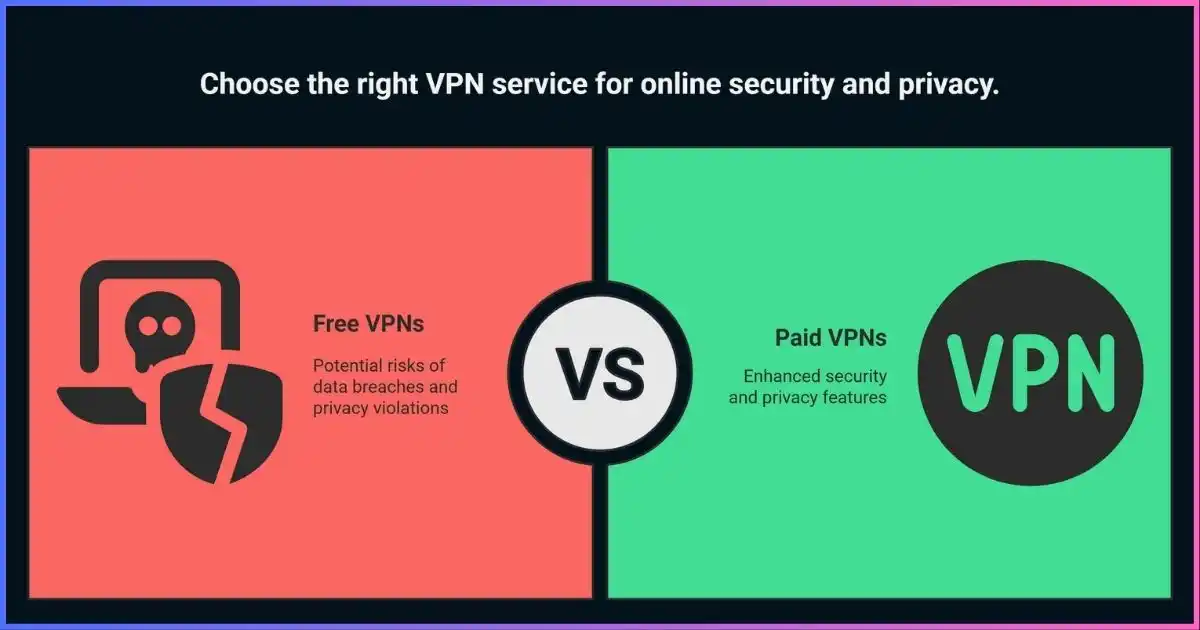
Table of Contents
The evidenceWhat recent research says about free VPN app security
The NDSS 2026 paper, MVPNalyzer: An Investigative Framework for Auditing the Security & Privacy of Mobile VPNs, evaluated 281 popular VPN apps from Google Play using a framework designed to inspect app behavior, tunnel traffic, and configuration. It reported that 61 apps transmitted unencrypted data; five sent sensitive VPN configuration files in cleartext; 29 leaked user traffic, including DNS, outside the tunnel; 169 did not obfuscate VPN traffic against trivial blocking; 76 transmitted Android Advertising ID; and 107 failed the study’s best-practice checks for VPN configuration files.
“Unencrypted data” in this finding refers to observed app data and control/configuration traffic; it should not be casually paraphrased as “the VPN tunnel for all 61 apps had no encryption.” That distinction matters: a client can use an encrypted tunnel yet still contact its own API over insecure HTTP, or expose configuration information before the tunnel is established. The paper also found configuration-file exposures that could let an on-path attacker interfere with tunnel setup.
Observed issues in the study sample
Counts from 281 tested Android VPN apps. Categories overlap; one app may appear in multiple bars.Percentages are calculated from the paper’s reported counts divided by 281 and rounded to one decimal place. “Not obfuscated” concerns resistance to simple VPN blocking; it is not itself proof of data exposure. This visual does not imply the categories add up to 100%.
Five cleartext VPN configuration files
Share of the 281-app sample (a simple proportion, not a malware rate).- 5 apps (1.8%) sent sensitive VPN configuration files in cleartext.
- 276 apps (98.2%) did not show this specific observed issue in the reported sample.
- That second number does not certify those apps as safe; they may have other issues or unexamined behaviors.
Earlier research also raised concerns about mobile VPN apps, but samples and methods differ. For that reason, this article uses the directly relevant 2026 Android study for its quantitative chart and treats older studies as context rather than combining their figures into a misleading single “industry failure rate.” Security can change when developers release new builds, so check the app version, provider documentation, and later audits before installing.
Threats explainedThe main risks of using a free VPN
1. Weak or missing encryption on some traffic
The VPN tunnel should use a modern, authenticated protocol such as WireGuard, OpenVPN, or IKEv2/IPsec, configured securely. But the app also exchanges login, server-list, and connection-setup data with the provider’s backend. If any of that happens in cleartext, a hostile network may be able to inspect or tamper with it even if the later tunnel is encrypted. The 2026 study’s five cleartext configuration-file cases make setup security especially important.
2. DNS or ordinary traffic bypassing the tunnel
A leak happens when traffic follows a path the user did not intend—for example, DNS queries or an app connection leaving over the ordinary network while the VPN appears connected. A VPN cannot promise perfect protection across every OS version, split-tunnel setting, browser resolver, or network transition. Look for a kill switch or system-level “block connections without VPN” option, then confirm behavior after sleep, Wi-Fi changes, and reconnects. See our DNS leak guide and VPN kill-switch guide.
3. Tracking identifiers and excess data collection
A VPN provider can observe the connection metadata that reaches its servers, such as your source IP, connection timing, selected server, and data volume. HTTPS usually protects page contents and full URLs from the VPN, but the provider may still see destination IP addresses and sometimes domain-level clues. App analytics and advertising identifiers are a separate layer: the NDSS sample found 76 apps transmitting Android Advertising ID. Read the privacy disclosures for the VPN app and any SDKs it uses, not just the tunnel’s encryption description.
4. Ad-supported monetization and third-party sharing
Ads do not automatically mean a VPN sells browsing history, and a free plan does not automatically mean advertising. The important questions are which data is collected, who receives it, how long it is retained, and whether collection can be disabled. Be especially wary of vague privacy notices that reserve broad rights to share “usage data” without defining it, or consent screens that bundle optional tracking with basic connectivity.
5. Peer-to-peer bandwidth resale
Some services route other customers’ traffic through free users’ devices or residential IP addresses. This model may be described as a “residential network,” “community bandwidth,” or “earn rewards” feature. It creates a different risk from ordinary VPN tunneling: websites may see your address as the origin of someone else’s activity, and your connection may carry traffic you did not initiate. Avoid it unless you have read and affirmatively accepted the exact terms—and for most users, choose a VPN that does not use their device as an exit node.
6. Fake apps, opaque ownership, and poor support
An app-store listing is a distribution checkpoint, not a full security audit. Check the developer’s legal
identity, official website, privacy policy, support channel, update history, and whether the same name links
consistently across stores and web properties. Download only from the provider’s official site or the recognized
app store, and do not install configuration profiles or certificates just because an app asks. Google Play
requires VPN apps using Android’s VpnService to disclose their use, encrypt data to the tunnel
endpoint, and follow user-data policies; those platform rules are helpful baseline requirements, not a guarantee
that each app behaves well in practice.
Follow the moneyHow do free VPNs make money?
Running VPN servers, paying transit providers, maintaining apps, responding to incidents, and conducting security reviews all cost money. A sound free offering explains how those costs are covered and what limits keep the service viable. “Free” may be a customer-acquisition route for paid subscriptions, a nonprofit service, an ad-supported app, or a product that monetizes data or bandwidth. Those models have very different privacy implications.
| Funding model | Typical trade-off | What to inspect |
|---|---|---|
| Freemium plan funded by subscriptions | Fewer locations, devices, or advanced features; a data cap may or may not apply | Whether the provider’s privacy commitments cover free users equally; paid-plan upsells and free-tier limits |
| Nonprofit or publicly supported | May have constrained capacity or depend on donations/grants | Governance, funding disclosures, audited accounts, and a sustainable operations plan |
| Advertising and analytics | Ads or measurement may be built into the app | Identifiers collected, ad partners, opt-outs, and whether VPN usage or destinations are shared |
| Bandwidth-sharing network | Your device or IP may carry traffic for other customers | Whether participation is enabled by default, exit-node controls, abuse handling, and clear opt-in consent |
| Unclear or undisclosed | Users cannot assess the provider’s incentive or accountability | Treat missing ownership, funding, or privacy details as a reason to choose another service |
A company’s funding model is a clue, not proof of misconduct. A paid VPN can still collect too much data, suffer a breach, or make claims that have not been independently checked. Likewise, a free tier subsidized by paying customers can provide useful privacy if its architecture and operational practices support the promise.
Choose by needFree VPN vs. freemium VPN vs. paid VPN
| Question | Unknown “free” app | Established freemium plan | Reputable paid plan |
|---|---|---|---|
| How is it funded? | May be unclear or advertising-led | Often subscription cross-subsidy; verify provider statement | Subscription revenue, though incentives still need scrutiny |
| Data and server choice | May be heavily limited or undocumented | Usually restricted compared with paid tier | Typically broader locations and more capacity |
| Privacy evidence | Often sparse, vague, or absent | Look for a detailed policy, audit scope, and transparent ownership | Look for the same evidence; payment alone is no guarantee |
| Best fit | None until provider and app are independently vetted | Occasional browsing and basic protection from a known provider | Regular use, multiple devices, dependable support, and broader features |
| Main drawback | Unknown operator or hidden monetization risk | Less control, congestion, or missing advanced features | Recurring cost; trust still rests partly with the provider |
For a VPN, “free” features such as a small server list or speed cap are usually more defensible than monetization that requires broad access to user data. Compare the free plan’s actual limits against your use case instead of expecting premium streaming, high-volume downloads, or a fixed country for no cost.
Practical checklistHow to choose a safer free VPN
- Identify the company.Find the operator’s legal name, address or jurisdiction, official domain, support contacts, and ownership history. Check that store developer links lead to the same organization.
- Read the privacy policy closely.Distinguish browsing/activity logs from connection diagnostics, crash reports, account details, payment records, and aggregated analytics. Look for what is retained, for how long, and who receives it.
- Look for independent scrutiny.A useful audit names the auditor, date, scope, platform and apps examined, exceptions, and whether remediation was verified. An audit of an app’s code does not necessarily verify server-side logging; a policy audit is not a penetration test.
- Check the security basics.Use a maintained app with modern protocols, authenticated encryption, DNS handling, IPv6 behavior, and a kill switch. Avoid services that cannot say which protocol is used or present “proxy” features as full-device VPN protection.
- Inspect permissions and disclosures.Ask whether each permission makes sense for the feature. A VPN does not normally need access to contacts or SMS to route network traffic. Review store privacy disclosures, while remembering they are supplied by developers.
- Understand the business model.Find out whether ads, analytics, referral sharing, or peer bandwidth are involved. Avoid unexplained data collection and any bandwidth-sharing default you cannot disable.
- Install and test before relying on it.Get the app from the official store/site. Check your visible IP and DNS behavior while connected, test reconnects after changing networks, and confirm the kill switch blocks traffic when the tunnel drops. Do not test using sensitive accounts.
- Keep the app current and remove it if it behaves strangely.Review update history, permissions after upgrades, battery/data use, unexpected ads or redirects, and requests to install certificates or profiles.
A quick red-flag scan
- Promises complete anonymity, guaranteed unblocking, or “100% untraceable” protection.
- No named operator, meaningful privacy policy, or working support site.
- Requests unrelated permissions or installs a certificate without a clear explanation.
- Enables residential bandwidth sharing or extensive advertising by default.
- Uses only vague “no logs” language with no definition, retention detail, or corroborating evidence.
- Pushes sideloaded APKs from mirrors or asks you to ignore OS security warnings.
Lower-risk optionsSafer alternatives to unknown free VPN apps
Use a reputable provider’s free tier
A known provider’s freemium tier can be a reasonable choice for everyday browsing if its restrictions fit your needs. Proton VPN currently describes its free plan as unlimited in bandwidth, with free servers in 10 countries selected from a published list. Its plan documentation describes one free connection and limitations compared with paid service; server selection, streaming, P2P, and advanced features are restricted. Those are provider-published plan details and may change, so confirm the current terms before you sign up.
The important point is the model: constrained capacity and reduced choice can be transparent trade-offs. Check the provider’s current privacy policy and independent review scope as well as the plan page. See our Proton VPN review and VPN free-trial guide.
Use tools that address the actual problem
If you only need privacy on public Wi-Fi, HTTPS is now common, and keeping your device updated, using MFA, avoiding unknown hotspots, and disabling file sharing can reduce risk without installing a VPN. If you need access to company resources, use your organization’s approved VPN. For private browsing, a reputable browser with tracker protection may be more relevant than a random VPN app. A VPN does not make an untrusted website trustworthy.
Consider a paid plan for regular or sensitive use
A paid subscription can provide broader server choice, more devices, dependable capacity, and customer support. It does not remove the need to research the provider: assess logging claims, independent audits, ownership, transparency reports, security history, and cancellation terms. Our guide to choosing a VPN explains how to compare those factors.
Set expectationsWhat VPN encryption does—and does not—protect
A VPN encrypts the connection between your device and the VPN server and changes the public IP address visible to destination services. This can reduce what a local Wi-Fi operator or internet provider can observe about your tunneled traffic, and it can help on networks that block or restrict access.
| A VPN can help with | A VPN does not solve |
|---|---|
| Encrypting traffic between device and VPN server when correctly configured | Phishing, fake login pages, malicious downloads, or unsafe browser extensions |
| Reducing exposure of DNS requests to a local network when DNS is routed through the tunnel | Tracking tied to accounts, cookies, fingerprinting, or payment identity |
| Masking your home IP from websites, which see the VPN exit IP instead | Making the VPN company unable to see connection metadata or guaranteeing no logs |
| Securing traffic on some untrusted network paths | Making a fake hotspot legitimate, or protecting compromised devices and apps |
| Changing apparent location for services where permitted by their terms | Guaranteed streaming access, anonymity, or protection from every form of surveillance |
On public Wi-Fi, a VPN cannot authenticate the hotspot itself. Keep software updated, use MFA, never bypass certificate warnings, and confirm that the tunnel remains active after network changes. Our VPN protocol guide explains how protocol choice affects the connection.
AnswersFrequently asked questions
Should I use a free VPN?
Can free VPNs see my browsing history?
Are free VPNs illegal?
Do free VPNs sell your data?
Is a free VPN from an app store safe?
Is Proton VPN Free safe?
Can a VPN protect me from hackers?
Choose privacy you can verify
Start with a transparent provider, read what its free tier collects and limits, and test the app before trusting it with sensitive traffic.
See a paid VPN option →Final verdict: Are free VPNs safe?
Some free VPN plans can offer useful protection when a reputable operator funds the service transparently, publishes clear privacy terms, maintains secure apps, and accepts independent scrutiny. Unknown free VPNs can expose users to weak tunnel setup, traffic leaks, tracking, or unclear monetization—and the 2026 Android study demonstrates that those are real issues in a substantial app sample.
Choose based on verifiable provider practices, not price labels or download counts. For occasional use, a credible freemium plan may be enough. For sensitive or sustained use, consider a well-audited paid provider or your organization’s approved service. See our VPN buying guide.
Disclosure: Some links on this page may be affiliate links. If you make a purchase through them, JoshWP may earn a commission at no extra cost to you. This does not change the security criteria discussed above.
Sources & comparison methodology
This article is a research-based explainer, not a laboratory comparison of every free VPN. Quantitative app findings above come from the NDSS 2026 MVPNalyzer paper. Counts are shown against its 281-app Android sample; percentages are calculated from the published counts and rounded to one decimal place. Findings are sample- and version-specific, categories overlap, and the study does not establish that every free VPN has the same risks. Current Proton plan details are attributed to Proton’s own documentation. General platform policy is attributed to Google Play and Apple; store policy does not replace independent product evaluation.
- NDSS Symposium: MVPNalyzer study abstract and findings
- U.S. Federal Trade Commission: The market for VPN apps
- Google Play policy for apps using VpnService
- Apple App Review Guidelines, VPN apps
- Proton VPN plan details
- Proton VPN: independent no-logs audit information
- CSIRO-led study of Android VPN apps (2016), historical context
- Center for Democracy & Technology: questions to ask VPN services
Provider feature descriptions are attributed as provider claims, not independently verified head-to-head results. No synthetic market-share estimates, malware pie charts, or unsupported VPN-user percentages are used.