IPVanish vs SafeShell: Which VPN Is Better?
IPVanish vs SafeShell is not simply a contest between two interchangeable VPNs. IPVanish is the more complete conventional service: it allows unlimited devices, supports familiar protocols, documents a kill switch and backs its present no-logs position with recent independent assessments. SafeShell is a narrower streaming and gaming specialist whose App Mode can route different apps through different countries at the same time.
IPVanish wins overall, but SafeShell does one thing unusually well
Choose IPVanish for an all-purpose VPN across a large household. Its Essential plan has unlimited connections, WireGuard/OpenVPN/IKEv2, a documented kill switch, 3,400+ servers and a 30-day eligible long-plan refund. Choose SafeShell if your priority is running, for example, one streaming app through the UK and another through Japan without repeatedly reconnecting. Its five-device limit, seven-day direct-purchase refund and less transparent privacy evidence keep it behind overall.
Table of Contents
At a glanceIPVanish vs SafeShell: Quick Comparison
| Category | IPVanish Essential | SafeShell | Winner |
|---|---|---|---|
| Overall score | 8.1/10 | 7.8/10 | IPVanish |
| Published price* | $52.56 / 24 months ($2.19/mo) | $79.99/year in US App Store ($6.67/mo) | IPVanish |
| Monthly price* | $12.99 | $12.99 in US App Store | Tie |
| Refund | 30 days on eligible 1-/2-year purchases | 7 days on eligible first direct web purchase | IPVanish |
| Simultaneous devices | Unlimited | 5 | IPVanish |
| Network disclosure | 3,400+ servers; 150 locations; 55 countries | 2,000+ servers; 61 regions in live directory | IPVanish |
| Protocols | WireGuard, OpenVPN, IKEv2 | ShellGuard (TLS 1.3), Stealth (QUIC) | Different strengths |
| Kill switch | Documented, platform-dependent | Not clearly documented cross-platform | IPVanish |
| Independent no-logs evidence | 2025 Schellman; 2022 Leviathan | No clearly surfaced independent audit | IPVanish |
| Standout feature | Unlimited connections and exact server choice | Simultaneous multi-region App Mode | Depends on use |
*USD figures checked September 19, 2026. SafeShell’s dynamic website did not expose one stable numeric web price, so its figures are from the US Apple App Store and may differ by website, store or region. Taxes and promotions can change.
IPVanish: conventional all-rounder
Unlimited devices, familiar protocols, granular server choice and stronger verifiable privacy controls.
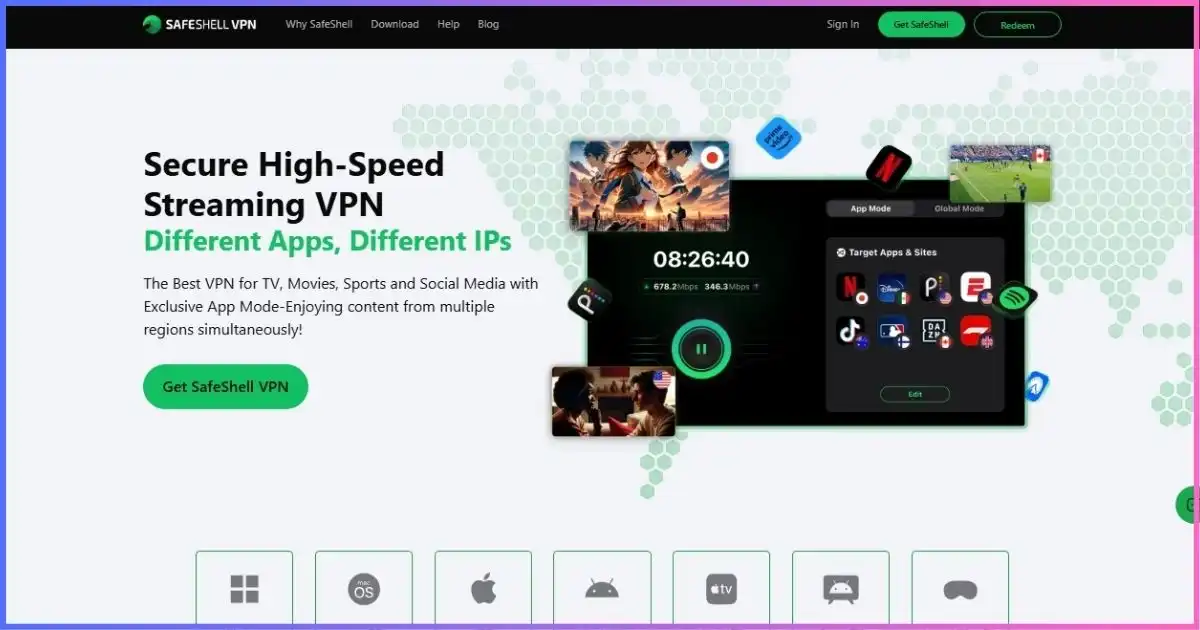
SafeShell: routing specialist
Per-app multi-region routing, streaming-oriented apps, proprietary stealth transport and gaming tools.
Round 1 · IPVanish winsPricing, Renewals and Refunds
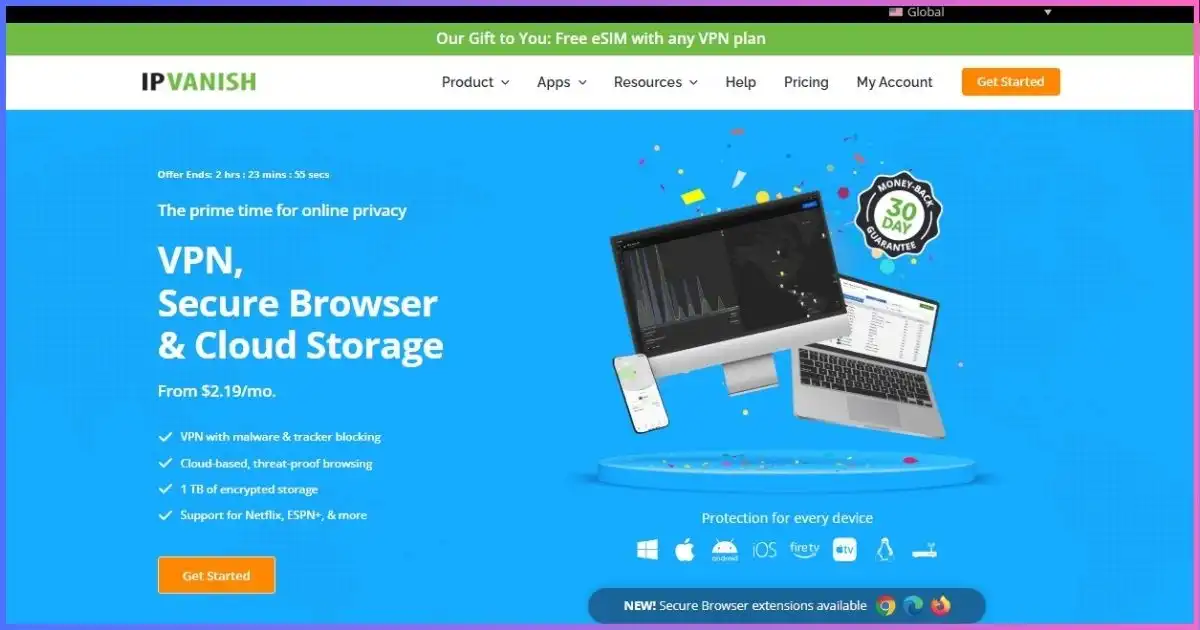
IPVanish is easier to price and cheaper on the comparable published offers. Essential costs $52.56 upfront for 24 months, equivalent to $2.19 per month, and then renews at $89.99 per year. Its introductory annual term is about $39.99, while the flexible monthly plan is $12.99.
SafeShell’s website uses a dynamic checkout that did not provide one stable public USD price in our check. The US Apple App Store listed $79.99 per year, $12.99 monthly and $5.99 weekly. These are useful reference points, not universal web prices: region, tax, platform and promotions can change the amount, and Apple and Google subscriptions may not transfer between stores.
| Cost or term | IPVanish Essential | SafeShell | What matters |
|---|---|---|---|
| Longest published comparison | $52.56 / 24 months | $79.99 / 12 months (US Apple listing) | Different term lengths; IPVanish costs less upfront |
| Monthly | $12.99 | $12.99 (US Apple listing) | Same reference price |
| Renewal | $89.99/year after 2-year intro | Auto-renews at store price | Check checkout before paying |
| Refund | 30 days on eligible annual/2-year plans | 7 days on eligible first direct web purchase | Store purchases use store policies |
Published upfront charges (USD)
Term lengths differ. SafeShell figure is the US Apple annual listing, not a universal website price.
first 24 mo
Apple 12 mo
annual renewal
monthly*
Do not pay extra for IPVanish Advanced unless you need its non-core extras: Threat Protection Pro, Secure Browser, 1 TB cloud backup, phone support or the larger 5 GB eSIM allowance. Essential uses the same VPN network and already includes 3 GB of eSIM data.
Round 2 · IPVanish winsPrivacy, Ownership and Audit Evidence
IPVanish is based in the United States and owned by Ziff Davis. Its present no-logs claim has more external support than SafeShell’s: Schellman completed a 2025 assessment covering nine technical areas, following a 2022 Leviathan review. The review scope included traffic/activity data, metadata, DNS requests and user IP logging. As with any assurance engagement, this is point-in-time evidence rather than a permanent guarantee; the newest detailed report may also require an IPVanish account.
There is important history. Under previous ownership, IPVanish supplied source and connection information during a 2016 criminal investigation despite advertising a no-logs policy. The episode became public in 2018. Current ownership, infrastructure and later reviews came afterward, but the incident remains relevant when judging institutional trust.
SafeShell is operated by Singapore-based GearUp Portal Pte Ltd. Its marketing says it does not keep online-activity or connection logs, yet the broader April 2025 GearUp privacy policy lists categories including account and purchase data, city/country/region, IP and MAC addresses, device identifiers, ISP, timestamps, diagnostics, ping/performance data and usage preferences. Some may be operational, optional or product-wide rather than browsing records, but the documents do not reconcile the categories clearly enough. We also found no clearly published independent SafeShell no-logs or infrastructure audit.
An assurance standard such as ISAE 3000 (Revised) helps define how non-financial assurance work is performed; it does not mean readers should ignore scope, date or access to the report.
For a deeper look at what providers can collect, read our VPN logging policies guide.
Round 3 · IPVanish winsSecurity, Protocols and Leak Protection
IPVanish offers WireGuard for efficient everyday use, OpenVPN for configurability and IKEv2 for supported-device mobility. Its apps document a kill switch, DNS leak protection, selected-platform split tunneling, OpenVPN Scramble and selected Double Hop routes. Basic Threat Protection blocks domains at the DNS layer; Advanced adds the more capable Threat Protection Pro on Windows and macOS.
SafeShell takes a proprietary route. ShellGuard is described as TLS 1.3-based, while Stealth uses QUIC to make the connection more resilient on filtered networks. QUIC is a standardized modern transport—see RFC 9000—but SafeShell’s product implementation remains proprietary. Protocol names alone do not prove performance or privacy.
SafeShell also advertises AES-256-GCM, forward secrecy and DNS leak protection. The larger concern is failure behavior: its current public documentation does not establish a consistent, system-wide kill switch across platforms. That makes IPVanish the safer default when a brief tunnel interruption must not expose traffic. Our VPN protocol guide explains why open standards and implementation details both matter.
Round 4 · IPVanish winsServer Network Size and Transparency
IPVanish publishes 3,400+ servers in 150 locations across 55 countries, backed by 56,000+ IP addresses. The 150 figure is locations—not countries. It also lets users select cities and individual servers, which is useful when troubleshooting congestion or choosing a stable endpoint.
SafeShell’s live directory showed 61 regions and 2,000+ servers, with many locations labeled up to 10 Gbps. Other SafeShell pages separately say 100+ locations or 10,000+ nodes across 40+ countries. Nodes, servers, locations, regions and countries are not interchangeable units, so we use the live directory’s concrete numbers and preserve the inconsistency rather than manufacturing one total.
IPVanish has also publicized redundancy, direct peering, nftables-based networking and ports up to 50 Gbps. SafeShell’s 10-Gbps labels and IPVanish’s port capacity are infrastructure ceilings, not speeds a subscriber will automatically receive.
Round 5 · IPVanish wins narrowlySpeed, Stability and How to Test
IPVanish has the stronger conventional speed proposition because WireGuard is widely understood, server selection is granular and the provider documents peering and capacity upgrades. SafeShell’s ShellGuard and QUIC-based Stealth may perform well, especially where ordinary VPN traffic is throttled, but independent reproduction is harder with proprietary protocols.
Do not compare providers using a single speed test or provider “up to” number. Record three or more runs on the same device and ISP, first without a VPN and then through equivalent nearby and distant locations. Compare medians for download, upload, latency, reconnection time and stability after switching Wi-Fi/mobile networks. SafeShell’s Stealth can improve reachability while still being slower than its normal mode.
Round 6 · IPVanish winsApps, Platforms and Simultaneous Devices
IPVanish allows unlimited simultaneous connections, versus five for SafeShell. That gap matters in homes with phones, laptops, tablets and TVs. IPVanish covers Windows, macOS, Android, iOS, Linux, Fire TV, Android TV, Google TV and Apple TV, with router setup options for devices that cannot run an app.
SafeShell has apps for Windows, macOS, Android, iOS/iPadOS, Apple TV, Android TV, Google TV and Apple Vision Pro. Fire TV marketing exists, but users should verify the current install path on their exact device. Public documentation is much thinner for Linux, routers and game consoles. Its Vision Pro support is unusual and valuable, but not enough to offset the five-device cap.
IPVanish’s 2026 Apple TV app is particularly capable, with WireGuard, OpenVPN UDP/TCP, configurable ports, Scramble and IKEv2. Read our full IPVanish review and SafeShell review for platform-by-platform detail.
Round 7 · SafeShell winsSplit Tunneling, App Mode and Multi-Region Routing
This is SafeShell’s defining advantage. In App Mode, you can assign supported apps to different locations simultaneously: a sports app might use the US, a drama service Japan and a browser the UK. Current iOS and Android builds can also add custom domains. Other traffic can follow another route through Global Mode, and Bypass Apps can remain outside the VPN.
This is not multi-hop. Multi-hop sends one traffic flow through two VPN servers in sequence. SafeShell instead applies different routes to different applications or domains at the same time. IPVanish offers selected-platform split tunneling and Double Hop routes, but it does not reproduce SafeShell’s polished many-app/many-country workflow.
App rules still require care. A service may use helper processes, CDNs or authentication domains that need matching rules, while DNS and background traffic can behave differently across operating systems. Test the final public IP inside each app rather than assuming every rule worked.
Round 8 · SafeShell winsStreaming, Smart TVs and Ad Filtering
SafeShell is the better streaming specialist. App Mode avoids constant reconnecting in a household that uses services from multiple regions, and native mobile/TV apps expose routes optimized around content access. The advantage is workflow—not a guarantee that every catalog will always work. Streaming platforms change blocking systems frequently.
IPVanish is better for sheer household scale. Unlimited connections, native Apple TV/Fire TV/Android TV apps and selectable WireGuard/OpenVPN routes make it easy to protect every screen. If you generally use one VPN region at a time, that may be more valuable than SafeShell’s App Mode.
SafeNet can filter some ads and risky domains only while SafeShell is active. It is not available everywhere and cannot remove ads embedded directly into Netflix, Disney+ or another service’s own video stream. For broader options, see our best VPNs for streaming.
Round 9 · IPVanish winsTorrenting, P2P and Port Forwarding
Both services permit P2P, and SafeShell labels compatible regions. IPVanish is the safer recommendation because it combines WireGuard/OpenVPN with a documented kill switch and exact server selection. Neither service currently provides ordinary VPN-side inbound port forwarding, so users who require active incoming connections should choose another option.
Avoid older IPVanish guides that recommend SOCKS5 unless current account/support documentation confirms it for your plan. Bind the torrent client to the VPN interface where supported, enable the kill switch, verify the public IP and use only authorized files. Our torrenting VPN guide covers providers and setup considerations in more depth.
Round 10 · SafeShell wins narrowlyGaming, Dual Assurance and Consoles
SafeShell’s Game Mode and Dual Assurance are distinctive: on supported devices, the service can use Wi-Fi and mobile data together to improve continuity when one path becomes unstable. This can help mobile gaming on inconsistent networks, though it may consume cellular data and cannot repair congestion at the game server.
IPVanish counters with granular city/server selection, unlimited household devices and easier router coverage for consoles. It is often the more practical console option, while SafeShell is more interesting for a supported phone or tablet. Neither guarantees lower ping, open NAT or immunity from every denial-of-service attack; a VPN normally adds distance and encryption overhead.
See our gaming VPN guide for console, routing and NAT tradeoffs.
Round 11 · CloseTravel, Public Wi-Fi and Restrictive Networks
SafeShell’s QUIC-based Stealth mode is purpose-built for networks that identify or throttle ordinary VPN connections. IPVanish offers OpenVPN Scramble, configurable ports on supported apps and a 3 GB eSIM allowance with Essential. IPVanish also lets a traveler connect unlimited devices rather than five.
Neither service guarantees operation against a national firewall. Install and sign in before departure, save support details offline, keep more than one protocol available and check local law. SafeShell’s proprietary Stealth design may connect where standard routes struggle; IPVanish is easier to understand and troubleshoot. Our VPNs for restrictive countries guide explains the additional risks.
Round 12 · IPVanish winsCustomer Support and Everyday Usability
IPVanish supplies 24/7 chat, setup documentation and a mature interface that exposes cities, server load and protocol choices without making the basics difficult. Advanced adds phone support, but most Essential users should not upgrade for that reason alone.
SafeShell’s app-led experience is friendly when the goal is obvious—pick an app, assign a region and connect—but its public documentation leaves more unanswered questions about the kill switch, privacy-policy categories, Linux/router setup and exact network accounting. Support can help, yet core limitations should be documented before purchase.
Decision guideShould You Choose IPVanish or SafeShell?
Strength profile
- IPVanish: balanced general VPN with stronger evidence.
- SafeShell: standout streaming workflow.
- Scores describe comparative fit, not measured speed.
Choose IPVanish if you…
- Need unlimited simultaneous connections
- Want WireGuard, OpenVPN or IKEv2
- Require a documented kill switch
- Value recent independent no-logs reviews
- Use Linux, routers or several TV devices
- Want the longer eligible refund period
Choose SafeShell if you…
- Route different apps to different regions
- Prioritize streaming over privacy evidence
- Want QUIC-based Stealth mode
- Can stay within five devices
- Use Game Mode/Dual Assurance
- Accept a shorter direct refund period
Round-by-round scorecard
IPVanish is better overall; SafeShell is better for multi-region streaming
IPVanish wins with 8.1/10. Unlimited connections, standard protocols, a documented kill switch, two modern privacy assessments, more transparent network reporting and a 30-day eligible long-plan refund make it the safer default recommendation.
SafeShell scores 7.8/10. App Mode is excellent for routing multiple streaming apps through different countries, and Stealth plus Dual Assurance add useful specialist tools. Its five-device ceiling, seven-day direct-purchase refund, inconsistent network units and absence of a clearly surfaced independent privacy audit prevent it from winning overall.
FAQsIPVanish vs SafeShell FAQs
Is IPVanish better than SafeShell?
Which is cheaper, IPVanish or SafeShell?
Which is better for streaming?
Does SafeShell have a kill switch?
Does either VPN offer port forwarding?
How many devices can I connect?
Is SafeShell’s App Mode the same as multi-hop?
Which is safer for privacy?
Sources & comparison methodology
Research cutoff: September 19, 2026. Prices, promotions, refund rules, apps and network disclosures can change.
- IPVanish official plan, renewal, refund, server-directory, protocol, app, Double Hop, Scramble, eSIM and infrastructure/RAM-only rollout materials.
- IPVanish 2025 Schellman assessment reporting and 2022 Leviathan no-logs review materials, considered alongside the documented 2016 prior-ownership incident.
- SafeShell subscription terms, current refund policy, US Apple App Store listing and live server/region directory.
- SafeShell App Mode, custom-domain, Global Mode/Bypass Apps, ShellGuard, Stealth, SafeNet and Game Mode/Dual Assurance documentation.
- GearUp Portal privacy policy dated April 7, 2025, compared with SafeShell’s shorter privacy marketing claims.
- Context: IETF RFC 9000 for QUIC and IAASB ISAE 3000 (Revised) for assurance-engagement scope.
Scoring method: We weighted current price and renewal clarity, refunds, privacy architecture and verification, protocols and leak controls, network disclosure, likely route reliability, apps/devices, streaming, split routing, P2P, gaming, travel and support. We compared IPVanish Essential with SafeShell’s ordinary VPN subscription and did not award points for unrelated bundle extras. We did not invent universal speed-retention or streaming-success percentages.
Disclosure: This article contains affiliate links. We may earn a commission if you buy through them, at no additional cost to you. That does not change the comparison or verdict. A VPN protects traffic only between your device and its VPN server; it does not legalize infringement, eliminate phishing or replace device and account security.