5 Best Web Scraping Providers: Proxies and Managed APIs Compared
The best web scraping provider is the one that delivers valid records at a predictable total cost—not the one with the largest advertised IP pool. We compared five active services across proxy types, targeting, session control, managed scraping, entry price, billing model, and operational fit.
Webshare is our best overall self-service pick. Oxylabs is best for enterprise scraping APIs, Bright Data has the broadest managed toolkit, ProxyShare offers the lowest small-package residential unit rate here, and IPRoyal is best for non-expiring residential traffic.
Which provider should you choose?
Choose Webshare if you own the crawler and need affordable proxy infrastructure. Choose Oxylabs or Bright Data when managed rendering, retries, anti-bot handling, parsing, or enterprise support are worth more than the lowest bandwidth rate. Choose ProxyShare for a concentrated 10 GB pilot, or IPRoyal when usage is sporadic and expiring traffic would be wasteful.
Table of Contents
Understand the productRaw Proxies and Managed Scraping APIs Are Not the Same
A raw proxy network supplies IPs, rotation, sticky sessions, authentication, and location targeting. You still manage the crawler, browser, retries, fingerprints, validation, parsing, storage, and monitoring. A managed scraper or unlocker API takes a URL or structured request and handles more of that access stack. It costs more per request but may cost less per accepted record after engineering time and failures.
Side by sideBest Web Scraping Providers Compared
| Provider | Best for | Residential entry | Advertised pool | Controls | Managed option |
|---|---|---|---|---|---|
| Webshare | Self-service value | $3.50 / 1 GB monthly | 80M+; 195 countries | Country, city, ASN; US state/ZIP; 1 min–24 hr sticky | Raw proxies in this comparison |
| Oxylabs | Enterprise API | $30 / 5 GB | 175M+; 195 countries | Country, city, state, ZIP, ASN, coordinates | Web Scraper API from $49/mo |
| Bright Data | Managed toolkit | $4/GB promo PAYG* | 400M+ monthly; 195 countries | Country, state, city, US ZIP, ASN/carrier | Web Unlocker: 5K free; $1.50/1K PAYG |
| ProxyShare | Budget pilot | $9 / 10 GB / 30 days | 75M+; 195+ locations | Country/city; sticky up to 24 hr | Raw proxies |
| IPRoyal | Non-expiring data | $7.35 PAYG; $7 subscription | 64M+; 195+ countries | Country/state/city; sticky up to 7 days** | Raw proxies |
*Bright Data’s $4/GB was a displayed 50%-off offer; verify eligibility and duration. **A residential peer can disconnect before a selected IPRoyal TTL ends. Pool figures are provider-reported.
Pricing contextUnit Price and Minimum Commitment Charts
Residential $/GB at the smallest public tier
List prices; not equivalent performance.
Cash required for the compared entry package
1 GB
10 GB
5 GB
1 GB
promo
ProxyShare expires after 30 days; IPRoyal traffic does not expire. Confirm Bright Data funding and checkout terms.
Ranked reviewsThe Five Best Providers in Detail
Webshare — approachable proxy infrastructure at a low entry cost
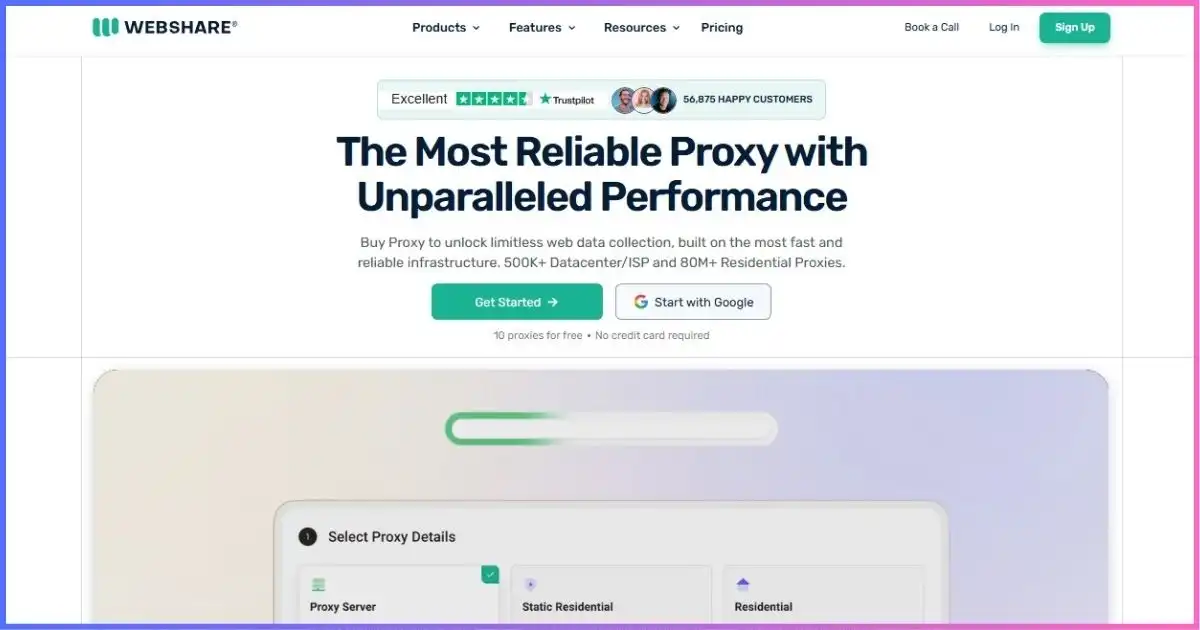
Webshare combines a useful free plan with straightforward self-service controls. The free tier supplies 10 datacenter proxies and 1 GB monthly without a card. Rotating residential starts at $3.50 for 1 GB, shared datacenter at $2.99 for 100 IPs, and shared static residential at $6 for 20 IPs.
The endpoint generator supports rotating or 1-minute-to-24-hour sticky sessions, sub-users, password or authorized-IP authentication, and granular targeting. The trade-off is scope: your team owns browsers, retries, anti-bot logic, parsing, and storage. Monthly residential allowance does not roll over, and refunds require cancellation within two days plus low usage.
Pros
- Low paid entry and free plan
- HTTP/SOCKS5 and API access
- Flexible rotation and targeting
- 80M+ advertised residential pool
Cons
- No full managed scraper here
- Monthly traffic does not roll over
- Conditional two-day refund window
- Targeting depends on live inventory
See our Webshare review.
Oxylabs — premium proxies plus successful-result scraping
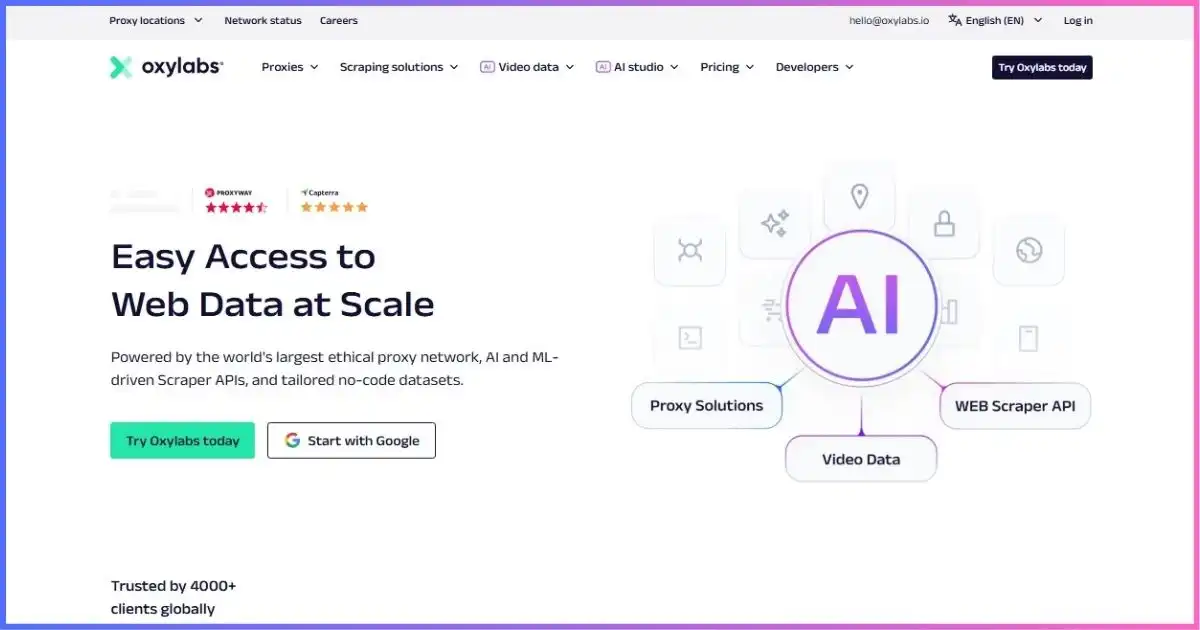
Oxylabs is strongest when a project needs both premium proxies and a managed extraction layer. Web Scraper API handles rotation, CAPTCHA challenges, JavaScript rendering, batching, scheduling, and optional parsing. Its free trial includes up to 2,000 results; Micro starts at $49 monthly. Returned 2xx and 4xx results count, while provider-side 5xx/6xx failures do not.
Raw residential service starts at $30 for 5 GB and advertises 175M+ IPs across 195 countries, detailed geo/network filters, sticky sessions, HTTP(S), HTTP/3, and SOCKS5. It is capable and well supported, but its enterprise orientation costs more than simple jobs need.
Pros
- Managed API and raw networks
- Detailed targeting
- Result-based billing
- 24/7 enterprise support
Cons
- Higher proxy minimum
- Target/mode changes result capacity
- Marketing performance is not independent
- Overkill for basic sites
See our Oxylabs review.
Bright Data — raw networks, Web Unlocker, browser API, and datasets
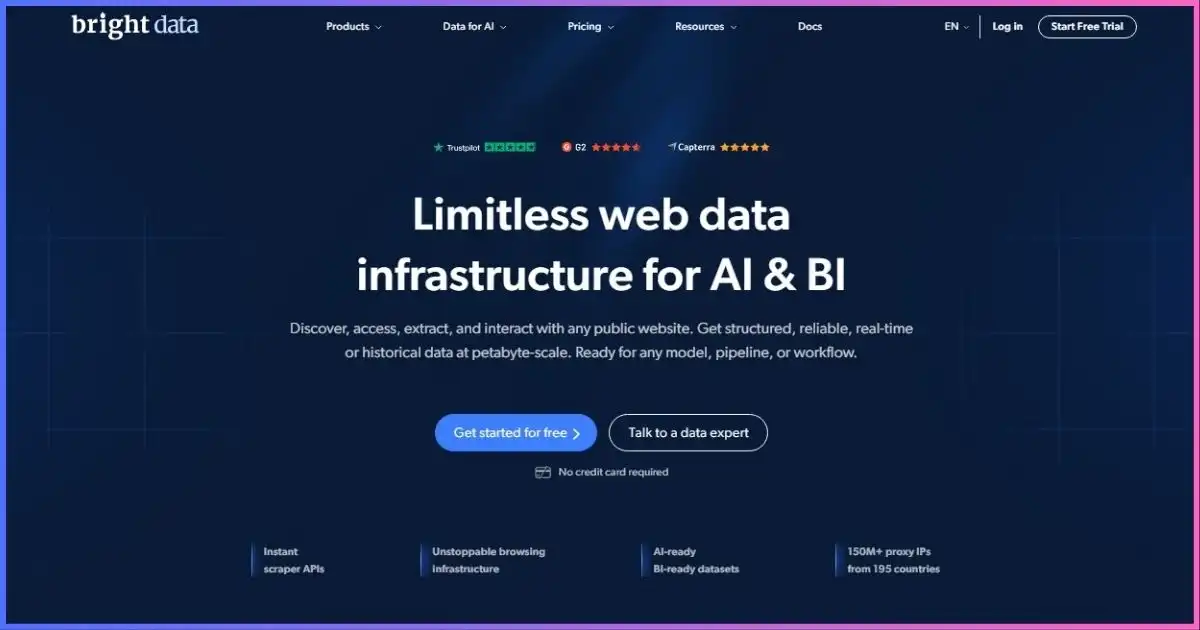
Bright Data spans raw residential, ISP, and datacenter networks, plus Web Unlocker, browser infrastructure, scraper APIs, and datasets. Web Unlocker offers 5,000 requests per month free and $1.50 per 1,000 successful requests PAYG; it handles selection, rendering, CAPTCHA solving, retries, fingerprints, and headers.
The residential page displayed a promotional $4/GB PAYG price when checked. New residential zones face business eligibility and human-reviewed KYC, so many scraping teams will find Web Unlocker easier. Keep products separate: raw proxy spend does not include managed API usage.
Pros
- Broadest toolkit here
- Precise targeting
- Spend limits and PAYG
- Managed pay-for-success option
Cons
- Complex product catalog
- Residential KYC/eligibility
- Promo may change
- Separate product billing
See our Bright Data review.
ProxyShare — inexpensive residential bandwidth with 30-day validity
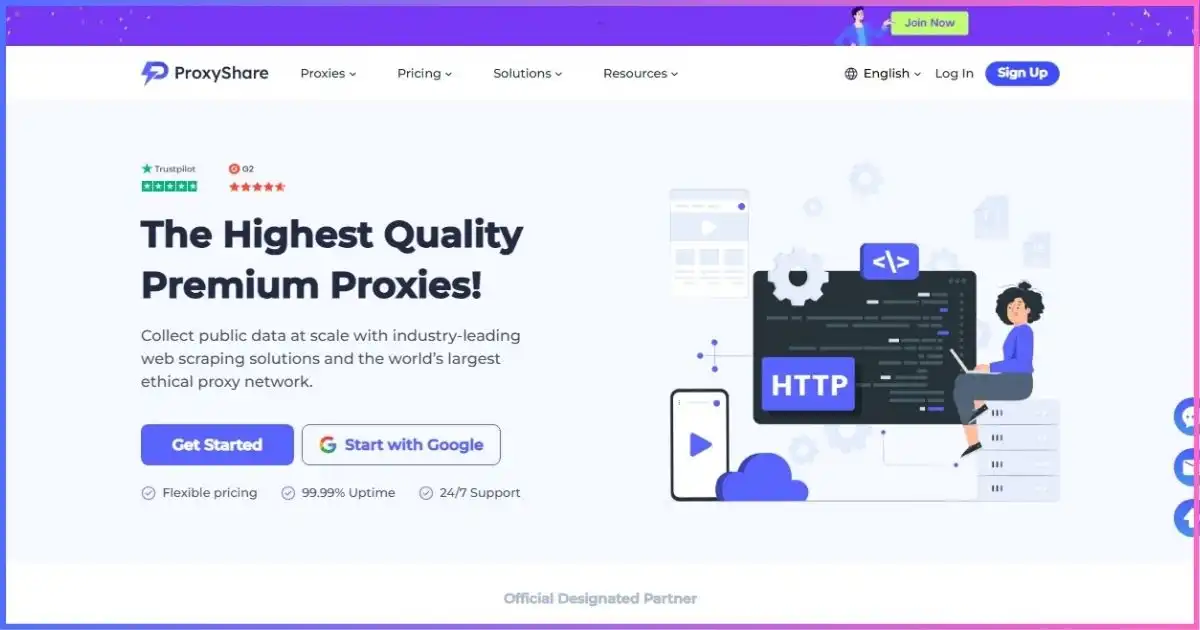
The smallest rotating package is $9 for 10 GB, or $0.90 per included GB. ProxyShare advertises 75M+ IPs, 195+ locations, country/city targeting, HTTP/SOCKS5, unlimited concurrent sessions, and sticky sessions up to 24 hours.
The allowance lasts 30 days, so low utilization can erase the attractive unit price. Although cards include generic “unlimited bandwidth” wording, the explicit GB amount is the allowance. Public terms say purchases are non-refundable; trials are sales-arranged.
Pros
- Lowest small-tier $/GB
- Unlimited sessions
- HTTP/SOCKS5
- Static options available
Cons
- 30-day validity
- No self-service free trial verified
- Non-refundable terms
- No current mobile plan verified
See our ProxyShare review.
IPRoyal — flexible bandwidth for irregular workloads
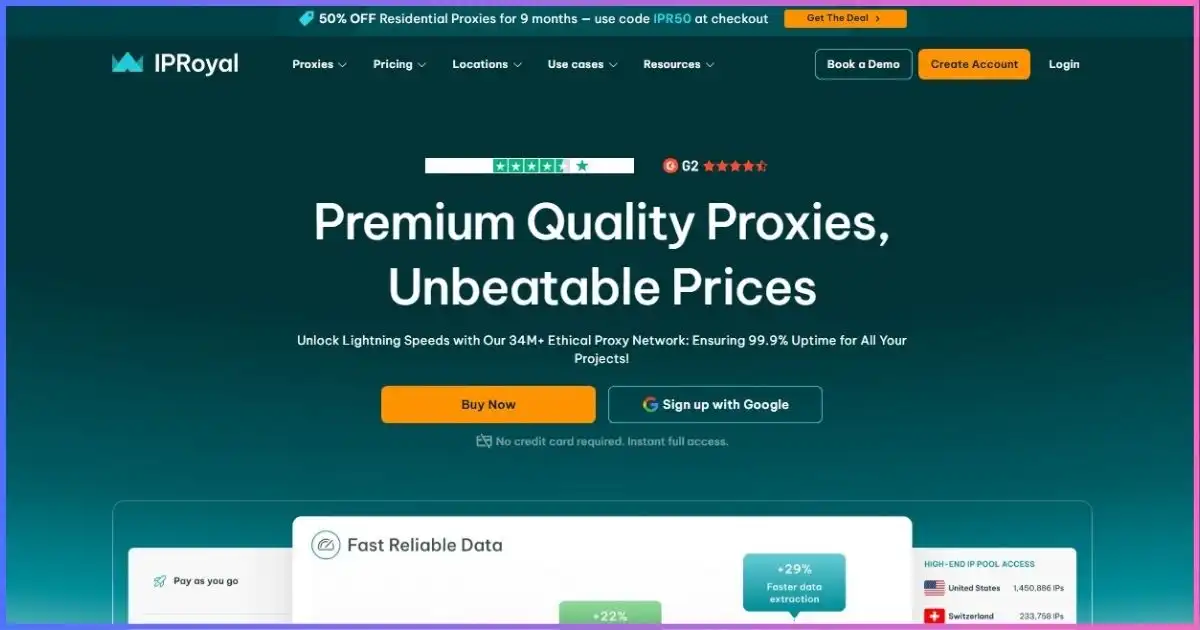
IPRoyal’s residential traffic does not expire, changing the economics for seasonal jobs and development. PAYG starts at $7.35 for 1 GB; subscription pricing begins at $7 and reaches $5.25/GB at 10 GB. The headline $1.75/GB requires 10 TB.
It advertises 64M+ IPs in 195+ countries, country/state/city targeting, HTTP(S)/SOCKS5, unlimited sessions, API access, per-request rotation, and sticky TTLs up to seven days. A peer can still disconnect before that TTL.
Pros
- Traffic never expires
- Strong session control
- Unlimited sessions
- Dual authentication
Cons
- Higher entry unit rate
- Best rate requires 10 TB
- No general free trial
- Peer stability is not guaranteed
See our IPRoyal review.
Budget correctlyCalculate Cost per Accepted Record
Add subscription or traffic, request/credit multipliers, rendering, retries, transfer, storage, and engineering labor. A 200 response may still be a block page, consent screen, empty app shell, wrong locale, duplicate, or stale record.
Illustrative monthly total cost
Example only; both routes produce equal validated output.
Raw: $30 infrastructure + 6 hours × $25. Managed: $100 usage + 1 hour × $25. Replace with your data.
Decision workflowHow to Select and Test a Provider
- Define accepted output. Specify fields, freshness, geography, volume, and validation rules.
- Classify targets. Separate static pages, JavaScript apps, search engines, marketplaces, and authenticated areas.
- Build a representative pilot. Include easy, hard, regional, and long-tail URLs—not provider demo pages.
- Cap spend and retries. Set concurrency, byte, credit, timeout, and monthly limits before launch.
- Measure full yield. Track accepted URLs, p50/p95 completion, bytes or credits per record, block rate, duplicates, and labor.
- Scale gradually. Recheck target terms, compliance, rate limits, and data quality at each volume step.
GovernanceResponsible Web Scraping
Collect only data you are authorized to access. Review applicable law, contracts, privacy duties,
intellectual-property rules, and target restrictions with qualified counsel when risk is material. The Robots Exclusion Protocol
(RFC 9309) defines robots.txt behavior, but it is not an authorization grant.
Throttle by domain, back off on errors, cache unchanged pages, avoid unnecessary assets, minimize personal data, restrict API credentials, encrypt stored results, and delete data on schedule. Proxy access does not make prohibited activity acceptable.
FAQCommon Questions
What is the best provider overall?
Webshare is best for most self-service teams. Oxylabs is better for an enterprise managed API, and Bright Data for a broad managed collection stack.
Which is cheapest?
ProxyShare has the lowest compared residential unit rate at $0.90/GB, but requires 10 GB and expires after 30 days. Webshare has the lowest paid cash entry at $3.50. IPRoyal costs more per GB but does not expire.
Residential or datacenter proxies?
Datacenter proxies suit tolerant targets and high-volume cost control. Residential proxies help when consumer-network reputation and location fidelity matter. Test both; residential is not automatically better.
Is a managed API worth it?
Often yes for dynamic or protected targets. Compare cost per accepted record after browser, retry, anti-bot, and maintenance labor—not API price against raw bandwidth alone.
Do pool sizes predict performance?
No. Counting windows differ and live availability varies. Target-specific success, latency, session stability, and valid-data yield matter more.
Final Verdict
Webshare is the best web scraping provider for most teams with an existing crawler. Oxylabs wins for enterprise managed scraping, Bright Data for product breadth and targeting, ProxyShare for a low-cost 30-day pilot, and IPRoyal for irregular use where non-expiring traffic matters.
Run a capped pilot on your own targets and choose by cost per accepted record—not an advertised pool or headline rate.
Disclosure: This page contains affiliate links. We may earn a commission at no extra cost to you. Rankings reflect product fit and verified public information, not commission rates. Prices and terms were checked September 17, 2026 and can change. No paid checkout or controlled cross-provider performance benchmark was performed.
Sources & comparison methodology
We checked official pricing, product pages, documentation, help centers, and terms for all five providers on September 17, 2026. Raw-proxy and managed-API pricing are kept separate; minimum quantities and validity periods are preserved. Network size and performance figures are attributed claims, not independent measurements.
- Webshare: pricing, residential, static residential, datacenter, endpoint generator, bandwidth, and refund documentation.
- Oxylabs: pricing, Residential Proxies, Web Scraper API, billing, rate-limit, and trial documentation.
- Bright Data: proxy, Web Unlocker, Browser API, network-access/KYC, and billing documentation.
- ProxyShare: residential, static residential, datacenter, pricing, and terms pages.
- IPRoyal: residential pricing, quick-start, documentation, and refund/trial guidance.
- Neutral references: MDN proxy/tunneling guide and IETF RFC 9309.
Ranking criteria: product scope, entry cost, targeting/session controls, developer experience, managed capabilities, support, terms transparency, and stated-use-case fit.