Private Internet Access vs Surfshark VPN: Which Unlimited-Device VPN Wins?
Private Internet Access vs Surfshark VPN is one of the closest value comparisons in the market. Both allow unlimited simultaneous devices, run RAM-only server networks, support WireGuard and OpenVPN, include ad/tracker filtering, offer split tunneling and multi-hop options, and back eligible new purchases with a 30-day refund window. Neither forces a household to count phones and laptops.
The similarities end when you examine how each service is built. Surfshark covers 100 countries, layers post-quantum protection onto WireGuard, and offers Dynamic MultiHop, Rotating IP, NoBorders, Alternative ID, and stronger mobile feature parity. PIA costs less over the checked long term, publishes a clear three-year renewal, opens its app code, offers deep desktop controls and every US state, and supports VPN-side port forwarding. Surfshark wins overall 9.2 to 8.8, while PIA is the better choice for torrenters, US location hunters, and configuration-heavy desktop users.
Quick verdict: Surfshark wins for most people
Choose Surfshark for broader international coverage, easier apps, better mobile tools, stronger streaming/travel features, flexible multi-hop, IP rotation, and post-quantum protection. Choose PIA for the lowest transparent long-term cost, port forwarding, all 50 US states, open-source apps, deeper desktop routing and DNS controls, or a clearer three-year renewal.
Table of Contents
- Quick comparison
- Pricing and renewal
- Privacy and audits
- Security and protocols
- Server network
- Speed and reliability
- Apps and usability
- Split tunneling and controls
- Streaming and TV support
- Torrenting and port forwarding
- Gaming
- Travel and restrictive networks
- Extra features and bundles
- Who should choose each?
- FAQs
- Final verdict
At a glancePrivate Internet Access vs Surfshark: Quick Comparison
| Category | Private Internet Access | Surfshark VPN | Winner |
|---|---|---|---|
| Overall score | 8.8 / 10 | 9.2 / 10 | Surfshark |
| Lowest checked offer | $2.03/mo · $79/39 months | $2.49/mo · $67.23/27 months | PIA |
| Renewal disclosure | $79 every 3 years | Annual renewal at checkout rate | PIA |
| Network | 91 countries / 154 locations; total undisclosed | 4,500+ servers / 100 countries | Surfshark |
| US coverage | All 50 states | Multiple major US cities | PIA |
| Devices | Unlimited | Unlimited paid; trial capped at 3 | Tie |
| Apps | Open source; deep desktop control | Easier interface; broader mobile features | Depends |
| Protocols | WireGuard, OpenVPN; adjustable encryption | WireGuard + PQ layer, OpenVPN, IKEv2, limited Dausos beta | Surfshark |
| Multi-hop | OpenVPN via Shadowsocks/SOCKS5 proxy | Dynamic MultiHop with custom entry/exit | Surfshark |
| Port forwarding | Yes, supported regions | No | PIA |
| Ad/tracker blocker | MACE | CleanWeb | Tie |
| Refund / trial | 30 days for eligible new users | 30 days + eligible 7-day trial | Surfshark |
Round counts summarize category leaders; the final score is weighted. Privacy and security matter more than one convenience feature.
Round 1 · PIA winsPricing, Renewal, Trials, and Refunds
For a fair comparison, use PIA’s standard VPN plan against Surfshark Starter. Both contain the complete VPN rather than antivirus or data-removal bundles. PIA has the lower effective rate and the clearer renewal: $79 buys 39 months initially and the checked checkout states renewal at $79 every three years. Surfshark charges less cash upfront—$67.23—but covers only 27 months and then renews annually at the applicable checkout rate.
| Term | PIA | Surfshark Starter |
|---|---|---|
| Monthly | $11.95 | $16.45 in the official July 2026 guide |
| One year | $39.95 first year ($3.33/mo), then $49.99/year | $3.39/month equivalent in the plan guide |
| Longest checked term | $79 / 39 months ($2.03/mo) | $67.23 / 27 months ($2.49/mo) |
| Long-plan renewal | $79 every 3 years | Renews annually at rate disclosed at checkout/account |
| Free trial | No standard comparable trial | 7 days on eligible 12/24-month signups; 3-device cap |
| Refund | 30 days for eligible new subscribers | 30 days for eligible first purchase |
Winner: PIA. Surfshark has the better trial, but PIA is cheaper per included month and gives buyers a stable, explicit three-year renewal. See our best cheap VPN guide for more price-first choices.
First-term effective cost
Lower is better. The monthly equivalent divides the upfront charge by all included promotional months.
Round 2 · PIA wins narrowlyPrivacy, Jurisdiction, Audits, and Ownership
PIA operates in the United States and belongs to Kape Technologies. Surfshark B.V. operates in the Netherlands and is part of the Nord Security group while maintaining a separate product. Both countries can issue binding legal requests; jurisdiction alone is not a privacy score. The stronger questions are what data exists, whether infrastructure minimizes retention, and how independently those claims have been tested.
Open source, audited, court tested
PIA publishes production app code, runs RAM-only servers, issues quarterly transparency reports, and has been unable to provide useful activity logs in US court cases. Deloitte completed a third ISAE 3000 assessment of its no-logs controls and token-based Dedicated IP system, following 2022 and 2024 reviews.
RAM-only, audited, request transparency
Surfshark uses a 100% RAM-only network and completed Deloitte no-logs engagements in 2023 and 2025. Its 2025 scope included standard, static, and multiport servers plus deployment processes. An April 2026 disclosure said a binding warrant produced account/payment information but no online-activity records.
PIA’s open-source apps and repeated court history give it the narrow advantage in evidence depth. Surfshark’s more recent privacy policy is unusually specific: servers temporarily process user ID and/or source IP plus connection timestamps and delete them within 15 minutes after a session ends. That operational processing is not the same as retained browsing logs, but it is worth understanding.
Both providers’ engagements use the ISAE 3000 (Revised) assurance framework. These reports are point-in-time assessments, not permanent guarantees. PIA’s United States base and Kape ownership may still concern users who prioritize jurisdictional distance; Surfshark’s Netherlands base does not make it immune to EU or Dutch law.
Winner: PIA, narrowly. For provider-specific analysis, read our PIA review and Surfshark review.
Round 3 · Surfshark winsSecurity, Protocols, Kill Switches, and Multi-Hop
Both services support WireGuard and OpenVPN. The official WireGuard specification describes a lean protocol using the Noise framework and modern cryptography, but provider implementation still determines authentication, DNS, server security, address handling, and app behavior.
| Feature | PIA | Surfshark |
|---|---|---|
| Primary protocols | WireGuard, OpenVPN UDP/TCP | WireGuard, OpenVPN UDP/TCP, IKEv2 on supported apps, limited Dausos beta |
| Post-quantum layer | No current equivalent in ordinary apps | Supported WireGuard apps |
| Kill switch | Standard and Advanced Kill Switch | Kill switch on Windows/macOS/Linux/Android/iOS |
| Encryption controls | Adjustable OpenVPN data/authentication settings | Secure defaults; fewer manual choices |
| Multi-hop | OpenVPN → Shadowsocks/SOCKS5 proxy | Dynamic MultiHop with chosen entry/exit |
| IP rotation | No direct Rotating IP equivalent | Changes IP every 5–10 minutes without disconnecting |
| Obfuscation | Multi-Hop/Obfuscation via proxy, OpenVPN only | Camouflage through OpenVPN; NoBorders workflow |
| Server persistence | RAM-only claim | 100% RAM-only claim with automatic rebuilds |
PIA is better for users who want to select OpenVPN ports, encryption behavior, DNS resolvers, and connection automation. Surfshark is better for mainstream advanced privacy: Dynamic MultiHop is more intuitive than routing OpenVPN through a proxy, and Rotating IP changes the visible address without dropping the tunnel. Surfshark’s post-quantum WireGuard layer is also shipping now, whereas Dausos should still be treated as a narrow macOS App Store beta—not a universal protocol.
Neither multi-hop system makes you anonymous against account login, cookies, browser fingerprinting, or a compromised endpoint. Extra hops generally increase latency and reduce throughput.
Winner: Surfshark. It offers more useful modern privacy controls without requiring as much configuration.
Round 4 · Surfshark wins globallyServer Network and US Coverage
Surfshark publishes 4,500+ servers in 100 countries, with every server advertised at 10 Gbps and selected high-traffic infrastructure reaching 100 Gbps. PIA publishes 91 countries and 154 locations, including every US state, but no longer gives a dependable total server count. Ignore old articles quoting 24,000 or 35,000 PIA servers as if they were current.
Published international coverage
Surfshark leads by nine countries. PIA’s real differentiator is one location in every US state.
4,500+ servers
154 locations
state coverage
Surfshark wins travel and international exit choice. PIA wins if you need a virtual location in Wyoming, Alaska, Maine, or another state most providers skip. Both use virtual locations in some markets; a registered IP country is not always the physical server country.
Winner: Surfshark overall; PIA for US granularity.
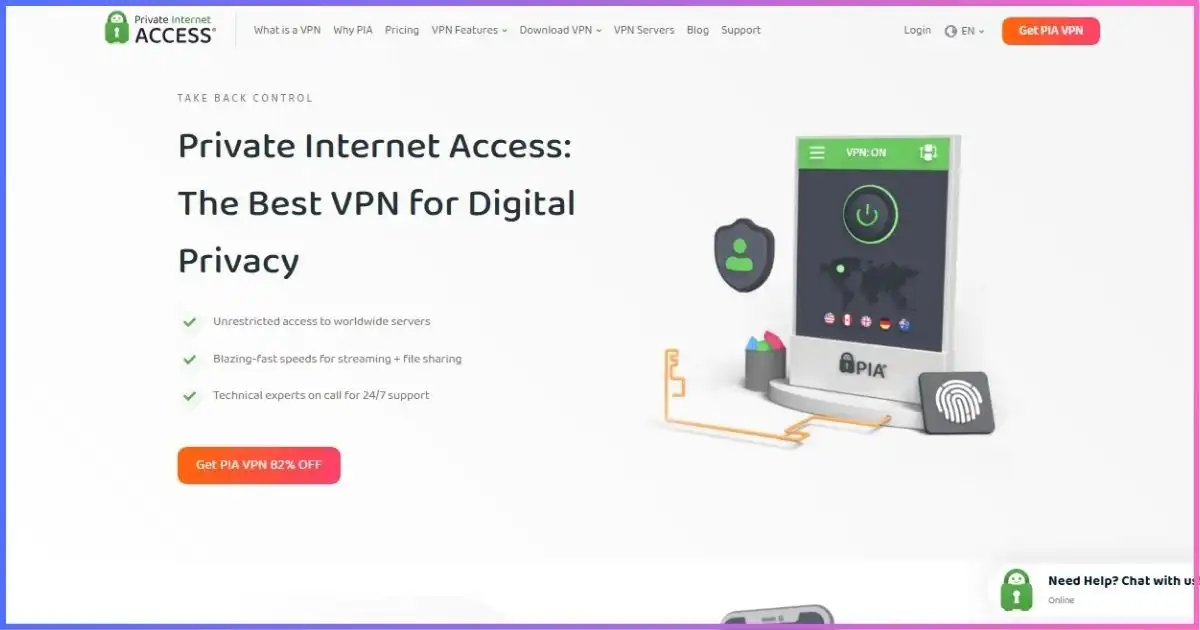
PIA emphasizes customization, every US state, and power-user controls.
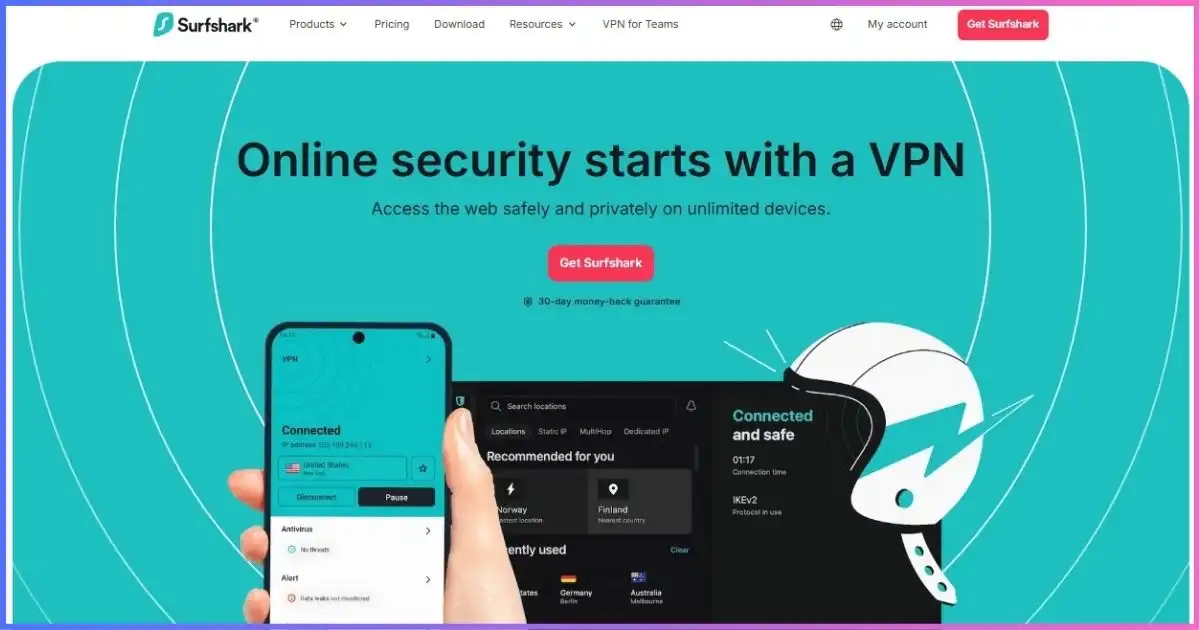
Surfshark emphasizes easy apps, 100-country reach, and unlimited household devices.
Round 5 · Surfshark wins narrowlySpeed and Connection Reliability
WireGuard should be the default speed choice on both services. PIA’s entire published network is 10 Gbps-capable, while Surfshark says every server is at least 10 Gbps and selected infrastructure reaches 100 Gbps. Raw port capacity does not equal one user’s speed: hardware is shared, and ISP peering, distance, load, device CPU, and Wi-Fi dominate real results.
Surfshark gains a narrow edge from its larger published fleet, broader country map, Everlink self-healing design, and FastTrack routing work. PIA counters with highly visible latency, location control, adjustable MTU/transport options, and automation. On a difficult line, PIA may be faster after tuning; on a normal connection, Surfshark is easier to leave on Automatic/WireGuard.
Winner: Surfshark, narrowly. PIA remains excellent for users willing to tune settings.
Round 6 · Surfshark winsApps, Unlimited Devices, and Ease of Use
Both paid services allow unlimited simultaneous connections. Surfshark’s eligible seven-day trial is temporarily capped at three devices; once converted to a paid subscription, the allowance becomes unlimited. A “simultaneous device” allowance still assumes personal/household use under each provider’s acceptable-use terms.
| Platform | PIA | Surfshark |
|---|---|---|
| Windows | Deep settings, app/IP split rules, DNS control, CLI | Cleaner workflow, Bypasser, Dynamic MultiHop, Rotating IP |
| macOS | Current split tunneling, port forwarding, MACE, automation | Bypasser, MultiHop, Rotating IP, NoBorders |
| Linux | Strong GUI, CLI, split tunneling, MACE, port forwarding | Native app with fewer parity features |
| Android / iOS | Solid apps; Android per-app rules | Bypasser on both Android and iOS; stronger feature parity |
| Apple TV | Native tvOS 17+ app | Native tvOS app |
| Android / Fire TV | Native apps, MACE | Native apps, CleanWeb |
| Browser extensions | Chrome and Firefox | Chrome, Firefox, Edge |
| Routers | Manual configuration | Manual configuration |
PIA is the better Linux and desktop power-user app. Surfshark presents its advanced features more coherently and carries more of them onto iOS and macOS. Both need manual router setup rather than a first-party router experience like ExpressVPN.
Winner: Surfshark for most users; PIA for Linux and configuration depth.
Round 7 · PIA wins desktop controlSplit Tunneling, DNS, Kill Switches, and Automation
PIA’s current desktop split tunneling covers Windows, macOS, and Linux. It can route applications through or around the VPN and bypass individual IPv4/IPv6 addresses or subnets. Windows and Linux can also decide whether DNS follows individual app rules or always stays with PIA DNS. Android adds per-app behavior.
Surfshark Bypasser spans Windows, macOS, Android, iOS, and browser extensions. That is better mobile/browser reach, but PIA offers more desktop routing and DNS granularity. Surfshark’s rotating address and Dynamic MultiHop sit beside Bypasser, although Rotating IP cannot run with Dedicated IP, static locations, or MultiHop.
Both kill switches should be enabled before using P2P or public Wi-Fi. PIA’s Advanced Kill Switch can block internet access even when the VPN is intentionally off; this is safer for always-on desktops but can confuse users who forget it is active.
Winner: PIA for power-user routing; Surfshark for mobile reach. See split tunneling vs full tunneling before creating bypass rules.
Round 8 · Surfshark winsStreaming, Apple TV, Fire TV, and Smart DNS
Surfshark is the stronger general streaming choice because it combines 100-country coverage, mature TV apps, WireGuard, Bypasser, and a larger documented streaming footprint. PIA provides streaming-optimized locations and native Apple TV, Android TV, and Fire TV apps, but its access can require more server experimentation.
| Feature | PIA | Surfshark |
|---|---|---|
| Native Apple TV | Yes, tvOS 17+ | Yes |
| Android TV / Fire TV | Yes | Yes |
| Streaming-optimized labels | Yes, region-specific locations | No separate task list; use standard locations |
| Split tunneling on mobile | Android-focused | Android and iOS |
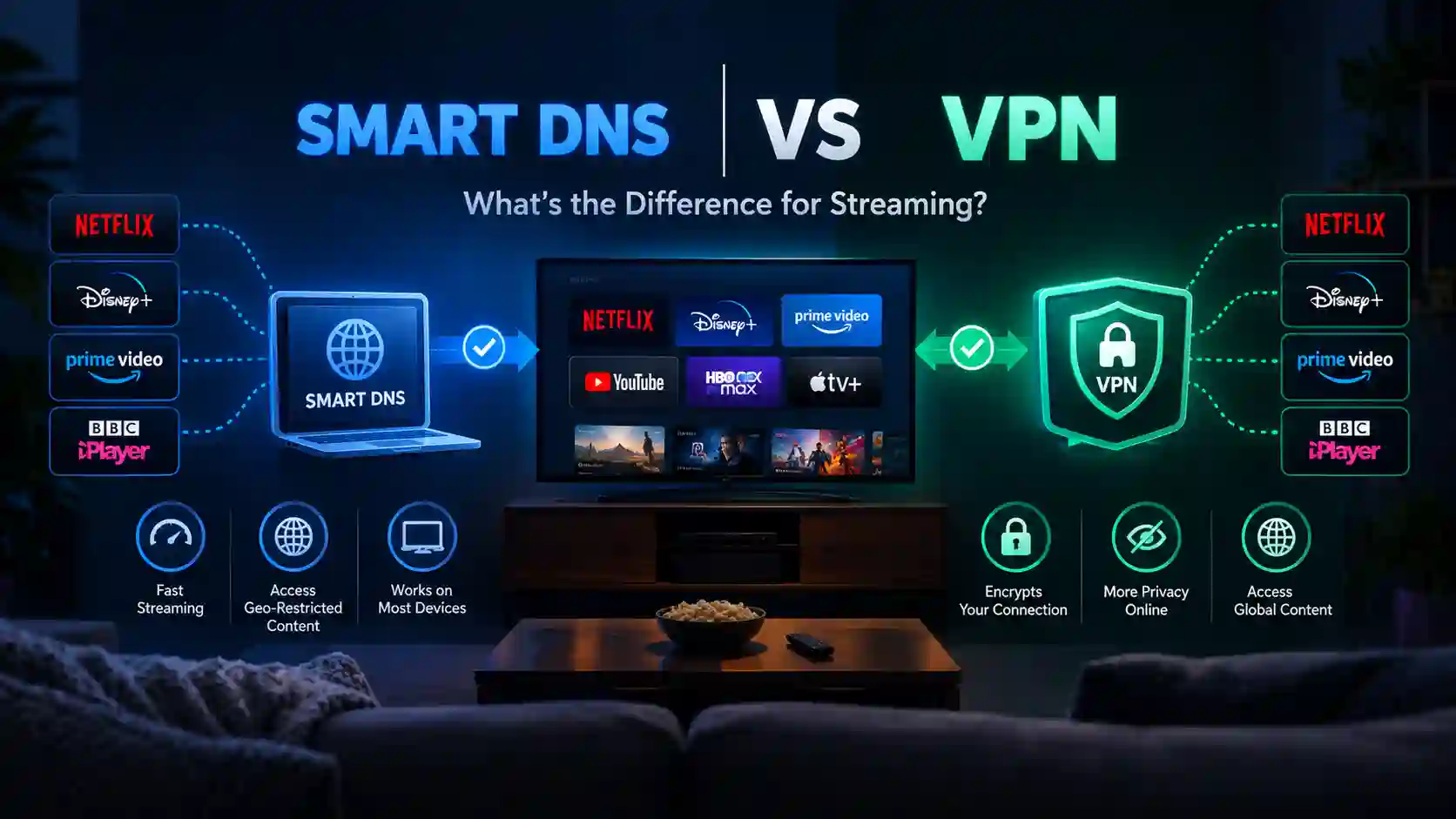
| Smart DNS | No major comparative advantage | Discontinued February 2, 2026 |
| Country reach | 91 countries | 100 countries |
Streaming success changes by platform, catalog, account, server IP, country, and time. Test your exact service during the refund window. Bypassing geo-restrictions may conflict with a platform’s terms.
Winner: Surfshark. For more options, see our best VPNs for streaming.
Round 9 · PIA wins decisivelyTorrenting and Port Forwarding
Both providers allow P2P, support WireGuard, include kill switches, and place no ordinary data cap on paid plans. PIA wins because it offers VPN-side port forwarding in supported regions. Surfshark does not.
Port forwarding creates an inbound path through the VPN’s NAT firewall, improving peer reach for seeding and smaller swarms. PIA assigns the port automatically, and not every location supports it; US locations are generally excluded. The port may change, so copy the active value into the torrent client and recheck it after reconnecting.
Surfshark remains fine for popular torrents with healthy peer discovery, but heavy seeders and self-hosting workflows lose a meaningful control. On either VPN, bind the torrent client to the VPN interface, enable the kill switch, and make sure Bypasser/split tunneling does not exclude it.
Winner: PIA. Compare more providers in our top VPNs for torrenting guide.
Round 10 · Surfshark wins narrowlyGaming and Latency
Both VPNs can mask the residential IP from direct peers, avoid traffic-type-based throttling, or improve an inefficient ISP route. Neither can guarantee lower ping, protect the game company’s infrastructure, repair weak Wi-Fi, or remove congestion.
PIA is attractive for US gaming because every state has a location and users can tune protocol and MTU behavior. Surfshark wins globally with nine more countries, FastTrack routing, and the larger published fleet. For competitive play, use the closest WireGuard server and avoid multi-hop, obfuscation, or TCP unless the network requires them.
Winner: Surfshark globally; PIA for fine-grained US routing. Our gaming VPN guide covers router setup and DDoS limits.
Round 11 · Surfshark winsTravel and Restrictive Networks
Surfshark’s travel case is stronger: 100 countries, unlimited devices, NoBorders on Windows/macOS/Android/iOS, OpenVPN Camouflage, Dynamic MultiHop, Alternative ID, and better mobile feature parity. NoBorders detects filtering and presents suitable locations automatically.
PIA can route OpenVPN through a managed Shadowsocks proxy or configured SOCKS5 proxy using Multi-Hop and Obfuscation. It exposes more manual controls, which helps technical users, but is less friendly when a traveler needs a connection immediately.
No VPN guarantees operation under every censorship system. Install apps and manual fallback profiles before travel, and review local law. Winner: Surfshark. See our best VPN for travel and restrictive-country VPN guides.
Rounds 12–14MACE vs CleanWeb, Dedicated IP, and Bundle Extras
MACE vs CleanWeb: tie
PIA MACE and Surfshark CleanWeb block known ad, tracker, phishing, and malware domains. MACE requires an active VPN and is documented on Windows, macOS, Linux, Android, Android TV, and Fire TV. CleanWeb covers mainstream desktop, mobile, and TV apps, while browser extensions have separate behavior.
Both can reduce clutter and exposure to malicious domains; neither scans arbitrary downloaded files or replaces antivirus. False positives are possible. Surfshark One adds a separate antivirus product, but that should not be confused with Starter’s CleanWeb.
Dedicated IP: PIA wins privacy design
Both sell dedicated addresses as add-ons. PIA uses an account-generated token designed to prevent the service from associating the dedicated IP with a specific account on the server side. Surfshark provides one location per account; it cannot be changed after activation, and certain anonymous/add-on purchase types can sit outside the normal refund guarantee.
Either dedicated address reduces shared-IP crowd anonymity. Buy one for allowlisting, remote access, fewer CAPTCHAs, or consistent business logins—not as a general privacy upgrade.
Surfshark bundles: Surfshark wins optional breadth
Surfshark Starter includes Alternative ID. Surfshark One adds Antivirus, Alert, and Search; One+ adds Incogni data-removal service. Regional identity-theft or scam-protection benefits can vary, so verify eligibility rather than assuming every checkout includes the same protection.
PIA keeps the consumer plan focused on the VPN and sells Dedicated IP separately. That simplicity is an advantage if you already have antivirus and identity tools. Surfshark wins for buyers who genuinely want a bundle, not merely a larger feature list.
Editorial score profile
Surfshark leads in network/use cases and usability; PIA leads price and power-user value.
- PIA overall8.8
- Surfshark overall9.2
- PIA strengthsPrice · P2P · control
- Surfshark strengthsReach · apps · travel
Decision guideWho Should Choose PIA or Surfshark?
Best for power users and P2P
- You want the lowest long-term effective price and explicit renewal.
- You need VPN-side port forwarding.
- You need a server location in a specific US state.
- You use Linux or want detailed desktop app/IP/DNS rules.
- You value open-source apps and repeated court-tested no-logs history.
- You prefer a focused VPN over a security bundle.
Best for most households
- You travel or need the broader 100-country network.
- You want easier apps and better iOS/macOS feature parity.
- You want post-quantum WireGuard protection.
- You will use Dynamic MultiHop, Rotating IP, or NoBorders.
- Streaming and native TV simplicity are priorities.
- You want Alternative ID or an optional antivirus/data-removal bundle.
Still undecided?
Choose Surfshark if you want the better default experience. Choose PIA if “port forwarding,” “all 50 states,” “Linux controls,” or “known three-year renewal” describes your actual requirement.
Common questionsPrivate Internet Access vs Surfshark VPN FAQs
Is PIA or Surfshark better overall?
Surfshark is better overall because it covers more countries, has stronger mobile feature parity, adds post-quantum WireGuard protection, and offers easier multi-hop, IP rotation, streaming, and restrictive-network workflows. PIA is better for port forwarding, desktop customization, all-50-state coverage, and long-term pricing clarity.
Which is cheaper, PIA or Surfshark?
PIA is cheaper in the checked offers: $79 for 39 months ($2.03/month equivalent), renewing at $79 every three years. Surfshark Starter costs $67.23 for 27 months ($2.49/month equivalent) and then renews annually at the rate disclosed at checkout.
Do PIA and Surfshark allow unlimited devices?
Yes. Both paid subscriptions allow unlimited simultaneous connections under their account and acceptable-use terms. Surfshark’s eligible seven-day trial is capped at three devices until it converts to a paid plan.
Which is better for torrenting?
PIA is better because it provides VPN-side port forwarding in supported locations. Both allow P2P, support WireGuard, and include kill switches, but Surfshark does not offer inbound port forwarding.
Which is better for streaming?
Surfshark is the better general streaming option because of its 100-country network, mature TV apps, strong mobile tools, and broader documented compatibility. PIA has useful streaming-optimized locations. Surfshark discontinued SmartDNS in February 2026, so use a native app or router on TVs.
Which has better privacy?
Both have RAM-only infrastructure and Deloitte no-logs evidence. PIA has open-source apps, three Deloitte assessments, and court-tested history where it could not provide activity logs. Surfshark has 2023/2025 assurance, infrastructure audits, and current request transparency. We give PIA a narrow evidence-depth win.
Does either VPN work in restrictive countries?
Surfshark is easier through NoBorders and OpenVPN Camouflage. PIA offers OpenVPN-based Multi-Hop/Obfuscation through Shadowsocks or a configured SOCKS5 proxy. Neither can guarantee access under every censorship system, and users should install fallbacks before travel.
Does Surfshark still offer Smart DNS?
No. Surfshark discontinued SmartDNS on February 2, 2026. Restore automatic DNS on previously configured TVs, then use Surfshark’s Apple TV, Android TV, or Fire TV app, a compatible router, or a protected hotspot.
Final Verdict: Surfshark Wins, but PIA Is the Better Specialist
Surfshark wins this Private Internet Access vs Surfshark VPN comparison, 9.2/10 to 8.8/10. Its broader network, modern privacy tools, post-quantum layer, mobile feature parity, streaming support, NoBorders workflow, and easier apps make it the better recommendation for most households and travelers.
PIA is not a consolation prize. It is cheaper per included month, publishes a clear three-year renewal, covers every US state, opens its client code, offers granular desktop and DNS control, and is the clear torrenting winner because it supports port forwarding. If one of those capabilities is the reason you are buying a VPN, choose PIA. Otherwise, Surfshark’s wider and more cohesive product earns the overall win.
Affiliate disclosure: We may earn a commission if you purchase through a marked link, at no additional cost to you. Affiliate relationships do not determine winners, scores, caveats, or methodology. VPN use must comply with applicable law and service terms.
Sources & comparison methodology
Research date: September 19, 2026. This comparison uses current official pricing, checkout disclosures, server directories, support documents, privacy policies, audit reports, transparency materials, platform guides, and feature documentation. Pricing and network totals are snapshots.
PIA materials reviewed: current monthly/one-year/three-year-plus-three-month pricing and renewal disclosures; August 2026 server-location directory; 91-country/154-location and all-50-state materials; platform requirements; WireGuard/OpenVPN, kill switch, split tunneling, DNS, MACE, Multi-Hop/Obfuscation, Shadowsocks, SOCKS5, automation, port forwarding, Apple TV, Android/Fire TV, Dedicated IP, refund, open-source, 2025 Deloitte engagement, and transparency documentation.
Surfshark materials reviewed: current Starter/One/One+ pricing; July 2026 plan guide; 4,500+/100-country infrastructure materials; August 2026 privacy policy; 2025 Deloitte no-logs engagement; Trust Center and 2026 transparency report; WireGuard/post-quantum, OpenVPN, Dausos beta, kill switch, CleanWeb, Bypasser, Dynamic MultiHop, Rotating IP, NoBorders, Camouflage, Alternative ID, Dedicated IP, FastTrack, Everlink, streaming, TV apps, SmartDNS discontinuation, trial, and refund documentation.
Scoring weights: privacy evidence 25%; security architecture and controls 25%; network and practical use cases 20%; apps and usability 15%; price, devices, support, and refund terms 15%. Round winners are explanatory; weighted scores determine the final result.
Performance method: we do not publish one universal speed-loss or permanent streaming-success percentage. Results vary with baseline connection, device, protocol, physical distance, route, server load, Wi-Fi, ISP peering, service, and time. Infrastructure specifications are not treated as independent speed tests.
Pricing method: monthly equivalents divide the first upfront charge by all included promotional months. Renewal prices are reported separately. Taxes, currency, region, account status, checkout route, and promotions can change the final amount.