IPVanish VPN Review: Unlimited Devices, Strong US Coverage, and Important Caveats
This IPVanish VPN review finds a much-improved US-based VPN built for households that want unlimited simultaneous connections, detailed server selection, capable TV apps, and a low first-term price. Its current network exceeds 3,400 servers and 56,000 IP addresses across 150 locations in 55 countries, while recent upgrades add Double Hop, a growing RAM-only fleet, 50 Gbps-capable infrastructure, Apple TV protocol choice, and Advanced-plan malware protection powered by VIPRE.
The caveats matter. Country coverage trails the leaders, the full RAM-only transition is not complete, renewal is substantially higher than the $2.19 promotional rate, VPN-side port forwarding is absent, and IPVanish operates in the United States. Its prior owner also provided user data in a 2016 case despite the no-logs policy at the time. Two later audits under new ownership strengthen the current claim, but they do not erase that history.
Our verdict in 30 seconds
IPVanish is a good-value VPN for US-focused households, streamers, and device-heavy families. Essential supplies the complete VPN, unlimited connections, WireGuard, Threat Protection, and 3 GB of eSIM data. Advanced becomes compelling if you would pay separately for 1 TB cloud backup, Secure Browser, Threat Protection Pro, phone support, or 5 GB of eSIM data. NordVPN, Proton VPN, and ExpressVPN remain stronger overall; IPVanish wins on device freedom and hands-on server control.
Table of Contents
At a glanceIPVanish VPN Review Snapshot
| Category | What IPVanish offers | Our assessment |
|---|---|---|
| Ownership | US-based; owned by Ziff Davis | Five Eyes jurisdiction, but current practices matter more than location alone |
| Network | 3,400+ servers, 56,000+ IPs, 150 locations, 55 countries | Deep US/city choice; global country breadth trails leaders |
| Devices | Unlimited simultaneous connections | Excellent for large households |
| Plans | Essential and Advanced | Same core VPN; Advanced adds security, browser, storage, support, and eSIM extras |
| Protocols | WireGuard, OpenVPN UDP/TCP, IKEv2; Scramble with OpenVPN | Good protocol breadth; platform availability varies |
| Privacy evidence | 2022 Leviathan and 2025 Schellman no-logs assessments | Meaningful current evidence; full latest report access is limited |
| Refund | 30 days on eligible annual and two-year plans | Monthly purchases generally do not receive the same window |
| Best for | Unlimited devices, US cities, TV apps, cloud-backup bundles | Strong value specialist rather than the best overall VPN |
IPVanish category scores
Editorial scores based on current documentation, privacy evidence, platform support, network reach, pricing, and practical limitations.
Costs explainedIPVanish Pricing: Essential vs Advanced
IPVanish sells two consumer tiers. Essential contains the entire VPN: unlimited devices, full network access, protocols, server selection, ordinary Threat Protection, and 3 GB of travel eSIM data. Advanced uses the same VPN engine but adds Threat Protection Pro, Secure Browser, 1 TB of Livedrive cloud backup/storage, file sync and sharing, phone support during published hours, and 5 GB of eSIM data.
| Feature | Essential | Advanced |
|---|---|---|
| Two-year introductory total | $52.56 ($2.19/mo equivalent) | $78.96 ($3.29/mo equivalent) |
| Listed annual renewal | $89.99 | $109.99 |
| VPN devices | Unlimited | Unlimited |
| VPN network and protocols | Complete access | Same complete access |
| Threat Protection | DNS/domain filtering while VPN is active | Adds always-on Threat Protection Pro on Windows/macOS |
| Secure Browser | — | Included cloud-based disposable browser |
| Cloud storage | — | 1 TB Livedrive backup, sync, and sharing |
| Support | Chat/email resources | Adds phone support during published hours |
| Travel eSIM | 3 GB | 5 GB |
Which IPVanish plan should you choose?
Choose Essential if you primarily want a VPN. Advanced is worth the $26.40 first-term difference if you will actually use 1 TB of backup, need its always-on malware scanner, or value phone support and Secure Browser. Do not upgrade for “better VPN speed”—both tiers use the same network.
The advertised 30-day refund applies to eligible one- and two-year subscriptions, not broadly to every monthly purchase or every billing channel. Auto-renewal cancellation and a refund request are separate actions.
Introductory total vs annual renewal
Each renewal covers only one year, while the lower first charge covers two years.
first 2 years
1-year renewal
first 2 years
1-year renewal
Trust and accountabilityPrivacy, No-Logs Audits, and the 2016 Incident
IPVanish is based in the United States and owned by Ziff Davis. The US is part of the Five Eyes intelligence alliance, but jurisdiction alone does not determine whether a VPN is safe. What matters is which data the service collects, how infrastructure is configured, whether claims are independently examined, and what happens when legal requests arrive.
The current privacy policy says IPVanish does not monitor, collect, or log browsing activity, traffic destinations, DNS queries, or source/VPN IP assignments. A 2022 assessment by Leviathan Security Group and a second assessment finalized by Schellman in February 2025 supported the current no-logs claim. Schellman reportedly examined nine technical areas across servers, regions, and subscription tiers.
The historical logging incident must not be hidden
In 2016, under previous ownership, IPVanish provided source and connection information in a US criminal investigation even though its public policy presented the service as no-logs. The disclosure became public in 2018. The case involved serious alleged abuse, but the central consumer-trust issue is that the retained information contradicted the policy.
Ziff Davis took ownership later, the systems and policies have changed, and the 2022 and 2025 audits evaluate the newer operation—not the old one. That is meaningful remediation, not retroactive exoneration. Privacy-critical users must decide whether present evidence outweighs historical institutional damage. Read our VPN logging-policy guide to understand the difference between activity, connection, account, and diagnostic data.
RAM-only migration: useful, but incomplete
IPVanish added a RAM-only location filter across its apps and has been moving clusters away from persistent disks. 2026 reporting described nearly 1,000 RAM-only servers in 25 locations with a full-fleet target in 2027. Until the company consistently documents completion, it would be inaccurate to call all 3,400+ servers diskless.
RAM-only design reduces persistence after reboot; it does not by itself prove no logging during runtime. Configuration controls, change management, audits, and the privacy policy remain necessary.
Technical protectionSecurity Features, Protocols, and Double Hop
IPVanish provides modern encryption, private DNS, leak protection, a kill switch on major platforms, auto-connect, detailed server selection, WireGuard, OpenVPN, IKEv2, Scramble obfuscation, split tunneling on selected apps, and Double Hop routes. Feature availability is not identical on every operating system.
WireGuard
The best default for speed-sensitive browsing, streaming, gaming, and downloads. WireGuard uses a compact modern protocol design; IPVanish handles its service-side key and address management.
OpenVPN
UDP favors speed, TCP favors compatibility on difficult networks, and configurable ports help when firewalls interfere. Windows now benefits from Data Channel Offload.
IKEv2 and Scramble
IKEv2 remains useful on supported Apple devices and network changes. Scramble disguises OpenVPN traffic, helping with basic VPN blocking at a speed cost.
The underlying WireGuard protocol specification documents its Noise-based handshake, ChaCha20-Poly1305 transport encryption, rotating keys, and forward-secrecy properties. Using WireGuard does not make all providers identical: server configuration, authentication, DNS, apps, routing, and logging practices sit around the protocol.
Kill switch and auto-connect
Keep the kill switch enabled for untrusted Wi-Fi, P2P, and sensitive sessions. Current apps document it across Windows, macOS, iOS, and Android, but behavior and interaction with split tunneling vary. A kill switch protects accidental VPN drops; it cannot protect an app you deliberately exclude or traffic sent before the VPN starts.
Test your own device by connecting, beginning a continuous IP/DNS check, and interrupting the tunnel. Our guide to how VPN kill switches work explains reboot, sleep, network-change, and app-crash scenarios.
Double Hop
Double Hop sends traffic through two VPN locations so the entry server sees the original IP while the exit sees the destination traffic. This can improve separation if one endpoint is monitored. It is not “double encryption” in a way that makes ordinary modern encryption twice as strong, and it cannot solve browser fingerprinting or account tracking.
Use it for sensitive research, not 4K streaming or competitive games. The extra route increases latency, reduces throughput, and is limited to supported location pairs.
Threat Protection vs Threat Protection Pro
Essential’s ordinary Threat Protection uses DNS/domain filtering while the VPN is connected to block known ads, trackers, and malicious sites. Advanced adds Threat Protection Pro on Windows and macOS. Powered by VIPRE, Pro runs without an active VPN, analyzes specific pages and downloads, quarantines detected files, and adds Windows-only incoming network monitoring.
That is a meaningful upgrade from DNS filtering, but the exact consumer integration should not be equated automatically with every VIPRE enterprise product. AV-Comparatives recorded a 100% protection rate for the tested VIPRE Endpoint Detection & Response version in its August–November 2025 enterprise test; results apply to that submitted product/version and test set, not every future IPVanish build.
Coverage and controlServer Network: 3,400+ Servers Across 150 Locations
IPVanish’s live marketing figures now separate 55 countries from 150 server locations. Older pages and third-party reviews sometimes converted the location total into 112 or 113 countries. That is not a like-for-like measure. The current network exceeds 3,400 servers and 56,000 IP addresses, with particularly granular city and individual-server selection in the United States.
Users can inspect location, load, latency, and—in current apps—whether a cluster uses RAM-only infrastructure. This visibility is useful when one server is crowded or a streaming service blocks a specific IP range. Virtual locations should be labeled separately from physical hardware locations so users can make jurisdiction and latency decisions.
Country coverage among major VPNs
A location is not a country. These provider-published country totals were checked in September 2026.
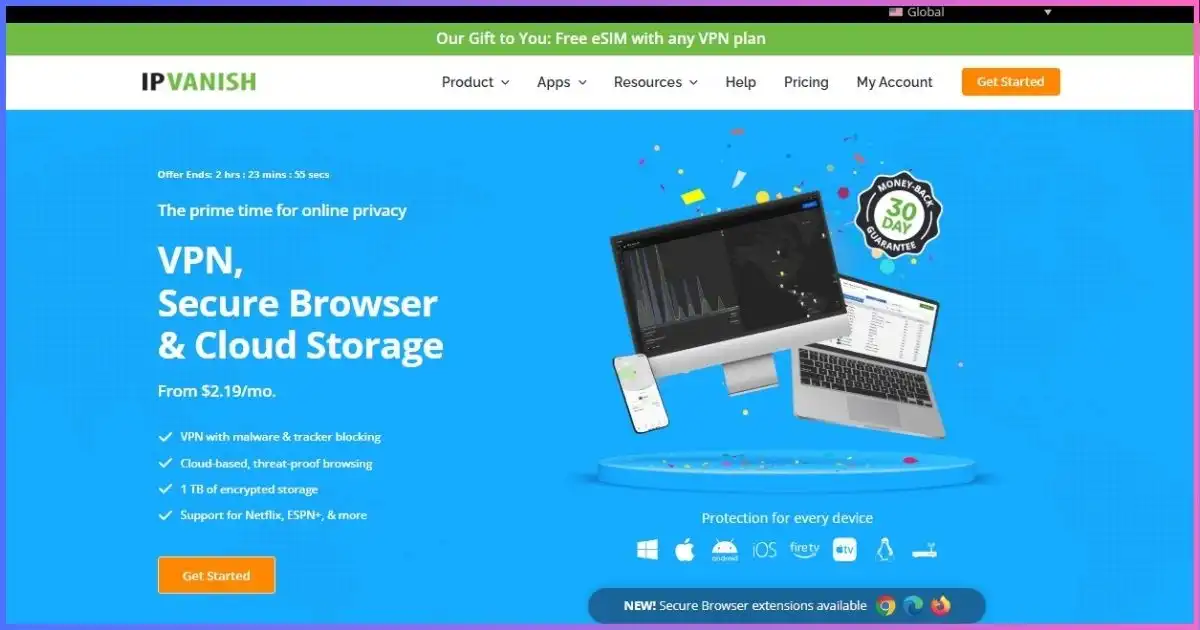
IPVanish emphasizes unlimited connections, granular server choice, and protection across household devices.
PerformanceSpeed, Reliability, and Infrastructure Upgrades
IPVanish has spent heavily on the network rather than chasing a larger country headline. Recent infrastructure disclosures describe dual data-center/provider redundancy in major cities, direct peering, ports up to 50 Gbps, an NFTables-based packet-processing stack, and OpenVPN Data Channel Offload on Windows.
Those specifications are promising, but port capacity is shared and provider “up to” multipliers are not universal results. Actual speed depends on baseline connection, Wi-Fi, device, physical distance, server load, protocol, ISP peering, and time. Start with WireGuard and the lowest-latency nearby city. Compare a second server manually because IPVanish makes that unusually easy.
| Activity | Start with | Avoid unless needed | Reason |
|---|---|---|---|
| Everyday browsing | WireGuard + nearest city | Double Hop | Low overhead and easy server switching |
| Streaming | WireGuard in required country | Scramble / Double Hop | Prioritizes throughput and latency |
| Restrictive Wi-Fi | OpenVPN TCP 443 + Scramble | IKEv2 first | Makes VPN traffic less obvious and resembles common HTTPS transport |
| Sensitive research | Double Hop + kill switch | Split tunneling | More route separation and fewer bypass paths |
| Torrenting | WireGuard + kill switch | Double Hop | Best normal P2P throughput; no port forwarding |
| Gaming | Closest WireGuard server | TCP, Scramble, Double Hop | Minimizes extra hops and retransmission overhead |
Living room supportStreaming, Apple TV, Fire TV, and Android TV
IPVanish is strongest for streaming households with many devices. Native apps cover Apple TV, Amazon Fire TV, Android/Google TV, phones, tablets, and computers, while unlimited simultaneous connections remove account-slot management.
The July 2026 Apple TV update is important: tvOS users can now choose WireGuard, OpenVPN UDP/TCP, or IKEv2. OpenVPN exposes configurable ports and Scramble, giving Apple TV more troubleshooting options than typical one-protocol TV apps. WireGuard is the sensible first choice for 4K playback; Scramble is for network blocking, not extra speed.
Streaming access changes by service, country, catalog, account, platform, DNS behavior, server IP, and time. IPVanish is capable, but it is not as consistently documented across regional services as NordVPN or ExpressVPN. Test the exact platform during the 30-day window and switch cities when an IP is blocked. See our best streaming VPNs comparison for alternatives.
One account can cover the entire household
Essential already includes unlimited VPN connections, the complete network, and all core streaming protocols.
P2PIs IPVanish Good for Torrenting?
IPVanish allows P2P traffic and imposes no bandwidth cap. WireGuard, unlimited devices, a kill switch, and detailed city/server selection make it convenient for ordinary downloads. The provider does not require a separate P2P category.
The major limitation is no VPN-side port forwarding. Without an inbound mapped port, peer discovery and seeding can be less effective, particularly with smaller swarms. Scramble does not fix this—it only makes OpenVPN traffic less recognizable to blocking networks. Avoid stale claims that the historical SOCKS5 option replaces a current encrypted P2P setup; a proxy would not provide full VPN encryption anyway.
- Choose WireGuard and a nearby city.Sort by latency or compare two individual servers rather than relying on one automatic result.
- Enable the kill switch.Make sure it remains active across sleep, reboot, and network changes on your platform.
- Bind the torrent client where possible.Select the IPVanish VPN interface in qBittorrent or another capable client for a second failure barrier.
- Verify the swarm-visible IP.A browser IP test does not confirm which interface the torrent client uses.
Heavy seeders should compare Proton VPN and PIA in our top VPNs for torrenting guide.
Latency firstGaming With IPVanish
IPVanish is a solid gaming VPN for PC and mobile because it exposes city, latency, and individual-server controls. It can mask the residential public IP from direct peers, work around inefficient ISP routing, and prevent traffic-type classification. It cannot protect a game company’s servers, guarantee lower ping, fix Wi-Fi interference, or remove congestion on the last mile.
Connect to the nearest WireGuard server and compare the route with the VPN off. Avoid Double Hop and Scramble for competitive play unless the network blocks the normal connection. Consoles generally require a compatible router or a shared computer connection; Smart DNS or DNS changes alone do not provide VPN encryption or IP masking.
Our best VPNs for gaming guide explains router setup, NAT behavior, throttling, and realistic DDoS protection.
Platform experienceApps, Split Tunneling, and Device Support
Native apps cover Windows, macOS, Linux, Android, iOS/iPadOS, Apple TV, Fire TV, Android/Google TV, and compatible ChromeOS environments. Unlimited simultaneous connections are the standout: a family can protect phones, work laptops, tablets, TVs, and travel devices without deciding which session to disconnect.
| Platform | Strong points | Limitations to check |
|---|---|---|
| Windows | WireGuard, OpenVPN DCO, kill switch, split tunneling, Threat Protection Pro on Advanced | Always-on security component can conflict with existing endpoint software |
| macOS | WireGuard/OpenVPN/IKEv2 options, kill switch, Threat Protection Pro on Advanced | Split-tunneling parity is not as clearly documented as Windows/Android |
| Linux | Official support and common manual protocol options | Fewer GUI/security extras and less feature parity |
| Android | WireGuard, kill switch, app/domain split tunneling, Threat Protection | Device-vendor networking behavior can differ |
| iOS/iPadOS | WireGuard/IKEv2, current kill-switch support, Threat Protection | Apple platform rules limit advanced routing controls |
| Apple TV | WireGuard, OpenVPN UDP/TCP, IKEv2, ports, Scramble | No ordinary per-app split tunneling |
| Fire/Android TV | Native apps, split tunneling on supported builds, RAM-only filter | Remote-control UI exposes fewer settings than desktop |
| Routers | Manual compatibility can protect consoles and smart devices | No polished first-party router app comparable to ExpressVPN Aircove |
Split tunneling requires platform-specific expectations
Windows and Android provide the clearest split-tunnel workflows, including app and—in supported builds—domain rules. Fire TV and Google/Android TV also offer useful exclusions. Do not assume the same controls exist on macOS, iOS, Linux, or Apple TV merely because the marketing page lists “split tunneling” generally.
Excluded traffic exposes the normal IP and bypasses VPN encryption. Keep exclusions narrow and review our split tunneling vs full tunneling guide before routing a bank, browser, or download client outside the tunnel.
Beyond the VPNIs IPVanish Advanced Worth It?
Threat Protection Pro
Advanced’s most security-relevant extra runs on Windows and macOS even when the VPN is disconnected. It analyzes pages and downloads, blocks malicious content and trackers, quarantines detected files, and adds incoming-network monitoring on Windows. This is closer to endpoint protection than normal VPN DNS filtering.
If you already run a full antivirus or managed endpoint suite, check compatibility and avoid duplicating real-time scanners. If you currently rely only on browser warnings, Pro is a meaningful improvement.
Secure Browser
Secure Browser runs a disposable browser remotely in the cloud, isolating the local device from much of the page execution. It is useful for unknown links, one-off research, or reducing local traces. It does not make account logins anonymous, defeat behavioral tracking inside the remote session, or replace a VPN for other apps.
1 TB Livedrive storage
The Advanced plan includes 1 TB of cloud backup/storage with file synchronization and sharing. It can materially change the plan’s value if it replaces a separate backup bill. Confirm supported devices, version history, recovery behavior, deletion retention, and encryption/key-management terms before treating it as your only backup. A cloud copy should complement—not replace—an offline or separately controlled backup.
eSIM and phone support
Essential includes 3 GB of eSIM data and Advanced includes 5 GB, subject to supported destinations, device compatibility, activation, expiry, and redemption terms. That is helpful for a short trip but not a reason to overpay at renewal. Advanced’s phone support may matter to less technical households; chat and documentation remain sufficient for most buyers.
Buying decisionIPVanish vs NordVPN, Surfshark, Proton VPN, and ExpressVPN
| VPN | Best reason to choose it | Network | Devices | Long-term entry* | Main limitation |
|---|---|---|---|---|---|
| IPVanish | Unlimited devices, US cities, Advanced backup/security bundle | 3,400+ / 55 countries / 150 locations | Unlimited | $2.19/mo | Narrower country map; no port forwarding |
| NordVPN | Best mature all-purpose toolkit | 8,000+ / 150 countries | 10 | $3.49/mo | Higher price; complex tiers |
| Surfshark | Best established unlimited-device value | 4,500+ / 100 countries | Unlimited | $2.49/mo | No port forwarding |
| Proton VPN | Privacy transparency, free tier, Secure Core, P2P forwarding | 20,000+ / 149 countries | 10 paid | $2.99/mo | More platform feature differences |
| ExpressVPN | Travel, routers, and simplest TV experience | 113 countries / 214 locations | 10–14 | $2.99/mo | Higher renewal; no forwarding |
*Introductory monthly equivalent on the longest checked prepaid offer. Taxes, bonus periods, eligibility, and renewal rates vary.
Published network scale
Server totals are not standardized. ExpressVPN and PIA are omitted because they do not publish a dependable current total.
IPVanish editorial profile
Value and unlimited devices lead; privacy history and geographic breadth reduce the overall score.
- Privacy evidence7.7
- Security controls8.4
- Network reach7.9
- Apps & usability8.3
- Price & value8.8
Choose IPVanish if…
- You need unlimited simultaneous connections for a large household.
- You want detailed US city/server selection and strong Fire TV or Apple TV apps.
- The Advanced plan can replace a separate 1 TB backup or malware-protection subscription.
- You prefer a low initial total over the broadest country network.
Choose another provider if…
- You want the strongest all-purpose feature set: see IPVanish vs NordVPN.
- You want unlimited devices with broader country coverage: compare IPVanish vs Surfshark.
- You prioritize router simplicity and travel coverage: read IPVanish vs ExpressVPN.
- You require port forwarding and maximum public audit transparency: review our best VPN providers.
How the 8.1/10 score is weighted
Privacy and security make up half the score; unlimited devices cannot compensate for weak fundamentals.
- Privacy evidence25%
- Security25%
- Network & uses20%
- Apps & usability15%
- Value & support15%
Best configurationHow to Set Up IPVanish Properly
- Install only from IPVanish or an official app store.Update every device before travel and avoid third-party APK/download sites.
- Use WireGuard for the first benchmark.Connect to the nearest city, inspect server load/latency, and compare a second server before blaming the VPN.
- Enable auto-connect and the kill switch.Configure automatic protection for untrusted Wi-Fi and test behavior across sleep, reboot, and network changes.
- Prefer RAM-only locations where available.Use the app filter while the fleet migration continues; do not assume unmarked clusters are diskless.
- Turn on ordinary Threat Protection.Advanced users can separately enable Threat Protection Pro on Windows/macOS and check compatibility with existing antivirus tools.
- Reserve Scramble and Double Hop for the right problem.Scramble helps with blocking; Double Hop improves route separation. Both can reduce performance.
- Run IP and DNS leak checks.Repeat after changing protocols, split-tunnel rules, or router configurations.
Balanced assessmentIPVanish Pros and Cons
Pros
- Unlimited simultaneous connections on both plans
- Low two-year introductory total
- 3,400+ servers, 56,000+ IPs, and detailed city/server choice
- Strong US coverage and 150 selectable locations
- WireGuard, OpenVPN, IKEv2, and Scramble
- Apple TV app now includes real protocol choice
- Double Hop and a visible RAM-only server filter
- Two later independent no-logs assessments
- Advanced includes capable malware protection and 1 TB backup
- 3 GB or 5 GB travel eSIM allowance by tier
Cons
- Only 55 countries—well behind leading coverage maps
- RAM-only migration is still incomplete
- Large renewal increase after the two-year offer
- No VPN-side port forwarding
- US/Five Eyes jurisdiction
- Historical 2016 logging-policy contradiction under prior ownership
- Full latest audit is not as open pre-purchase as Proton’s reports
- Split-tunneling and kill-switch parity varies by platform
- No polished first-party router platform
- Advanced security can duplicate existing antivirus/backup products
Common questionsIPVanish VPN Review FAQs
Is IPVanish safe?
IPVanish now provides WireGuard, OpenVPN, private DNS, leak protection, kill switches, Double Hop, a growing RAM-only fleet, and two later no-logs assessments. The 2016 disclosure under prior ownership remains an important trust caveat. Current evidence is stronger, but no VPN removes phishing, malware, browser, or endpoint risk.
Does IPVanish keep logs?
The current policy says IPVanish does not log browsing activity, traffic destinations, DNS queries, or source/VPN IP assignments. Leviathan’s 2022 assessment and Schellman’s 2025 assessment supported the later operation’s no-logs claim. Account, payment, app, support, and consent-based diagnostic data are separate categories.
How much does IPVanish cost?
The checked two-year Essential offer cost $52.56 ($2.19/month equivalent) and renewed at $89.99 per year. Advanced cost $78.96 ($3.29/month equivalent) and renewed at $109.99 per year. Prices, taxes, and offers can change.
Which IPVanish plan is best?
Essential is best for VPN-only buyers because it includes the complete network, unlimited devices, protocols, and ordinary Threat Protection. Choose Advanced if its Threat Protection Pro, Secure Browser, 1 TB Livedrive storage, phone support, or extra eSIM data replace products you would otherwise purchase.
Does IPVanish work with Netflix and other streaming services?
IPVanish works with many major streaming platforms and has strong Apple TV, Fire TV, and Android TV apps. Access changes by service, catalog, account, location, IP, platform, and time. Test your exact service during the refund period.
Is IPVanish good for torrenting?
It supports P2P and provides WireGuard, unlimited bandwidth, detailed server selection, and a kill switch. It does not offer VPN-side port forwarding, making Proton VPN or PIA better for users who need inbound peer connectivity.
How many devices can use IPVanish?
Both Essential and Advanced allow unlimited simultaneous VPN connections for devices in the subscriber’s household, subject to the service’s acceptable-use terms.
What is IPVanish Scramble?
Scramble is an OpenVPN obfuscation setting that makes VPN traffic less recognizable to restrictive or filtered networks. It can improve compatibility but usually adds overhead. It is not a speed booster, multi-hop feature, or port-forwarding tool.
Is IPVanish better than Surfshark?
Both allow unlimited devices. IPVanish offers granular US server choice, an Advanced cloud/security bundle, and more configurable Apple TV protocols. Surfshark covers substantially more countries and has a stronger current privacy/infrastructure evidence package. Surfshark is the better general pick; IPVanish can be better for US-centric households.
Final Verdict: IPVanish Is a Good Unlimited-Device Value, Not the Privacy Leader
IPVanish earns 8.1/10. It offers unlimited connections, a low first-term price, excellent US server control, capable TV apps, strong modern protocols, a growing RAM-only fleet, and useful Advanced extras. Large households and buyers who need both a VPN and 1 TB of cloud backup can get exceptional practical value.
It falls short of the leaders on country coverage, audit openness, completed RAM-only deployment, router polish, and P2P port forwarding. The historical logging incident remains relevant even though ownership, systems, and audit evidence have changed. Choose Essential for VPN-only use; choose Advanced only if its security and backup tools replace separate bills, and set a reminder before the annual renewal.
Affiliate disclosure: We may earn a commission if you purchase through a marked link, at no additional cost to you. Affiliate relationships do not change our scoring, caveats, or methodology. VPN use must comply with applicable law and service terms.
Sources & comparison methodology
Research date: September 19, 2026. We reviewed current pricing, plan, network, protocol, app, privacy, audit, transparency, and infrastructure disclosures. IPVanish’s official site was inconsistently indexable in the research environment, so claims were cross-checked against current support/product disclosures, audit documents, Ziff Davis/IPVanish announcements, and recent reporting tied to provider briefings.
IPVanish materials reviewed: Essential/Advanced pricing and renewal disclosures; server/location materials; Privacy Policy; Trust Center and transparency summaries; 2022 Leviathan and 2025 Schellman no-logs materials; WireGuard, OpenVPN, IKEv2, Scramble, kill-switch, split-tunneling, Double Hop, RAM-only filter, Apple TV, Fire TV, Android TV, P2P, refund, device, Secure Browser, Threat Protection, Threat Protection Pro, Livedrive storage, phone-support, and eSIM documentation.
Comparison materials: current official pricing, network, device, privacy, protocol, P2P, audit, and platform disclosures for NordVPN, Surfshark, Proton VPN, ExpressVPN, and Private Internet Access. Countries, cities, locations, physical servers, virtual locations, and IP addresses are kept as distinct units.
Scoring weights: privacy evidence 25%; security architecture and controls 25%; network and practical use cases 20%; apps and usability 15%; pricing, devices, support, and refund terms 15%. Cloud storage and security bundles are assessed for value but do not substitute for VPN fundamentals.
Performance method: we do not publish one universal speed-loss or permanent streaming success percentage. Results depend on baseline connection, route, server load, distance, protocol, device, Wi-Fi, ISP peering, content platform, and time. Provider “up to” speed claims are not treated as independent benchmarks.
Pricing method: introductory monthly equivalents divide the upfront first charge by every included month. Renewal prices are reported separately because first-term discounts expire. Currency, tax, region, account status, billing channel, and promotions can change checkout.