ExpressVPN vs Private Internet Access
ExpressVPN vs Private Internet Access is a choice between premium simplicity and power-user value. ExpressVPN combines stronger worldwide reach, shipped post-quantum protection, automatic Lightway obfuscation, polished streaming apps, and the more integrated router experience. Private Internet Access (PIA) costs dramatically less over the long term, permits unlimited simultaneous connections, publishes open-source apps, and gives advanced users granular DNS, encryption, split-tunneling, proxy, and port-forwarding controls.
After comparing the two across price, privacy, security, network coverage, speed, devices, apps, streaming, torrenting, gaming, travel, and support, ExpressVPN wins narrowly, 9.2/10 to 8.8/10. PIA is still the better purchase for large households, torrent users, and anyone who wants maximum configuration freedom at the lowest sustainable renewal price.
Is ExpressVPN Better Than Private Internet Access?
ExpressVPN is better for most people who prioritize security implementation, global coverage, streaming, travel, routers, and ease of use. Basic covers 10 devices, 113 countries and 214 app-selectable locations. Its open-source Rust Lightway protocol has hybrid post-quantum protection, its entire server fleet uses RAM-only TrustedServer, and automatic obfuscation requires less manual intervention on restrictive networks.
Private Internet Access is better for value, unlimited devices, torrenting, and deep customization. Its 39-month offer costs $69.81 ($1.79/month equivalent) and was advertised to renew at the same $69.81 every three years. PIA supports unlimited devices, open-source apps, granular desktop split tunneling, configurable WireGuard/OpenVPN behavior, Multi-Hop via proxy, and VPN-side port forwarding in supported non-US regions.
Table of Contents
- ExpressVPN vs PIA overview
- 12-round scorecard
- Pricing and value
- Privacy, ownership and audits
- Security and protocols
- Servers and network coverage
- Speed and reliability
- Apps, devices and split tunneling
- Streaming and smart TVs
- Torrenting and port forwarding
- Gaming
- Travel and restrictive networks
- Support and ease of use
- Which VPN should you choose?
- Frequently asked questions
- Final verdict
- Sources and methodology
At a glanceExpressVPN vs Private Internet Access Comparison
The fairest baseline is ExpressVPN Basic against PIA’s standard VPN subscription. ExpressVPN Advanced and Pro add higher device limits plus password, email, identity, eSIM, AI, and Dedicated IP benefits; PIA sells antivirus and Dedicated IP separately. Those extras can be valuable, but they do not improve the ordinary VPN network, so this comparison does not use them to inflate either score.
| Category | ExpressVPN Basic | Private Internet Access | Winner |
|---|---|---|---|
| Overall score | 9.2 / 10 | 8.8 / 10 | ExpressVPN |
| Best for | Premium simplicity, streaming, travel, routers | Budget households, torrenting, advanced controls | Depends |
| Long-term price | $83.72 / first 28 months $99.95/year renewal | $69.81 / first 39 months $69.81 every 3 years renewal | PIA |
| Countries / locations | 113 / 214 | 91 / 154 | ExpressVPN |
| Server total | Not currently published | Not currently published | Tie |
| Devices | 10 on Basic | Unlimited | PIA |
| Protocols | Lightway, WireGuard on selected apps, OpenVPN, selected IKEv2 | WireGuard and configurable OpenVPN | ExpressVPN |
| Post-quantum protection | Shipping with Lightway and WireGuard on supported apps | No comparable shipping feature documented | ExpressVPN |
| RAM-only servers | Yes, entire TrustedServer estate | Yes, entire NextGen network | Tie |
| Open-source apps | No; Lightway core is open source | Yes | PIA |
| Port forwarding | No VPN-side forwarding | Supported locations outside the US | PIA |
| Money-back period | 30 days for eligible new users | 30 days for eligible new users | Tie |
*PIA percentage compares its $69.81 three-year renewal with three ExpressVPN annual renewals at $99.95. Prices are USD snapshots verified September 19, 2026; tax, region, account state and promotions can change checkout totals.
12-round comparison scorecard
ExpressVPN’s one-round lead becomes a larger rating gap because security implementation, reach and everyday reliability carry more weight than raw round count.
ExpressVPN wins security/protocols, network reach, streaming, travel, and usability. PIA wins pricing, devices, app/split-tunnel control, and P2P. Privacy, speed, and gaming tie.
Round 1 · PIA wins decisivelyPricing, Renewal Costs, and Refunds
PIA is not merely a little cheaper—it has a radically lower published long-term cost. The current fall offer charges $69.81 for 39 months (three years plus three promotional months), equal to $1.79 per month initially. More importantly, the pricing page states that it renews at $69.81 every three years. PIA’s annual plan is $47.88 for the first year and each annual renewal, while month-to-month service costs $11.95.
ExpressVPN Basic charges $83.72 for the first 28 months (24 months plus four promotional months), equal to $2.99 per month initially. It then renews at $99.95 per year. ExpressVPN Advanced and Pro raise the initial equivalent price and bundle non-VPN products, but Basic already includes the complete VPN network, 10 devices and Lite Protection.
Long-term first payment and normalized 3-year renewal cost
Lower is better. Introductory terms cover different lengths; renewal comparison normalizes three Express annual renewals against PIA’s published three-year renewal.
first payment
first payment
3 renewal years
3-year renewal
Both services advertise 30-day money-back guarantees for eligible new subscribers. Purchases through Apple, Google, Amazon, or another reseller can follow that store’s rules, and disabling auto-renewal is not the same as submitting a refund request. Long-term offers are prepaid, so compare the total charge and the explicit renewal line rather than multiplying a promotional monthly equivalent indefinitely.
Best price: PIA’s unlimited-device plan costs less upfront and advertises a dramatically lower long-term renewal.
See PIA’s Current Price →Round 2 · TiePrivacy, Ownership, Jurisdiction, and Audits
ExpressVPN is based in the British Virgin Islands; PIA is based in the United States. Both are owned by Kape Technologies. The US is the less privacy-friendly headline jurisdiction, but jurisdiction alone is an inadequate shortcut. The more useful questions are what the provider collects, whether the infrastructure can retain activity data, how claims are tested, and what real request disclosures show.
ExpressVPN’s privacy case starts with TrustedServer: its entire VPN estate runs in volatile memory and reloads a controlled image rather than writing normal operating state to disk. KPMG’s 2025 ISAE 3000 Type 1 engagement examined TrustedServer and privacy controls as of February 28, 2025 and reported no identified exceptions in the controls it tested. ExpressVPN also publishes a large portfolio of app, protocol, router and privacy assessments plus transparency reports.
PIA also says its complete NextGen fleet is RAM-only. Its production apps are open source, it publishes quarterly transparency reporting, and Deloitte Audit Romania has completed three ISAE 3000 (Revised) engagements covering 2022, 2024 and 2025. The latest work examined server configurations, management and incident processes, and token-based Dedicated IP technology. PIA also has historical US court matters in which it said useful activity logs did not exist.
We score privacy as a tie: ExpressVPN wins on jurisdiction and overall assessment breadth; PIA wins on open-source clients, repeated infrastructure assurance and a long public operational record. As the Electronic Frontier Foundation’s VPN guidance emphasizes, a VPN shifts trust from your ISP to the VPN provider. Audits, source visibility, infrastructure design and request transparency matter more than slogans.
ExpressVPN trust strengths
- BVI operating jurisdiction
- Entire estate uses TrustedServer RAM-only design
- Broad app, server, protocol and router assessment portfolio
- Public transparency reporting
PIA trust strengths
- Open-source production apps
- Three Deloitte infrastructure assurance engagements
- Quarterly transparency reports
- RAM-only fleet and prior court-tested claims
For help reading provider claims without marketing shortcuts, use our VPN logging-policy guide.
Round 3 · ExpressVPN winsSecurity, Encryption, and VPN Protocols
ExpressVPN wins the security implementation round because it combines a controlled RAM-only estate with deployed post-quantum tunnel protection. Lightway is an open-source protocol core rewritten in Rust, uses hybrid ML-KEM protection, and handles network changes without rebuilding the connection from scratch. ExpressVPN also offers a post-quantum WireGuard implementation on supported iOS, Android and Windows apps, plus OpenVPN and selected IKEv2 support.
PIA takes the conventional, highly configurable route. WireGuard is the normal speed choice; OpenVPN lets users select ports and encryption behavior, use TCP or UDP, and route through Shadowsocks or SOCKS5 with Multi-Hop. PIA’s Kill Switch and Advanced Kill Switch, private/custom DNS choices, automation rules and MACE filtering give experienced users more knobs than ExpressVPN.
PIA wins configurability; ExpressVPN wins architecture and future-facing protection. ExpressVPN’s hybrid ML-KEM use aligns with the algorithm standardized in NIST FIPS 203. That does not make a device or website universally quantum-safe—it protects the VPN key-establishment layer on supported connections.
| Security feature | ExpressVPN | Private Internet Access |
|---|---|---|
| Primary fast protocol | Lightway; WireGuard on supported apps | WireGuard |
| Post-quantum layer | Hybrid ML-KEM on supported Lightway/WireGuard connections | No comparable shipping feature documented |
| Kill switch | Internet Kill Switch default-on on major desktops; platform modes vary | Kill Switch plus Advanced Kill Switch |
| Threat blocking | Lite Protection blocks ads, malicious sites and adult sites; higher tiers add trackers | MACE blocks ad, tracker and malware domains while VPN is active |
| Obfuscation | Automatic with Lightway behavior | OpenVPN Multi-Hop via Shadowsocks/SOCKS5 |
| Manual control | Streamlined settings | Ports, protocol, encryption, DNS and proxy controls |
DNS blockers reduce exposure to known domains; neither Lite Protection nor MACE is a full antivirus or a substitute for browser and operating-system updates. Compare the categories in our VPN vs antivirus guide.
Lightway Turbo and adapter binding
On supported Windows connections, Lightway Turbo can use multiple tunnels under suitable conditions. It relies on a packet-filter driver rather than exposing the normal ExpressVPN Tunnel adapter. If you bind a torrent client to the VPN interface, disable Turbo so the conventional adapter remains available. ExpressVPN’s “up to” Turbo result is a provider-controlled conditional figure, not a speed promise.
Round 4 · ExpressVPN winsServer Network and Location Coverage
ExpressVPN lists 113 countries and 214 app-selectable locations, including every US state. PIA lists 91 countries and 154 locations, also including all 50 states. Neither currently publishes a dependable global server-unit total, so old claims such as “ExpressVPN has 3,000+ servers” or giant legacy PIA counts should not be repeated as current fact.
Both use virtual locations where local hardware is unavailable or unsuitable, and both identify these in their location materials. A virtual location still provides an IP registered to the named market while the physical server sits elsewhere. That can improve availability but may affect latency and legal routing, so users with strict residency requirements should check the physical host details.
Published geographic coverage
ExpressVPN leads in both countries and selectable locations. Counts do not reveal physical machine totals or capacity.
ExpressVPN’s lead matters most for international travel and users who need specific regional exits. PIA still has excellent US coverage and explicitly labels streaming-optimized, city-level and virtual locations. Both advertise 10-Gbps infrastructure; Express also describes selected up-to-40-Gbps capacity. These figures describe server links, not the speed one subscriber will receive.
Round 5 · TieSpeed and Connection Reliability
ExpressVPN Lightway and PIA WireGuard are both capable of saturating ordinary home connections under favorable conditions. The practical winner changes by city, ISP, peering, server load, device, Wi-Fi quality and time of day. A universal retention percentage based on one lab, one protocol or one country would create false precision.
ExpressVPN has the smoother mobility story: Lightway keeps connection state through Wi-Fi-to-cellular changes and its Automatic mode removes guesswork. PIA can be just as fast on WireGuard and gives experts more OpenVPN port and encryption options for unusual networks. PIA also displays location latency, which helps identify likely nearby routes before connecting.
Capability profile (editorial assessment)
Relative scores summarize documented product capabilities, not laboratory throughput.
ExpressVPN: strongest in ease, worldwide coverage and streaming workflow.
PIA: strongest in customization, P2P tooling and device value.
Rounds 6–7 · PIA winsApps, Simultaneous Devices, and Split Tunneling
PIA permits unlimited simultaneous connections; ExpressVPN Basic permits 10, Advanced 12 and Pro 14. Ten is plenty for many people, but PIA removes device accounting for large families, shared households, test labs and people with many phones, computers and streaming boxes.
Both support Windows, macOS, Linux, Android, iOS, Fire TV, Apple TV and browser pathways. ExpressVPN offers the more uniform interface and stronger router integration. PIA publishes its apps as open source and surfaces much deeper desktop controls without requiring a higher plan.
Consistent apps and the better router workflow

ExpressVPN makes the common path easy: choose Smart Location, connect, and let Automatic protocol selection handle the rest. Split tunneling supports app and IP/subnet rules on Windows, macOS and Linux, per-app routing on Android, limited single-IPv4 exclusions on iOS, and router-level device routing. DNS remains inside ExpressVPN while connected.
Fortify is ExpressVPN’s current router offering, based on the GL.iNet Flint 2 (GL-MT6000). It includes Wi-Fi 6 AX6000 hardware, multi-tunnel/device routing and 12 months of ExpressVPN Advanced for eligible new or returning users. The advertised up-to-900-Mbps WireGuard figure is a controlled hardware client-mode result—not a guaranteed internet speed. Retired Aircove models keep critical security updates through the published 2027/2028 windows.
Open-source apps with desktop-grade traffic rules
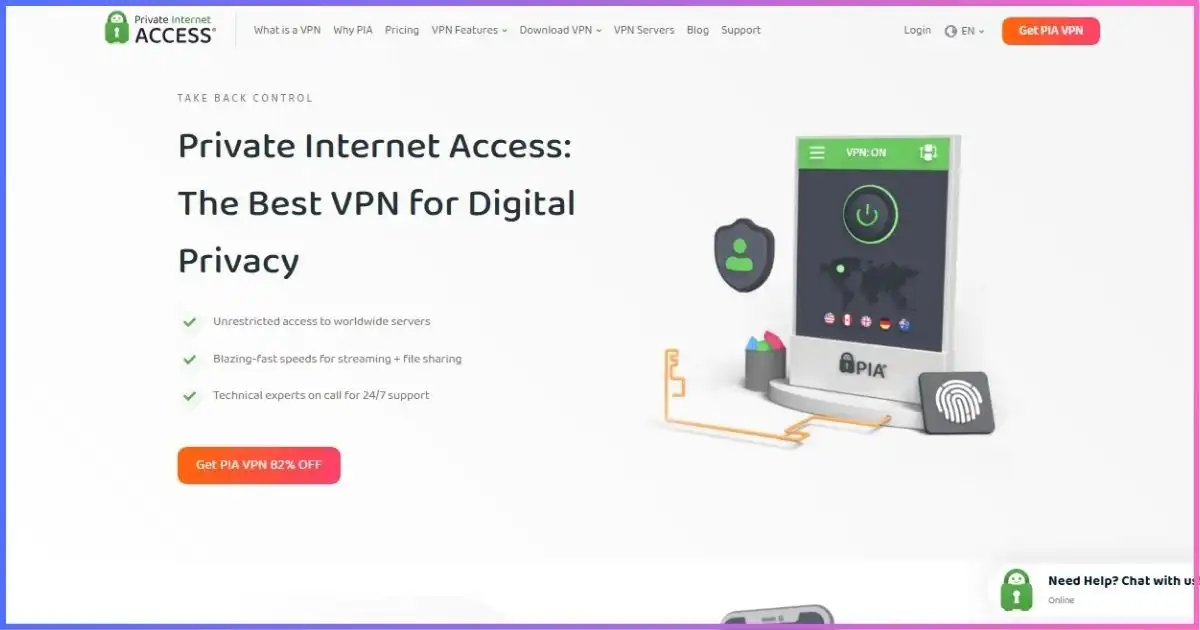
PIA split tunneling on Windows, macOS and Linux can assign apps to the VPN or direct connection, create “VPN only” behavior for selected apps, and bypass IPv4/IPv6 addresses or subnets. Windows and Linux also let DNS follow app rules or remain VPN-only. Android supports per-app behavior, though mobile and TV controls are not identical to desktop.
This gives PIA the overall apps-and-devices win: unlimited connections, open-source clients and finer desktop/DNS policy. ExpressVPN counters with iOS split exclusions and superior router-level grouping. If routing behavior matters, compare the concepts in our split tunneling vs full tunneling guide.
Round 8 · ExpressVPN winsStreaming, Smart TVs, and Media Devices
Both services provide native Apple TV, Android TV and Fire TV options, plus location choices intended for streaming. PIA labels streaming-optimized endpoints and offers Smart DNS for devices that cannot run an app. ExpressVPN has the more consistent living-room experience: 214 locations, polished TV clients, MediaStreamer, and Fortify/Aircove device routing.
MediaStreamer and PIA Smart DNS are unencrypted DNS products. They do not create a VPN tunnel, hide traffic from the local network, or provide the same location flexibility as the full apps. Use a native TV app or protected router whenever possible, and treat Smart DNS only as a compatibility fallback.
ExpressVPN wins this round for broader coverage, easier TV setup and more coherent router support. PIA is perfectly viable for budget households and its unlimited connections are useful when every screen runs a native app. Neither can guarantee permanent access to a specific catalog because streaming platforms continually rotate detection rules and block addresses. Compare more options in our best VPNs for streaming guide.
Streaming winner: ExpressVPN. It offers the smoother mix of TV apps, 214 locations, DNS fallback and router-level device routing.
Get ExpressVPN for Streaming →Round 9 · PIA winsTorrenting, P2P, and Port Forwarding
Both services allow P2P traffic broadly and provide kill-switch protection. ExpressVPN is easier to configure, but it does not offer VPN-side inbound port forwarding. Port forwarding configured on an ExpressVPN router operates outside the encrypted tunnel and is not equivalent.
PIA offers VPN-side port forwarding in supported regions outside the United States. Availability, assigned ports and locations can change, but when enabled it can improve inbound peer reachability and seeding. PIA also supports interface binding, displays the forwarded port, and exposes advanced kill-switch and DNS controls that suit experienced torrent users.
PIA therefore wins clearly. Connect to a forwarding-capable region, enter the assigned port in the torrent client, disable conflicting UPnP/NAT-PMP behavior where appropriate, bind the client to the VPN interface, and verify that traffic stops when the tunnel drops. Port forwarding exposes the listening application, so keep that software updated. See our torrenting VPN comparison for other forwarding-capable services.
Round 10 · TieGaming, Latency, and Consoles
ExpressVPN has the better console workflow. Fortify and supported Aircove routers can cover Xbox, PlayStation, Switch and other devices that lack full VPN apps, assign them to separate tunnels, and switch regions without changing console network settings. Lightway reconnects quickly, and the larger location map offers more routing choices.
PIA counters with WireGuard, unlimited device connections, visible server latency, and supported-region port forwarding. Advanced users can adjust OpenVPN transport and ports or bypass a specific game with split tunneling while keeping other apps inside the VPN.
We score gaming as a tie. ExpressVPN wins router and console convenience; PIA wins price and manual network control. Neither guarantees lower ping, open NAT, easier matchmaking, or immunity from DDoS attacks. A VPN normally adds distance and encryption overhead; it helps only if its alternate route avoids poor ISP peering or hides your household IP. Read our best gaming VPN guide for a latency-first test process.
Round 11 · ExpressVPN winsTravel and Restrictive Networks
ExpressVPN wins travel through broader country coverage, polished network handoffs and automatic obfuscation behavior in Lightway. You do not need to select a special “stealth server” for ordinary restrictive-network use, and 214 locations make it easier to find nearby exits across regions.
PIA can route OpenVPN through Shadowsocks or SOCKS5 using Multi-Hop, which may help on some filtered networks. It also costs less, supports unlimited devices and covers 91 countries. However, it does not offer a comparably simple, universal cross-platform stealth workflow, and the proxy hop can reduce speed.
Round 12 · ExpressVPN winsCustomer Support and Ease of Use
Both providers advertise 24/7 live support and maintain extensive setup documentation. ExpressVPN wins because the normal workflow demands fewer decisions: Automatic protocol, Smart Location, consistent apps, guided TV clients and an integrated router path. Its settings explain the main trade-offs without making users design their own transport.
PIA remains approachable for a basic connection, but advanced encryption, protocol, port, DNS, split-routing, proxy and automation controls create a steeper ceiling. That is an advantage for power users and a source of avoidable misconfiguration for beginners. PIA documentation is extensive, though some behavior varies meaningfully by operating system.
Buying decisionShould You Choose ExpressVPN or Private Internet Access?
Choose ExpressVPN if you want
- The simplest premium experience
- Shipped post-quantum tunnel protection
- 113 countries and 214 locations
- Automatic obfuscation for travel
- Better TV and router workflows
- Broad split routing including iOS/router options
Choose PIA if you want
- The lowest long-term cost
- Unlimited simultaneous connections
- Open-source apps and granular controls
- VPN-side port forwarding
- Configurable WireGuard/OpenVPN and DNS
- Advanced desktop split tunneling
Best overall: ExpressVPN
ExpressVPN’s higher price buys a more coherent product: broader reach, stronger deployed protocol protection, automatic stealth behavior, polished streaming apps and a genuine router ecosystem. It is the safer default recommendation for users who do not want to manage networking details.
Best value: Private Internet Access
PIA’s published three-year renewal is exceptionally difficult to beat. Unlimited devices make the economics even better for households, and the core privacy evidence is far stronger than the low price might suggest: RAM-only servers, open-source apps, repeated Deloitte work and public transparency reports.
Best for torrenting: Private Internet Access
Port forwarding, interface binding, advanced kill-switch behavior and configurable DNS make PIA the obvious pick. ExpressVPN supports P2P but cannot match that inbound-connectivity workflow.
Best for streaming and travel: ExpressVPN
Its location breadth, TV apps, MediaStreamer fallback, router routing and automatic obfuscation reduce friction at home and abroad. PIA works well in ordinary conditions but requires more manual choices at the edges.
FAQsExpressVPN vs Private Internet Access: Frequently Asked Questions
Is ExpressVPN better than Private Internet Access?
Which is cheaper, ExpressVPN or PIA?
Which is faster, ExpressVPN or PIA?
Is PIA safe despite being based in the United States?
Which VPN is better for Netflix and smart TVs?
Which VPN is better for torrenting?
Do ExpressVPN and PIA keep activity logs?
How many devices can I use?
ExpressVPN Wins Overall; PIA Wins the Value Argument
ExpressVPN wins this ExpressVPN vs Private Internet Access comparison, 9.2/10 to 8.8/10. It is the more complete mainstream VPN: deployed post-quantum protection, full TrustedServer infrastructure, 113-country coverage, automatic Lightway obfuscation, polished streaming support, and a superior router workflow. Choose it when convenience, travel reliability and cross-device consistency justify the premium.
Private Internet Access is the smarter economic decision for many technical users. Its exceptionally low published renewal, unlimited devices, open-source apps, granular split tunneling, configurable networking and port forwarding deliver enormous value. Choose PIA for a large household, torrenting, or advanced desktop control—and keep ExpressVPN for the use cases where friction matters more than price.
Disclosure: This article contains affiliate links. If you purchase through them, we may earn a commission at no extra cost to you. The ranking reflects documented capabilities, current pricing, trust evidence and editorial judgment—not commission rates. Prices and network figures were verified September 19, 2026 and can vary by region, tax, account status and promotion.
Sources & Comparison Methodology
We compared ExpressVPN Basic with PIA’s standard VPN subscription across 12 decision areas. Security, privacy, price and network quality received the greatest weight; device policy, apps, streaming, P2P, gaming, travel and support completed the score. ExpressVPN bundle extras and PIA add-ons were excluded unless directly relevant to the VPN experience.
- 25% — Security, protocols and infrastructure
- 20% — Privacy, audits and transparency
- 20% — Price, renewal and refunds
- 15% — Network breadth, speed and reliability
- 10% — Streaming, P2P, gaming and travel
- 10% — Apps, devices, support and usability
Official provider material checked:
- ExpressVPN Basic pricing and renewal disclosures, plan/device documentation, and 30-day new-user guarantee.
- ExpressVPN 113-country/214-location directory, Trust Center, KPMG 2025 engagement, TrustedServer and transparency materials.
- ExpressVPN Lightway, post-quantum WireGuard, Lightway Turbo, kill switch, split tunneling, TV, MediaStreamer, Fortify and Aircove retirement documentation.
- PIA live US pricing and renewal disclosures, 91-country/154-location directory, unlimited-device and platform documentation.
- PIA’s third Deloitte engagement, RAM-only NextGen network, open-source apps, quarterly transparency and no-logs materials.
- PIA WireGuard/OpenVPN, kill switch, MACE, split tunneling, Multi-Hop, Smart DNS, streaming and supported-region port-forwarding documentation.
We did not publish synthetic universal speed-retention, streaming-success or gaming-latency percentages. ExpressVPN’s selected up-to-40-Gbps links, Fortify’s controlled up-to-900-Mbps client-mode result and PIA’s 10-Gbps links describe capacity or controlled hardware results—not guaranteed customer throughput. Neither provider publishes a dependable current global server-unit total.
Audits are point-in-time evidence. Promotional pricing, renewal disclosures, server locations, platform features, streaming access and censorship resistance can change. Verify the final charge, renewal period, tax, platform support and local VPN law before purchasing.