Surfshark VPN vs SafeShell VPN
Surfshark wins this comparison for most buyers. It costs less on the current long-term offer, permits unlimited simultaneous connections, publishes clearer network figures, documents a real kill switch, uses RAM-only servers, and backs its no-logs policy with Deloitte assurance work. SafeShell has one compelling counterpunch: App Mode can route different apps or domains through different countries at the same time, making it the better specialist for a multi-region streaming household.
Table of Contents
- Quick answer
- At-a-glance comparison
- Pricing and refunds
- Privacy and logging
- Security and protocols
- Servers and infrastructure
- Speed and reliability
- Streaming and App Mode
- Gaming
- Torrenting and P2P
- Apps and devices
- Special features
- Travel and restrictive networks
- Support and usability
- Which should you choose?
- FAQs
- Final verdict
- Sources and methodology
The decision in one minuteSurfshark vs SafeShell: Which VPN Is Better?
Surfshark is better overall. Its $2.49 monthly equivalent on the checked 27-month Starter offer is far below SafeShell’s stable US App Store annual reference of $6.67 per month. Surfshark also offers unlimited paid-plan devices, 4,500-plus RAM-only servers in 100 countries, a 30-day refund, a documented kill switch, mature standard protocols, two Deloitte no-logs assurances, and clearer cross-platform support.
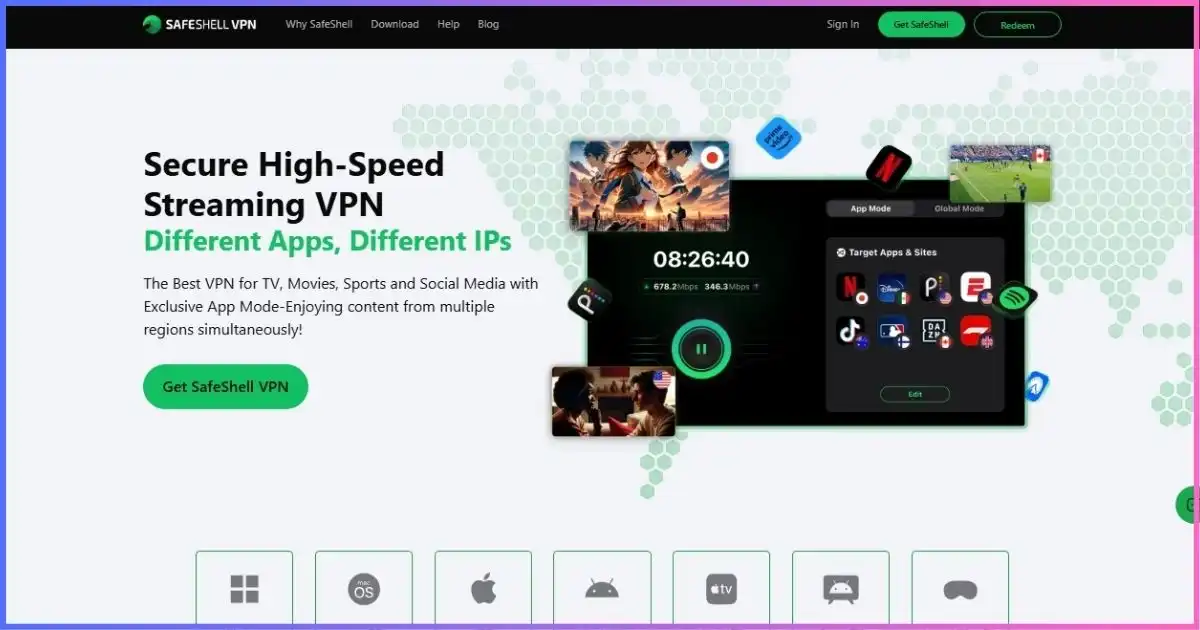
SafeShell is better for one specific workflow: different streaming apps connected to different countries simultaneously. Surfshark Bypasser is conventional split tunneling—it sends chosen apps/sites through or around one selected VPN route. SafeShell App Mode can assign separate apps or custom domains to separate VPN regions concurrently.
Recommendation: choose Surfshark as a general household VPN. Choose SafeShell only when App Mode, integrated subtitle translation, or a specific TV-app route solves a problem ordinary split tunneling cannot.
Category score comparison
Editorial ratings out of 10 based on published evidence, capability, terms, and platform support.
At a glanceSurfshark VPN vs SafeShell VPN Comparison Table
| Category | Surfshark | SafeShell | Winner |
|---|---|---|---|
| Long-term price reference | $2.49/mo equivalent; $67.23 first 27 months | $6.67/mo equivalent; $79.99 US App Store year | Surfshark |
| Simultaneous devices | Unlimited after trial | 5 | Surfshark |
| Network | 4,500+ servers, 100 countries | 61 regions/2,000+ servers in live directory; other pages conflict | Surfshark |
| Refund | 30 days | 7 days, first eligible direct purchase only | Surfshark |
| No-logs evidence | Deloitte assurances in 2023 and 2025 | No clearly published independent assurance found | Surfshark |
| Protocols | WireGuard, OpenVPN, IKEv2, limited Dausos beta | ShellGuard and Stealth | Surfshark |
| Kill switch | Clearly documented on major platforms | Current platform behavior not clearly documented | Surfshark |
| Multi-region app routing | Bypasser routes apps/sites in or out of one VPN route | App Mode assigns different apps/domains to different countries | SafeShell |
| TV platforms | Apple TV, Android TV, Fire TV | Apple TV, Android/Google TV, Vision Pro; Fire TV route varies | Tie |
| P2P | Documented P2P support, kill switch; no port forwarding | Directory marks P2P regions; thinner safety documentation | Surfshark |
| Gaming specialty | FastTrack/Everlink, WireGuard, unlimited devices | Game Mode and Dual Assurance on supported devices | SafeShell |
| Overall score | 9.1/10 | 7.8/10 | Surfshark |
Round wins across this comparison
Surfshark wins 7 categories, SafeShell 3, with 2 ties.
- Surfshark wins7
- SafeShell wins3
- Ties2
Round 1 · Surfshark winsPricing, Trials, Renewals, and Refunds
Surfshark is the less expensive long-term purchase. Its Starter plan showed $67.23 for the first 27 months, equal to $2.49 for each included month. SafeShell’s most stable public price reference was the US Apple App Store: $79.99 per year, or $6.67 per month equivalent. SafeShell also listed $12.99 monthly and $5.99 weekly.
| Term | Surfshark | SafeShell | Important fine print |
|---|---|---|---|
| Long term | $2.49/mo equivalent; $67.23 for 27 months | $6.67/mo equivalent; $79.99/year in US App Store | Both are prepaid; regional tax and offers vary |
| One year | $3.39/mo equivalent; $40.68 first year in official plan guide | $79.99/year US App Store reference | Checkout and app-store prices can differ |
| Monthly | $16.45 Starter | $12.99 | SafeShell wins short-term monthly price |
| Weekly | Not the normal plan structure | $5.99 | Repeated weekly billing is about $25.96 per average month |
| Trial | 7 days on eligible web 12/24-month purchases; 3-device cap during trial | New-user trial availability and length shown at signup | Both can auto-renew |
| Refund | 30 days | 7 days for eligible first direct purchase | App stores apply their own refund decisions |
Effective monthly cost by comparable term
USD pricing snapshots; lower is cheaper. Long-term terms and renewal mechanics differ.
Surfshark’s two-year plan renews annually after the initial term, but the public page did not expose one stable renewal dollar amount during research. Record the renewal price shown at your checkout. SafeShell app-store subscriptions renew through Apple or Google unless canceled at least 24 hours before the period ends.
Round 2 · Surfshark winsPrivacy, Jurisdiction, and Logging Evidence
Surfshark
Operated by Surfshark B.V. in the Netherlands. The August 27, 2026 policy says it does not retain visited IPs, browsing history, bandwidth, network traffic, session history, or stored connection timestamps. Temporary server connection data—user ID and/or source IP plus timestamps—is deleted within 15 minutes after a session.
SafeShell
Operated by GearUp Portal Pte. Ltd. in Singapore. Marketing claims no online activity or connection logs, but its April 2025 group-wide privacy policy describes account, location, IP/MAC/device identifier, ISP, timestamp, diagnostic, ping, and usage/preference collection without clearly reconciling every category with the slogan.
Surfshark’s no-logs design was independently assessed by Deloitte in 2023 and again in 2025. The later ISAE 3000 engagement examined standard, static, and multiport VPN servers plus configuration and deployment processes. SafeShell had no clearly surfaced independent no-logs or infrastructure assurance in the public materials reviewed.
Surfshark also publicly reported that an April 2026 Amsterdam District Court warrant produced only account-existence confirmation and payment data, not online activity records. That does not make the company immune to lawful orders; it demonstrates what data was available in that case.
Round 3 · Surfshark winsSecurity, Encryption, Protocols, and Kill Switch
| Feature | Surfshark | SafeShell |
|---|---|---|
| Primary protocol | WireGuard with post-quantum protection in supported apps | ShellGuard, described as TLS 1.3-based |
| Fallback/restrictive protocol | OpenVPN TCP/UDP; Camouflage with OpenVPN; NoBorders | Stealth, described as QUIC-based obfuscation |
| Additional protocol | IKEv2; Dausos beta on macOS App Store only | No standard WireGuard/OpenVPN selector documented |
| Encryption | Modern cipher suites by protocol; post-quantum WireGuard layer | AES-256-GCM and forward secrecy claims |
| Kill switch | Documented for Windows, macOS, Linux, Android, iOS | Referenced in provider content but current app-by-app behavior is unclear |
| Double VPN | Dynamic MultiHop with user-selected pairs | No; App Mode is not multi-hop |
| DNS/ad filtering | CleanWeb across major apps and TV clients | SafeNet while connected; platform and route limitations |
Surfshark’s standard protocol choices are easier to evaluate because WireGuard and OpenVPN have public specifications and broad implementation scrutiny. Its new Dausos protocol is proprietary and Cure53-audited, but was still a beta limited to the macOS App Store build when checked. It should not yet drive a purchase decision.
SafeShell’s ShellGuard and Stealth are sensible on paper. ShellGuard focuses on everyday stability; Stealth wraps traffic in QUIC for networks that identify VPNs. SafeShell itself warns that some ISPs throttle QUIC. The bigger drawback is operational documentation: the review materials do not establish consistent kill-switch behavior across desktop, mobile, and TV platforms.
Both vendors discuss quantum-resistant protection. NIST’s finalized standards provide the broader technical context, but a VPN’s post-quantum key exchange does not make every website, device, or application quantum-safe; see the NIST post-quantum standards overview.
Round 4 · Surfshark winsServer Network and Infrastructure Transparency
Surfshark reports 4,500+ servers in 100 countries. It says the fleet is entirely RAM-only, every server has at least a 10 Gbps port, and selected high-traffic infrastructure reaches 100 Gbps. Those numbers are clearly defined enough for comparison.
SafeShell’s pages use several unreconciled units. Its live directory showed 61 regions and 2,000+ servers, while the features page advertised 100-plus locations and a separate FAQ claimed 10,000-plus nodes in more than 40 countries. Those can all represent different layers—selectable regions, route variants, backend nodes—but SafeShell does not explain the relationship. We use the live directory as the conservative baseline.
A port-speed claim is shared capacity, not a subscriber speed guarantee. Distance, congestion, server load, device, Wi-Fi, protocol, ISP peering, and destination determine actual throughput.
Round 5 · Surfshark wins narrowlySpeed, Stability, and Everyday Performance
Surfshark has the safer performance profile: WireGuard is mature, every listed server has at least a 10 Gbps port, Everlink can shift a connection away from an unhealthy backend without exposing the ordinary IP, and FastTrack evaluates multi-server routes. SafeShell offers ShellGuard, high-capacity routes, streaming-specific endpoints, and a 10 Gbps claim for most current directory locations.
We do not assign a universal retention percentage because it would not transfer to your line. For either service, test the same nearby location, device, protocol, wired/Wi-Fi condition, and time window. Use WireGuard on Surfshark and ShellGuard on SafeShell as the first baseline; enable Camouflage/Stealth only when blocking resistance is required.
Round 6 · SafeShell winsStreaming, Smart TVs, and Multi-Region App Routing
This is SafeShell’s strongest round. App Mode can assign different apps—or custom domains—to different VPN countries simultaneously. One TV app can use South Korea, another the United States, while local services remain outside those routes. Global Mode handles ordinary one-country device-wide tunneling and can exempt selected apps.
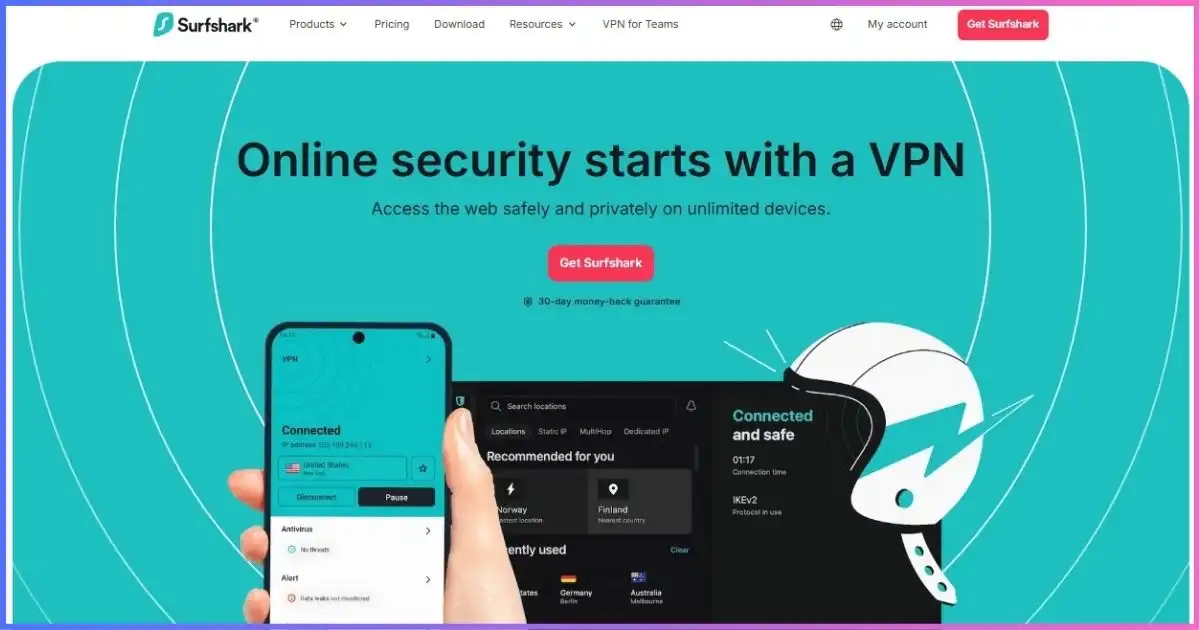
Surfshark is still a strong streaming VPN. It offers Apple TV, Android TV, Fire TV, desktop and mobile apps, unlimited household devices, CleanWeb, Smart DNS for incompatible devices, and Bypasser. But Bypasser is conventional split tunneling: it decides which apps or websites use the VPN or ordinary connection. It does not give several apps several foreign VPN locations at the same time.
| Need | Surfshark | SafeShell | Better choice |
|---|---|---|---|
| Whole household coverage | Unlimited devices | 5 devices | Surfshark |
| Several apps, several countries at once | Not through ordinary Bypasser | App Mode | SafeShell |
| Apple TV | Native app | Native tvOS 17+ listing | Tie |
| Fire TV | Clearly documented native support | Promoted, but installation route varies by model | Surfshark |
| Subtitle translation | No comparable integrated headline feature | Dual subtitles across 30+ languages on supported content | SafeShell |
| Long refund test window | 30 days | 7 eligible direct days | Surfshark |
Neither provider can permanently guarantee a streaming catalog. App, country, account, device, DNS state, IP block, and time all matter. Fully restart the streaming app after connecting and test playback during the applicable refund window. See our broader best streaming VPN comparison.
Round 7 · Tie, with different strengthsGaming, Latency, and DDoS-Oriented IP Masking
Surfshark is the better general gaming VPN: WireGuard, unlimited device connections, broad 100-country coverage, FastTrack route selection, Everlink resilience, and router support make it adaptable. SafeShell’s dedicated Game Mode is easier for supported titles, while Dual Assurance can switch between Wi-Fi and mobile-data paths on compatible devices.
Both services mask the residential public IP from direct peers, shifting IP-targeted exposure to the VPN endpoint. Neither can protect a game publisher’s servers, prevent account attacks, fix weak Wi-Fi, or guarantee a lower ping. A VPN helps latency only when its route is better than the ISP’s original path.
Console users generally need a compatible router or computer-shared connection. Smart DNS is not an encrypted VPN and does not provide DDoS-oriented IP masking. Compare router and console options in our best gaming VPN guide.
Round 8 · Surfshark winsTorrenting, P2P, Kill Switch, and Port Forwarding
Surfshark is the safer P2P choice because its kill switch, WireGuard support, auto-connect, and P2P-capable directory are more clearly documented. Unlimited connections also let every household device use the VPN without cycling logins. Ensure Bypasser does not exclude the torrent client.
SafeShell marks P2P/BitTorrent support by region and App Mode can assign the client to a VPN route. Its weakness is fail-closed documentation: a provider blog mentions a kill switch, but the reviewed current support and feature pages do not clearly explain platform behavior.
Neither service documents ordinary VPN-side inbound port forwarding. Torrents can work through outbound connections, but seeding and small swarms may be less efficient. Use authorized content only; a VPN does not scan every download or prevent accidental sharing. Power users can compare documented forwarding alternatives in our top VPNs for torrenting.
Round 9 · Surfshark winsApps, Device Support, and Simultaneous Connections
| Platform | Surfshark | SafeShell |
|---|---|---|
| Windows | WireGuard/OpenVPN, kill switch, Bypasser, MultiHop, Rotating IP | ShellGuard/Stealth, Global/App Mode; kill-switch behavior unclear |
| macOS | Two app routes; Dausos beta only in App Store build | Native/App Store client; feature parity can vary |
| Linux | Native GUI/CLI support | No prominent first-class Linux download found |
| Android/iOS | Native apps, Bypasser, Rotating IP, unlimited paid devices | Native apps, App Mode, Game Mode on supported devices |
| Apple TV | Native app with CleanWeb support | Native app; App Mode is a standout |
| Android/Google TV | Native app | Native TV download |
| Fire TV | Clearly documented | Marketing support; verify installation for exact model |
| Apple Vision Pro | No equivalent headline listing reviewed | Native listing |
| Routers | Manual configuration and guides | No prominent first-class router workflow reviewed |
| Connections | Unlimited after trial | 5 |
Surfshark is the obvious family and device-heavy choice. SafeShell remains attractive when those five slots are concentrated on TVs and App Mode-compatible devices. For fuller standalone analysis, read our Surfshark review and SafeShell VPN review.
Round 10 · Depends on the jobCleanWeb, SafeNet, MultiHop, App Mode, and Extras
Surfshark’s best extras
- Dynamic MultiHop with user-selected server pairs
- Rotating IP every 5–10 minutes without disconnecting
- CleanWeb blocking across major apps and TV clients
- Alternative ID included with Starter
- Dedicated IP add-on and static-IP locations
- Antivirus, Alert, Search, and Incogni on higher tiers
- Everlink self-healing and FastTrack routing
SafeShell’s best extras
- App Mode with separate countries per app/domain
- Global Mode with bypass exemptions
- Game Mode and Dual Assurance
- Dual subtitle translation in 30+ languages
- SafeNet ad/tracker/malicious-domain filtering
- Streaming-labeled routes and TV-first interface
- Apple Vision Pro support
Surfshark is broader and more privacy-oriented. SafeShell is narrower but more inventive around entertainment. SafeNet requires an active VPN connection, cannot remove ads embedded directly in Netflix or Disney+ streams, and is not available identically on every platform. CleanWeb also cannot guarantee removal of every first-party or embedded ad, but its platform coverage is documented more clearly.
Round 11 · Surfshark wins overallTravel, Public Wi-Fi, and Restrictive Networks
Surfshark is the better travel companion: 100 countries, unlimited devices, auto-connect, kill-switch documentation, NoBorders, OpenVPN Camouflage, post-quantum WireGuard, and a longer test/refund window. SafeShell Stealth can disguise VPN traffic through QUIC and App Mode is useful for keeping local apps outside foreign streaming routes.
On filtered networks, start with Surfshark WireGuard or SafeShell ShellGuard. Move to NoBorders/Camouflage or Stealth only when the normal protocol fails. Obfuscation can reduce speed, and no provider can guarantee availability under active blocking.
A VPN protects traffic to the VPN server but cannot make a phishing site legitimate, replace updates, or secure a compromised device. The FTC’s public Wi-Fi guidance explains why HTTPS improved ordinary hotspot safety while account security and scam awareness remain essential.
Round 12 · Surfshark winsEase of Use, Support, and Documentation
Both apps are designed for non-technical users. SafeShell’s mode-based interface is excellent when the goal is “send this app to this country.” Surfshark is easier to evaluate before buying because it publishes clearer platform matrices, protocol documentation, privacy evidence, support workflows, server totals, and refund terms.
Surfshark offers 24/7 support, extensive setup guides, and in-account auto-renewal management for direct purchases. SafeShell offers email, in-app feedback, and Telegram support. Its seven-day window creates more pressure to test quickly, and a direct refund may require account/payment evidence while store purchases follow store procedures.
For most households, Surfshark is the smarter buy
It is cheaper long-term, covers unlimited devices, has stronger privacy evidence, and gives you 30 days to test. SafeShell remains the App Mode specialist.
Buying adviceWho Should Choose Surfshark—and Who Should Choose SafeShell?
Choose Surfshark if you…
- Want the best overall value and unlimited paid-plan devices
- Prioritize audited no-logs evidence and RAM-only infrastructure
- Need Linux, router, Fire TV, and mature cross-platform documentation
- Want a clearly documented kill switch and conventional protocols
- Regularly torrent, travel, or protect a large household
- Want MultiHop, Rotating IP, Alternative ID, or security-suite upgrades
Choose SafeShell if you…
- Need several streaming apps connected to different countries at once
- Use Apple TV or Vision Pro as the center of your setup
- Value integrated dual-subtitle translation
- Play a supported game that benefits from its guided routes
- Only need five devices and accept a shorter refund period
- Can test every required app and region immediately
If neither compromise works, compare NordVPN’s larger network and stronger mature feature set in NordVPN vs Surfshark or see how it handles SafeShell’s specialist routing in NordVPN vs SafeShell. Our full VPN provider ranking covers additional alternatives.
Common questionsSurfshark VPN vs SafeShell VPN FAQs
Is Surfshark better than SafeShell?
Surfshark is better overall because it is cheaper long-term, supports unlimited paid-plan devices, has a larger clearly defined country network, documents its kill switch and protocols, provides a 30-day refund, and has repeated independent no-logs assurance. SafeShell is better for simultaneous multi-country app routing.
Which is cheaper, Surfshark or SafeShell?
Surfshark is cheaper on the compared long-term offers: $2.49 per included month for the first 27 months versus SafeShell’s $6.67 monthly equivalent on its $79.99 US App Store annual listing. SafeShell’s $12.99 monthly plan is cheaper than Surfshark Starter’s $16.45 month-to-month option.
Which VPN is better for streaming?
SafeShell wins for a household that needs different apps connected to different countries simultaneously. Surfshark is better for covering many devices, clearer Fire TV support, and a longer 30-day test window. Streaming availability can change with service, account, region, IP, device, and time.
What is the difference between Surfshark Bypasser and SafeShell App Mode?
Surfshark Bypasser is split tunneling: selected apps or websites use the VPN or bypass it while the VPN uses one location. SafeShell App Mode can assign different supported apps or domains to different VPN locations concurrently.
Which VPN is more private?
Surfshark. It uses RAM-only servers, publishes a more precise no-logs policy, underwent Deloitte no-logs assurance in 2023 and 2025, documents temporary connection-data deletion, and publishes transparency reporting. SafeShell has less independent verification and broader privacy-policy language.
Which supports more devices?
Surfshark allows unlimited simultaneous connections after the trial. SafeShell permits five devices. Surfshark’s seven-day trial is limited to three devices until it converts to a paid plan.
Which is better for gaming?
Surfshark is better for general multi-device and router gaming. SafeShell may be more convenient for supported titles because Game Mode and Dual Assurance focus on route selection and Wi-Fi/mobile stability. Neither can guarantee lower ping.
Which is better for torrenting?
Surfshark, because its P2P, kill switch, WireGuard, and auto-connect documentation is clearer. Neither provider includes ordinary VPN-side port forwarding, so serious seeders may want a different service.
Do Surfshark and SafeShell have free trials?
Surfshark offers an eligible seven-day web trial on 12- and 24-month purchases with supported payment methods, capped at three devices during the trial. SafeShell offers new-user trials with the current length and eligibility shown during signup. Both may auto-renew unless canceled.
Final Verdict: Surfshark Wins, but SafeShell Owns One Niche
Surfshark wins 9.1/10 to 7.8/10. It is the better VPN for privacy, price, household coverage, refund protection, infrastructure transparency, P2P, travel, and general platform support. Starter is the sensible plan: the core VPN and Alternative ID are enough for most buyers.
SafeShell remains the more interesting streaming specialist. App Mode is not a marketing rename for ordinary split tunneling; its ability to assign multiple apps to multiple countries concurrently can genuinely simplify a complex TV setup. That advantage is worth paying for only if you will use it.
Bottom line: buy Surfshark for an all-purpose VPN. Buy SafeShell for App Mode, subtitle translation, or a confirmed game/TV workflow—and test it immediately because its eligible direct refund window is only seven days.
Affiliate disclosure: We may earn a commission if you purchase through a marked link, at no extra cost to you. Affiliate relationships do not change the winner, scoring, limitations, or methodology.
Sources & comparison methodology
Research date: September 18, 2026. This comparison uses current official product, pricing, policy, infrastructure, and support documentation. We do not publish universal speed percentages or permanent streaming success rates because results vary with route, server, ISP, device, app, country, and time.
Surfshark materials reviewed: pricing and plan guide; live server directory; August 27, 2026 privacy policy; Trust Center and transparency report; 2025 Deloitte ISAE 3000 report; protocol, Dausos, post-quantum, kill switch, Bypasser, CleanWeb, MultiHop, Rotating IP, Everlink, FastTrack, trial, cancellation, refund, device, router, streaming, gaming, and P2P documentation.
SafeShell materials reviewed: homepage, features, download page, live server directory, privacy policy, user agreement, subscription terms, App Mode and Global Mode guides, ShellGuard and Stealth protocol guide, SafeNet, Game Mode, Dual Assurance, device, subscription, trial and refund FAQs, plus US Apple App Store and Google Play listings.
Scoring: privacy/security 25%; performance and infrastructure 20%; streaming and routing 20%; platforms/devices 15%; pricing/refunds 15%; support/usability 5%. SafeShell receives extra credit for unique app-by-country routing; Surfshark receives credit for independently verified privacy controls and unlimited paid connections.
Pricing method: monthly equivalents divide the upfront charge by included months. SafeShell uses a stable US App Store listing because direct checkout is dynamic. Surfshark uses its public direct offer. Taxes, currencies, bonus months, app-store prices, regional eligibility, and renewals can change.