Business VPN vs Zero Trust Network Access (ZTNA): Which Fits Your Team in 2026?
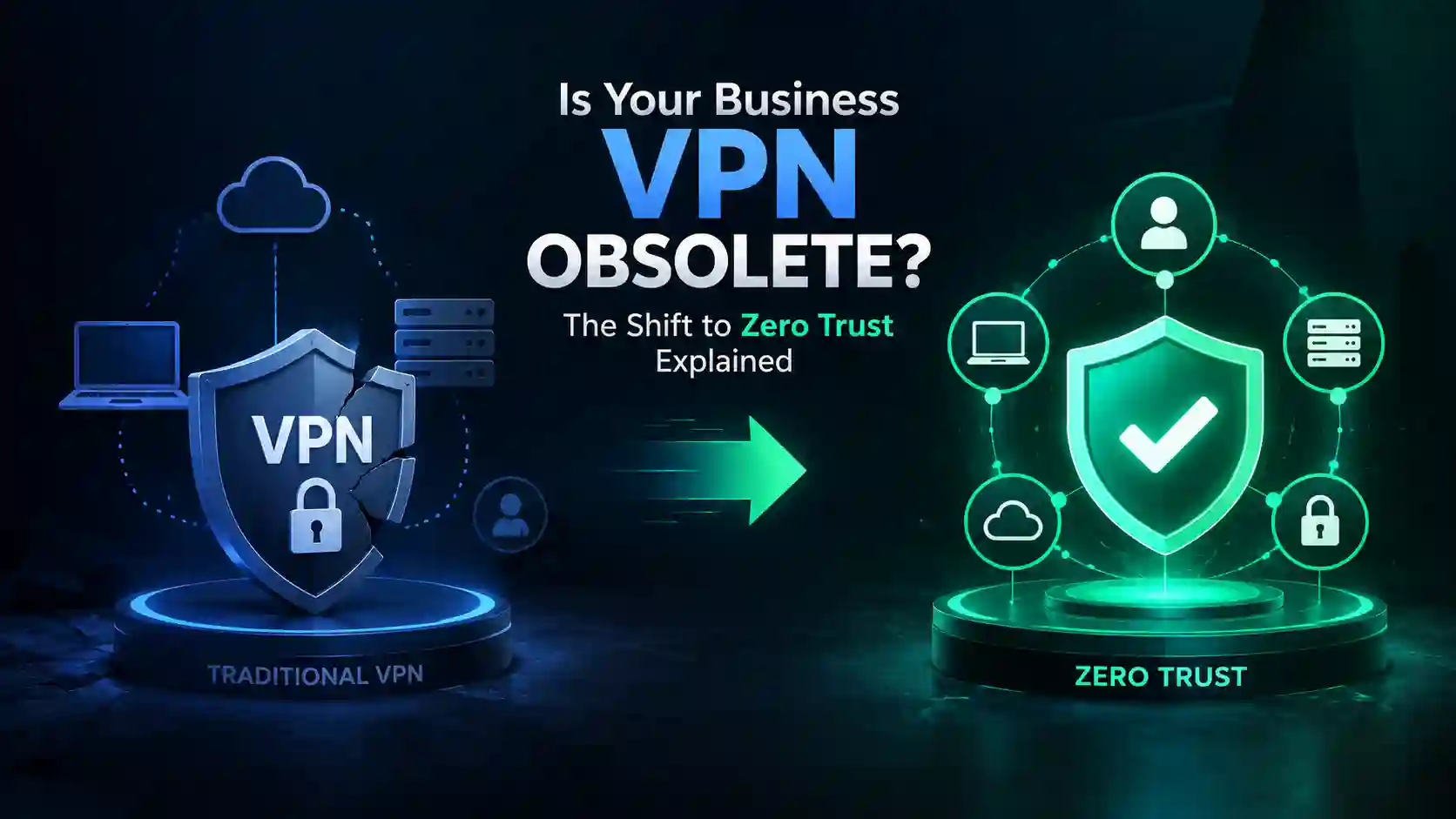
The VPN vs Zero Trust debate is no longer theoretical — it is the decision every security, IT and ops leader has to make in 2026 when choosing how remote employees and contractors reach internal apps. A business VPN tunnels a user into a network and trusts them once inside; Zero Trust Network Access (ZTNA) verifies identity, device posture and risk on every request and grants access to specific applications, not a network.
Both models have mature products behind them, and the right answer is rarely either/or. Below we compare the two on architecture, security model, cost, scale, user experience and migration risk — and give you a decision path for teams of 5 up to 5,000.
Business VPN vs ZTNA: Which Is Better in 2026?
A business VPN is still the right choice for small teams, cost-sensitive organizations, legacy on-prem apps that require full network access, and teams whose threat model is mostly external traffic encryption. ZTNA is the better choice when you have SaaS-heavy or cloud-native applications, contractors and BYOD users, sensitive data that should never touch broad network tunnels, or compliance regimes that demand least-privilege access and continuous verification.
The honest market signal: Gartner has predicted that at least 70% of new remote-access deployments will be served predominantly by ZTNA rather than VPNs — a structural shift, not a fad. But ZTNA still demands more setup, identity plumbing and policy discipline than a VPN. Most teams land on a hybrid: a business VPN as the baseline remote-access layer, plus ZTNA on top for sensitive apps, contractors and BYOD.
Table of Contents
- Business VPN vs ZTNA: what each actually is
- Full head-to-head comparison table
- How the two architectures differ
- Security model comparison
- When to pick each (decision framework)
- Cost and scale at 10, 100 and 1,000 seats
- The hybrid play most teams actually run
- 6-step migration playbook
- What neither model solves
- How we compared them
- FAQs
- Final verdict
- Sources & research notes
DefinitionsBusiness VPN vs Zero Trust: What Each Actually Is
A business VPN is a tunnel-and-trust model. A remote user authenticates once, the VPN tunnel brings them “onto the corporate network,” and from there they can usually reach any host that the firewall allows. The job of the VPN is to encrypt traffic in transit and hide the user’s IP; the job of the rest of your infrastructure is to decide what that user can touch.
A Zero Trust Network Access (ZTNA) system is an identity-and-resource model. Every access request — even from the same user, same device, same hour — is evaluated against identity, device posture, location, app, and policy before the request is allowed through. The user never lands on a broad network; they are brokered straight into a specific application or service.
Tunnel-based trust
One authentication opens a broad tunnel to the corporate network. Once inside, users can typically reach many hosts that network policy allows.
- Encrypts traffic in transit
- Hides user IP from the internet
- Simple to deploy; decades of muscle memory
- Security depends on what sits behind the tunnel
Identity & resource-based trust
Every request is evaluated — identity, device health, app, policy — before being brokered to a specific resource. No broad network access is granted.
- Least-privilege by design
- Continuous verification of device and user
- Hides internal services from the internet
- Requires an identity platform and policy discipline
For solo operators and very small teams who only need “keep my traffic private and stop ISP snooping,” a standard consumer-grade business VPN often does enough. For teams where the answer to “what happens if one laptop is compromised?” matters, ZTNA closes an entire class of risk that a VPN cannot.
Head-to-headBusiness VPN vs ZTNA: Full Comparison
| Dimension | Business VPN | ZTNA |
|---|---|---|
| Access model | Network-level: tunnel onto the corporate network | Application-level: brokered access to specific resources |
| Authentication | Typically once at tunnel start | Per-request, with continuous device-posture checks |
| Default trust | Trust after authentication (inside-the-network trust) | No implicit trust; least privilege by design |
| Lateral movement risk | Higher — tunnel often grants broad reach | Lower — user sees only allowed applications |
| Internal app visibility | Often visible to any tunneled user | Hidden unless the user is explicitly allowed |
| BYOD & contractor fit | Poor — granting network access to untrusted devices is risky | Strong — per-app access with device posture gates |
| Deployment complexity | Low to medium | Medium to high (identity, policy, connectors) |
| Legacy app fit | Excellent — legacy apps expect a network | Needs wrapping, tunneling or agent support |
| Cloud / SaaS fit | Often unnecessary — SaaS has its own auth | Natural fit; brokered access with IdP context |
| User experience | One click on, one click off | Transparent after setup, but first-touch can be more involved |
| Typical pricing model | Per-seat license, cheap at small scale | Per-user + infrastructure, steeper at small scale |
| Maturity | Decades; every OS supports it natively | Rapidly maturing; vendor landscape still consolidating |
Where each model wins (editorial scoring)
How a business VPN and ZTNA compare across the six dimensions that actually drive a buying decision. Green = VPN, purple = ZTNA.
ArchitectureHow the Two Architectures Differ
The mental picture matters because it is where almost every real-world incident story starts. In a VPN model, the attacker who compromises one laptop often gets network-level reach: shared drives, databases, internal services, printer queues. In a ZTNA model, the same compromised laptop sees only the applications its identity and device posture still authorize — and even those can be re-evaluated on the next request.
1. Authenticate → 2. Tunnel → 3. Network
- User opens the VPN client
- Enters credentials (+ MFA ideally)
- Tunnel is established to the gateway
- Traffic is routed onto the corporate network
- Firewalls, ACLs and app-layer controls then apply
1. Identity → 2. Context → 3. Broker to app
- User requests a specific app
- Identity platform validates user + device + risk
- Policy engine authorizes the request
- Broker or gateway connects the user to that app only
- Subsequent requests are re-evaluated continuously
That architectural split is why the market is moving. A 2025 Secure Network Access Report found that 52% of organizations cite VPNs as their biggest security challenge — and the reason is usually not the tunnel itself but what the tunnel grants access to once it opens. ScienceDirect-cited research also documents a 238% surge in VPN-targeted attacks between 2020 and 2022 as remote work exploded, putting edge VPN devices squarely on attacker radars.
Security modelSecurity Model: What Each One Actually Protects
A business VPN protects traffic — it is a secure pipe. It does not, by itself, decide which user can read which file, call which API, or reach which server. That job belongs to everything sitting behind the gateway: firewalls, network segmentation, application authorization, identity access management.
ZTNA builds the authorization decision into the access layer itself. That is a much stronger security model for distributed teams because it removes the “trusted network” assumption that has been the failure mode of most remote-work breaches. IBM’s annual Cost of a Data Breach report has consistently put the global average breach cost around $4.88 million, and remote-access and identity gaps appear in a disproportionate share of those incidents.
Three concrete security differences:
- Lateral movement. A tunneled attacker inside a VPN perimeter can scan and pivot; a ZTNA attacker sees only the specific apps they were authorized for at the moment of request.
- BYOD and contractors. Handing a contractor network access through a VPN is almost always too much. ZTNA lets you grant access to, say, “the staging Jira board” and nothing else.
- Post-incident revoke. Pulling a compromised device off a ZTNA platform is often one click in the identity provider; pulling it off a VPN plus every downstream ACL is a project.
That said, a well-built VPN stack — VPN plus MFA, plus proper network segmentation, plus least-privilege IAM, plus logging — can deliver security that is more than adequate for small and mid-size businesses. The gap between a hardened VPN and a basic ZTNA deployment is often smaller than the gap between a hardened VPN and a poorly-configured one.
Decision frameworkWhen to Pick Each
The honest answer is that most buying teams land on one of four patterns. Match yours before picking vendors.
| Team profile | Recommended primary model | Why |
|---|---|---|
| 2–15 person remote team, mostly SaaS tools, no on-prem secrets | Business VPN (+ MFA everywhere) | Cheap, familiar, and the real security work is in the SaaS apps and MFA. See our best VPN for remote teams guide for providers ranked on team fit. |
| 10–100 person growing company, mix of SaaS + on-prem, contractors | Hybrid: business VPN baseline + ZTNA on sensitive apps | VPN covers general remote access; ZTNA gates the apps that matter most (finance, HR, customer data, code repos). |
| 100–1,000+ seat enterprise, regulated, BYOD, global contractors | ZTNA-first with VPN retained for specific legacy paths | Least privilege, continuous verification, and contractor isolation pay back quickly at this scale. |
| Journalists, activists, humanitarian, healthcare users in high-risk regions | Business VPN for traffic encryption + ZTNA for sensitive apps | VPN hides your location and traffic on hostile networks; ZTNA gates access to case files and patient data. See our best VPN for journalists and best VPN for healthcare guides. |
Two special cases worth flagging:
- Developer teams with self-hosted tools. A VPN gives developers fast access to build servers and dev databases, but ZTNA on production apps (dashboards, deploy tooling, secrets managers) keeps an errant laptop from becoming a production incident. Our best VPN for developers picks rank on exactly this split.
- Hardware-first deployments. If you want every home-office device — including IoT — covered, a VPN on the router does that in one shot; see our best VPN routers guide. ZTNA cannot reach devices that do not run an agent or use an app gateway.
Budget-conscious starting point: a strong business VPN at ~$1.99/mo per seat plus enforced MFA covers the vast majority of remote-access risk for teams under 50 people.
Start with Surfshark for Your Team →Cost & scaleWhat They Actually Cost at 10, 100 and 1,000 Seats
Sticker prices mislead because VPN and ZTNA vendors price differently. Business VPNs are typically per-seat licenses; ZTNA vendors charge per user plus infrastructure (connectors, identity integration, logging). At small scale, a business VPN is dramatically cheaper. At enterprise scale, the gap narrows — and the cost of a single breach usually dwarfs the annual ZTNA bill.
Estimated annual spend by team size (USD)
Illustrative ranges for a business VPN vs a ZTNA deployment at three team sizes. Green = VPN, purple = ZTNA. Editorial estimates, September 2026.
At 10 seats a business VPN can be 7–8× cheaper; at 1,000 seats the ZTNA stack is typically several times more expensive — but its breach-prevention value compounds.
Market adoption of Zero Trust (share of enterprises)
Share of organizations reporting some Zero Trust adoption vs full mature implementation, per 2025–2026 industry data.
Intent is high (65–70% expected to adopt Zero Trust as a core strategy by 2026), but mature implementations remain rare — a reminder that “we bought ZTNA” and “we operate ZTNA” are very different milestones.
Real-world patternThe Hybrid Play Most Teams Actually Run
In practice, very few organizations of any size rip-and-replace a working VPN overnight. The pattern we see most often in 2026 is layered:
- Business VPN for general remote connectivity. Encrypts traffic, provides stable egress, and covers devices that cannot run a ZTNA agent (IoT, printers, guest Wi-Fi devices). Our best VPN for remote workers and best VPN free trials guides help teams validate this layer cheaply.
- ZTNA brokered access to sensitive apps. Finance systems, HR platforms, customer data, source code, admin consoles, production environments — anything where a compromised laptop should not get broad network reach.
- Identity as the common control plane. The same IdP (Azure AD / Entra, Okta, Google Workspace, JumpCloud) issues the session used by both the VPN and the ZTNA broker, so offboarding is one action.
- Device posture gates on both layers. A non-compliant device can be refused ZTNA access entirely and routed to a limited VPN profile instead of a full one.
This hybrid is exactly the shape Gartner’s forecast implies: ZTNA serves the majority of new remote-access use cases (SaaS, contractors, BYOD), while legacy network needs still flow through a well-secured VPN. It also lets you test the “is VPN obsolete?” question incrementally instead of betting the company on a cutover.
Low-risk starting point: keep your current VPN, put ZTNA in front of your three most sensitive apps, and measure what you actually learn before committing the whole network.
Secure the VPN Layer First →Playbook6-Step Migration Playbook: VPN → ZTNA (or to Hybrid)
Honest caveatsWhat Neither Model Solves
- Endpoint compromise. A VPN or ZTNA broker cannot protect you from a laptop that an attacker already owns. Endpoint protection, patching and device posture are non-negotiable.
- Phishing and credential theft. Both models collapse if the attacker gets a valid session. MFA, hardware keys and training matter more than the access layer itself.
- Application-layer vulnerabilities. ZTNA brokers traffic to an app; it does not patch the app. WAF, SAST, dependency hygiene and secrets management are still your job.
- Logging, SIEM and incident response. ZTNA gives you richer logs per access request; a VPN gives you tunnel logs. Neither replaces a real SOC or response plan.
- Compliance theater. “We bought ZTNA” is not the same as operating a mature program. Gartner’s forecast suggests only about 10% of large enterprises will have a mature, measurable Zero Trust program by 2026 — most are still in progress.
MethodologyHow We Compared Them
We compared business VPN and ZTNA across the dimensions that actually drive enterprise buying decisions: security model, access granularity, deployment complexity, cost at three seat sizes, user experience, legacy-app fit, BYOD/contractor fit and maturity. Editorial weights:
- 30% — Security model & least-privilege posture
- 20% — Access granularity (per-app vs per-network)
- 20% — Deployment complexity & cost at scale
- 15% — User experience & friction
- 15% — Maturity, ecosystem and vendor stability
FAQsBusiness VPN vs ZTNA: Frequently Asked Questions
Is ZTNA better than a business VPN?
Will ZTNA replace VPNs?
Is a VPN enough for a small business?
Can I use ZTNA and a VPN together?
What is the biggest security weakness of a business VPN?
Is ZTNA expensive?
Do I still need a VPN if I use ZTNA?
What is the cheapest way to start improving remote-access security today?
Business VPN vs Zero Trust, in One Paragraph
The VPN vs Zero Trust choice is no longer either/or — it is a layered decision. A hardened business VPN remains the cheapest and simplest remote-access layer for small and mid-size teams, and a strong one (with MFA, WireGuard-class protocols and proper ACLs) is more than adequate for most SaaS-heavy workflows. ZTNA is the right upgrade for sensitive apps, contractors, BYOD and regulated work, and it is the direction the market is structurally moving — Gartner forecasts the majority of new deployments will be predominantly ZTNA. Most teams in 2026 should start with a strong business VPN like Surfshark, harden it properly, and then pilot ZTNA on the three apps where a compromised laptop would hurt the most. Expand ZTNA app-by-app in sensitivity order; retire VPN paths only when every dependent device and application has a proven alternative.
| Team size | Primary access layer | Where ZTNA earns its keep | First move |
|---|---|---|---|
| 2–15 people | Business VPN | Almost never — focus on MFA and app permissions | Start with Surfshark |
| 15–100 people | VPN + ZTNA on sensitive apps | Customer data, finance, HR, code, admin consoles | Pilot ZTNA on 3 apps |
| 100–1,000+ | ZTNA-first, VPN for legacy paths | Contractors, BYOD, regulated data, global teams | Identity platform first |
Disclosure: This article contains affiliate links. If you purchase through them, we may earn a commission at no extra cost to you. Market statistics are drawn from Gartner, IBM / Ponemon, the 2025 Secure Network Access Report and peer-reviewed research cited in the sources. Pricing and product behavior change quickly — confirm current terms on vendor sites before committing, especially annual contracts.
Sources & Research Notes
Architecture comparisons draw on vendor documentation and peer-reviewed security research; market forecasts come from Gartner and industry surveys. Editorial scores and cost estimates are our own judgments, verified September 2026.
- Gartner Market Guide for Zero Trust Network Access: forecast that at least 70% of new remote-access deployments will be served predominantly by ZTNA rather than VPN services — cited inline in the quick answer and market-adoption section.
- Gartner / industry surveys (2025–2026): approximately 65–70% of organizations expected to adopt Zero Trust as a core cybersecurity strategy by 2026; only ~10% of large enterprises predicted to have a mature, measurable Zero Trust program by 2026.
- IBM / Ponemon Institute, Cost of a Data Breach Report: global average breach cost around $4.88 million — cited in the security-model section.
- 2025 Secure Network Access Report: 52% of organizations cite VPNs as their biggest security challenge — cited inline in the architecture section.
- ScienceDirect (2025), “A study on the VPN security landscape post Covid-19” (K. Qollakaj, cited by 10): documented a 238% surge in VPN-targeted attacks between 2020 and 2022 — cited inline.
- Vendor and industry reference for architectural comparison: Fortinet, Cato Networks, Duo/Cisco, NordLayer, Verizon Business, OpenVPN and Cloudbrink comparison pieces on ZTNA vs VPN published 2024–2026.
- MarketsandMarkets, Mordor Intelligence, SNS Insider, Grand View Research: ZTNA market sizing and CAGR forecasts (2025–2033) — used to contextualize the market shift rather than quoted numerically in-article.
Editorial cost ranges and scoring weights are our own estimates. Actual ZTNA and VPN pricing depends on seat count, deployment model, identity platform and support tier — always confirm current terms with vendors before committing.