NordVPN vs Surfshark VPN
NordVPN wins overall—but Surfshark is the smarter value for big households
NordVPN earns our overall recommendation with the larger live server directory, more mature specialty infrastructure, Meshnet, continued SmartDNS support, and a longer record of independent no-logs assessments. Surfshark counters with a much lower introductory price, unlimited paid devices, and broader split tunneling.
In this NordVPN vs Surfshark VPN comparison
NordVPN vs Surfshark: the quick verdict
Choose NordVPN if you want the more complete VPN system. Its network reaches 150 countries in the live server directory, specialty options are more developed, and tools such as Meshnet, Onion over VPN, Double VPN, SmartPlay, and the optional Dedicated Server product give demanding users more room to grow. It also allows 10 simultaneous connections—enough for most individuals and smaller families.
Choose Surfshark if price and device count matter most. Its 27-month Starter offer costs materially less upfront and places no limit on devices under a paid subscription. Bypasser is available on more platforms than NordVPN’s native split tunneling, and Dynamic MultiHop plus Rotating IP make it unusually flexible for the money.
For individual deep dives, read our complete NordVPN review and Surfshark VPN review.
NordVPN and Surfshark compared at a glance
| Category | NordVPN | Surfshark | Winner |
|---|---|---|---|
| Lowest advertised long-term plan | $3.49/month equivalent; $94.23 for 27 months | $2.49/month equivalent; $67.23 for 27 months | Surfshark |
| Documented renewal | Basic renews at $139.08/year after offer | Renews annually at the applicable rate; no stable public dollar figure | NordVPN clarity |
| Server directory | 8,027 servers, 150 countries, 225 locations | 4,500+ servers, 100 countries | NordVPN |
| Simultaneous connections | 10 | Unlimited on paid plans | Surfshark |
| RAM-only servers | Yes, for the standard network | Yes | Tie |
| Post-quantum protection | Available through NordLynx on listed platforms | Optional layer with WireGuard | Tie |
| Split tunneling | Windows, Android, Android TV, extensions; Linux rules | Windows, macOS, Android, iOS, extensions | Surfshark |
| SmartDNS | Yes; separate, unencrypted SmartDNS option | Discontinued February 2, 2026 | NordVPN |
| Port forwarding | No on consumer VPN; available with separate Dedicated Server add-on | No | NordVPN |
| Refund window | 30 days for eligible initial purchases | 30 days for eligible first purchases | Tie |
Pricing and network figures were checked September 18, 2026. Promotions, taxes, currencies, plan availability, and renewal rates can change by region or checkout channel.
Category scorecard
Editorial scores out of 10, based on the criteria explained in the methodology.
Round results
NordVPN: 7 winsSurfshark: 3 winsTies: 21. Pricing, plans, renewals, and refunds
Surfshark costs less and covers more devices
Both providers use steep introductory discounts and substantially higher short-term rates.
| Plan length | NordVPN Basic | Surfshark Starter |
|---|---|---|
| Long-term offer | $3.49/mo; $94.23 upfront for 27 months | $2.49/mo; $67.23 upfront for 27 months |
| One year | $5.49/mo; $65.88 upfront | $3.39/mo equivalent |
| Month to month | $14.99 | $16.45 |
| Devices | 10 simultaneous | Unlimited on a paid plan |
| Refund policy | 30 days, eligible initial purchase | 30 days, eligible first purchase |
Surfshark Starter is the clear entry-level bargain: the advertised long-term total is $27 lower and it can protect every compatible household device. Its higher tiers are also aggressive: Surfshark One is advertised at $2.79/month equivalent ($75.33 for 27 months), while One+ is $4.49/month ($121.23 for 27 months). One adds Antivirus, Alert, and private Search; One+ adds the Incogni data-removal service.
NordVPN charges more but offers clearer published renewal numbers. Basic renews at $139.08 for one year after the 27-month promotion. Complete costs $4.49/month equivalent ($121.23 upfront) and renews at $219.48/year; Prime costs $7.49/month equivalent ($202.23 upfront) and renews at $296.28/year. Complete adds storage and advanced protection features, while Prime bundles identity-oriented services that vary by market.
The 30-day promises also have conditions. NordVPN generally excludes renewals and applies store-specific handling to Apple and Amazon purchases. Surfshark’s guarantee applies to eligible first purchases, with renewals, some add-ons, and certain store transactions treated differently. Canceling auto-renewal is not the same as asking for a refund.
Entry-plan price comparison
Advertised USD totals; column height is proportional to price. “Renewal” is the published annual figure after the initial NordVPN offer.
2. Privacy, logging, ownership, and audits
Both are credible; NordVPN has the longer assurance record
Neither service promises absolute anonymity, but both minimize ordinary VPN activity data.
NordVPN
Operated from Panama, outside the 5/9/14 Eyes intelligence-sharing groupings. Its July 2026 privacy disclosures say it does not retain browsing history, traffic content, bandwidth use, or the IP address assigned by the VPN. A temporary last-session timestamp is deleted within 15 minutes, while a 90-day service-use indicator records whether the service was used—not what was done.
Surfshark
Legally based in the Netherlands, an EU and 14 Eyes country, but jurisdiction alone does not create data that is not retained. Its August 2026 policy says it does not store visited IP addresses, browsing activity, bandwidth, connection timestamps, or traffic. Temporary user ID, source IP, and connection timestamps are deleted within about 15 minutes.
NordVPN completed a sixth independent no-logs assurance engagement with Deloitte in late 2025. Surfshark has Deloitte assurance work from 2023 and 2025, and its 2025 report is publicly downloadable—an accessibility advantage—whereas NordVPN’s detailed report is generally account-gated.
Surfshark also publishes warrant information and disclosed in April 2026 that a request produced only limited account/payment records. That is useful evidence of how minimization works in practice. NordVPN receives the slight overall edge for the frequency and longevity of its assurance cycle, while Surfshark deserves credit for easier public access and transparency.
NordVPN’s 2018 Finland server incident—disclosed in 2019—remains relevant context. Unauthorized access occurred through a data-center remote-management system. Nord said the server held no user logs; it subsequently expanded audits, bug bounties, RAM-only deployment, and colocated infrastructure. The incident is a reason to scrutinize its controls, not a reason to erase the remediation that followed.
3. Encryption, protocols, and post-quantum protection
NordVPN has the more mature protocol toolkit
Both provide modern encryption, a kill switch, private DNS handling, and a WireGuard-based fast path.
NordVPN’s default performance protocol is NordLynx, its WireGuard implementation. OpenVPN remains available, IKEv2 is offered on selected setups, and NordWhisper is designed to make VPN traffic more usable on restrictive networks. NordWhisper now spans Windows, macOS, Linux, Android, iOS, and Android TV, but it cannot be combined with Dedicated IP, Meshnet, or Onion over VPN.
Surfshark supports WireGuard, OpenVPN, and IKEv2, with Camouflage mode operating through OpenVPN. Its Dausos protocol is a promising censorship-resistance option but remains beta and is limited to the macOS App Store build at the time of review. NoBorders can automatically surface server choices when the app detects restrictive conditions.
Both have moved toward post-quantum protection. NordVPN exposes it through NordLynx on Windows, Linux, Android, iOS, tvOS, and Android TV, though macOS is not currently listed and it conflicts with some specialty modes. Surfshark lets users add post-quantum protection to WireGuard. The transition matters because standardized post-quantum cryptography is intended to reduce future “harvest now, decrypt later” risk; see the NIST finalized post-quantum standards overview.
| Security feature | NordVPN | Surfshark |
|---|---|---|
| Fast protocol | NordLynx | WireGuard |
| Restricted-network option | NordWhisper; obfuscated OpenVPN servers | NoBorders; Camouflage; Dausos beta |
| Multi-hop | Preset Double VPN routes | Preset and Dynamic MultiHop routes |
| Onion routing | Onion over VPN servers | No dedicated equivalent |
| Kill switch | System- and app-level options vary by OS | Available; behavior varies by OS |
| Malware/phishing blocking | DNS protection broadly; advanced scanning on supported desktop builds/tiers | CleanWeb; Antivirus in One/One+ |
NordVPN renamed Threat Protection Pro to Scam, phishing, and malware protection. The advanced file-scanning version is restricted to supported Windows 10/11 and sideloaded macOS 12+ builds on eligible higher tiers; the broader DNS-level protection is not the same product. Neither provider’s blocker should replace operating-system updates, backups, and careful download habits.
4. Server coverage and infrastructure
NordVPN has the larger, wider network
A nearby server usually matters more than the headline total, but breadth gives travelers more choices.
NordVPN’s live location directory listed 8,027 servers across 150 countries and 225 locations when checked. A separate help page used a larger 8,400+/167+ claim because the company counts and labels infrastructure differently across pages; for an apples-to-apples comparison, we use the live directory.
Surfshark lists 4,500+ servers in 100 countries. That is still excellent geographic reach, and its entire fleet is RAM-only with at least 10Gbps connectivity and selected 100Gbps upgrades. NordVPN also uses RAM-only standard servers and encrypted boot, with 10Gbps hardware broadly deployed.
NordVPN’s colocated servers—hardware it owns and manages—are an advantage, but claims that it owns every server would be inaccurate. It operates a hybrid network and says a substantial share is colocated. Surfshark uses RAM-only architecture to reduce persistent data exposure across its leased and managed footprint.
NordVPN also offers more distinct specialty endpoints: Double VPN, Onion over VPN, obfuscated servers, P2P labeling, Dedicated IP, and a separate Dedicated Server product. Surfshark offers static-IP locations, paid Dedicated IP, MultiHop, and flexible user-built Dynamic MultiHop routes.
5. Speed, latency, and connection reliability
Both are fast; NordVPN is a little more consistent at the edges
No single speed percentage is honest for every user, device, route, or hour of the day.
NordLynx and Surfshark’s WireGuard mode are both capable of sustaining high-throughput broadband on nearby uncongested servers. The meaningful differences tend to appear when the route is long, a specialty mode adds another hop, or a network blocks conventional VPN traffic. NordVPN’s denser directory can make it easier to find a nearby alternative; Surfshark’s Everlink is designed to preserve protection while the app repairs an interrupted tunnel.
MultiHop/Double VPN, obfuscation, antivirus inspection, and post-quantum layers can add overhead. That tradeoff is expected. Start with automatic server selection and the recommended fast protocol, then compare two or three nearby locations at the same time of day. For gaming, prioritize latency and jitter; for video, prioritize stable throughput; for calls, look for low packet loss.
Capability profile
NordVPN’s shape is strongest in network breadth, specialty tools, and streaming flexibility. Surfshark stretches furthest on device allowance and value. The chart represents our weighted feature assessment—not laboratory throughput results.
■ NordVPN ■ Surfshark
6. Streaming, smart TVs, and SmartDNS
NordVPN offers more ways to connect a television
Both provide native apps for common streaming platforms, but only one still provides SmartDNS.
NordVPN integrates SmartPlay into its VPN apps, combining encrypted tunneling with DNS technology designed to improve streaming access. Its separate SmartDNS setup remains available for devices that cannot run a VPN app, though SmartDNS is not encrypted and supports a narrower set of services. Native apps or a VPN-configured router remain the safer option.
Surfshark discontinued Smart DNS on February 2, 2026. Older reviews that still recommend entering Surfshark SmartDNS addresses on a console or legacy television are obsolete. Current alternatives are a native Surfshark TV app, router coverage, or a protected hotspot. Surfshark Public DNS is not a VPN and does not substitute for SmartDNS.
Both providers routinely support major video platforms, but streaming access changes as platforms update blocking systems. Treat unblocking as a best-effort capability, not a permanent guarantee. NordVPN gets the edge because it combines broad server choice, SmartPlay, and the remaining SmartDNS option. See our broader best VPNs for streaming comparison for device-specific recommendations.
7. Gaming, DDoS exposure, and remote play
NordVPN’s Meshnet is the differentiator
A VPN can protect the public IP address seen by peers, but it cannot make a distant server physically closer.
For ordinary matchmaking, both services provide fast WireGuard-family protocols and broad location choice. Connecting through a VPN can reduce direct IP exposure and may help if an ISP route is poor, but encryption normally adds a small amount of latency. Pick a server near the game server—not merely one near you.
NordVPN’s free, open-source Meshnet connects up to 10 of your own devices and 50 external devices in a private network. That is useful for remote LAN-style play, file access, and reaching a home device without exposing it directly to the internet. Surfshark lacks a direct Meshnet equivalent, though unlimited device connections are attractive for gaming households.
Neither VPN can stop an attack aimed at a game’s own servers, eliminate lag caused by Wi-Fi, or bypass a game’s terms safely. Console users generally need router or hotspot coverage. Our gaming VPN guide explains setup and latency tradeoffs in more detail.
8. Torrenting and port forwarding
NordVPN wins, but not because its normal VPN supports port forwarding
Both allow P2P traffic and include a kill switch; neither consumer VPN forwards incoming ports.
NordVPN says all standard servers now support P2P traffic, reducing the need to hunt for a dedicated label. Surfshark also permits P2P and can route activity to suitable locations. In either app, enable the kill switch, bind the download client to the VPN interface when supported, and confirm the visible IP before starting a transfer.
NordVPN’s regular servers and Dedicated IP add-on do not support port forwarding. However, its separate Dedicated Server product can expose up to 20 rules in a limited set of locations. That is a substantially different and more expensive product, not a hidden feature of a normal NordVPN subscription. Surfshark does not provide VPN-side port forwarding, including on Dedicated IP.
This gives NordVPN the edge for users who truly need inbound connectivity and are willing to buy the server product; casual P2P users can be happy with either. Only download material you are legally permitted to share. Compare more choices in our best VPNs for torrenting guide.
9. Apps, devices, and split tunneling
Surfshark is better for large and mixed-device households
Unlimited does not mean infinite bandwidth, but it removes the device-count arithmetic.
NordVPN allows 10 simultaneous connections, while Surfshark allows unlimited simultaneous devices on a paid plan. Surfshark’s eligible seven-day trial is different: it is capped at three devices. Both support Windows, macOS, Linux, Android, iOS, browser extensions, popular smart-TV systems, Fire TV, and router installation.
Surfshark also wins split tunneling. Its Bypasser is available on Windows, macOS, Android, iOS, and browser extensions, although the exact app-versus-website controls differ. NordVPN provides native split tunneling on Windows, Android, Android TV, and extensions, plus Linux port/subnet allowlisting. It does not currently offer equivalent native controls on iOS or macOS.
Surfshark’s interface is friendly to households because one subscription can stay installed everywhere. NordVPN’s app has a more developed server taxonomy and specialty-tool workflow, which power users may prefer. The right winner depends on whether you value capacity or control, but unlimited connections make Surfshark the stronger general device proposition.
10. Extra privacy and security features
NordVPN has deeper networking tools; Surfshark has the better household bundle
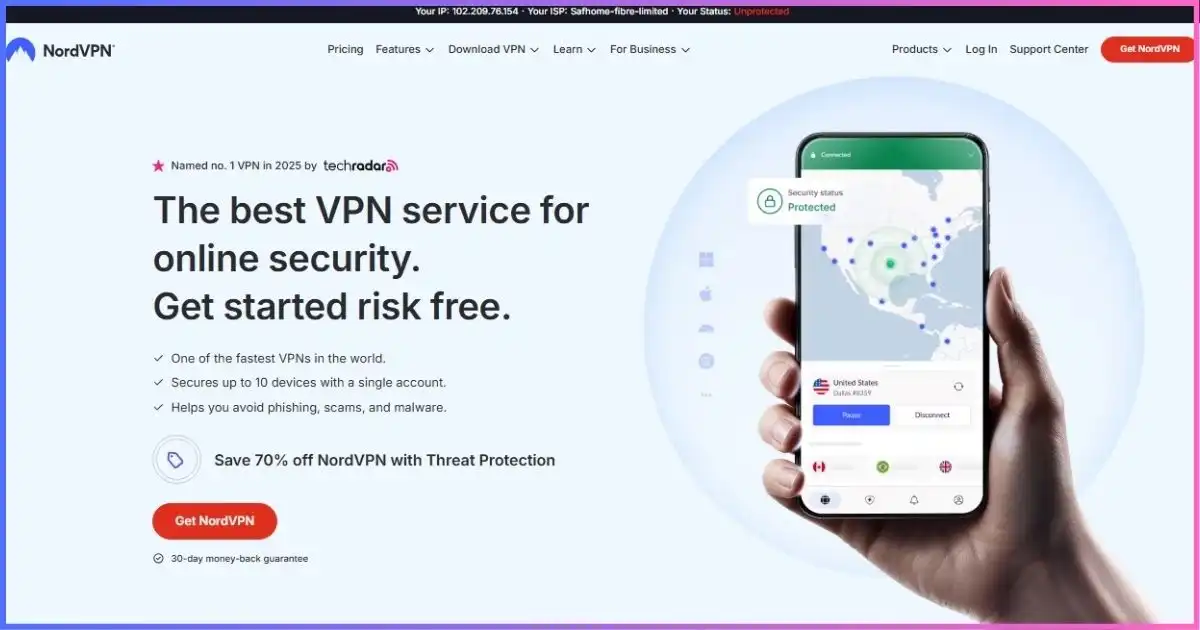
NordVPN extras
- Meshnet for private device networking
- Double VPN and Onion over VPN
- Scam, phishing, and malware protection
- Dark Web Monitor
- Dedicated IP and separate Dedicated Server options
- Encrypted cloud storage on eligible plans
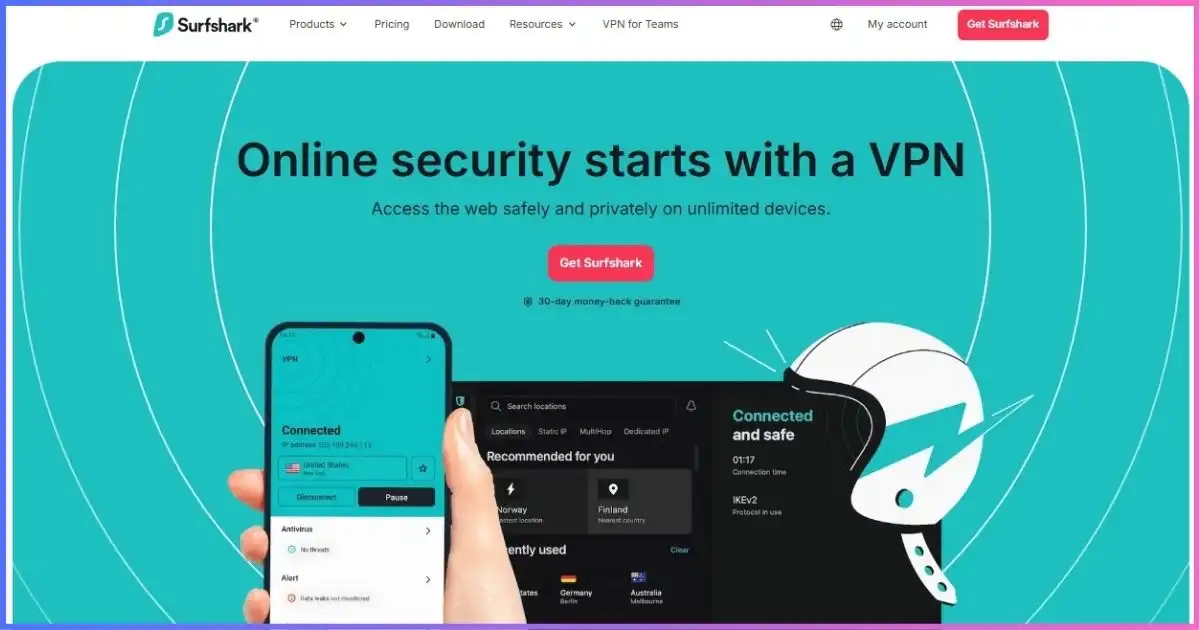
Surfshark extras
- Dynamic MultiHop with custom entry and exit
- Rotating IP every five to ten minutes
- Alternative ID on Starter
- Alert, Search, and Antivirus on One
- Incogni data-removal service on One+
- Dedicated and static IP choices
Surfshark’s Rotating IP changes the visible VPN address without changing the selected location, but it cannot run with Dedicated IP, Static IP, or MultiHop. NordVPN’s networking extras are better for remote access and specialty routing; Surfshark’s bundles are better if you also want identity masking, breach alerts, antivirus, and data-broker removal under one bill.
11. Travel and restrictive networks
NordVPN provides more mature fallback routes
Install and sign in before entering a country or network where VPN websites may be unavailable.
NordWhisper and obfuscated OpenVPN servers give NordVPN two distinct approaches when normal traffic is blocked. Surfshark answers with NoBorders, Camouflage mode, and the emerging Dausos protocol. Dausos could narrow the gap, but its beta status and current platform restriction make NordVPN the safer recommendation today.
Travelers should download installers, note manual setup instructions, enable automatic protection on untrusted Wi-Fi, and keep a second connection method available. A VPN encrypts traffic between the device and VPN server, but it does not make a malicious login page safe or replace HTTPS. The FTC’s public Wi-Fi guidance recommends secure connections and updated devices alongside sensible account security.
VPN legality and service reliability vary by country. Check local law before travel. Our best VPN for travel guide covers pre-departure setup, roaming, and hotel-network considerations.
12. Customer support and everyday usability
Both are approachable and well documented
Live chat is useful, but accurate platform documentation matters more for unusual configurations.
Both providers offer 24/7 live chat, email/ticket support, setup guides, troubleshooting documentation, and largely consistent consumer apps. NordVPN’s documentation is especially deep around protocol compatibility and specialty products; Surfshark’s app and account model is easier for users who simply want every household device covered.
Support agents can resolve billing and basic connection problems, but they should not be treated as the final word on privacy or platform limits. Cross-check material claims against the current policy, plan page, and technical documentation. Keep the transaction receipt because store purchases may need to be handled through Apple, Google, Amazon, or another billing provider.
Which VPN should you choose?
Choose NordVPN if you…
- Want the strongest all-around feature set
- Need broad international server coverage
- Use SmartDNS on a device without a VPN app
- Want Meshnet, Onion over VPN, or mature obfuscation
- May need a separate dedicated server with port forwarding
- Prefer a longer history of repeated no-logs assurance work
Choose Surfshark if you…
- Want the lowest entry price of these two
- Need unlimited simultaneous connections
- Want split tunneling on macOS or iOS
- Prefer customizable MultiHop routes and Rotating IP
- Want Antivirus, Alternative ID, or Incogni bundles
- Value a publicly downloadable assurance report
If neither profile feels right, compare the wider field in our best VPN providers guide or see how another premium rival stacks up in ExpressVPN vs NordVPN.
NordVPN is the better VPN overall; Surfshark is the better bargain
NordVPN wins this comparison 9.4 to 9.1. Its larger live network, stronger specialty-server lineup, Meshnet, continued SmartDNS support, mature restricted-network options, and repeated independent assurance work add up to the more capable service. The 10-device allowance is generous enough for most buyers.
Surfshark remains the easy recommendation for a large household or a tighter budget. Its $67.23 introductory total, unlimited paid devices, broad Bypasser coverage, and flexible MultiHop tools deliver outstanding value. Just account for future annual renewal pricing and do not follow outdated SmartDNS instructions.
NordVPN vs Surfshark VPN FAQs
Is NordVPN better than Surfshark?
NordVPN is better overall for server coverage, specialty features, streaming setup flexibility, Meshnet, and its longer assurance history. Surfshark is better for price, unlimited devices, and broad split-tunneling support. The better choice depends on which advantages you will actually use.
Is Surfshark cheaper than NordVPN?
Yes, at the prices checked September 18, 2026. Surfshark Starter was $67.23 for 27 months, while NordVPN Basic was $94.23 for 27 months. Both are introductory prepaid offers, so compare the renewal disclosure displayed at checkout.
Which is faster, NordVPN or Surfshark?
Both can be very fast with NordLynx or WireGuard. NordVPN may be more consistent across a wider set of routes because its directory is larger, but location, ISP, device, protocol, congestion, and time of day can reverse a result. Test nearby servers during the refund window.
Which VPN is better for streaming?
NordVPN wins narrowly. Both have native apps and broad streaming support, but NordVPN also retains SmartDNS for incompatible devices. Surfshark discontinued its SmartDNS service on February 2, 2026.
Does either VPN allow port forwarding?
Neither ordinary consumer VPN service supports port forwarding, and buying a Dedicated IP does not change that. NordVPN’s separate Dedicated Server add-on supports up to 20 port-forwarding rules in limited locations; it is not included with a normal VPN plan.
Can I use NordVPN or Surfshark on every device?
Both support major desktop, mobile, television, browser, and router platforms. NordVPN permits 10 simultaneous connections. Surfshark has no simultaneous-device limit on paid subscriptions, making it easier for large households.
Do NordVPN and Surfshark keep logs?
Both state that they do not retain ordinary browsing activity, traffic content, or stored connection logs that identify what a user did through the VPN. Both have undergone independent assurance work. They still process limited account, billing, security, and product-specific data, so “no logs” should not be read as “no data whatsoever.”
Do both VPNs have a 30-day money-back guarantee?
Both advertise 30-day refund periods for eligible initial or first purchases. Renewals, add-ons, and purchases through certain app stores can be excluded or handled by the store. Canceling renewal alone may not initiate a refund.
Sources & comparison methodology
Research date: September 18, 2026. We reviewed current provider pricing/checkout disclosures, plan documentation, server directories, application support pages, protocol and feature documentation, privacy policies, transparency material, refund terms, and available independent assurance summaries. Named primary sources included Nord Security/NordVPN and Surfshark plan, support, legal, infrastructure, and audit materials; external technical context came from NIST and consumer-security context from the U.S. Federal Trade Commission.
Scoring: The overall score weights security and privacy (25%), performance and reliability (20%), server coverage and specialty infrastructure (15%), streaming and P2P capability (15%), apps and usability (10%), price and renewal value (10%), and support/transparency (5%). A feature receives credit only when its current availability and material restrictions can be identified. Price is evaluated using both the initial total and known renewal disclosure—not the advertised monthly equivalent alone.
Limits: VPN performance and streaming access vary by route, device, network, location, and date. Server totals may change daily, and providers may count physical, virtual, city-level, and specialty capacity differently. Scores are comparative editorial judgments, not guarantees. We did not treat affiliate compensation as a scoring criterion.
Affiliate disclosure: We may earn a commission if you purchase through the provider buttons on this page, at no additional cost to you. This helps fund our research. It does not change our rankings, and Surfshark remains the recommended choice where its lower cost, unlimited devices, or broader split tunneling is the better fit.