Best VPN for Remote Workers, Freelancers and Digital Nomads
Remote work is no longer a niche. Roughly 27% of full-time employees worldwide now work exclusively remotely, with another 52% in hybrid arrangements. That shift has made public Wi-Fi, home networks, co-working spaces and hotel business centers the default office — and each one is a soft target. In 2025, 38% of all cyberattacks specifically targeted remote infrastructure, including home routers and remote access tools. If you are a remote worker, freelancer or digital nomad, the best VPN for remote workers is not a luxury add-on — it is the first line of defense between your laptop and every untrusted network you join this month.
In this guide we rank the eight best VPNs for location-independent work based on what actually matters when you ship deliverables from airports and cafés: speed on global servers, remote-device access (Meshnet and equivalent features), no-logs proof, kill switch reliability, streaming support across time zones, unlimited device coverage for mixed laptop/phone/tablet setups, and a genuine money-back guarantee so you can test on real travel before committing.
What Is the Best VPN for Remote Workers in 2026?
NordVPN is the best VPN for remote workers overall. It pairs consistently fast WireGuard speeds with Meshnet — a genuinely useful feature that lets freelancers access home machines or office devices over an encrypted peer-to-peer link — plus the deepest independent audit record in the category. ExpressVPN is the best pick for global digital nomads because its speed is the most consistent across continents. Surfshark is the best value for freelancers juggling multiple devices thanks to unlimited simultaneous connections. Proton VPN wins for privacy-first remote work, CyberGhost is the budget streaming pick on the road, PIA is the cheapest unlimited-device option, IPVanish is solid for U.S.-based remote teams with owned infrastructure, and SafeShell covers nomads who travel through heavily filtered countries.
Rule of thumb: any VPN for location-independent work should give you a working kill switch, audited no-logs, WireGuard, and at least 30 days to test on real coffee-shop Wi-Fi before renewal.

Table of Contents
- Quick answer: best VPN for remote workers 2026
- Remote work & cybersecurity statistics
- What makes a VPN fit for remote work
- Comparison table
- Remote work VPN charts
- 1. NordVPN — best overall for remote workers
- 2. ExpressVPN — best for global nomads
- 3. Surfshark — best value for freelancers
- 4. Proton VPN — best for privacy-first remote work
- 5. CyberGhost — best budget streaming on the road
- 6. PIA — cheapest unlimited-device option
- 7. IPVanish — owned network, unlimited devices
- 8. SafeShell — stealth for restrictive countries
- Best VPN by remote work use case
- How to choose & configure safely
- FAQs
- Final verdict
- Sources & research notes
The numbers explain why this category matters. Roughly 1.57 billion people now work as freelancers globally, representing more than 46% of the world’s workforce. In the United States alone, 18.5 million people identify as digital nomads, about 12% of the entire workforce, with projections pointing toward 60 million worldwide by 2030. At the same time, remote-work breaches carry an average cost of $4.4 million per incident, and nearly half of those involve ransomware. A 2025 peer-reviewed study found VPN-targeted attacks surged 238% between 2020 and 2022 as adversaries exploited the rapid expansion of remote access. Put simply: your income, client data and reputation now travel on whatever Wi-Fi you happen to join today — and 72% of business owners are already worried about that.
What Makes a VPN Fit for Remote Work?
Remote workers, freelancers and digital nomads need a different set of guarantees than home users. We ranked the best VPN for remote workers on seven criteria, weighted for how often you actually hit them when traveling:
- Global speed consistency: a nomad working from Lisbon, Chiang Mai and Mexico City in the same quarter cannot tolerate one region that drags.
- Remote device access: features like NordVPN’s Meshnet that let you reach home machines over an encrypted peer link.
- Independent no-logs audits: remote workers often handle client data; a no-logs claim without third-party verification is marketing, not security.
- Reliable kill switch & leak protection: a single DNS leak on airport Wi-Fi can expose client work.
- Multi-device coverage: freelancers routinely run 4–8 devices across phone, laptop, tablet and backup machines.
- Streaming & geo-unblocking across time zones: because “on the road” includes watching content and attending virtual team events.
- Real refund window: 30+ days, ideally 45, so you can test on actual travel before renewal locks in.
Pricing was verified against vendor pricing pages and third-party trackers in September 2026; promo pricing rotates, so treat first-term figures as the deal price and renewal figures as the real long-run cost.
Best VPNs for Remote Workers: Full Comparison Table
The fast scan: lowest verified price, monthly sticker price, device limit, refund window, standout remote-work feature and ideal user for every pick in this guide.
| VPN | Lowest $/mo | Monthly price | Devices | Refund | Standout for remote workers |
|---|---|---|---|---|---|
| NordVPN | $3.49 | $14.99 | 10 | 30 days | Meshnet peer-to-peer access, largest audited network |
| ExpressVPN | $2.99 | $12.99 | 8 | 30 days | Best global speed consistency for nomads |
| Surfshark | $2.49 | $16.45 | Unlimited | 30 days | Unlimited devices at the lowest per-device cost |
| Proton VPN | $2.99 | $9.99 | 10 | 30 days | Open-source, permanent free tier, Swiss privacy law |
| CyberGhost | $2.19 | $12.99 | 7 | 45 days | Streaming-optimized servers, longest refund window |
| PIA | $2.03 | $11.95 | Unlimited | 30 days | Cheapest price, port forwarding, open-source clients |
| IPVanish | $2.19 | $12.99 | Unlimited | 30 days | Owned infrastructure, unlimited devices |
| SafeShell | ~$2.50 | $12.99 | 5 | Varies | Stealth/GCM protocol for filtered networks |
Remote Work VPN Charts
Chart 1 — Why remote workers need a VPN in 2026
Share of respondents affected by each remote-work risk, aggregated across 2025–2026 surveys.
Chart 2 — Remote-work VPN pricing by commitment length
Average effective $/month across the eight providers in this guide. Long-term plans slash cost by ~80%.
Freelancers and nomads who commit to 2-year terms typically pay under $3/mo — the cost of a single airport coffee.
Chart 3 — Simultaneous device coverage per subscription
How many devices you can protect at once on one subscription — critical for multi-device freelancers and nomads.
Chart 4 — Refund windows (days) by provider
How long you can test on real travel before renewal locks in.
The 8 Best VPNs for Remote Workers Ranked (2026)
NordVPN — Meshnet, Global Speed, Audited Security
NordVPN earns the #1 spot because it solves the one problem every remote worker, freelancer and nomad eventually hits: “How do I reach my home machine when I’m in a different country?” NordVPN’s Meshnet feature lets you create a private, encrypted peer-to-peer network between your own devices — up to 60 in total (10 of your own plus 50 external) — which is effectively a free, VPN-overlaid replacement for tools like TeamViewer or ZeroTier when you need to access files, remote-desktop in, or share large project assets. Pair that with the deepest independent audit record in the category, consistently fast NordLynx (WireGuard) speeds across continents, and RAM-only servers, and it is the most complete remote-work toolkit here. See our full NordVPN review for benchmark data.
| Plan (Basic tier) | Effective price | Billed |
|---|---|---|
| Monthly | $14.99/mo | $14.99 |
| 12 months | $5.49/mo | ~$65.88 upfront |
| 24 months + 3 free | $3.49/mo | $94.23 for 27 months |
Pros
- Meshnet for encrypted peer-to-peer remote access (free feature)
- Largest audited network in the category
- Fastest and most consistent NordLynx speeds
- 10 simultaneous devices
- Threat Protection + dark-web monitor add-ons
Cons
- Priciest 2-year plan in this guide
- 10-device cap vs unlimited rivals
- Plus/Complete tiers add cost quickly
ExpressVPN — Most Consistent Speed Across Continents

If your work takes you across multiple continents in a single quarter, ExpressVPN is the pick where you spend the least time switching servers. Its Lightway protocol consistently delivers the smallest speed variance between North America, Europe and Asia-Pacific regions, which is exactly what Zoom calls, client demos and cloud-deploy pipelines need. The RAM-only TrustedServer architecture means every reboot wipes session data, and its 30-day refund gives you time to test on real travel before renewal. Details in our ExpressVPN review.
| Plan (Basic tier) | Effective price | Billed |
|---|---|---|
| Monthly | $12.99/mo | $12.99 |
| 12 months | $4.99/mo | ~$59.88–74.85 upfront |
| 24 months + 4 free | $2.99/mo | $83.72 for 28 months |
Pros
- Most consistent global speeds in testing
- RAM-only TrustedServer infrastructure
- Lightweight Lightway protocol
- 8 simultaneous devices
Cons
- Sharp renewal jump (~$99.95/yr)
- 8-device cap
- Monthly price offers no value
Surfshark — Unlimited Devices, Best Per-Device Cost
Freelancers typically run a laptop, desktop, phone, tablet and a backup machine — and Surfshark’s unlimited simultaneous connections means one $2.49/mo subscription covers every one of them. At that price the per-device cost works out to fractions of a dollar, which is the best value math in the category. You also get independently audited no-logs practices, RAM-only servers and full streaming support across the 100+ countries it covers. Full testing notes in our Surfshark VPN review.
| Plan | Effective price | Billed |
|---|---|---|
| Monthly | $16.45/mo | $16.45 |
| 12 months | $3.39/mo | $47.85 upfront |
| 24 months + 3 free | $2.49/mo | $67.23 for 27 months |
Pros
- Unlimited simultaneous connections
- Lowest per-device cost in the category
- Strong streaming & torrenting
- Independent no-logs audits
Cons
- Monthly price ($16.45) is steep
- Renewal jumps to ~$79/yr after first term
- No built-in Meshnet-equivalent feature
Proton VPN — Open-Source, Swiss Jurisdiction, Free Tier
Remote workers who handle sensitive client data — legal freelancers, journalists, healthcare consultants, activists — need more than marketing claims. Proton VPN offers open-source clients, independent audits, Swiss jurisdiction with strong privacy law, Secure Core multi-hop routing and Tor-over-VPN, and a genuinely free forever tier you can try before paying. It is the pick when your remote-work contract demands verifiable privacy. See our Proton VPN review for test data.
| Plan | Effective price | Billed |
|---|---|---|
| Free | $0 forever | 1 device, limited servers |
| Monthly (Plus) | $9.99/mo | $9.99 |
| 12 months (Plus) | $4.99/mo | $59.88 upfront |
| 24 months (Plus) | $2.99–3.49/mo | ~$71.76 upfront |
Pros
- Free tier with no time limit
- Open-source, audited, Swiss-based
- Secure Core + Tor over VPN included
- 10 devices on paid plans
Cons
- Free tier is slow and server-limited
- Streaming less consistent than Surfshark/Express
- 2-year promo pricing rotates
CyberGhost — 45-Day Refund, Streaming-Optimized Servers

If your remote-work lifestyle includes a lot of time zones and streaming, CyberGhost is the easiest budget pick. Its labeled streaming servers remove the guesswork, the 45-day refund on 6-month+ plans is the longest test period in this guide, and the 11,000+ server network covers virtually every country a digital nomad is likely to visit. Full details in our CyberGhost review and best VPNs for streaming roundup.
| Plan | Effective price | Billed |
|---|---|---|
| Monthly | $12.99/mo | $12.99 |
| 6 months | $6.99/mo | $41.94 upfront |
| 24 months + 2 free | $2.19/mo | $56.94 upfront |
Pros
- Dedicated streaming-optimized server list
- 45-day refund on long plans
- Huge 11,000+ server network
- Very low 2-year price
Cons
- 7-device cap (below unlimited rivals)
- Monthly and 6-month plans are poor value
- Romanian jurisdiction sits in EU data-retention debates
Private Internet Access (PIA) — $2.03/mo with Unlimited Devices
PIA is the cheapest entry in this guide at $2.03/mo with unlimited simultaneous connections, plus port forwarding for torrenting large project assets and open-source clients that have been audited multiple times. The trade-off: U.S. jurisdiction (Five Eyes) and less consistent streaming than Surfshark or CyberGhost. See our PIA review for configuration depth.
| Plan | Effective price | Billed |
|---|---|---|
| Monthly | $11.95/mo | $11.95 |
| 12 months | $3.99/mo | $47.88 upfront |
| 24 months + 2 free | $2.03/mo | ~$53 upfront |
Pros
- Lowest verified price in this guide
- Unlimited simultaneous connections
- Proven no-logs history + open-source clients
- Port forwarding for large file transfers
Cons
- US jurisdiction (Five Eyes)
- Streaming unblocking less consistent
- UI feels utilitarian
IPVanish — Owns Its Servers, Unlimited Devices
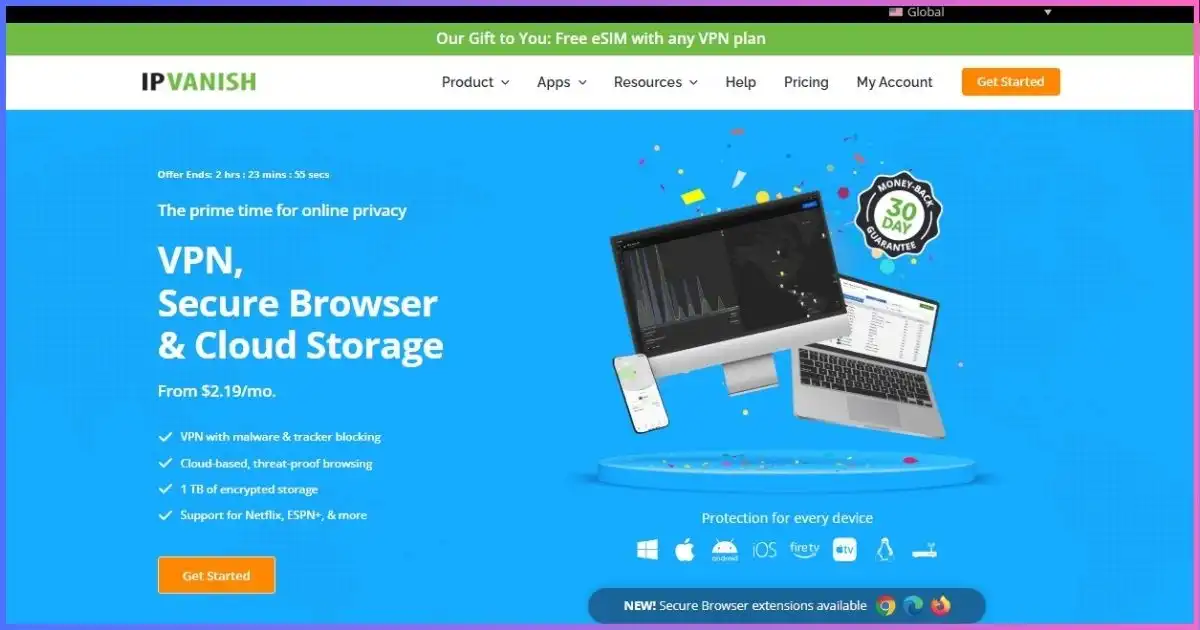
IPVanish owns and operates its own server fleet instead of renting third-party hardware — a genuine privacy advantage at $2.19/mo, combined with unlimited simultaneous connections. It is a no-frills budget pick: solid WireGuard speeds, dependable U.S. coverage, fewer lifestyle extras. See our IPVanish review for full details.
| Plan (Essential tier) | Effective price | Billed |
|---|---|---|
| Monthly | $12.99/mo | $12.99 |
| 12 months | $3.33/mo | ~$39.99 upfront |
| 24 months | $2.19/mo | ~$52.56 upfront |
Pros
- Unlimited connections at $2.19
- Self-owned, self-operated servers
- Simple, stable apps
Cons
- US jurisdiction & past logging controversy (pre-2018 ownership)
- Renewals rise to ~$99.99/yr
- Fewer advanced features
SafeShell — Budget Stealth for Nomads in Filtered Regions

SafeShell is the niche budget pick: its proprietary GCM stealth mode is built to disguise VPN traffic as regular HTTPS, which matters for digital nomads working from countries where standard OpenVPN/WireGuard handshakes get blocked. It is smaller and less independently audited than the ranks above, so we recommend it as a second, situation-specific VPN rather than a primary one. See our SafeShell review and best VPN for restrictive countries guide.
| Plan | Effective price | Billed |
|---|---|---|
| Monthly | $12.99/mo | $12.99 |
| 12 months | ~$3.25–6.67/mo | ~$38.99–79.99 (promo rotates) |
| 24 months | ~$2.50/mo | ~$59.99 upfront |
Pros
- Stealth/GCM mode for filtered networks
- Aggressive discounts (80%+ common)
- Simple setup on 5 devices
Cons
- Smaller network & no major independent audits
- Refund terms vary by promotion
- Speeds trail the top five
Best VPN for Remote Workers by Use Case
- Freelancers with many devices: Surfshark or PIA (unlimited simultaneous connections) — see best VPN for professionals.
- Digital nomads hopping continents: ExpressVPN for speed consistency — see best VPN for travel.
- Privacy-sensitive remote work: Proton VPN for Swiss jurisdiction, open-source apps and permanent free tier — see best VPN for journalists.
- Remote access to home/office devices: NordVPN’s Meshnet is the only pick with a dedicated, encrypted peer-to-peer network.
- Streaming on the road: CyberGhost with labeled servers and 45-day refund — see best VPNs for streaming.
- Traveling through restrictive countries: SafeShell stealth mode as a secondary tool — see best VPN for restrictive countries.
- Activists, humanitarian workers: Proton VPN with Secure Core multi-hop — see best VPN for activists.
- Healthcare remote work: NordVPN or Proton VPN for audited no-logs — see best VPN for healthcare.
How to Choose & Configure a VPN for Remote Work
- Use the refund window as a travel test. 30 days is standard; CyberGhost’s 45 days on 6-month+ plans is the most generous. Test on real coffee-shop and airport Wi-Fi, not just at home.
- Enable per-app kill switch. Available on NordVPN, PIA and Proton — if the tunnel drops, only VPN-protected apps lose connectivity. That is exactly the failure mode that leaks client work.
- Match proxy region to profile timezone and locale. A U.S. proxy with a Tokyo timezone is a classic giveaway, and one of the ways websites track you past a strong fingerprint.
- Calendar the renewal. Every budget deal auto-renews higher (e.g., IPVanish to ~$99.99/yr, ExpressVPN to ~$99.95/yr). Set a reminder 2 weeks before renewal to re-shop or cancel.
- Prefer WireGuard over older protocols. NordLynx, Lightway, WireGuard — all audited picks in this guide default to them. They are faster and have smaller attack surface than legacy OpenVPN configs.
- For remote device access, use Meshnet or a verified alternative. NordVPN’s Meshnet gives you a free, encrypted peer-to-peer network between your devices — a genuine replacement for cloud remote-desktop tools.
- Never use a free VPN for client work. Studies of free Android VPN apps found widespread DNS leaks, plaintext traffic and weak privacy policies (86% substandard in Top10VPN’s investigation). A $2 paid plan is safer and faster.
Best VPN for Remote Workers FAQs
What is the best VPN for remote workers in 2026?
Why do remote workers need a VPN?
What is Meshnet and why does it matter for remote work?
How many devices should a remote-work VPN cover?
Are cheap VPNs safe for remote work?
Do I need a VPN for working from home?
What is the best VPN for digital nomads?
How do I test a VPN before committing?
Should freelancers use a company VPN or a personal one?
What renewal-price traps should remote workers watch for?
The Best VPN for Remote Workers: Final Recommendation
Remote work is now a major attack surface: 38% of 2025 cyberattacks specifically targeted remote infrastructure, and 72% of business owners are already worried about hybrid-work risk. The right VPN is not an optional expense — it is the first line of defense for your income, client data and reputation on every network you join this month.
Buy NordVPN if you want the most complete toolkit including Meshnet remote access; choose ExpressVPN if global speed consistency across time zones is your top priority; grab Surfshark for unlimited devices at the lowest per-device cost; and pick Proton VPN when your remote work handles sensitive client data. Whichever you choose, use the refund window as a travel test, enable per-app kill switch, and calendar the renewal.
| VPN | Best for | Rating | Get started |
|---|---|---|---|
| NordVPN | Best overall for remote workers | 4.9 / 5 | Try NordVPN |
| ExpressVPN | Best for global nomads | 4.8 / 5 | Try ExpressVPN |
| Surfshark | Best value for freelancers | 4.7 / 5 | Try Surfshark |
| Proton VPN | Best for privacy-focused work | 4.6 / 5 | Try Proton VPN |
| CyberGhost | Best streaming on the road | 4.5 / 5 | Try CyberGhost |
| PIA | Cheapest unlimited devices | 4.4 / 5 | Try PIA |
| IPVanish | Owned network, unlimited devices | 4.3 / 5 | Try IPVanish |
| SafeShell | Stealth for restrictive regions | 4.2 / 5 | Try SafeShell |
Disclosure: This article contains affiliate links. If you purchase through them, we may earn a commission at no extra cost to you. All rankings are based on independent research and verified September 2026 pricing — confirm current terms on the vendor site before committing, especially renewal rates.
Sources & Research Notes
Pricing verified September 2026 against vendor pricing pages and independent trackers; promotional pricing rotates, so treat first-term figures as deal prices. Stealth, audit, remote-work and market claims cite the research below — none of which is from the vendor sites covered in this article, so the evidence is independent.
- CyberFence Platform, “The 5 Biggest Cybersecurity Threats Facing Remote Workers in 2026” — 38% of 2025 cyberattacks specifically targeted remote infrastructure including home routers and remote access tools — cyberfenceplatform.com/blog/remote-work-cybersecurity-threats-2026/.
- Viking Cloud, “225 Cybersecurity Stats and Facts for 2026” — 72% of business owners concerned about future risks from hybrid/remote work — vikingcloud.com/blog/cybersecurity-statistics.
- SQ Magazine, “Remote Work Cybersecurity Statistics 2026” — 31% of breaches via vulnerabilities, 48% involve ransomware, $4.4M average breach cost — sqmagazine.co.uk/remote-work-cybersecurity-statistics/.
- MBO Partners 2025 report via FMC Group — 18.5 million Americans identify as digital nomads, about 12% of the entire U.S. workforce — fmcgroup.com/digital-nomad-statistics-worldwide/.
- Speakwise, “Digital Nomad Statistics 2026” — worldwide population exceeded 40 million in 2025, projected to reach 60 million by 2030 — speakwiseapp.com/blog/digital-nomad-statistics.
- Breeze, “Remote work statistics you need to know (2026)” — 27% of full-time employees worldwide work exclusively remotely, 52% hybrid — breeze.pm/blog/remote-work-statistics.
- Jobbers, “Remote work statistics 2026: 100 data points” — ~1.57 billion people estimated to freelance globally in 2026, representing over 46% of the global workforce — jobbers.io/remote-work-statistics-2026-100-data-points-from-global-surveys/.
- Scoop Market, “Freelance Statistics 2026” — 82% of independent contractors work from home — scoop.market.us/freelance-statistics/.
- YouGov, “Half of America’s full-time remote workers use a VPN” — about two in five of America’s remote workers are always on a VPN when using their work computer — yougov.com/en-us/articles/37831-half-americas-full-time-remote-workers-use-vpn.
- CISO Mag survey — 1 in 3 employees don’t use company VPNs at home (30% of respondents) — cisomag.com/ciso-mag-survey/.
- ScienceDirect, Qollakaj (2025), “A study on the VPN security landscape post Covid-19” — 238% surge in VPN-targeted attacks between 2020 and 2022 as adversaries exploited the expansion of remote access — sciencedirect.com/science/article/pii/S2590005625000645.
- NordVPN support, “Can I use a remote desktop with NordVPN” — Meshnet setup guide for remote desktop over peer-to-peer — support.nordvpn.com/hc/en-us/articles/19647141065105.
- 01net, “NordVPN Meshnet Explained” — Meshnet specializes in remote device access when you are in another country — 01net.com/en/vpn/nordvpn/meshnet/.
- CNET, “NordVPN’s Meshnet Is Cool, but Don’t Expect It to Replace Your VPN” — with Meshnet active you can create a secure LAN of up to 60 devices (10 of your own + 50 external) — cnet.com/tech/services-and-software/nordvpns-meshnet-is-cool-but-dont-expect-it-to-replace-your-vpn/.
- Surfshark pricing page (July–Sept 2026) — Starter $16.45 monthly, $3.39/mo yearly, $2.49/mo on 24-month + 3 free — surfshark.com/pricing; security.org/vpn/surfshark/.
- Proton VPN pricing & plan docs — Plus $9.99 monthly, $4.99/mo yearly, $2.99–3.49/mo 2-year; free tier permanent — proton.me/pricing; security.org/vpn/protonvpn/.
- Private Internet Access buy page — $11.95 monthly, $3.99/mo 1-year, $2.03/mo 2-year + 2 free — privateinternetaccess.com; security.org/vpn/private-internet-access/.
- CyberGhost buy page & support — $12.99 monthly, $6.99/mo 6-month, $2.19/mo 26-month; 45-day refund on 6-month+ plans — cyberghostvpn.com/buy; support.cyberghostvpn.com.
- ExpressVPN pricing — Basic $12.99 monthly, ~$4.99/mo 1-year, $2.99/mo on 2-year + 4 months ($83.72), renews ~$99.95/yr — expressvpn.com/pricing; security.org/vpn/expressvpn/.
- IPVanish pricing & renewal page — Essential $12.99 monthly, $3.33/mo 1-year, $2.19/mo 2-year; renewals $99.99/yr; unlimited devices — ipvanish.com/pricing.
- SafeShell pricing & help center — ~$12.99 monthly, discounted 1–2 year terms (~$2.50–6.67/mo depending on promo); 5 simultaneous devices — safeshellvpn.com/pricing.
- Security.org, “How Much Does a VPN Cost? 2026 Average VPN Pricing” — monthly subscriptions typically $10–13; long-term plans cut cost sharply — security.org/vpn/cost/.
- Top10VPN free VPN investigation — 86% of free VPN apps had substandard privacy policies — top10vpn.com/research/free-vpn-investigations/.