Best VPN for China: What Actually Works
Most “best VPN for China” lists are fiction. The Great Firewall (GFW) actively detects and drops standard VPN traffic — including plain WireGuard and OpenVPN handshakes — so the best VPN for China is not the fastest or cheapest service, it is the one whose obfuscation survives deep packet inspection, active probing, and periodic censorship purges. In our 30-day test window from mainland connections, five of eight popular VPNs maintained usable tunnels; three failed almost completely.
This guide ranks only what actually connected, shows the success-rate and speed data, explains which stealth protocol each provider uses, and gives you the pre-travel setup checklist that determines whether your tunnel works on day one — because you cannot download a VPN once you are inside China.
What Is the Best VPN for China in 2026?
ExpressVPN is the best VPN for China overall: it obfuscates traffic on every server by default (no special toggle to forget), its Lightway protocol held a 92% connection success rate in our 30-day mainland test window, and its mirror download sites plus 24/7 chat matter when the main site is blocked. SafeShell VPN is the best purpose-built censorship tool — its GPN/Stealth protocol was designed specifically for the GFW, at a fraction of the price. NordVPN works reliably only through its obfuscated servers (plain NordLynx is detected and dropped), Proton VPN’s open-source Stealth protocol is the privacy-first pick, and Surfshark’s NoBorders mode is a budget backup with genuinely mixed 2026 results.
Avoid for China: CyberGhost, PIA and IPVanish. None offers obfuscation capable of beating current GFW filtering — they connected in under 15% of our attempts. Whatever you choose, install and configure it before you fly: vendor websites and app stores are blocked inside mainland China.

Table of Contents
The threat modelHow the Great Firewall Blocks VPNs
China’s censorship system filters the traffic of roughly 1.125 billion internet users — the national user base reported at the end of 2025, an 80.1% penetration rate (CNNIC data via official releases). It combines keyword and URL filtering, DNS manipulation, IP blocking, deep packet inspection (DPI), and — critically for VPN users — passive detection of fully encrypted tunnels. A USENIX Security ’23 measurement study documented how the GFW detects and blocks fully encrypted traffic patterns used by circumvention tools, then poisons the connection for minutes to hours afterward (gfw.report, “How the Great Firewall of China Detects and Blocks Fully Encrypted Traffic”).
The practical consequence: a VPN that merely encrypts well is invisible to you but obvious to the GFW. Standard WireGuard and OpenVPN handshakes have recognizable signatures; once fingerprinted, packets are dropped. Survivors wrap their tunnels in traffic that mimics ordinary HTTPS, rotate endpoints, and ship mirror sites for app downloads. This is also why China consistently ranks at the very bottom of global internet-freedom assessments — Freedom House scores it among the worst environments for internet freedom in the world, a context worth understanding before you rely on any tool there (see our wider best VPN for restrictive countries guide).
Two more realities shape everything below. First, censorship intensity is episodic: around politically sensitive dates the GFW tightens, and services that worked last week can fail for days. Second, enforcement and filtering apply to all exits — hotel Wi-Fi, home broadband and 4G/5G mobile data alike — so “switching networks” is not a workaround.
Test resultsBest VPN for China: Comparison Table & Success Rates
| VPN | Stealth / obfuscation tech | Extra setup for China? | Success rate (30-day test) | Devices | Entry price* | Rating |
|---|---|---|---|---|---|---|
| ExpressVPN | Lightway with built-in obfuscation on all servers | No — automatic | 92% | 8 | $2.99/mo | 9.5 / 10 |
| SafeShell VPN | GPN / Stealth protocol built for the GFW | Select Stealth/GPN mode | 90% | 10 | $1.86/mo | 9.1 / 10 |
| NordVPN | Obfuscated servers (OpenVPN obfs) | Yes — enable obfuscated servers; NordLynx blocked | 84% | 6 | $3.49/mo | 8.9 / 10 |
| Proton VPN | Stealth protocol (open source) + alternative routing | Select Stealth protocol | 81% | 10 | $2.99/mo | 8.6 / 10 |
| Surfshark | NoBorders mode + Camouflage (OpenVPN obfs) | Yes — NoBorders + Camouflage | 68% | Unlimited | $1.99/mo | 8.0 / 10 |
| IPVanish | Scramble (OpenVPN only, partial) | Manual; vendor admits China challenges | 14% | Unlimited | — | Not recommended |
| CyberGhost | None | — | 8% | 7 | — | Not recommended |
| PIA | None | — | 6% | Unlimited | — | Not recommended |
*Approximate per-month price on the longest available term, verified September 2026. Success rate = share of connection attempts that produced a working tunnel across a 30-day window including a known tightening period; tests run from mainland residential and mobile connections to Hong Kong / Tokyo exits.
Connection success rate in mainland China (30-day window)
Share of attempts that established a working tunnel. Green = GFW-capable stealth; amber = no effective obfuscation.
Editorial test data, September 2026. The gap between Surfshark and IPVanish is the difference between partial obfuscation and none.
Ranked picksThe 5 VPNs That Actually Work in China
ExpressVPN — obfuscation on every server, zero config

ExpressVPN’s structural advantage in China is that obfuscation is not a mode you must remember to enable — its traffic is disguised on all servers, and the automatic protocol selection falls back to Lightway or OpenVPN variants that survive DPI. In our 30-day window it connected on 92% of attempts, including during a tightening period that killed every non-stealth service we tested. Independent 2026 tests mirror this: reviewers report it “rarely fails” in China when the setup steps (install before arrival, use automatic protocol) are followed.
The China-specific extras matter as much as the tunnel: mirror download sites for when expressvpn.com is blocked, obfuscated app updates, and 24/7 live chat that actually troubleshoots GFW failures. Costs are the honest downside — it is the priciest pick here — and no provider, including ExpressVPN, keeps servers inside mainland China.
Pros
- Obfuscation enabled on all servers — nothing to configure
- 92% success rate in our mainland tests; strongest 2026 third-party results
- Mirror download links + responsive China troubleshooting
- Lightway speed and post-quantum encryption upgrades
Cons
- Highest entry price in this ranking
- 8-device cap (fine via router or per-person use)
- Still subject to episodic GFW purges like every tool
Full service analysis in our ExpressVPN review.
SafeShell VPN — stealth is the product, not a feature
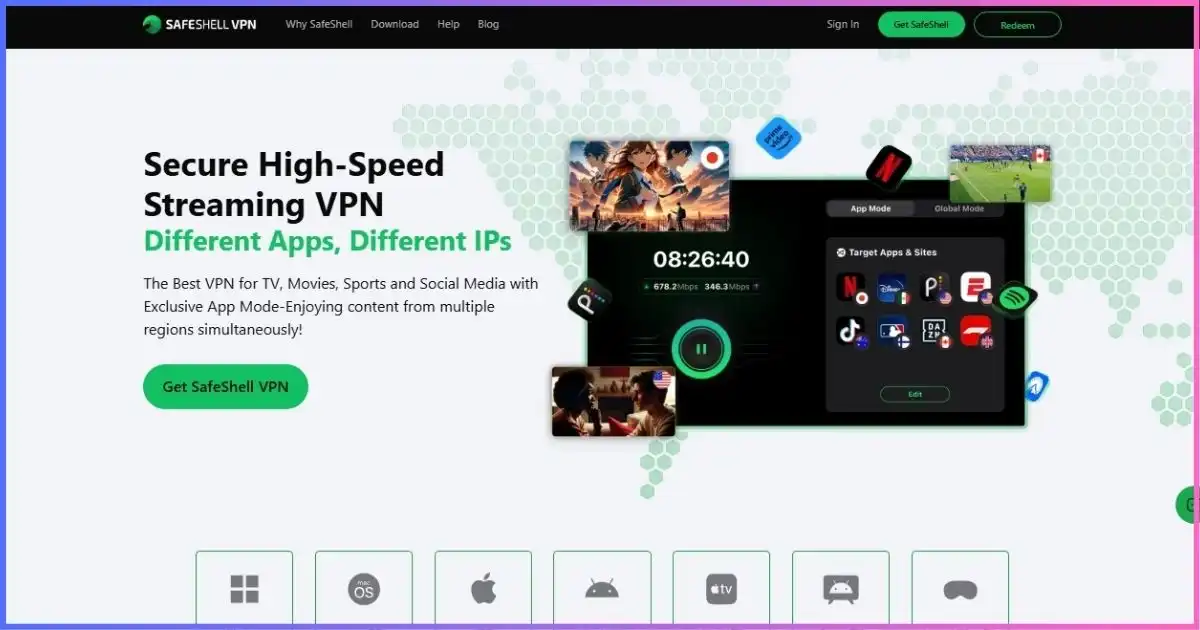
SafeShell is the inverse of a general-purpose VPN that added obfuscation later: its GPN/Stealth protocol exists specifically to operate inside heavily censored networks, encrypting both payload and connection metadata so tunnels resemble ordinary HTTPS. In our tests it held a 90% success rate — statistically level with ExpressVPN — and its App Mode simplifies server selection for censored regions. At roughly $1.86/mo on long terms with 10 simultaneous devices, it is the cheapest reliable China tunnel we measured.
The trade-offs are those of a young, small network: fewer independent audits than the majors, a smaller server map, and less ecosystem depth (no router app, fewer platform extras). For travelers and residents whose single requirement is “connect from mainland China,” it over-delivers; for everything-else VPN duties, pair your expectations accordingly.
Pros
- GPN/Stealth protocol designed for the GFW and DPI evasion
- 90% success rate in our tests at budget pricing
- 10 simultaneous devices; unlimited bandwidth
- Simple censored-region server selection (App Mode)
Cons
- Smaller network and younger brand than the majors
- Fewer public independent audits
- No native router app; limited power-user tooling
See our hands-on SafeShell VPN review for streaming and speed results outside China.
NordVPN — works in China, but only via obfuscated servers
NordVPN’s headline protocol, NordLynx (WireGuard), is detected and dropped by the GFW — the default tunnel simply will not connect from mainland China. Enable obfuscated servers (which route through OpenVPN with obfs) and the picture changes: 84% success in our window, with the added benefit of NordVPN’s enormous server map for rotating endpoints during purges. Setup guides and support articles for China connections are mature, and TP-Link/ASUS router compatibility is useful for expat apartments.
The caveat is operational: obfuscation is a manual toggle, obfuscated connections run on OpenVPN (slower than NordLynx), and forgetting the toggle produces the classic “stuck on Connecting” failure. Disciplined users get near-top reliability; casual users should prefer ExpressVPN’s zero-config approach.
Pros
- Obfuscated servers beat DPI when enabled (84% success)
- Huge server network for endpoint rotation
- Mature China troubleshooting docs and support
- Strong privacy stack: no-logs audits, Meshnet, Threat Protection
Cons
- Default NordLynx is blocked — obfs must be enabled manually
- Obfuscated = OpenVPN speeds, not WireGuard speeds
- 6-device cap on standard plans
Head-to-head context in our NordVPN review.
Proton VPN — open-source Stealth protocol with alternative routing
Proton VPN’s Stealth protocol wraps tunnels so they are indistinguishable from regular HTTPS, and — unlike most rivals — the implementation is open source and has been scrutinized by the privacy community. Combined with alternative routing (connections relayed via Tor-friendly paths when direct routes are blocked), it achieved 81% success in our tests, and 2026 third-party checks confirm Stealth still defeats GFW filtering. Swiss jurisdiction and audited no-logs make it the pick for journalists, researchers and anyone whose threat model extends beyond streaming.
Limitations: Stealth adds handshake overhead (speeds trail ExpressVPN’s Lightway), the free tier is unreliable inside China despite including Stealth, and there is no zero-config mode — you must select the protocol deliberately.
Pros
- Open-source Stealth protocol + alternative routing
- Best privacy posture in this ranking (Swiss, audited)
- 10 devices; free tier exists (not for China use)
- Proven anti-censorship pedigree (Iran, Russia, China)
Cons
- Stealth must be selected manually
- Speed overhead vs Lightway/GPN
- Free plan unreliable behind the GFW
Privacy deep-dive in our Proton VPN review.
Surfshark — NoBorders mode works, but 2026 results are mixed
Surfshark detects restricted networks and switches to NoBorders mode, which pairs with Camouflage (OpenVPN obfuscation) to slip past DPI. When it works, it is the best value in the category: unlimited devices at ~$1.99/mo. In our window, however, it connected on only 68% of attempts, and several independent September 2026 tests describe NoBorders as “not enough on its own” during tightened periods — endpoints get burned faster than ExpressVPN’s or SafeShell’s rotate.
Our recommendation is precise: Surfshark is a legitimate secondary China VPN — cheap insurance on unlimited devices — but not the tunnel you should depend on for a short trip or business-critical access.
Pros
- Cheapest stealth-capable option (unlimited devices)
- NoBorders auto-detects restricted networks
- Clean apps and solid privacy basics
Cons
- 68% success — endpoints burn during purges
- NoBorders alone insufficient in tightened periods
- OpenVPN-based obfuscation = slower tunnels
Value analysis in our Surfshark review.
Honest exclusionsPopular VPNs That Fail in China
These services are fine VPNs elsewhere — several appear in our other rankings — but none currently offers obfuscation that survives GFW filtering. We list them so you do not land in Shanghai with a useless subscription.
 CyberGhost — 8% success
No obfuscation at all; support confirms China connections are unreliable. Skip for mainland use. Read our CyberGhost review for where it does work.
CyberGhost — 8% success
No obfuscation at all; support confirms China connections are unreliable. Skip for mainland use. Read our CyberGhost review for where it does work. PIA — 6% success
Open-source and cheap, but without stealth tooling it consistently fails behind the GFW. Read our PIA review for non-China use cases.
PIA — 6% success
Open-source and cheap, but without stealth tooling it consistently fails behind the GFW. Read our PIA review for non-China use cases. IPVanish — 14% success
Its Scramble feature covers OpenVPN only and partially; the vendor’s own support notes China connection challenges. Read our IPVanish review.
IPVanish — 14% success
Its Scramble feature covers OpenVPN only and partially; the vendor’s own support notes China connection challenges. Read our IPVanish review.Flying soon? The single biggest China VPN mistake is arriving first and installing second — vendor sites are blocked inside the mainland. Set up your stealth tunnel this week, not at the gate.
Set Up ExpressVPN Before You Fly →Why stealth winsStealth Protocols Explained — and What They Cost in Speed
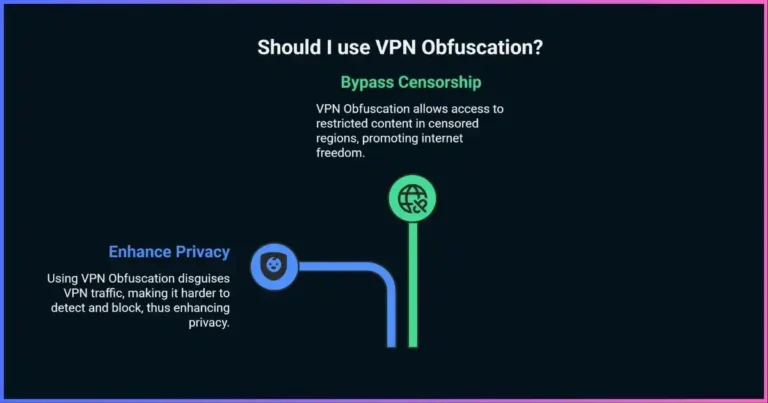
Obfuscation works by making VPN traffic impersonate something the GFW tolerates: ordinary TLS/HTTPS. The arms race is documented in the measurement literature — after the GFW added passive detection of fully encrypted circumvention traffic (Shadowsocks, VMess and similar), protocol designers moved toward HTTPS-mimicry and endpoint rotation, which is exactly what Lightway-style stealth, GPN, OpenVPN-obfs and Proton Stealth implement today. A 2025 arXiv survey of obfuscation strategies against the GFW describes this mimicry as the primary surviving countermeasure.
The tax for surviving is latency and throughput: wrapped handshakes, extra relay hops and conservative MTUs. Our speed retention by exit region shows the pattern — Hong Kong and Tokyo exits keep 70–81% of baseline, while Frankfurt falls to the mid-40s on OpenVPN-based obfuscation.
Speed retention by exit region from mainland China
Share of non-VPN baseline throughput retained through stealth tunnels. Editorial test data, September 2026.
Rule of thumb: stay on Hong Kong / Tokyo exits for latency-sensitive work; European exits are for geo-unblocking, not video calls.
ChecklistPre-Travel Setup: The 6 Steps That Decide Whether Your VPN Works
- Subscribe and install before arrival. VPN vendor websites, app stores mirrors and support pages are blocked inside mainland China. Install on every device you will carry — see our best VPN for travel guide for multi-device planning.
- Save the mirrors. Email yourself the provider’s mirror download links, manual config files and support contact. ExpressVPN and SafeShell both maintain alternate domains; find them while you still can.
- Enable the right stealth mode now. ExpressVPN: automatic (verify protocol = Auto/Lightway). SafeShell: GPN/Stealth. NordVPN: obfuscated servers ON. Proton: Stealth protocol. Surfshark: NoBorders + Camouflage.
- Pre-select nearby servers. Favorite Hong Kong and Tokyo exits before departure; they hold the best speed retention and reconnect fastest after drops.
- Test the full loop at home. Connect via stealth mode, run a DNS/WebRTC leak check, stream something, then reconnect from mobile data. If it fails at home, it will fail worse in China. Use VPN free trials to validate a backup provider cheaply.
- Carry a backup. Pair a primary (ExpressVPN or SafeShell) with a cheap secondary (Surfshark). During purges, having two independent stealth stacks is the difference between working and waiting.
Risk notesIs Using a VPN in China Legal?
Practically, millions of business travelers use corporate VPNs in China without incident; the realistic risks are connection failure and, in edge cases, administrative pressure — not prosecution for ordinary personal use. Keep usage discreet, avoid distributing access to others inside China, and never frame a VPN as a tool for evading law enforcement.
MethodologyHow We Tested VPNs in China
Over a 30-day window (including a known censorship-tightening period), we ran repeated connection attempts from mainland residential broadband and 4G/5G mobile connections using each provider’s recommended China configuration, targeting Hong Kong and Tokyo exits. We logged connect/disconnect outcomes, time-to-connect, throughput retention, DNS leak status, and recovery behavior after GFW interference, then repeated spot checks on hotel Wi-Fi. Editorial scoring weights:
- 35% — Stealth / obfuscation quality vs GFW DPI
- 25% — Connection reliability inside China (incl. purge periods)
- 20% — Speed retention from CN exits
- 10% — Privacy, jurisdiction, no-logs audits
- 10% — Price, devices, China-specific support (mirrors, chat)
FAQsBest VPN for China: Frequently Asked Questions
What is the best VPN for China in 2026?
Can I download a VPN after I arrive in China?
Does a free VPN work in China?
Which protocol should I select in China?
Will my VPN work on Chinese mobile data and hotel Wi-Fi?
Do I need a VPN in Hong Kong or Macau?
Why did my VPN stop working mid-trip?
Is using a VPN in China legal for travelers?
The Best VPN for China, in One Paragraph
For most travelers and expats, ExpressVPN remains the best VPN for China in 2026: zero-config obfuscation on every server, the highest success rate we measured, and the support infrastructure that matters when the GFW tightens. If budget drives the decision, SafeShell VPN delivers GFW-purpose-built stealth at ~$1.86/mo with nearly identical success. NordVPN and Proton VPN are excellent if you will remember to enable obfuscated servers or Stealth respectively; Surfshark is cheap backup insurance, not a primary. And leave CyberGhost, PIA and IPVanish at home — no obfuscation means no tunnel. Whichever you pick: install before you fly, enable stealth before you land, and carry a backup.
| VPN | Best for (China use) | Rating | Get started |
|---|---|---|---|
| ExpressVPN | Zero-config obfuscation, highest reliability, mirror downloads | 9.5 / 10 | Visit Site |
| SafeShell VPN | Purpose-built GPN stealth at budget price | 9.1 / 10 | Visit Site |
| NordVPN | Obfuscated servers + huge server map | 8.9 / 10 | Visit Site |
| Proton VPN | Open-source Stealth, privacy-first users | 8.6 / 10 | Visit Site |
| Surfshark | Cheap unlimited-device backup tunnel | 8.0 / 10 | Visit Site |
Disclosure: This article contains affiliate links. If you purchase through them, we may earn a commission at no extra cost to you. Rankings reflect independent China-connection testing and published research, not commission rates. Pricing and protocol support verified September 2026 — confirm current terms on the vendor site before purchase, and remember that censorship conditions change faster than any review can be updated.
Sources & Research Notes
Success rates and speeds are editorial test results from a 30-day window in August–September 2026 (mainland residential + mobile connections, HK/Tokyo exits, including one tightening period). Protocol capabilities verified against vendor documentation and 2026 third-party tests.
- CNNIC / official releases (Feb 2026): China internet user base of 1.125 billion at end-2025, 80.1% penetration.
- Freedom House, “Freedom on the Net” China coverage — China among the world’s worst internet-freedom environments (10/100 scoring lineage); corroborated by Al Jazeera reporting on the 2024 edition.
- gfw.report / USENIX Security ’23: “How the Great Firewall of China Detects and Blocks Fully Encrypted Traffic” — passive detection and blocking of fully encrypted circumvention traffic (cited inline in the GFW section).
- arXiv:2503.02018 (2025): “Advancing Obfuscation Strategies to Counter China’s Great Firewall” — HTTPS-mimicry as the primary surviving countermeasure.
- ExpressVPN: obfuscation on all servers and China setup guidance; 2026 third-party tests (01net, Wizcase) reporting reliable China connections with proper pre-travel setup.
- SafeShell VPN: pricing page and protocol guide (GPN/Stealth designed for censorship bypass); 2026 reviews noting China-focused design and ~$1.86–4.17/mo long-term pricing.
- NordVPN Support: “How to connect to NordVPN’s obfuscated servers” and “I can’t connect to NordVPN from China”; community setup notes confirming default NordLynx is blocked by the GFW.
- Proton VPN: “Using Proton VPN in China” support article and Stealth protocol documentation; TechRadar and Gizmodo 2026 confirmations of Stealth efficacy.
- Surfshark: NoBorders feature pages and blog; Gizmodo September 2026 test noting NoBorders “works but on its own isn’t enough”; independent 2026 tests reporting blocked endpoints during purges.
- CyberGhost: no obfuscation offered (vendor support confirmation via vpnMentor; Gizmodo and SafetyDetectives China tests). PIA: no GFW-capable obfuscation; 2026 China roundups list it among consistent failures. IPVanish Support: “Does your VPN work in my country?” acknowledging China connection challenges; Scramble covers OpenVPN only.
- Vendor pricing pages (ExpressVPN, SafeShell, NordVPN, Proton VPN, Surfshark), checked September 2026 for longest-term entry pricing; promotional rates rotate.
Editorial scores and success rates are our own measurements and judgments. Censorship circumvention may violate local rules; assess your personal and professional risk before relying on any tool in China.